Sell My Car Hub

How to fill out New Hampshire TDMV 10

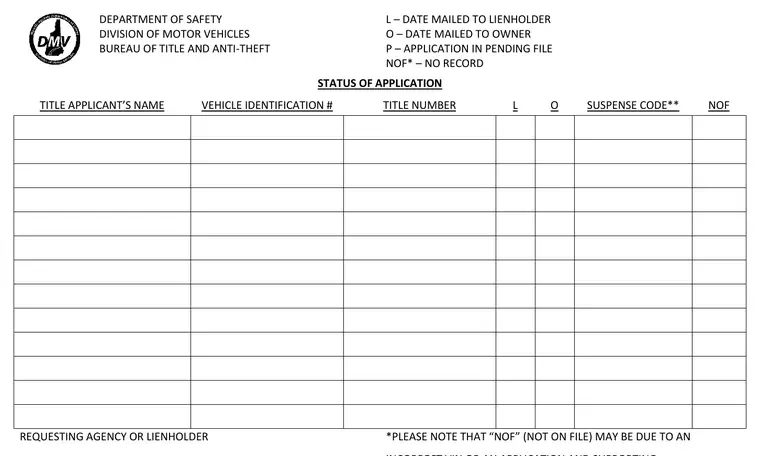
A lender's or an agency's enquiry sheet: a grid of thirteen rows, each carrying a title applicant's name, a vehicle identification number and a title number, sent to the Bureau of Title to ask where a batch of applications has got to. A private seller never files one, but the answer it comes back with is the thing a seller is usually waiting on, so it is worth knowing what the codes on it mean.
Written against TDMV 10 (Rev 12/2020), issued under Bureau of Title and Anti-Theft counter practice. If you are the seller and a buyer tells you the title has not arrived, the useful question is not where it is but whether it was ever applied for. RSA 261:4 gives the buyer 20 days from the date of sale to get the application and its supporting documents to the department, and RSA 261:20 charges a penalty equal to the fee when that is missed - so a title that is not on file six weeks later is usually a title nobody applied for.

Two documents, and they are not the same thing. Take the blank TDMV 10 from the dmv.nh.gov copy so you get the revision that is current today, then print our TDMV 10 guide and keep it beside you while you fill theirs in.

Filled in

What a completed one looks like

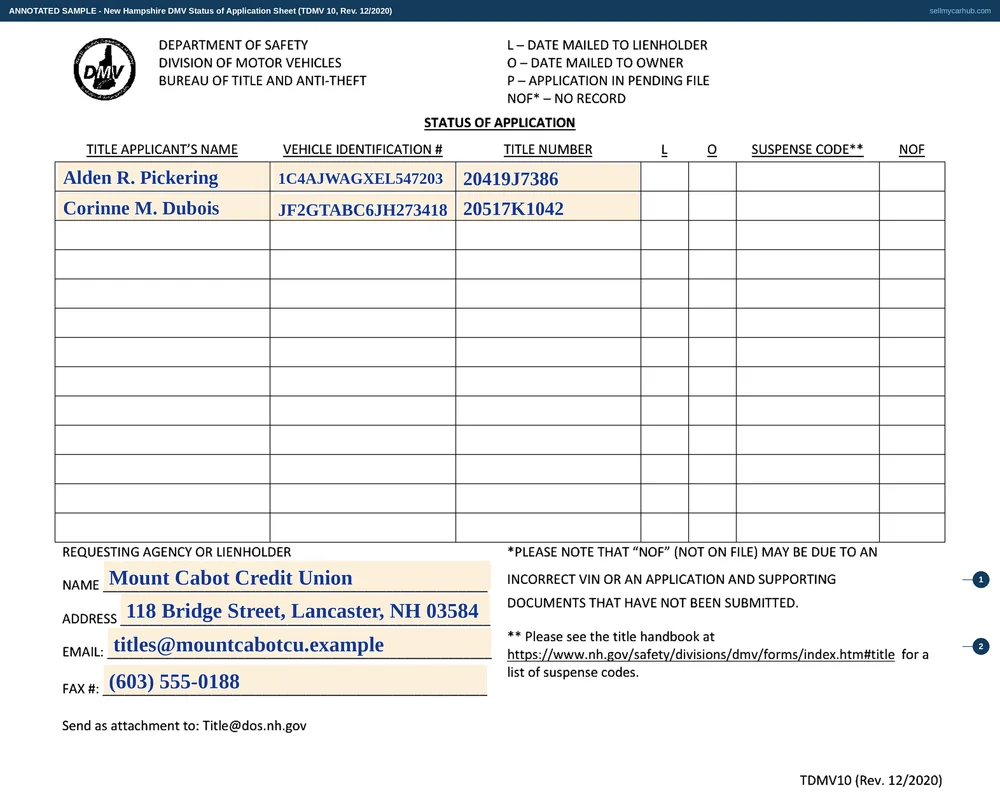
This is the actual TDMV 10, rendered from the PDF the New Hampshire Division of Motor Vehicles publishes and completed end to end: letterhead, every field, and the blocks at the foot.

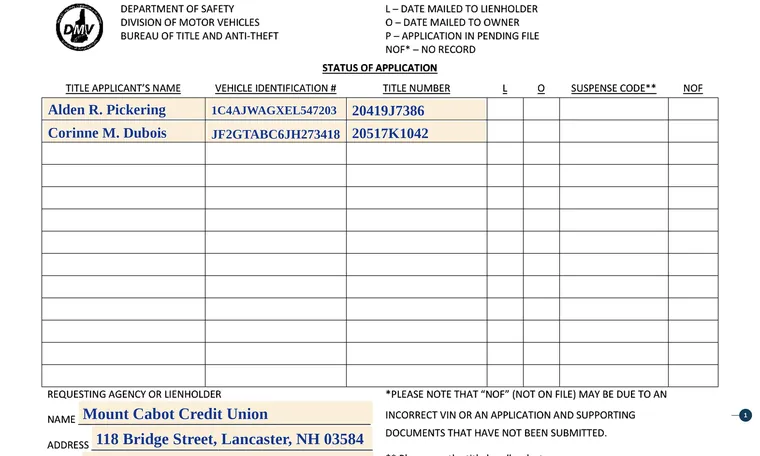
The New Hampshire Status of Application Sheet, form TDMV 10, filled in as an annotated sample. The requesting lienholder block names Mount Cabot Credit Union of Lancaster with an email and fax number. Two rows of the thirteen-row grid are completed, each with a title applicant's name, a vehicle identification number and a title number, and the remaining rows are empty. The legend at the head of the sheet explains that L is the date mailed to the lienholder, O the date mailed to the owner, P an application in the pending file and NOF no record.
Two completed rows out of thirteen, because that is how this sheet is actually used - a lender asking about the handful of titles it is waiting on. The column worth understanding is the one on the right: NOF does not mean the title is lost, it usually means no application ever reached Concord.
Field by field

Every line, in the order you meet it

  1. 1
    The lienholder fills this in

    The requesting block

    Name, address, email and fax of the agency or lienholder asking.

    Watch out: The Bureau replies to the email address on the sheet, so a wrong one turns a slow answer into no answer.

  2. 2
    The lienholder fills this in

    Title applicant's name

    The person the title is being issued to - the buyer, not the seller.

    Watch out: On a private sale this is the new owner. Searching under the seller's name will produce an NOF against a title that is in fact in progress.

  3. 3
    The lienholder fills this in

    Vehicle identification number

    The full number, in the second column of each row.

    Watch out: This is the field the record is keyed on and the field the form blames for most NOF results. One wrong character produces a confident no.

  4. 4
    The lienholder fills this in

    Title number, where it is known

    The third column.

    Watch out: On a first application after a private sale there is no title number yet, which is normal rather than a problem.

  5. 5
    Somebody else fills this in

    What comes back

    An L or O date, a P, a suspense code, or NOF.

    Watch out: A suspense code is the useful answer of the four, because it names what is holding the application up. The list is in the title handbook, not on this sheet.

  6. 6
    The lienholder fills this in

    Send it as an attachment

    By email to [email protected].

    Watch out: The form gives an email address and no postal instruction, which is a fair signal about how the Bureau wants to be asked.

At a glance

What goes where

On the formWhat to put in it
Requesting agency or lienholderName, address, email and fax number, at the side of the sheet.
The gridThirteen numbered rows. Each has a title applicant's name, a vehicle identification number, a title number, an L and an O column, a suspense code and an NOF column.
L and OL is the date mailed to the lienholder; O is the date mailed to the owner.
PApplication in pending file.
NOFNo record. The form's own note explains that not on file may be due to an incorrect VIN or an application and supporting documents that have not been submitted.
Suspense codeA number the Bureau writes in to say what is holding the application up, explained in the title handbook rather than on this sheet.

What gets this one rejected

Rules that decide whether it is accepted

Every line here was read off TDMV 10 (Rev 12/2020) itself — the PDF is here — and off the New Hampshire Division of Motor Vehicles pages. This is plain-language help with a form, not legal advice, and where our wording and the agency's differ, theirs governs.

Back to all New Hampshire seller paperwork, or what selling a car in New Hampshire involves.

Want the paperwork handled instead?

Get My Instant Offer → Online · about 2 minutes · free

Or send the details — we'll come to you

If a sale has stalled somewhere between a clerk's office and Concord and nobody can tell you where, we buy cars in exactly that condition.

or call/text (877) 405-1808