Sell My Car Hub

How to fill out Nevada VP 186, the Lien Release

Your lender's written statement that the loan is paid and its claim on the car is over. If a lienholder is still printed on the face of your title, this is the document that gets it off — and until it does, you cannot hand a clean title to a buyer.
Written against VP 186 (6/2023), issued under NRS 482.432, "Applicable statutory provisions for perfection and release of security interest". June 2023 revision. Read the box at the top before anything else: this form only works on a printed paper title. If your title is held electronically, the lienholder has to release it electronically instead and no paper version of this will be accepted.

Two documents, and they are not the same thing. Take the blank VP 186 from the dmv.nv.gov copy so you get the revision that is current today, then print our VP 186 guide and keep it beside you while you fill theirs in.

Filled in

What a completed one looks like

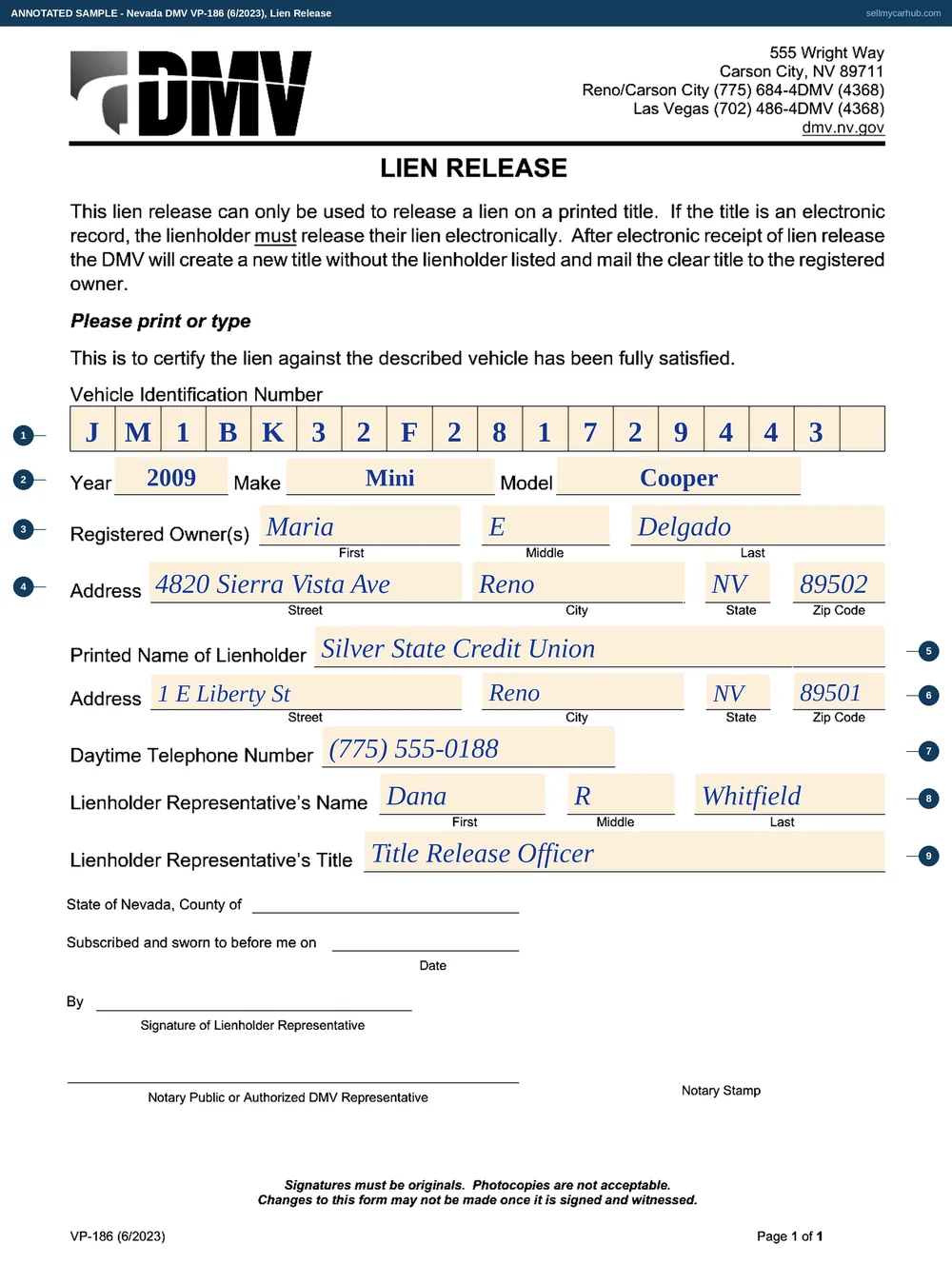
This is the actual VP 186, rendered from the PDF the Nevada Department of Motor Vehicles publishes and completed end to end: letterhead, every field, and the blocks at the foot.

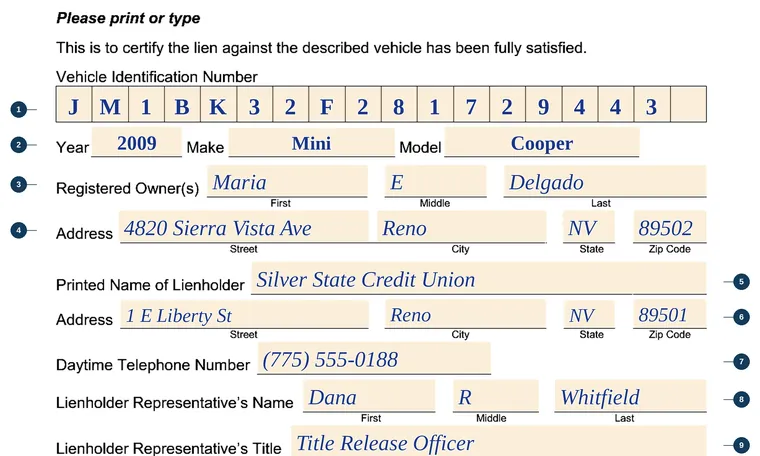
Nevada DMV form VP-186 Lien Release, filled in as a worked example with each field numbered
VP-186 completed for a paid-off 2009 Mini Cooper. The lender fills in and signs everything from the Printed Name of Lienholder line down; the top half is the car and the registered owner.
Field by field

Every line, in the order you meet it

  1. 1
    You fill this in

    Vehicle Identification Number

    One character per box, seventeen in all, copied off the title rather than off the dashboard.

    Watch out: Read it from the title itself. A VIN that does not match the DMV's record stops the release dead, and the windscreen plate is the easiest place to misread an 8 for a B.

  2. 2
    You fill this in

    Year, make and model

    The three short lines under the VIN boxes.

    Watch out: Copy the make and model exactly as the title spells them, abbreviations and all. The title is the document being corrected, so it is the one that has to agree.

  3. 3
    You fill this in

    Registered owner's name

    First, middle and last across the three boxes.

    Watch out: This is the registered owner, not the lienholder. If two people are named on the title, both names belong here.

  4. 4
    You fill this in

    Your address

    Street, city, state and ZIP.

    Watch out: Use the address the DMV has for you. If a clear title is going to be mailed out at the end of this, it goes to the address on record — update that first if it has changed.

  5. 5
    The lienholder fills this in

    Printed name of lienholder

    The lender's legal business name.

    Watch out: The name here has to match the lienholder printed on the title. Banks merge and rename constantly; if the title says one thing and the release says another, expect a question.

  6. 6
    The lienholder fills this in

    Lienholder's address

    The lender's street, city, state and ZIP.

    Watch out: Their lien-release department, not your local branch. It is usually a different city from the one you bank in.

  7. 7
    The lienholder fills this in

    Daytime telephone number

    A number the DMV can call.

    Watch out: This is the line the DMV uses when something does not add up. A dead number turns a same-day check into a letter.

  8. 8
    The lienholder fills this in

    Lienholder representative's name

    First, middle and last of the person at the lender who is signing.

    Watch out: A person, not a department. The notary is about to swear that this named individual signed in front of them.

  9. 9
    The lienholder fills this in

    Representative's title

    Their job title at the lender.

    Watch out: Blank here is a common rejection. The DMV wants evidence the signer had authority to release the lien, and the job title is the only place on the form that shows it.

  10. 10
    The lienholder fills this in

    County, date, signature and notary stamp

    The bottom block: county, the date sworn, the representative's signature and the notary's own signature and stamp.

    Watch out: Every line here is filled in at the notary's desk, not before. Nevada does not make you notarize the title assignment itself, but it does make you notarize this.

At a glance

What goes where

On the formWhat to put in it
VehicleVIN in the seventeen boxes, then year, make and model on the line beneath.
Registered ownerYour name as it appears on the title, and your address.
LienholderThe lender's printed business name, address and daytime telephone number.
Lienholder representativeThe name and job title of the person at the lender who is signing.
NotarizationSigned in front of a notary or an authorized Nevada DMV representative. Blank until then.

What gets this one rejected

Rules that decide whether it is accepted

What it costs

Duplicate title, vehicle staying in Nevada$20
Duplicate title, vehicle not in Nevada$35
Title Processing Fee, on a complete change of ownership$8.25

Every line here was read off VP 186 (6/2023) itself — the PDF is here — and off the Nevada Department of Motor Vehicles pages. This is plain-language help with a form, not legal advice, and where our wording and the agency's differ, theirs governs.

Back to all Nevada seller paperwork, or what selling a car in Nevada involves.

Want the paperwork handled instead?

Get My Instant Offer → Online · about 2 minutes · free

Or send the details — we'll come to you

Loan paid off but the lienholder is still printed on your Nevada title? Tell us what you have and we will work around it — a lien in the middle of a sale is an ordinary week for us.

or call/text (877) 405-1808