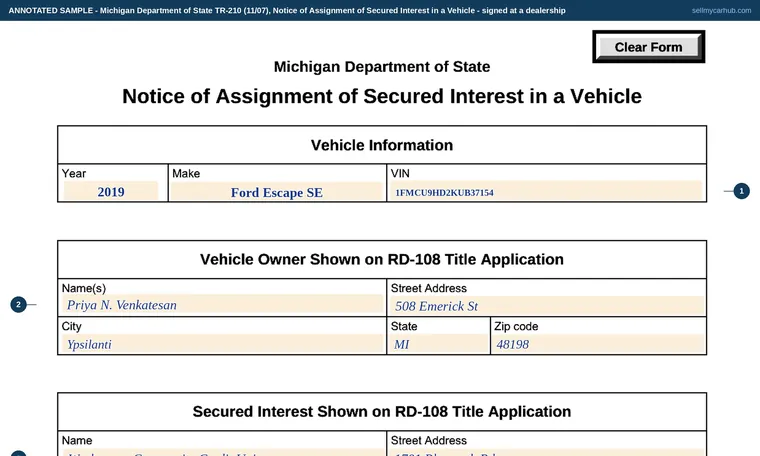
Not the seller's form, and worth knowing about for exactly that reason. It is what a dealership uses when the finance a buyer was approved for falls through after delivery: the buyer authorises the dealer to assume the loan itself, and a corrected title is issued showing the dealership as the new secured interest. If you are searching for a Michigan lien form and land here, this is not the one.
Written against TR-210 (11/07), issued under MCL 257.238, under Public Act 300 of 1949. The reason a Michigan seller ends up reading about liens at all is that a financed Michigan vehicle has no paper title. The department holds it electronically and will not transfer it until the lender releases the lien, so the sequence is always: pay the lender, wait for the release, receive the paper certificate, then sell.
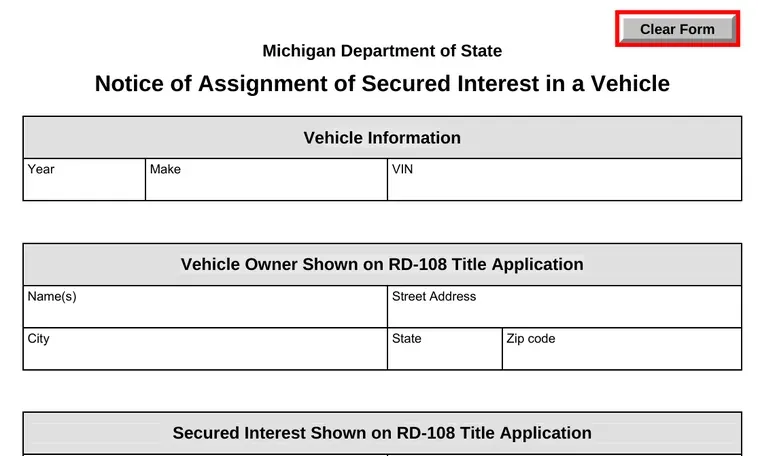
Two documents, and they are not the same thing. Take the blank TR-210 from the michigan.gov copy so you get the revision that is current today.
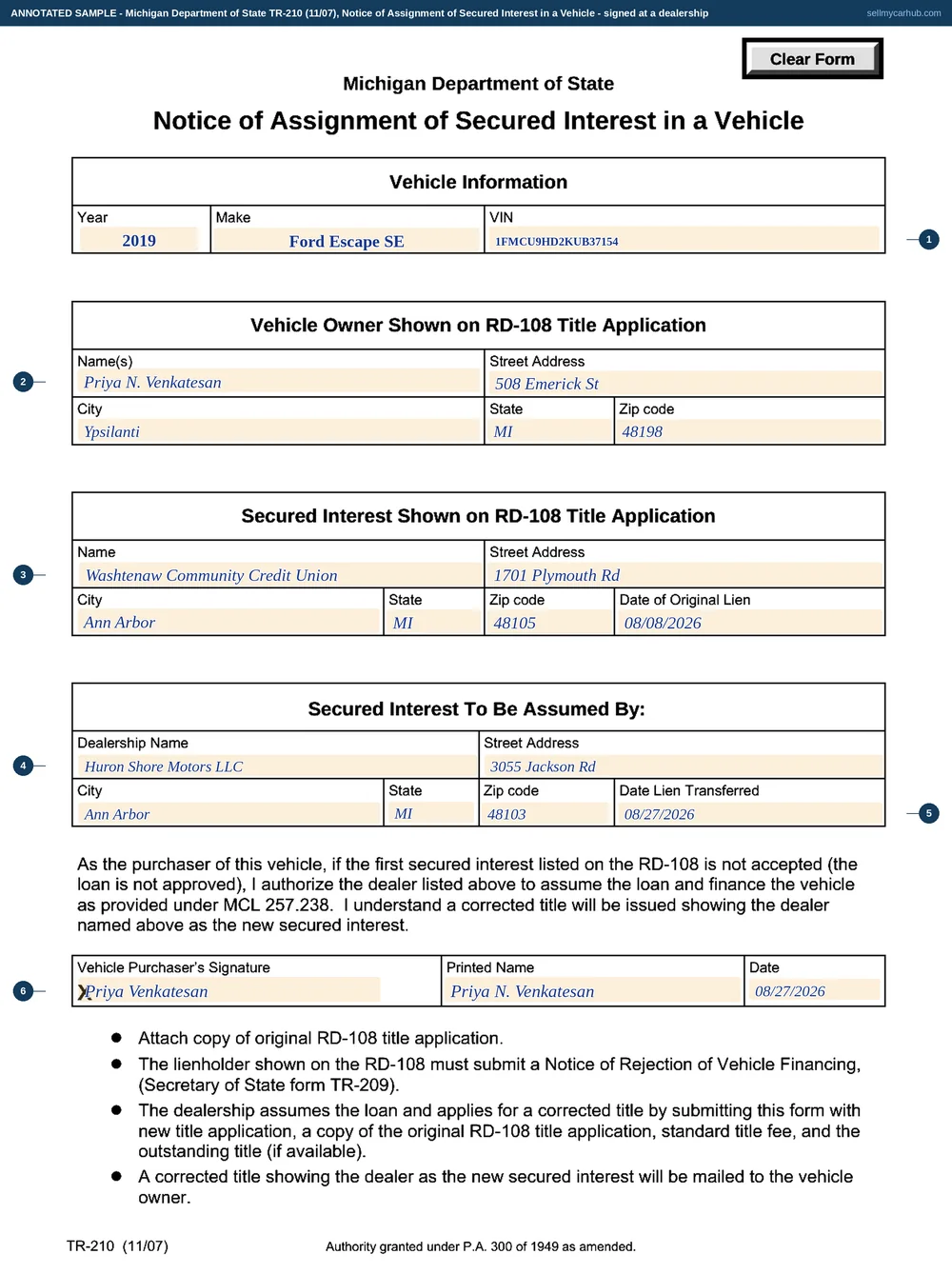
This is the actual TR-210, rendered from the PDF the Michigan Department of State publishes and completed end to end: letterhead, every field, and the blocks at the foot.
Year, make and VIN in the first box.
Watch out: The only vehicle detail this form asks for. Everything else on it is about money.
The buyer's name and address, copied from the dealership's own title application.
Watch out: Shown on RD-108 is doing the work in that heading. If there is no RD-108, this form has nothing to be consistent with.
The lender the buyer was originally approved by, with a date of original lien.
Watch out: This is the lender that has just said no. It stays on the form because the department needs to know which interest is being replaced.
The dealership taking the loan on itself, with its address.
Watch out: A dealership financing its own sale is not the same thing as the dealership owning the car, and the corrected title still goes to the buyer.
The date the secured interest moves, in the last box of the dealership block.
Watch out: It will be later than the date of original lien, and the gap between the two is how long the buyer spent believing they were financed elsewhere.
The buyer signs, prints their name and dates it, under the authorisation paragraph.
Watch out: Read the paragraph above it before signing. It authorises a dealership to become your lender, and it cites MCL 257.238 while doing so.
| On the form | What to put in it |
|---|---|
| Vehicle information | Year, make and VIN across the top box - the only part of the form that is not about who is owed money. |
| Vehicle Owner Shown on RD-108 Title Application | Name or names, street address, city, state and zip code. The heading tells you where the form sits: it is filled in from a dealership's application, not from a certificate. |
| Secured Interest Shown on RD-108 Title Application | The lender the buyer was originally financed by, with its address and the date of original lien. |
| Secured Interest To Be Assumed By | The dealership name and address, and the date lien transferred. |
| The authorisation | One printed paragraph: as the purchaser of this vehicle, if the first secured interest listed on the RD-108 is not accepted, the buyer authorises the dealer to assume the loan and finance the vehicle as provided under MCL 257.238. |
| Vehicle Purchaser's Signature | The buyer signs, prints their name and dates it. Nobody else signs this form at all. |
Every line here was read off TR-210 (11/07) itself — the PDF is here — and off the Michigan Department of State pages. This is plain-language help with a form, not legal advice, and where our wording and the agency's differ, theirs governs.
Back to all Michigan seller paperwork, or what selling a car in Michigan involves.