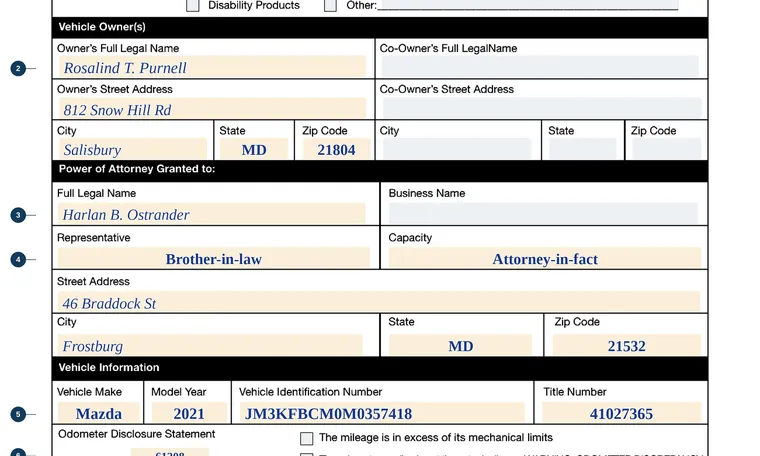
One page that lets somebody else sign a Maryland title in your place. It is restricted in two senses: it covers only the vehicle described on it, and it covers only the kind of document ticked at the top - titling, registration, correction or disability products. The odometer reading goes on the form itself, which is the detail that makes it work as an authority to sign a certificate rather than just an errand note.
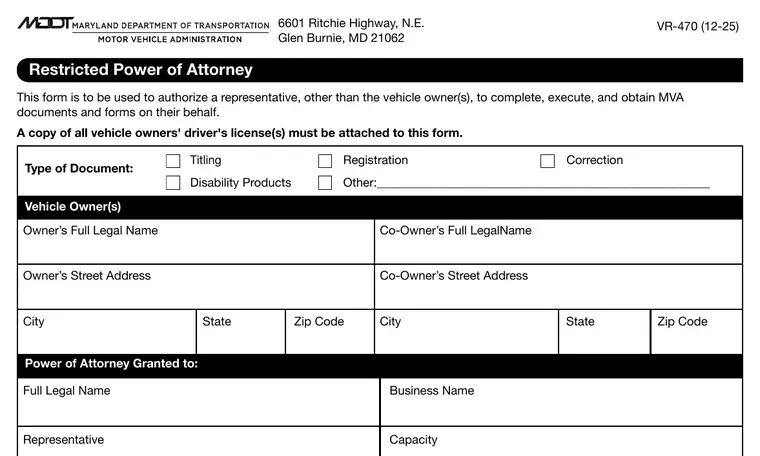
Written against VR-470 (12-25), issued under Maryland Transportation Article, Title 13, Subtitle 1. Fill in the odometer box yourself before the form leaves you. If the representative writes the mileage in later, the federal disclosure has been made by somebody who was not looking at the dashboard, and that is the exact failure the odometer power-of-attorney rules exist to prevent.
Two documents, and they are not the same thing. Take the blank VR-470 from the mva.maryland.gov copy so you get the revision that is current today, then print our VR-470 guide and keep it beside you while you fill theirs in.
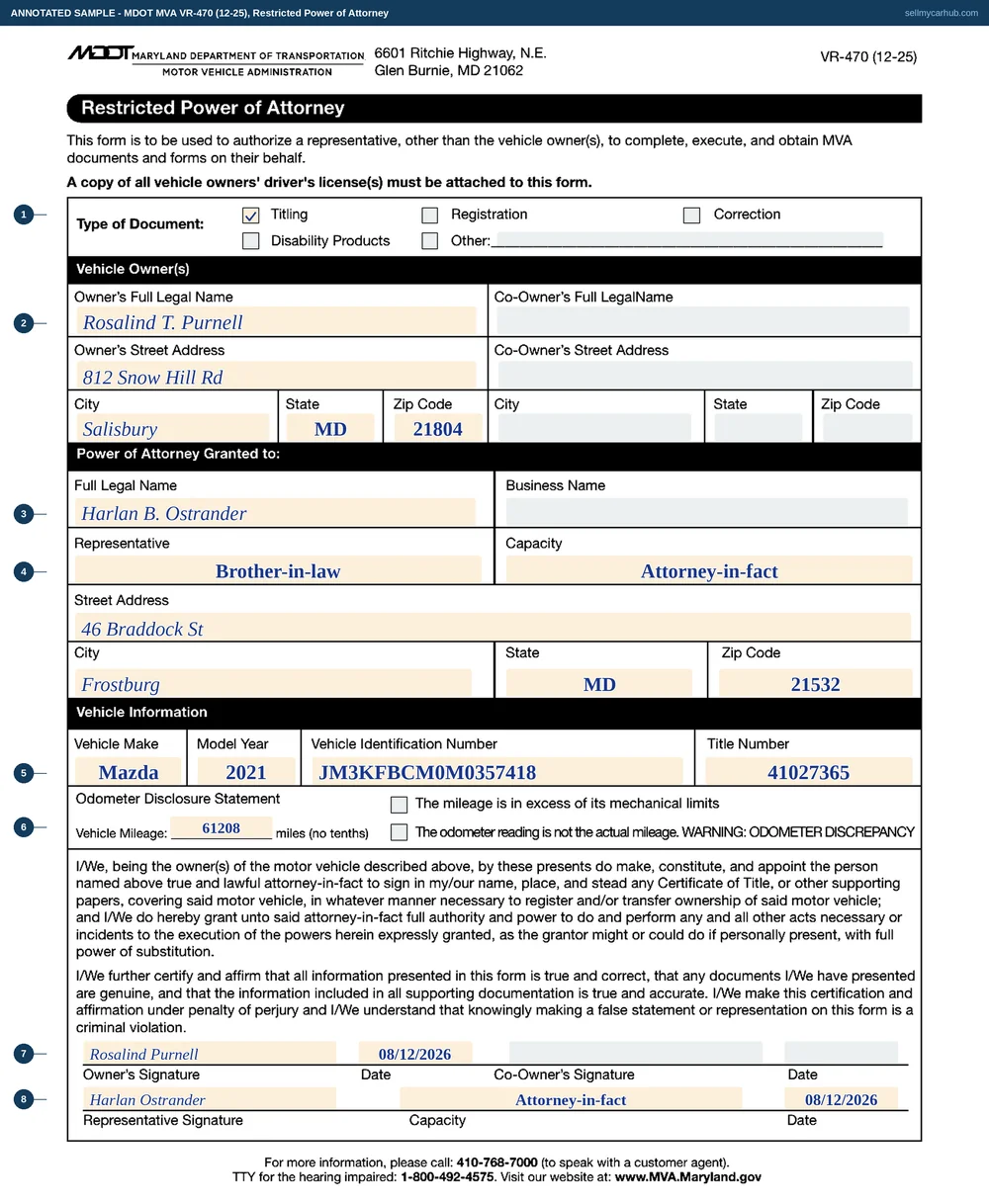
This is the actual VR-470, rendered from the PDF the Maryland Motor Vehicle Administration publishes and completed end to end: letterhead, every field, and the blocks at the foot.
Tick Titling for a sale. Registration, Correction, Disability Products and Other are the alternatives.
Watch out: Tick only what is actually needed. A power of attorney that covers everything is a power of attorney nobody should be asked to sign, and the MVA does not require it.
Left-hand column: name, street address, city, state and ZIP, with the same set on the right for a co-owner.
Watch out: Legal name means the name on the face of the certificate. This form is authorising somebody to sign as you, so the two have to be the same person on paper.
The person who will be signing, with a business name box beside it where the representative is acting for a company.
Watch out: Name one person, not a household. The MVA will be comparing this against the signature on the certificate.
Two boxes describing who they are to you - son, brother-in-law, office manager - and in what capacity they are acting.
Watch out: Say something specific. Capacity is what an agent looks at when deciding whether the authority is plausible, and blank is the least plausible answer available.
Four boxes across the vehicle row, from the face of the certificate.
Watch out: This row is the restriction. The authority extends to this vehicle and no other, which is exactly what you want if the form goes astray.
A box marked miles, no tenths, with the two exception ticks to its right.
Watch out: Write it yourself, on the day you sign. Handing over a form with the mileage blank turns your representative into the person making a federal certification about a car they may not have seen.
The signature block, with a co-owner pair beside it.
Watch out: No notary is needed here either, which surprises people who have signed a general power of attorney before. What is needed is the photocopied licence the form asks for at the top.
The last row, signed by the person accepting the authority, with their capacity and the date.
Watch out: They sign to accept it, and they are certifying under the same paragraph you are. An unsigned representative line leaves an authority nobody has taken up.
| On the form | What to put in it |
|---|---|
| Type of Document | Five ticks across the head of the sheet: Titling, Registration, Correction, Disability Products, and Other with a line to specify. |
| The identification requirement | A copy of all vehicle owners' driver's license(s) must be attached to this form. Printed directly under the opening paragraph. |
| Vehicle Owner(s) | Owner's full legal name with street address, city, state and ZIP, and the identical set of boxes for a co-owner alongside. |
| Power of Attorney Granted to | Full legal name and business name, then Representative and Capacity, then a full-width street address with city, state and ZIP. |
| Vehicle Information | Vehicle make, model year, vehicle identification number and title number across one row. |
| Odometer Disclosure Statement | A vehicle mileage box marked miles, no tenths, with the two exception ticks beside it and the odometer discrepancy warning. |
| The grant | The operative paragraph: appointing the person named above true and lawful attorney-in-fact to sign in my/our name, place, and stead any Certificate of Title, or other supporting papers, covering said motor vehicle, in whatever manner necessary to register and/or transfer ownership, with full power of substitution. |
| The certification | A second paragraph affirming under penalty of perjury that the information is true, that any documents presented are genuine, and acknowledging that knowingly making a false statement or representation on this form is a criminal violation. |
| Signatures | Owner's signature and date, co-owner's signature and date, then the representative's own signature with their capacity and a date. |
Every line here was read off VR-470 (12-25) itself — the PDF is here — and off the Maryland Motor Vehicle Administration pages. This is plain-language help with a form, not legal advice, and where our wording and the agency's differ, theirs governs.
Back to all Maryland seller paperwork, or what selling a car in Maryland involves.