Sell My Car Hub

How to fill out a Maryland title

Everything happens on one sheet. The reverse of a Maryland certificate is divided into four stacked blocks, and the top one - ASSIGNMENT OF OWNERSHIP - is the seller's and the only one that is. Underneath it sits APPLICATION FOR TITLE AND REGISTRATION, which the buyer may complete instead of a VR-005, and below that two DEALER'S REASSIGNMENT panels that a private sale never touches. The boxes below are numbered against the MVA's own specimen of the VR-002, reproduced blank in the Administration's Interactive Title and Registration Manual, and the numbers on the pictures match the numbers in the list.

There is no blank Maryland title to download and there never will be - yours came in the post from Glen Burnie on security paper with a control number on it. What the MVA does publish is a picture of one, inside a 116-page manual written for dealers and title service agents. This walkthrough is that picture, with a seller's boxes marked on it.

No notary, no witness, and no second chance with a pen. Alterations and erasures void the document.

The manual describes this block in one sentence that is worth reading twice: the section where the owner(s) of the vehicle will complete an assignment, as required by law, showing the name and address of the party or parties to whom they are transferring the ownership of the vehicle. Then it adds the part people miss - all federally conforming titles have both the printed name and signature of the buyer(s) and seller(s). Signature alone is not an assignment here. Print it as well.

The MVA's own specimen

The front of a Maryland title, blank and watermarked SAMPLE

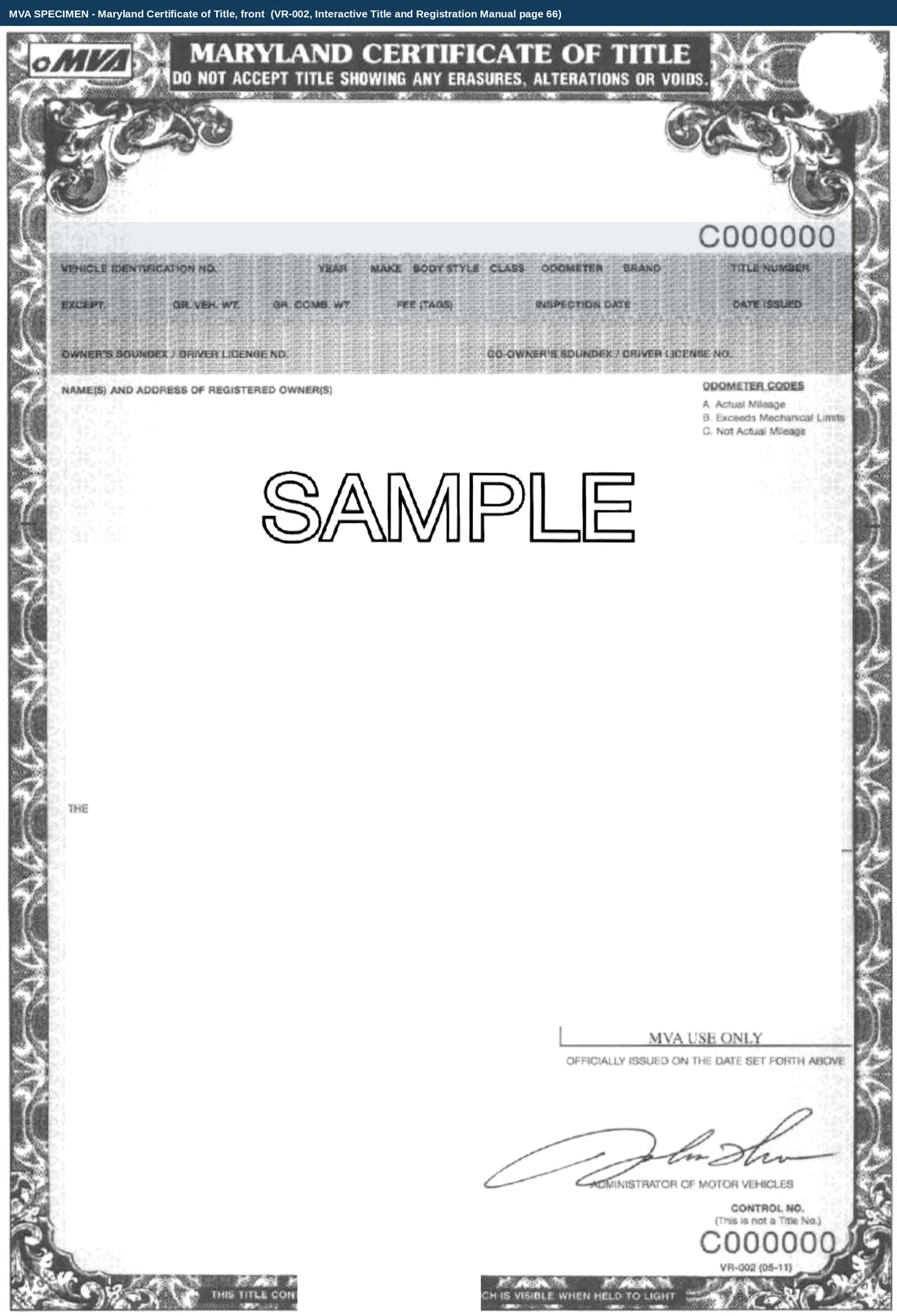
This is not a drawing and it is nobody's document. It is the VR-002 as the MVA reproduces it on page 66 of the Interactive Title and Registration Manual: SAMPLE across the middle, control number C000000 top and bottom, every field empty. A private seller writes nothing whatever on this side, and the band shaded here is the part that most looks like somewhere to write.

The blank front of a Maryland Certificate of Title, form VR-002, watermarked SAMPLE with the control number C000000 printed at the top right and again at the foot, above the form code and the Administrator of Motor Vehicles signature. The microprinted data band carrying the vehicle identification number, year, make, body style, class, odometer, brand, title number, weights, tag fee, inspection date, date issued and both owners' soundex numbers is shaded as a block the Administration prints rather than one the seller fills in.
That band is printed in Glen Burnie on the day the certificate is issued and, in the manual's own words, is protected from alteration by a background of safety block microprint. The odometer figure inside it is the reading from the last transfer rather than one you write. Reproduced from the MVA Interactive Title and Registration Manual, page 66.
Where you write

Assignment of Ownership, the top block on the reverse

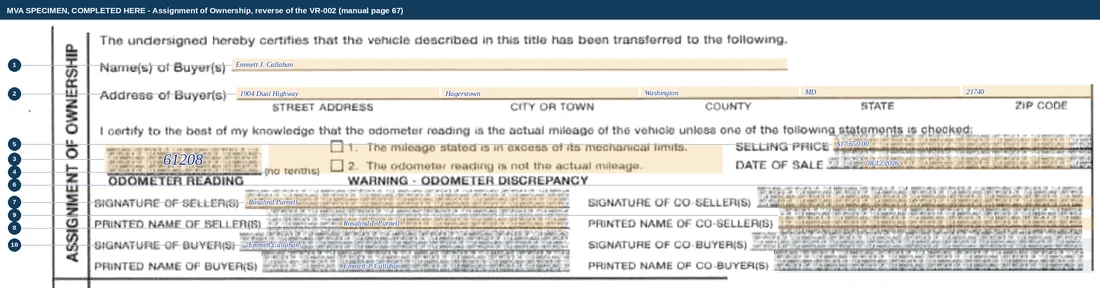
The same manual prints the reverse on the next page and prints it empty, which is why this one carries handwriting: the sale used across every form page on this site, written into the MVA's blank specimen. Amber marks the boxes that are the seller's and grey the ones that are not, and the numbers match the list below.

The Assignment of Ownership block on the reverse of a Maryland Certificate of Title, filled in on the MVA's own blank specimen. The buyer's name and street address, city, county, state and ZIP, the odometer reading box, the selling price, the date of sale and the seller's signature and printed name are shaded amber; the buyer's signature and printed name lines and the co-seller and co-buyer column are shaded grey.
Note that the odometer reading is a printed box on the certificate itself with the words no tenths beside it, and that SELLING PRICE and DATE OF SALE sit in the same column immediately above the signatures. Three fields, one row, and the excise tax the buyer pays is calculated from the middle one.
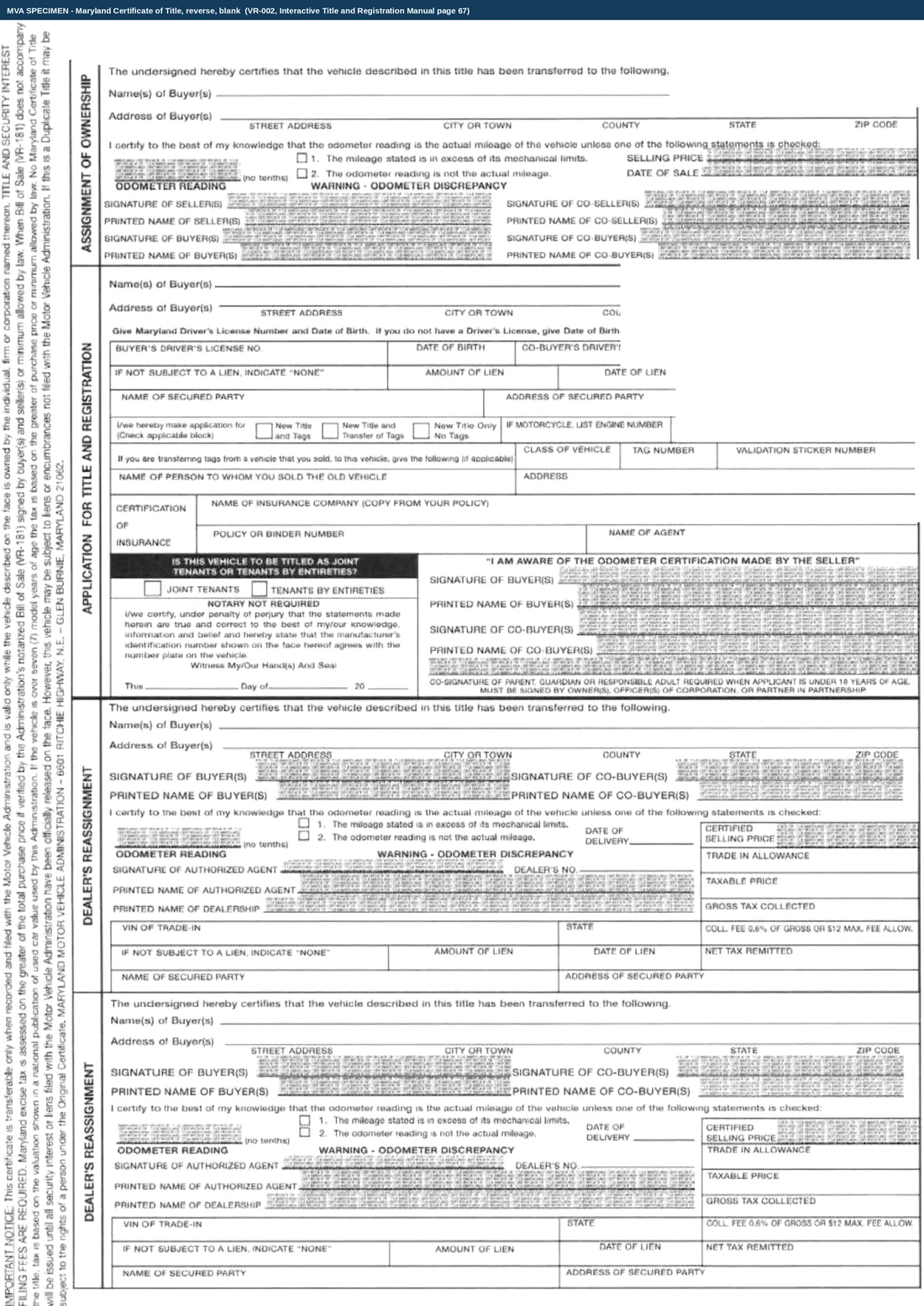
The whole reverse of a Maryland Certificate of Title, blank and unmarked, showing four stacked blocks. Assignment of Ownership at the top; then Application for Title and Registration with its driver's licence, lien, secured party, tag application, insurance and joint tenancy panels and the words NOTARY NOT REQUIRED; then two Dealer's Reassignment blocks carrying certified selling price, trade in allowance, taxable price, gross tax collected and net tax remitted columns. A block of small print runs vertically up the left margin.
Nothing is marked on this one, because the point of it is proportion: three of the four blocks belong to somebody else. The small print up the left margin is the IMPORTANT NOTICE, the certificate's own summary of the excise tax rule - and it is where the sentence about a notarised Bill of Sale lives that sends so many Maryland sellers looking for a notary they do not need.

Before you watch. The MVA does not publish a video showing the back of the VR-002 being filled in box by box. Several channels do and none of them is the Administration - they are dealerships, title services and how-to accounts, which is why none is embedded here. The thirty videos examined were the first page of youtube.com/user/MVAMaryland; the rest of that channel is road-safety campaigns, Vision Zero meetings and licence-office how-tos.

Published on the Administration's own channel on 26 May 2026 and, of the thirty videos on the channel's first page, the only one about transferring a car between two private parties. E-titling is the MVA's electronic route for a private sale, which is the transaction every form on this page belongs to. Nothing loads from YouTube until you press play.

Step by step

Every box, in the order you meet it

  1. 1
    You fill this in

    Name(s) of Buyer(s)

    The first line of the assignment block, on the rule that follows the printed sentence about the vehicle having been transferred to the following.

    Watch out: Write it before anybody signs. The MVA's list of common mistakes to avoid opens with leaving sections of the title blank, and a certificate handed over with this line empty is an open invitation for the name to be filled in by someone else.

  2. 2
    You fill this in

    Address of Buyer(s)

    The line underneath, split by printed sub-labels into STREET ADDRESS, CITY OR TOWN, COUNTY, STATE and ZIP CODE.

    Watch out: County is a real box on a Maryland title and it is easy to skip past because most states do not ask. Take it from the buyer's licence rather than guessing which county a Baltimore suburb sits in.

  3. 3
    You fill this in

    ODOMETER READING

    A printed box on the left of the block with the words no tenths beside it. Whole miles, read on the day you sign.

    Watch out: Whatever goes here has to match the VR-197 if you fill one in and the odometer line on the VR-005 if the buyer uses one. Fill this box first and copy from it; two documents disagreeing about the mileage is a discrepancy and the MVA treats it as one.

  4. 4
    You fill this in

    The two odometer statements

    Tick box 1 if the reading is in excess of its mechanical limits, or box 2 if the odometer reading is not the actual mileage. Above them the certificate has already certified the reading as actual unless one is checked.

    Watch out: Silence is an assertion here, not an omission. Leaving both empty on a car whose cluster was replaced is a false certification, and the words WARNING - ODOMETER DISCREPANCY are printed on the certificate for a reason.

  5. 5
    You fill this in

    SELLING PRICE

    Right-hand column of the block, directly above the date. The figure actually paid.

    Watch out: This is the number the buyer's excise tax is worked out from, so it is the number a buyer will occasionally ask you to shade. Do not. Where the MVA thinks the price is $500 or more under book value it charges tax on book value instead, and the only way back is a notarised VR-181 explaining the price - so an under-written figure costs the buyer money rather than saving it.

  6. 6
    You fill this in

    DATE OF SALE

    The line below the price. The day the vehicle changed hands.

    Watch out: The buyer's thirty days under Transportation Article 13-112 run from delivery, and this is the date anyone later reads as the day it happened. Write the real one even where the money moved a week earlier.

  7. 7
    You fill this in

    SIGNATURE OF SELLER(S)

    Left-hand column, first of the four signature rules. Sign as the name is printed on the face of the certificate.

    Watch out: No notary and no witness - the certificate says NOTARY NOT REQUIRED lower down the same sheet. What it will not forgive is a signature in the buyer's row, which is a void assignment and a VR-018 duplicate before you can start again.

  8. 8
    You fill this in

    PRINTED NAME OF SELLER(S)

    The rule immediately under your signature, in block capitals or plain print.

    Watch out: The manual is specific that this is not optional: all federally conforming titles have both the printed name and signature of the buyer(s) and seller(s). A signature on its own leaves the assignment incomplete.

  9. 9
    You fill this in

    SIGNATURE OF CO-SELLER(S) and PRINTED NAME OF CO-SELLER(S)

    The right-hand column of the same block, used only where the face of the title names a second owner.

    Watch out: If the two names on the front are joined by AND, both of you sign here. If the buyer is a couple and only one of them is on the licence you copied, that is a question to settle before the pen comes out, not afterwards.

  10. 10
    The buyer fills this in

    SIGNATURE OF BUYER(S) and PRINTED NAME OF BUYER(S)

    The last two rules of the assignment block. The buyer signs and prints to acknowledge the mileage you certified.

    Watch out: Watch them do it before you hand the keys over. An assignment with a blank buyer signature is not finished, and you will be the one the buyer telephones when the MVA hands it back.

  11. 11
    The buyer fills this in

    Application for Title and Registration, the buyer's block

    The second block down: buyer's driver's licence number, date of birth, lien details, the secured party's name and address, the tag application boxes, insurance company and policy number, and the joint tenancy question.

    Watch out: The buyer may fill this in or may use a separate VR-005 instead - the MVA accepts either. Nothing in this block is yours, including the line asking for the name of the person to whom you sold the old vehicle, which is about the buyer's own previous car.

  12. 12
    The buyer fills this in

    NOTARY NOT REQUIRED

    A heading over the buyer's certification, not a field. Underneath it the buyer certifies under penalty of perjury that the vehicle identification number on the face agrees with the number plate on the vehicle.

    Watch out: Read it once and then stop looking for a notary on this document. The only Maryland form in a private sale that needs one is the VR-181, and only when it is being used to prove the price.

  13. 13
    Dealers only

    The two DEALER'S REASSIGNMENT blocks

    The bottom half of the sheet: two identical panels with a certified selling price, trade in allowance, taxable price, gross tax collected and net tax remitted, plus a dealer's number and a VIN of trade-in.

    Watch out: A private seller never writes in these, and a private buyer never does either. If somebody selling you a car has completed one of them and is not a licensed dealer, that is the shape curbstoning takes - and the MVA's buying page lists the seller's name not being on the title as the first red flag.

Before the pen

Before the title comes out of the drawer

Six habits, and the first is the one that keeps catching people out: you are not looking for a notary.

You are not looking for a notaryThe certificate prints NOTARY NOT REQUIRED on its own reverse. Only the VR-181 is sworn, and only when it is proving the price.
Print the name as well as signing itThe manual calls a printed name and a signature the mark of a federally conforming title. One without the other is an incomplete assignment.
Nothing gets crossed outDO NOT ACCEPT TITLE SHOWING ANY ERASURES, ALTERATIONS OR VOIDS is printed across the top of the front. A mistake means a duplicate, not a correction.
Write the price you were actually paidIt sets the buyer's excise tax, and a figure well under book value costs them more rather than less.
Whole miles, no tenthsThe certificate's own box says so, and so does the VR-197 and the odometer line inside the VR-005.
Take the plates off in the drivewayNot later that week. The registration stays open in your name until they reach Glen Burnie, and the penalty clock does not care that the car has gone.

The ink rule is the MVA's own: “The top section on the reverse of the Maryland title is the “Assignment of Ownership”. This is the section where the owner(s) of the vehicle will complete an assignment, as required by law, showing the name and address of the party or parties to whom they are transferring the ownership of the vehicle.” — MVA Interactive Title and Registration Manual, revised November 2025.

Check your source

What gets repeated about Maryland titles, and what actually holds

Three things repeated with great confidence about selling a car in Maryland. Each of them costs a seller money, a second trip, or a penalty that keeps growing after the car is gone, and each correction below links the Maryland source it comes from.

"You have to get the title notarised in Maryland."

No - and the document says so itself. Printed on the reverse of the certificate, over the buyer's certification, are the words NOTARY NOT REQUIRED. What is notarised is the VR-181 bill of sale, and only in one circumstance: when it is being used to establish the price on a car under seven model years old that sold for $500 or more below book value. The MVA's instruction sheet puts it as a should rather than a must - if the vehicle is less than 7 years old, a notarized bill of sale signed by all buyers and sellers should accompany the title - because without one the buyer is simply taxed on book value instead.

MVA Interactive Title and Registration Manual, and Form VR-005A

"Once the car is sold and the title signed, I am finished."

Not in Maryland, where selling the car and closing the registration are two separate acts. Transportation Article 17-106(e)(5)(ii) states plainly that the monetary penalties provided in this subsection may not be avoided by transferring title to the vehicle. The registration stays live until the plates come back, and once the insurance ends behind a live registration the Administration may assess $200 for the first thirty days and $7 for every day after that, to a ceiling of $3,500 in a twelve-month period. Ten days is the window in 17-106(e)(1)(iv) that stops it before it starts.

Maryland Transportation Article, 17-106

"The mileage box is optional on anything over ten years old."

That was true until 2019 and the MVA's own dealer manual has not caught up - page 73 still prints motor vehicles 10 model years old or older at the head of its exemption list. The rule that binds is federal, at 49 CFR 580.17, and it splits at the 2011 model year: 2010 and earlier are exempt at ten years, 2011 and later not for twenty. The regulation supplies its own example, that model year 2011 vehicles become exempt in calendar year 2031. A 2014 sold today is nowhere near it.

49 CFR 580.17, the federal odometer exemptions
Who has to sign

One block, no oath, and six people who might have to put a pen to it:

Every owner printed on the faceIf two names are joined by AND, both sign the seller's lines and both print underneath. Where a co-seller signs, the right-hand column of the block exists for exactly that.
The buyerSigns and prints on the buyer's lines inside the same assignment block, acknowledging the mileage you have certified. The certificate carries a second, separate buyer's signature further down under the words I AM AWARE OF THE ODOMETER CERTIFICATION MADE BY THE SELLER.
A surviving spousePrints the deceased owner's name on one seller line with the word deceased after it, then signs and prints their own on the other with surviving spouse after it, and sends a certified death certificate with the title.
A personal representativeSigns the seller's line with personal representative or executor written after the signature, and a letter of administration under the seal of the court travels with the certificate.
An attorney-in-factOnly on a VR-470 restricted power of attorney, with a copy of every vehicle owner's driver's licence stapled to it and the odometer reading declared on the form itself.
Nobody at all, if it is a businessA corporation, LLC or trust signs through the person legally authorised to do so, and the MVA asks them to state their capacity after the signature.

Once it is signed

Signing is the middle of the job, not the end of it. What follows is the plates, which the MVA says come off before the buyer takes possession, and the tag return, which is the only document in Maryland that closes the car off your record.

The two things that follow a signed title — what happens to the plates and telling the MVA the car is gone — are set out in full on the Maryland paperwork page rather than repeated here.

The forms that go with it: the bill of sale, and when a notary has to watch you sign it, the separate mileage statement, for the times the box is not enough and the tag return, which is the only thing that closes your record.

Every field description here is taken from the MVA Interactive Title and Registration Manual, revised November 2025 and the Maryland Motor Vehicle Administration title pages, current as of 2026-08-23. Plain-language help with a form, not legal advice, and where our wording and the agency's differ, theirs governs.

Back to all Maryland paperwork, or what selling a car in Maryland involves.

Or let someone else do the paperwork

Get My Instant Offer → Online · about 2 minutes · free

Or send the details — we'll come to you

A title that never came, a lien from a bank that was bought twice since, or a car that has not moved since the water came up - tell us what you have and we will tell you the shortest way out of it.

or call/text (877) 405-1808