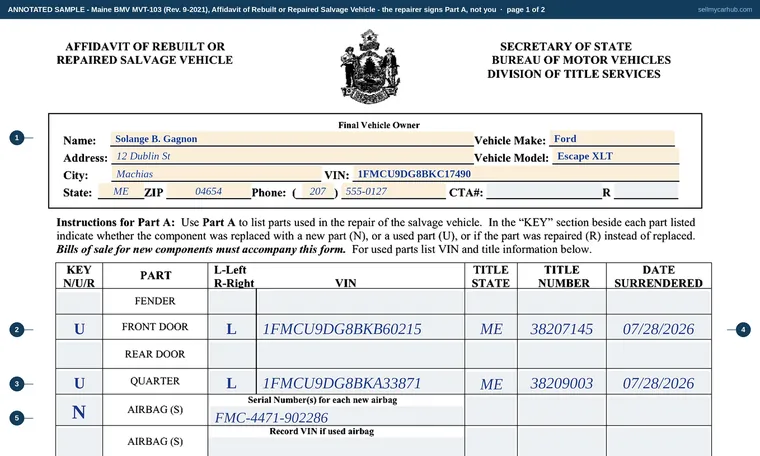
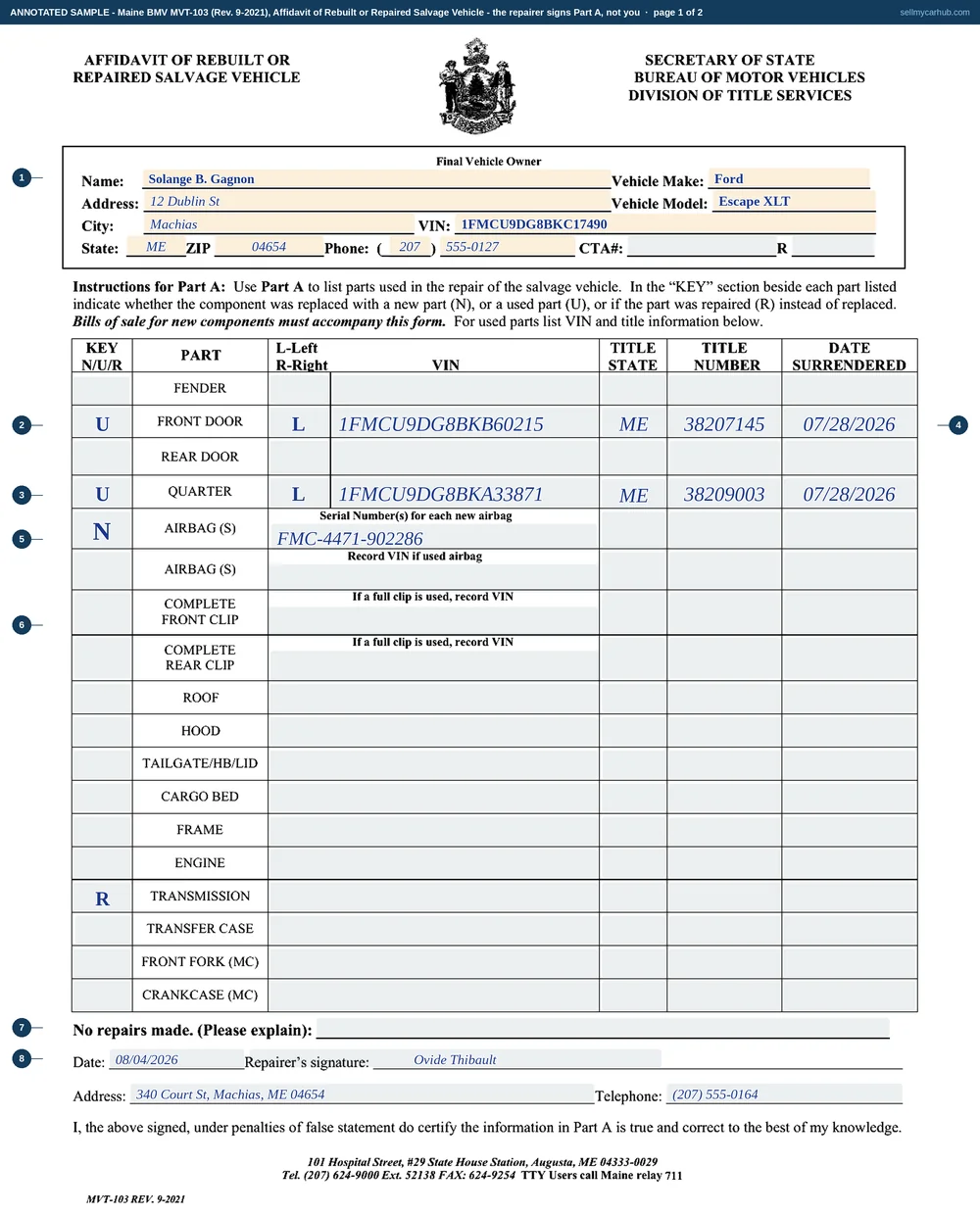
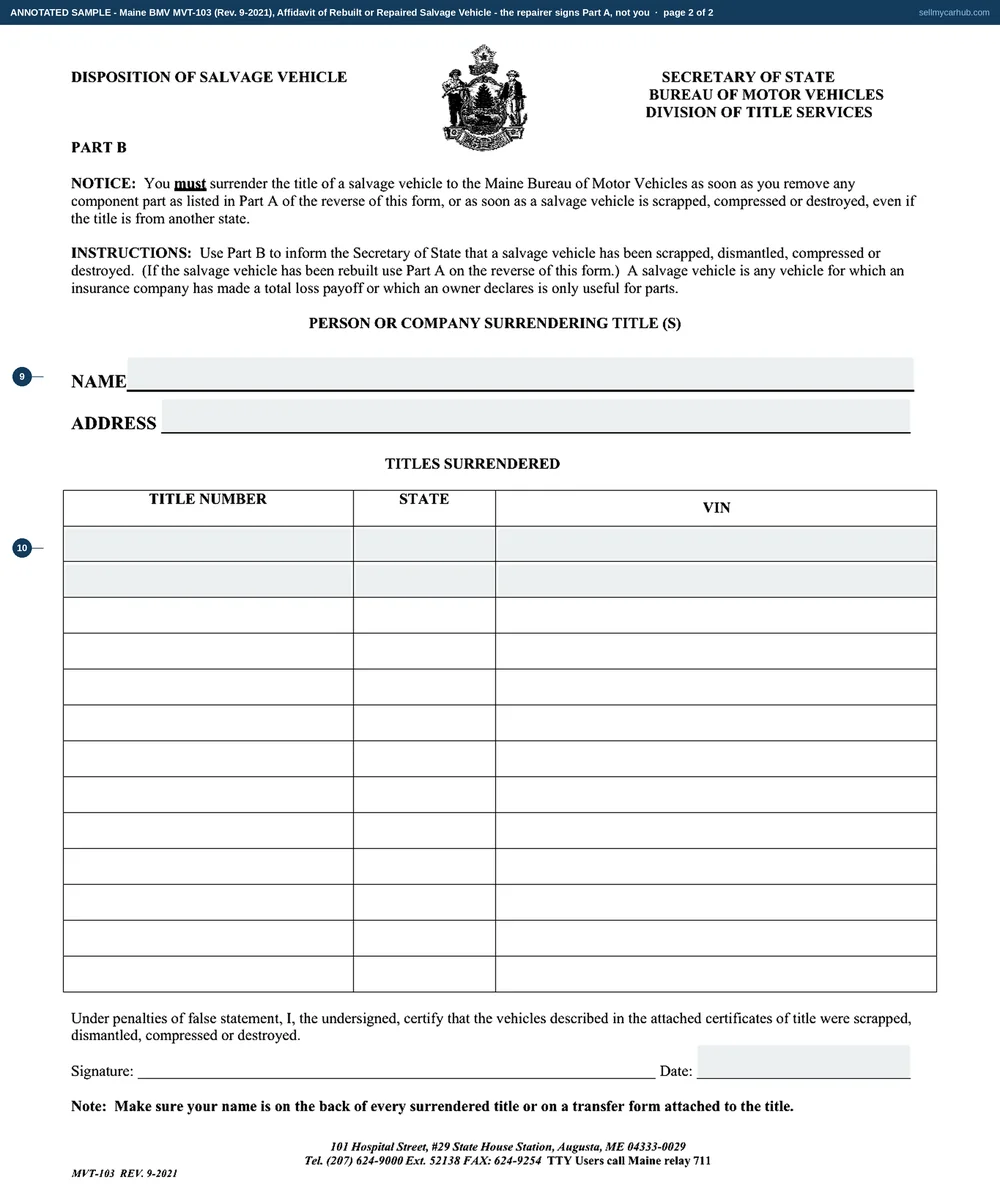
Two forms printed back to back, doing opposite jobs. Part A is the account of a rebuild: every component that went into the vehicle, whether it was new, used or repaired, and where each used part came from. Part B is the notice that a salvage vehicle has been scrapped, dismantled, compressed or destroyed, and is not coming back. Which side you are looking at decides who signs, and a private owner is on the Bureau's side of neither - Part A is signed by the repairer.
Written against MVT-103 (Rev 9-2021), issued under 29-A M.R.S. section 654. A vehicle stops being a motor vehicle in Maine only when the certificate of title or the certificate of salvage has been surrendered to the Secretary of State - the Bureau states that in its own training material, with asterisks around it. Until that happens the paperwork is still live, whatever condition the vehicle is in.
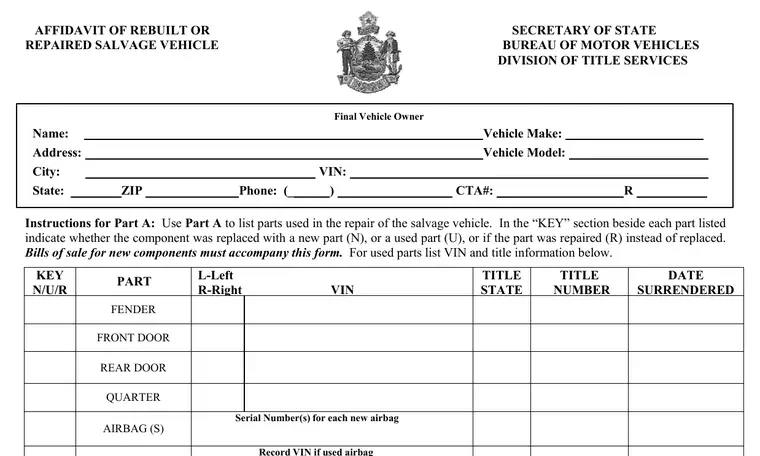
Two documents, and they are not the same thing. Take the blank MVT-103 from the maine.gov copy so you get the revision that is current today, then print our MVT-103 guide and keep it beside you while you fill theirs in.
This is all 2 pages of the actual MVT-103, rendered from the PDF the Maine Bureau of Motor Vehicles publishes and completed end to end: letterhead, every field, and the blocks at the foot.
Name, address, telephone, and the vehicle's make, model and identification number with the Bureau's reference number.
Watch out: Final vehicle owner means whoever will hold the rebuilt title, not the repairer. It is the one block on Part A that is about you.
N for new, U for used, R for repaired, beside every part in the list.
Watch out: Repaired is a real answer and it is the one that keeps the count down. A panel straightened rather than swapped is an R and does not add to the tally.
The narrow column beside the part name takes an L or an R.
Watch out: It matters for fenders, doors and quarters, which is why the column is there. A row that does not say which side is a row the Bureau has to query.
The donor's identification number, title state, title number and the date that title was surrendered.
Watch out: All four columns. A donor number with no surrender date leaves an open title somewhere in the record and that is exactly what the columns exist to close.
Serial numbers for each new airbag; the donor identification number for a used one.
Watch out: The instruction is printed inside the row itself rather than in the notes, which is why it is missed. There are two separate airbag rows for that reason.
If a full front or rear clip is used, record the identification number of the vehicle it came from.
Watch out: A clip is the biggest single donor contribution there is, and it carries the donor's own structure and stampings with it.
The line for a totalled vehicle repaired without replacing anything, with a space to explain.
Watch out: This is how a title gets coded Repaired rather than Rebuilt. It still needs the repairer's signature and it still needs the explanation.
Date, signature, address and telephone, under a certification given under penalties of false statement.
Watch out: The certification is that Part A is true and correct. It is the repairer's statement about their own work and not something an owner can sign on their behalf.
| On the form | What to put in it |
|---|---|
| Final Vehicle Owner | Name, address, city, state, postcode and telephone, then the vehicle make and model, the identification number, and the Bureau's own reference number for the application. |
| Part A, the key column | Beside every part listed, a single letter: N for a component replaced with a new part, U for a used one, or R for a part that was repaired rather than replaced. |
| Part A, the parts | Fender, front door, rear door, quarter, airbags, complete front clip, complete rear clip, roof, hood, tailgate or hatchback or lid, cargo bed, frame, engine, transmission, transfer case, and for a motorcycle the front fork and crankcase. Left and right are distinguished by an L or an R in their own column. |
| Part A, the donor columns | For each used part: the donor vehicle's identification number, the title state, the title number and the date that title was surrendered. |
| Part A, the airbag rules | Printed inside the table rather than in a footnote. Serial numbers for each new airbag; the identification number if a used airbag; and if a full clip is used, record the identification number. |
| Part A, no repairs made | A line for the case where the vehicle was declared totalled and repaired without replacing anything, with a space to explain. |
| Part A, the repairer | Date, repairer's signature, address and telephone, above a certification given under penalties of false statement. |
| Part B, the notice | A capitalised warning that a salvage vehicle's title must be surrendered as soon as any component part listed in Part A is removed, or as soon as the vehicle is scrapped, compressed or destroyed, even if the title is from another state. |
| Part B, the table | The person or company surrendering the titles, then a row per vehicle with the title number, the state and the identification number, under a certification that the vehicles described were scrapped, dismantled, compressed or destroyed. |
Every line here was read off MVT-103 (Rev 9-2021) itself — the PDF is here — and off the Maine Bureau of Motor Vehicles pages. This is plain-language help with a form, not legal advice, and where our wording and the agency's differ, theirs governs.
Back to all Maine seller paperwork, or what selling a car in Maine involves.