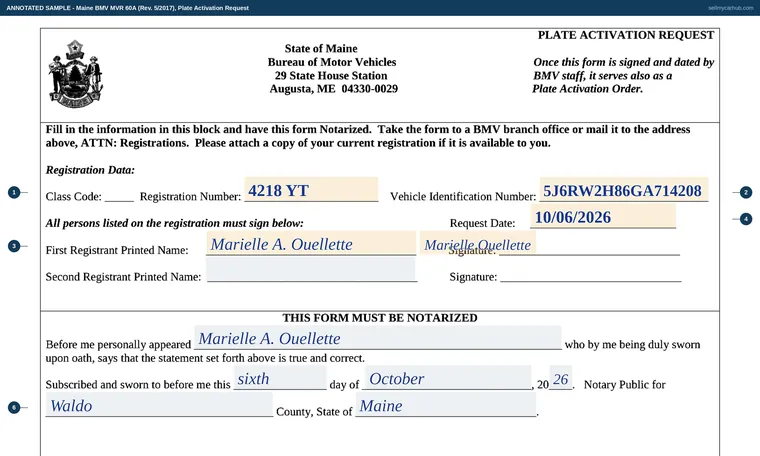
The other direction. A Maine plate that was cancelled - because the vehicle sold, because it was laid up for a winter, because the registration lapsed while nobody was driving it - is brought back into service on this sheet, and like its twin it becomes an order in its own right once Bureau staff have signed and dated it. It matters to a seller who has already handed a car over and then found they need the same plate number back on something else.
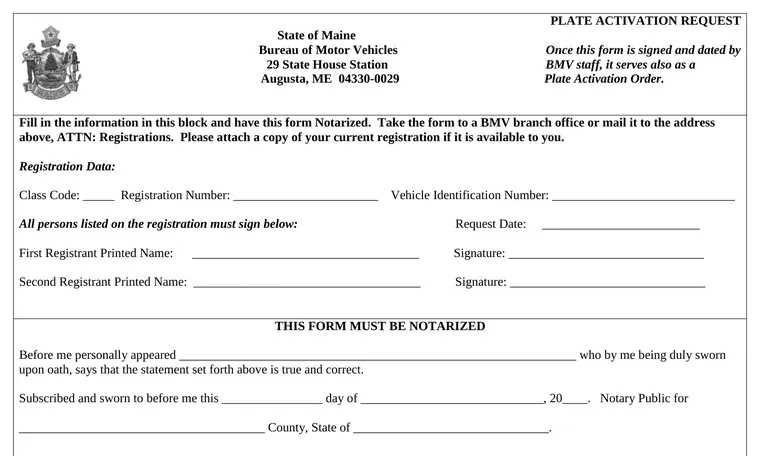
Written against MVR-60A (Rev 5/2017), issued under 29-A M.R.S. section 463. Neither this form nor its twin has anything to say about excise tax. Maine registration begins with the excise tax paid at a town office, and a reactivated plate on a newly acquired vehicle still means a trip to the municipal counter before anything can legally move.
Two documents, and they are not the same thing. Take the blank MVR-60A from the maine.gov copy so you get the revision that is current today, then print our MVR-60A guide and keep it beside you while you fill theirs in.
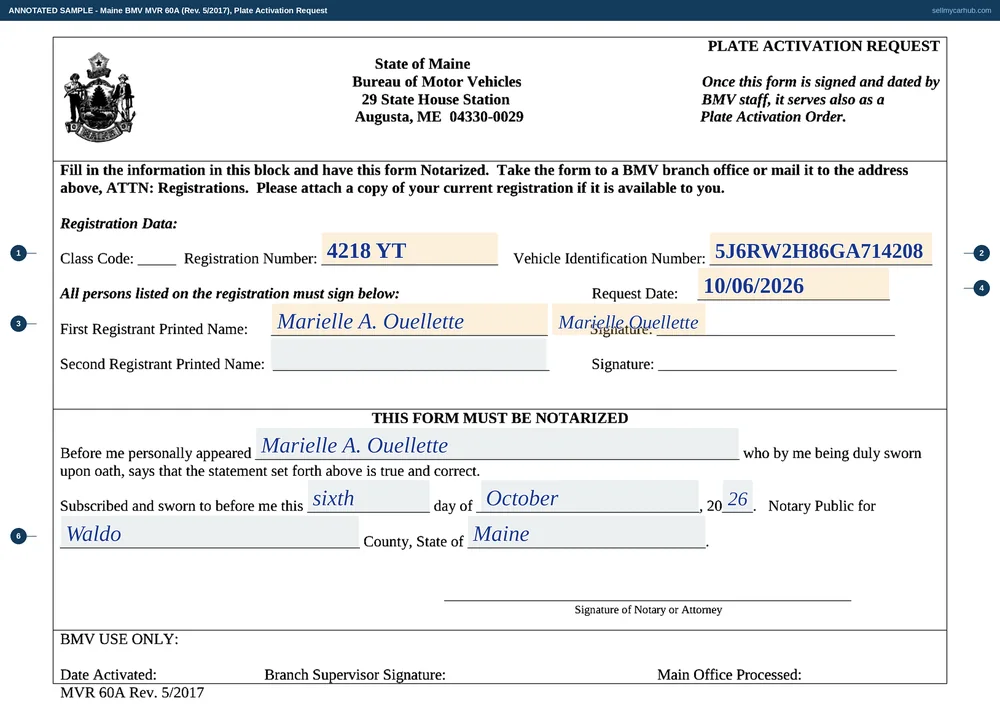
This is the actual MVR-60A, rendered from the PDF the Maine Bureau of Motor Vehicles publishes and completed end to end: letterhead, every field, and the blocks at the foot.
Both from the plate's own registration history.
Watch out: If you no longer have the paperwork, a BMV branch can look the number up. Guessing the class code is how this form comes back.
The vehicle the reactivated plate will be registered against.
Watch out: This is the box that differs from the cancellation sheet. Everything else about the two forms is the same and this is the field that carries the change.
First registrant, plus second registrant if the registration names one.
Watch out: The pairing of printed name and signature on each row is asked for on both sheets and is skipped on both sheets.
The request date box.
Watch out: Activation is not retrospective. The date you ask from is the date cover begins, not the date the vehicle arrived on the drive.
A copy, where one is available.
Watch out: Same wording as the cancellation sheet, same effect: not mandatory, and it shortens everything.
A notary or attorney completes the block naming a county and a state.
Watch out: Two sworn forms for one plate number is a lot of ceremony. Doing both in the same visit is cheaper than doing them a month apart.
Registration itself still begins with the municipal excise tax.
Watch out: An activated plate is not a registered vehicle. The Bureau's record and your town's excise record are two different things and both have to be right.
| On the form | What to put in it |
|---|---|
| Class code | The registration class the plate belongs to. |
| Registration number | The plate number being reactivated. |
| Vehicle identification number | The vehicle the activated registration will describe. |
| Every registrant signs | The same instruction as on the cancellation sheet: all persons listed on the registration must sign, with two printed-name and signature pairs provided. |
| Request date | Beside the signatures. |
| Notarization | The same full block, under the same capitalised requirement. |
| BMV use only | Date activated, branch supervisor signature, and main office processed. |
Every line here was read off MVR-60A (Rev 5/2017) itself — the PDF is here — and off the Maine Bureau of Motor Vehicles pages. This is plain-language help with a form, not legal advice, and where our wording and the agency's differ, theirs governs.
Back to all Maine seller paperwork, or what selling a car in Maine involves.