When the seventeen characters are gone. A rusted-away plate, a defaced number, a vehicle somebody built out of parts, or two vehicles carrying the same number - Indiana issues a special identification number and the car can then be titled. Three sections, a photograph, a police inspection and a fee, and until it is done there is no way to sell the vehicle at all.
Written against State Form 12907 (R8 / 11-24), issued under IC 9-17-4. This is the slowest thing in the Indiana title system and it cannot be started at a counter. If the plan is to sell the car, start the application before you advertise it, because a buyer will not wait out a Central Office process for a vehicle they cannot yet register.
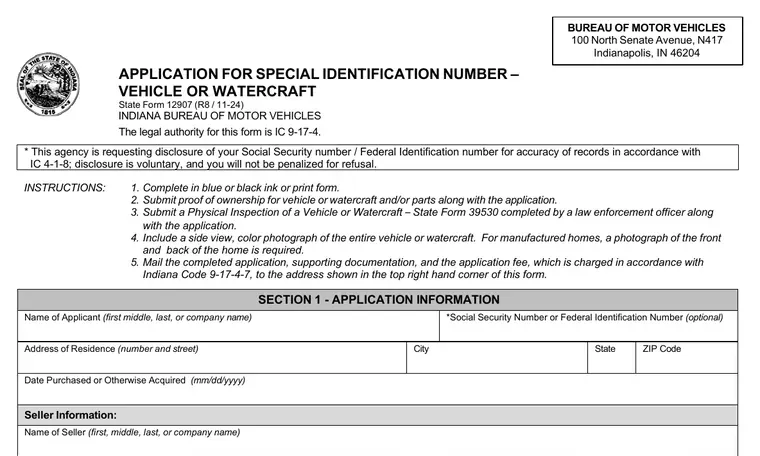
Two documents, and they are not the same thing. Take the blank State Form 12907 from the forms.in.gov copy so you get the revision that is current today.
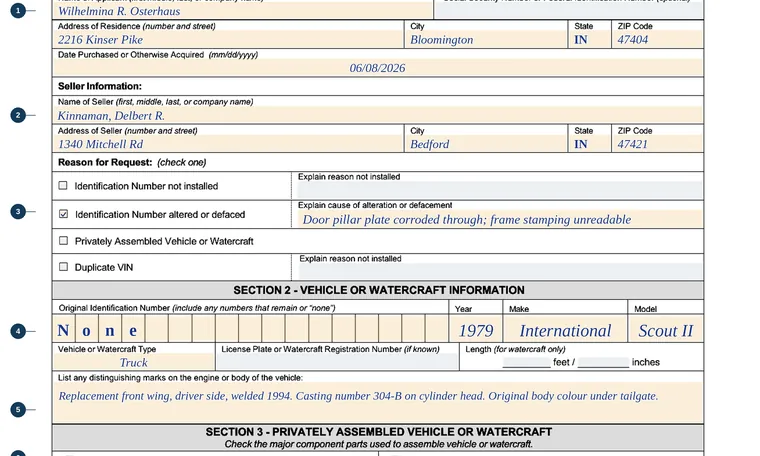
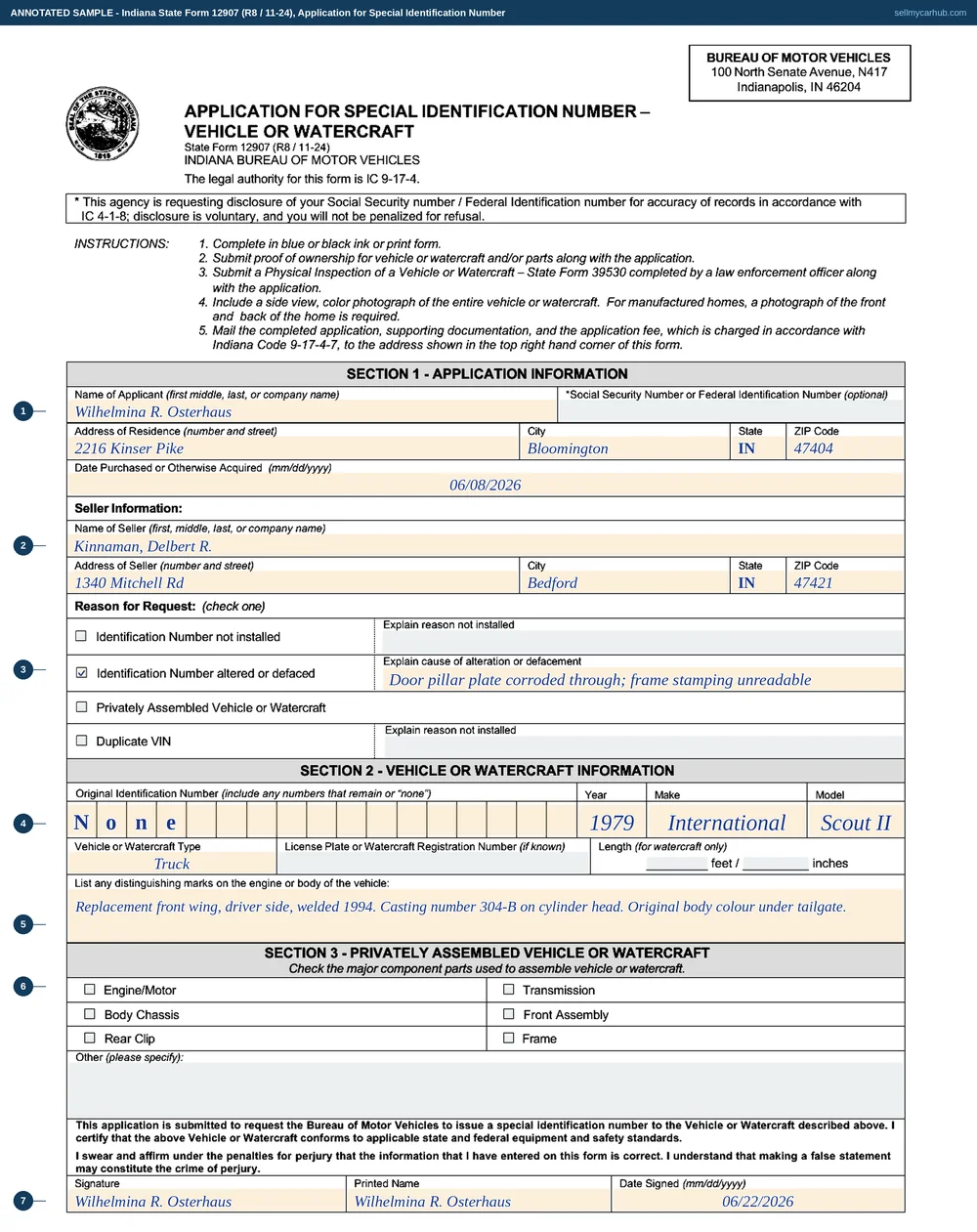
This is the actual State Form 12907, rendered from the PDF the Indiana Bureau of Motor Vehicles publishes and completed end to end: letterhead, every field, and the blocks at the foot.
Applicant name, address of residence, and the Date Purchased or Otherwise Acquired.
Watch out: Or otherwise acquired covers a vehicle inherited, given or found in an outbuilding. The date matters because it is the start of the ownership story the BMV is being asked to accept.
The name and address of whoever you got it from.
Watch out: Fill it in even if the sale was years ago and informal. A blank seller block on an application about an unidentifiable vehicle invites exactly the question you do not want asked.
One tick from four, and then the explanation line beside it.
Watch out: Altered or defaced asks you to explain the cause. Write what actually happened - corrosion, a collision, a repair panel - because a one-word answer reads as evasion.
Any characters that are still legible, or the word none.
Watch out: Partial is useful. Six readable characters out of seventeen is far better evidence than nothing, and the instruction explicitly asks for any numbers that remain.
Marks on the engine or body that would identify this particular vehicle.
Watch out: Casting numbers, a body tag, a repair, a colour change. This box is doing the work the missing plate used to do.
Ticks for Engine/Motor, Transmission, Body Chassis, Front Assembly, Rear Clip and Frame, plus an Other line.
Watch out: Leave it entirely alone unless you ticked Privately Assembled above. A part-built vehicle needs proof of ownership for the parts as well as the whole.
A side view colour photograph of the whole vehicle, and a physical inspection completed by a law enforcement officer.
Watch out: Arrange the inspection first. An officer who finds the number is readable after all saves you the entire application.
Signature, printed name and date under the conformity certification, then the whole packet and the fee to Central Office.
Watch out: You are certifying that the vehicle conforms to applicable state and federal equipment and safety standards. On a decades-old vehicle rebuilt from parts, that is a sentence worth reading twice.
| On the form | What to put in it |
|---|---|
| SECTION 1 - APPLICATION INFORMATION | Applicant name, an optional Social Security or Federal Identification Number, the address of residence, and the Date Purchased or Otherwise Acquired. |
| Seller Information | Inside section 1: the seller's name and full address, because the BMV wants to know where the vehicle came from. |
| Reason for Request | Four ticks, each with its own explanation line - Identification Number not installed, Identification Number altered or defaced, Privately Assembled Vehicle or Watercraft, and Duplicate VIN. |
| SECTION 2 - VEHICLE OR WATERCRAFT INFORMATION | Original Identification Number, with the instruction to include any numbers that remain or "none", then Year, Make, Model, Vehicle Type, plate or registration number if known, and a length box for watercraft. |
| Distinguishing marks | A free-text area: list any distinguishing marks on the engine or body of the vehicle. |
| SECTION 3 - PRIVATELY ASSEMBLED VEHICLE OR WATERCRAFT | Six component ticks - Engine/Motor, Transmission, Body Chassis, Front Assembly, Rear Clip, Frame - and an Other line. |
| The certification | That the vehicle conforms to applicable state and federal equipment and safety standards, above a signature, printed name and date. |
Every line here was read off State Form 12907 (R8 / 11-24) itself — the PDF is here — and off the Indiana Bureau of Motor Vehicles pages. This is plain-language help with a form, not legal advice, and where our wording and the agency's differ, theirs governs.
Back to all Indiana seller paperwork, or what selling a car in Indiana involves.