Sell My Car Hub

How to fill out Indiana State Form 205

The document the buyer hands over the counter with your signed certificate, and the one Indiana keys its title record from. It is a single side carrying the applicant, the residence address, the vehicle, the former title number, the purchase date, two lienholder blocks and a Gross Retail and Use Tax Affidavit across the foot. A seller never files it - but the price and the odometer reading on it are copied off what you wrote, so a mistake of yours surfaces here.
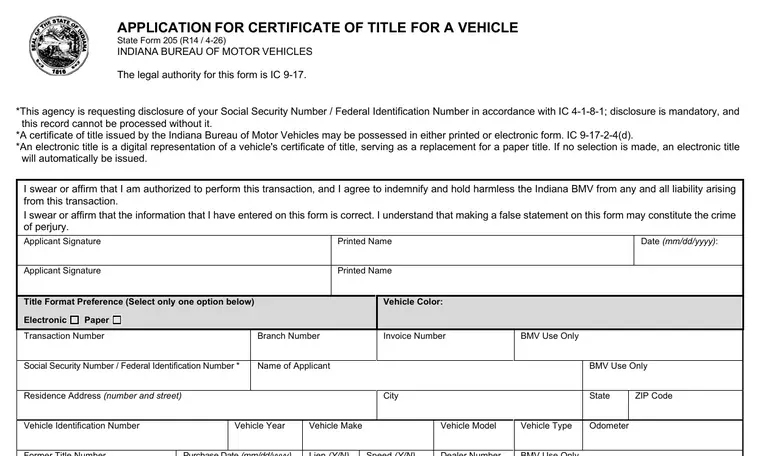
Written against State Form 205 (R14 / 4-26), issued under IC 9-17. This form is revised often - the copy read for this page is the fourteenth revision - and the BMV moves fields between rows when it does. Check the revision printed under the title against the copy on the BMV's forms page before you rely on the layout described here.

Two documents, and they are not the same thing. Take the blank State Form 205 from the forms.in.gov copy so you get the revision that is current today.

Filled in

What a completed one looks like

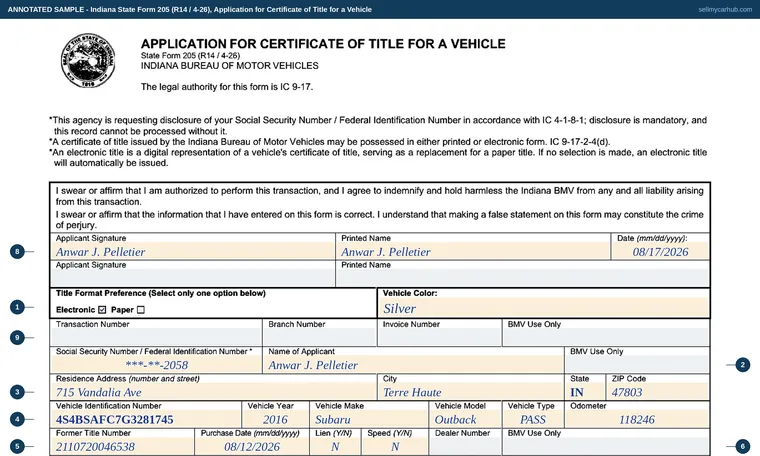
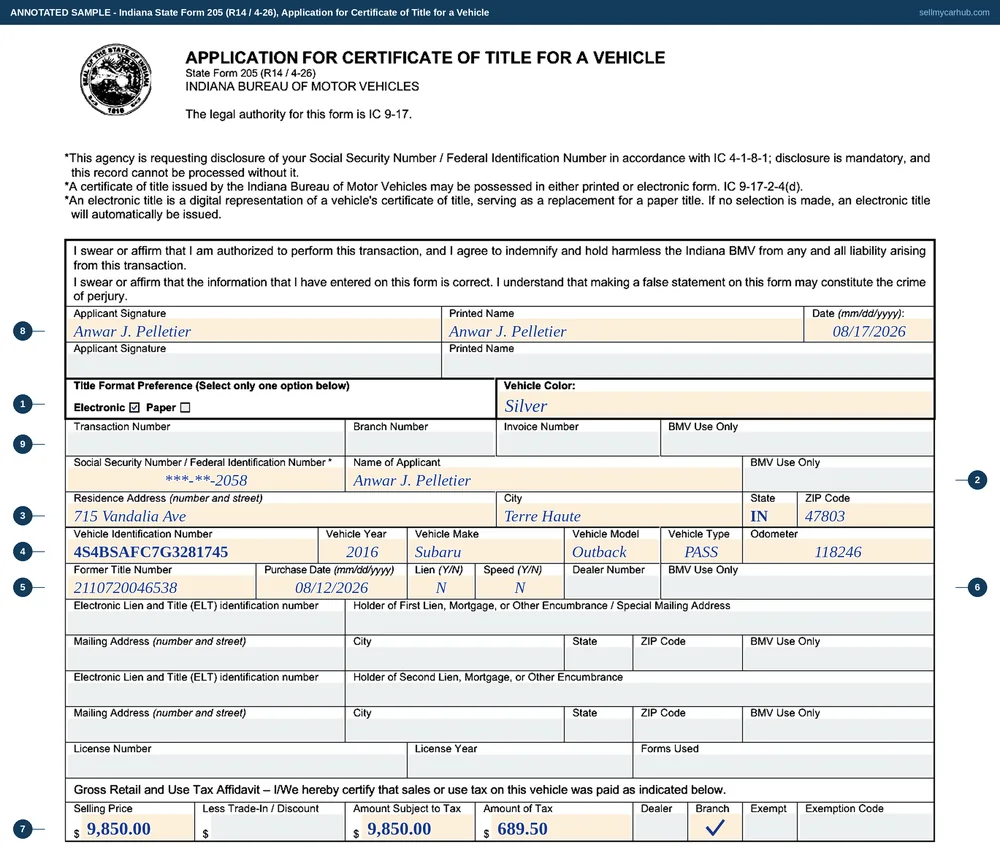
This is the actual State Form 205, rendered from the PDF the Indiana Bureau of Motor Vehicles publishes and completed end to end: letterhead, every field, and the blocks at the foot.

Indiana State Form 205 filled in for a private sale: applicant Anwar J. Pelletier of 715 Vandalia Ave, Terre Haute, a 2016 Subaru Outback with VIN 4S4BSAFC7G3281745 and an odometer reading of 118246, purchase date 12 August 2026, the Electronic title format box ticked, Lien answered N, both lienholder blocks left grey and empty, and a selling price of 9,850 dollars carried across the tax row to an amount of tax of 689.50.
The whole form as the BMV publishes it. Amber is what a private buyer writes; grey is a block that belongs to the branch, a dealer or a lender - which on an ordinary cash sale is most of the middle of the page.
Field by field

Every line, in the order you meet it

  1. 1
    The buyer fills this in

    Title Format Preference

    One tick, Electronic or Paper, in the pair of boxes above the vehicle colour.

    Watch out: Skipping it is a decision. The line printed above the boxes says an electronic title will issue automatically if nothing is selected, and a duplicate cannot afterwards be processed on an electronic title.

  2. 2
    The buyer fills this in

    Name of Applicant and the identification number

    Printed name in the Name of Applicant box, and the starred Social Security or Federal Identification Number to its left.

    Watch out: The starred footnote makes the number mandatory rather than optional. A buyer who will not put it on the form is a buyer whose title application is not going to be processed.

  3. 3
    The buyer fills this in

    Residence Address

    Number and street, city, state, ZIP - the applicant's own home address.

    Watch out: This is not where the car is kept and not where you live. It sets the county, and the county sets what the excise and any local wheel tax come to on registration day.

  4. 4
    The buyer fills this in

    The vehicle row

    Vehicle Identification Number, Year, Make, Model, Vehicle Type and the Odometer reading, straight across the page.

    Watch out: The odometer figure here has to be the one on the certificate. Two different readings on two documents about the same handover is the discrepancy a branch associate is trained to spot.

  5. 5
    The buyer fills this in

    Former Title Number and Purchase Date

    The number of the certificate being surrendered, and the date of the sale.

    Watch out: The purchase date is what the forty-five-day clock is measured from, so it is copied off the certificate rather than guessed at. A buyer who writes today's date to buy themselves more time has written a false statement on a sworn form.

  6. 6
    The buyer fills this in

    Lien (Y/N) and the two lienholder blocks

    A single letter, then two full blocks for a Holder of First Lien and a Holder of Second Lien with their addresses and Electronic Lien and Title identification numbers.

    Watch out: On a private cash sale the answer is N and both blocks stay empty. Where the buyer is financing, the lender's Indiana ELT identification number is what keeps the title electronic and out of the post.

  7. 7
    The buyer fills this in

    The Gross Retail and Use Tax Affidavit

    Selling Price, Less Trade-In / Discount, Amount Subject to Tax, Amount of Tax - then a tick for Dealer, Branch or Exempt.

    Watch out: On a private sale the trade-in box is empty and Branch is the tick, because the branch is collecting. Exempt needs a reason code beside it, and an unexplained Exempt tick is the fastest way to be sent to the back of the queue.

  8. 8
    The buyer fills this in

    Sign, and have the co-applicant sign

    Applicant Signature, Printed Name and date on the first row; a second row for a second applicant.

    Watch out: Nobody witnesses this. The line above it is an oath - making a false statement on this form may constitute the crime of perjury - and the branch takes it at face value.

  9. 9
    The buyer fills this in

    Leave the BMV Use Only boxes alone

    Transaction Number, Branch Number, Invoice Number, License Number, License Year, Forms Used and four boxes marked BMV Use Only.

    Watch out: Filling one in helpfully is not helpful. They are the branch's audit trail and an associate who finds them already written on has to work out who wrote them.

At a glance

What goes where

On the formWhat to put in it
Title Format PreferenceTwo boxes, Electronic and Paper, and a warning printed above them that if no selection is made, an electronic title will automatically be issued.
Applicant Signature and Printed NameTwo rows of them, for two applicants, above the affirmation that the signer is authorized to perform this transaction and agrees to indemnify and hold harmless the Indiana BMV.
Social Security Number / Federal Identification NumberStarred, with a footnote that disclosure is mandatory and this record cannot be processed without it. A company enters its Federal Identification Number instead.
Residence AddressNumber and street, city, state and ZIP. It is the applicant's home, and it is what puts the vehicle in a county for excise purposes.
The vehicle rowVehicle Identification Number, Vehicle Year, Vehicle Make, Vehicle Model, Vehicle Type and Odometer, all on one line across the page.
Former Title Number, Purchase Date, Lien, Speed, Dealer NumberThe second row. Lien and Speed are each a bare Y/N box; Dealer Number stays empty on a private sale.
Holder of First Lien, Mortgage, or Other EncumbranceA named block with its own Electronic Lien and Title identification number, mailing address, city, state and ZIP - and a second identical block beneath it for a Holder of Second Lien.
Gross Retail and Use Tax AffidavitFour money boxes along the bottom - Selling Price, Less Trade-In / Discount, Amount Subject to Tax, Amount of Tax - beside tick columns for Dealer, Branch, Exempt and an Exemption Code.
Vehicle ColorIts own box, top right, easy to miss and asked for on the BMV's checklist as a separate line item.
Transaction Number, Branch Number, Invoice NumberBranch fields. Four boxes on the form are simply labelled BMV Use Only and are not yours.

What gets this one rejected

Rules that decide whether it is accepted

Every line here was read off State Form 205 (R14 / 4-26) itself — the PDF is here — and off the Indiana Bureau of Motor Vehicles pages. This is plain-language help with a form, not legal advice, and where our wording and the agency's differ, theirs governs.

Back to all Indiana seller paperwork, or what selling a car in Indiana involves.

Want the paperwork handled instead?

Get My Instant Offer → Online · about 2 minutes · free

Or send the details — we'll come to you

If the idea of a branch queue, an appointment and a tax bill is the reason the car is still on your drive, tell us about it instead.

or call/text (877) 405-1808