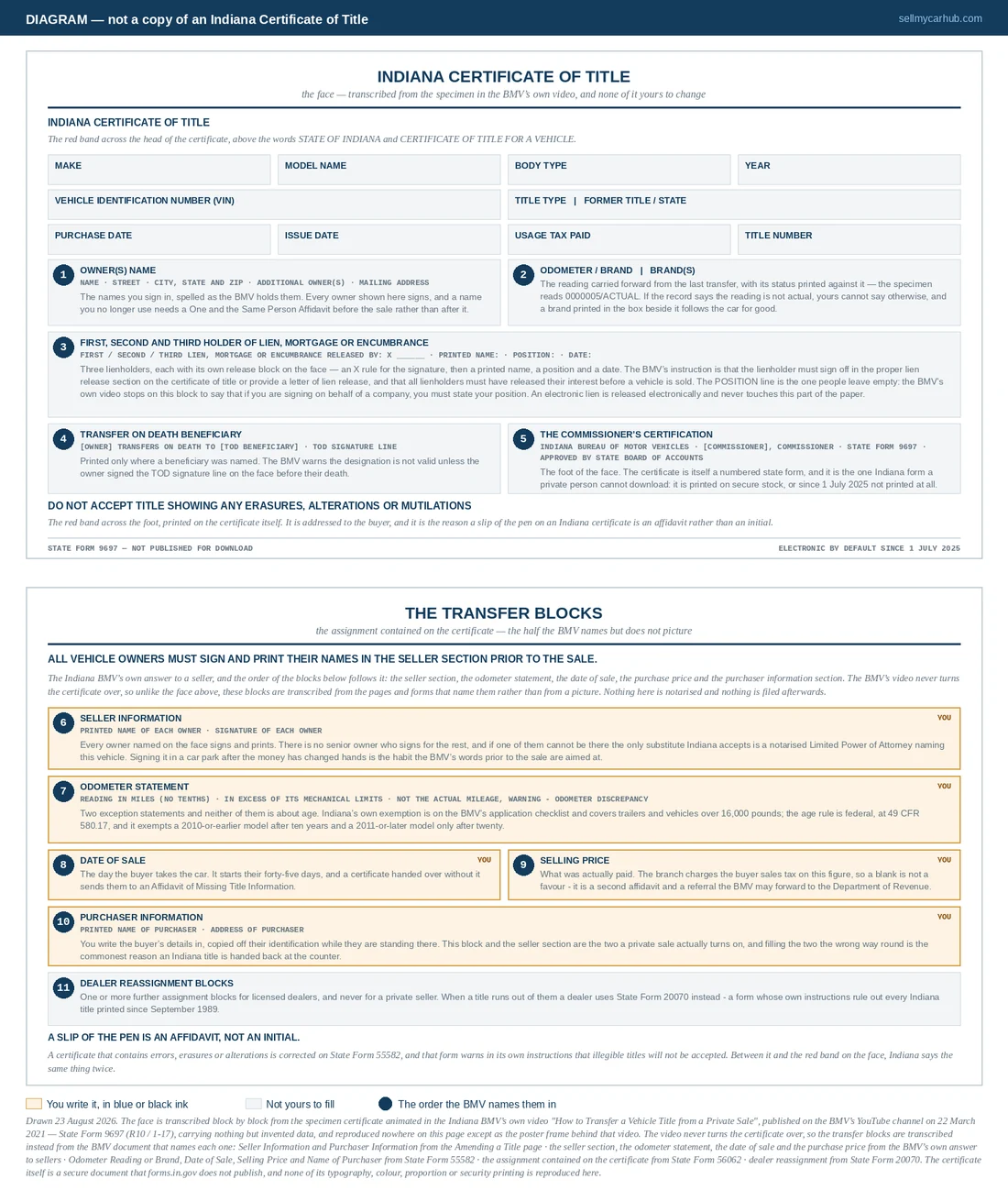
An Indiana certificate carries the whole private sale on one document. You complete the seller section, the odometer statement, the date of sale, the selling price and the purchaser section; the buyer takes it to a branch with State Form 205 and pays the tax. Nothing is notarised and nothing is posted back to you. The face of the certificate below is transcribed from a specimen the BMV animates in its own video; the blocks you write on are transcribed from the pages and forms that name them, each cited where it appears.
Last updated .
Your 8 boxes
As a private seller you complete these and nothing else:
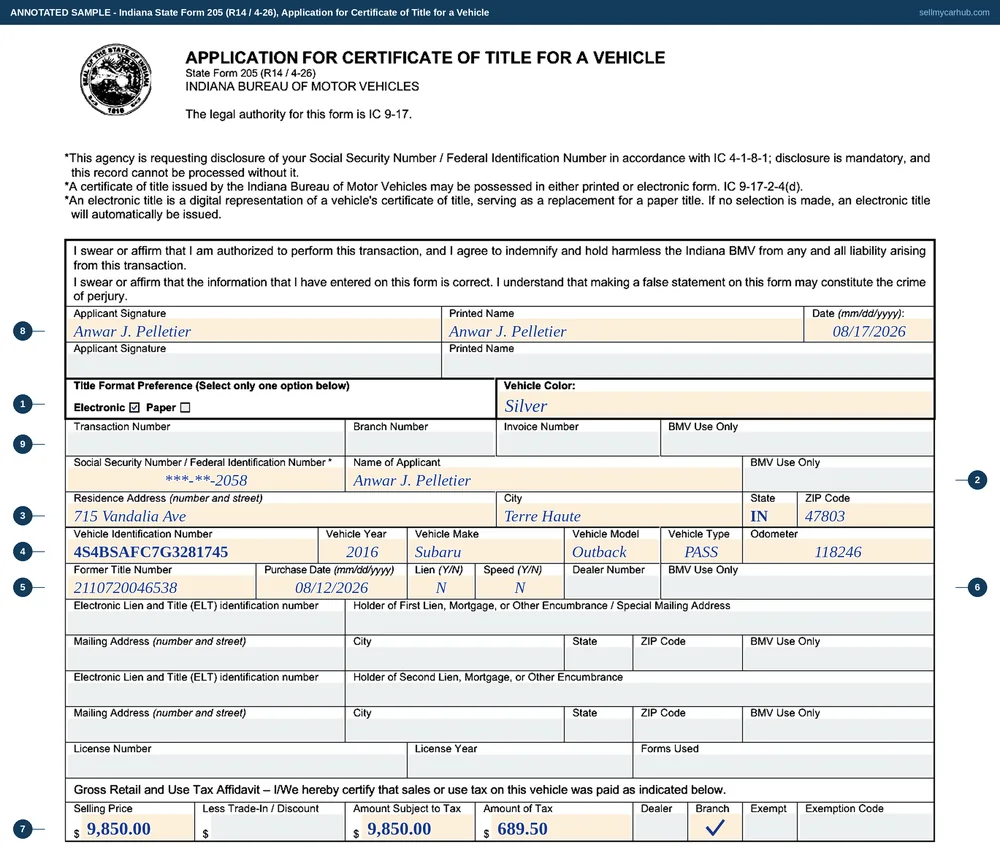
There is no blank Indiana certificate to download and nothing to practise on - the certificate is printed on secure stock and the only one in existence is the one in your drawer, or the electronic record behind your myBMV login. What you can download and rehearse on is State Form 205, which carries the same vehicle description, the same odometer reading and the same selling price, and that is the document shown filled in below.
Errors, erasures or alterations on a certificate are not corrected with a pen - they are corrected with State Form 55582, and the BMV adds that illegible titles will not be accepted.
The specimen the BMV shows is the printing whose footer reads State Form 9697 (R10 / 1-17), signed by a Commissioner who has since left office. Whether the sheet in your drawer is that printing or a later one, the set of blocks a private seller completes is the set the BMV names in its own answer to sellers, and that has not moved.
The certificate itself
An Indiana certificate, face and transfer blocks, drawn from the BMV's own specimen
Two panels. The upper one is the face of the certificate, transcribed block by block from a specimen the BMV animates in its own video - the same still sitting behind the play button further down this page. The lower one is the half a private seller writes on, in the order the BMV lists it in its answer to sellers. The numbered steps below the diagram follow the order you fill them in instead, which is not quite the same thing.
Amber — you write it, in pen
Grey — not yours to fill
Numbered — the face first, then the transfer
Click or tap the picture to open it full size.
Drawn, not photographed — but the face is drawn from a real specimen. Indiana publishes no picture of its certificate, and the certificate is itself a numbered state form — the footer reads State Form 9697 (R10 / 1-17), and like any secure document it is not served by forms.in.gov. The BMV's eleven title pages, its twenty-six vehicle forms, its twelve application packets and the Secretary of State's own Auto Dealer booklet were all searched and none contains one. What does contain one is the BMV video below, which animates a full specimen of the face carrying nothing but invented data — JOHN & JANE DOE of 123 NEW CAR DR — and every block name in the upper panel is transcribed from it. The video never turns the certificate over, so the transfer blocks come instead from the BMV documents that name them: the Amending a Title page for Seller Information and Purchaser Information, State Form 55582 for the odometer reading or brand, the date of sale, the selling price and the name of purchaser, and the Transfer on Death page for the TOD signature line.
The document that goes with it
State Form 205, completed for one private sale
The certificate is half the transaction and this is the other half. State Form 205 is what the buyer hands across the counter with your signed title, and it is where the price, the tax, the odometer reading and the title format all get keyed. Amber is what gets written on a straightforward cash sale between two people; grey is a block that belongs to the branch, to a dealer or to a lender.
Click or tap the picture to open it full size.
Look at the tax row. Four money boxes across the foot - selling price, less trade-in or discount, amount subject to tax, amount of tax - and on a private sale the middle one is empty and the other three do arithmetic in public. The figure in the first box is the one you wrote on the certificate, which is why leaving it blank there is not a favour to anybody.
Before you watch. It went up on 22 March 2021 and predates two changes on this page. Indiana began issuing electronic titles on 1 July 2025, and the fee chart in force from 1 January 2026 puts the title at $15.00 and the late administrative penalty at $30.00. The forty-five-day deadline and the seller's plate rule are unchanged.
Published by the Indiana BMV on its own YouTube channel, the one in.gov/bmv links from its own footer. The still behind the play button is the BMV's own specimen certificate, invented owners and all - it is the only picture of an Indiana title the state publishes anywhere. Nothing loads from YouTube until you press play.
Step by step
Every box, in the order you meet it
1
You fill this in
Check who the title actually names
Read the owner block on the face before you write anything. Every person printed there has to sign and print in the seller section, and a name that does not match your identification has to be reconciled first.
Watch out: If the title says Roselle M. Tichenor and your licence says Roselle Tichenor-Bayer, the branch wants a One and the Same Person Affidavit on State Form 13637 rather than a guess. It is a free form and a five-minute job before the sale; after the sale it is the buyer's problem and your phone call.
2
You fill this in
The seller section
Printed name and signature for every owner. The BMV's instruction is that all vehicle owners must sign and print their names in the seller section prior to the sale.
Watch out: Prior to the sale is the part people skip. A signature added later, in a car park, with the buyer waiting, is how the date of sale and the odometer statement end up disagreeing with each other.
3
You fill this in
The odometer statement
The current reading in whole miles, and nothing else unless one of the two printed statements is true - mileage in excess of its mechanical limits, or a reading that is NOT the actual mileage.
Watch out: Read it off the dash, not off the last service invoice. A number that turns out to be a thousand miles light is the kind of thing the buyer notices on the drive home, and there is no undoing an odometer statement once it is on a certificate.
4
You fill this in
The date of sale
The day the buyer takes the car, written as the BMV writes dates: month, day, four-digit year.
Watch out: This is the day the buyer's forty-five days start running, so it has to be the real one. Post-dating it to help somebody who has not organised themselves puts a false statement on a sworn document to save them thirty dollars.
5
You fill this in
The selling price
The actual amount paid, in figures.
Watch out: The branch charges the buyer 7% of whatever is written here. Leaving it blank does not help them - it sends them to State Form 56620, which the BMV reserves the right to forward to the Department of Revenue, and the Department may collect additional taxes.
6
You fill this in
The purchaser section
The buyer's full legal name and address, printed by you, in the block the BMV calls Purchaser Information.
Watch out: Copy it off their identification while they are standing there. This block and the seller section sit on the same face of the certificate and putting the two the wrong way round is the single most common reason an Indiana title comes back.
7
You fill this in
Take the plate off
Not a block on the certificate at all, but the step that ends your registration. The seller should remove the license plate from the vehicle at the time of the transaction.
Watch out: Do it before you hand over the keys, not after they drive away. Indiana never asks for the plate back, so nobody will chase you for it - which also means nothing will remind you that it is still on a car belonging to somebody else.
8
You fill this in
Photograph the whole face of it
One clear image of the completed certificate showing both sections, the odometer statement, the date and the price.
Watch out: This is your only record. There is no Indiana notice of sale, so if the buyer sits on it for six weeks and then claims the mileage was different, the photograph is the entire argument.
9
The buyer fills this in
The buyer completes State Form 205
At a branch: their name and address, the vehicle description, the odometer reading, the former title number, the purchase date, and the lien and title-format questions.
Watch out: The title format question defaults against them if they ignore it. If no selection is made, an electronic title will automatically be issued - and an electronic title cannot later be duplicated, only printed or amended.
10
The buyer fills this in
The buyer pays the tax and the fee
Seven per cent of the price you wrote, plus $15.00 for the title, plus $25.00 more if they want it couriered rather than posted.
Watch out: An ordinary title takes up to 21 calendar days to arrive in the post. A buyer who needs it sooner - to sell the car on, or to satisfy a lender - is the one who should be paying for the speed title, not you.
11
The buyer fills this in
Forty-five days, then thirty dollars
The certificate of title must be applied for within 45 days after the vehicle is purchased or otherwise acquired.
Watch out: The fee chart prices the miss at $30.00. It is small enough that some buyers simply decide to be late, which is worth knowing when you are deciding how long to keep your photograph of the certificate.
12
The buyer fills this in
Getting it home without a plate
72 hours from the date of acquisition, by the most direct route, to storage, an emissions station or a branch - with the certificate of title in the car.
Watch out: That is the whole permission. It is not a grace period for driving to work, and it runs from the date on the certificate rather than from the moment they collect the car.
Before the pen
Before you write on the certificate
Six habits worth having before you write anything on an Indiana certificate, and the first two are the ones that send a buyer back to you.
Blue or black ink, and only blue or black
Every BMV vehicle form opens with the same instruction - complete in blue or black ink or print form. The certificate is read by the same people.
No erasures, no correction fluid, no writing over
State Form 55582 exists because a certificate carrying errors, erasures or alterations has to be corrected by affidavit, and the same form warns that illegible titles will not be accepted.
Everybody named on the face signs
Two owners means two printed names and two signatures in the seller section. There is no senior owner who can sign for the other.
The price goes in, in figures
It is the number the branch taxes the buyer on. A blank there is not generosity, it is a second form and a referral to the Department of Revenue.
Whole miles
The odometer box is labelled Miles (no tenths), and the two numbered statements beside it are exceptions, not defaults.
Nothing gets notarised, so nothing gets checked
The signature block is an oath: making a false statement may constitute the crime of perjury. Nobody is going to look over the certificate before you hand it across, so you are the last check on it.
The certificate tells the buyer to refuse a messy one
Printed in a red band across the foot of the face: DO NOT ACCEPT TITLE SHOWING ANY ERASURES, ALTERATIONS OR MUTILATIONS. That instruction is aimed at the person you are handing it to.
What Indiana sellers get told that costs them a trip
Three things Indiana sellers are told confidently that are not true. Each correction links the BMV page or form it comes from.
“Leave the plate on so they can drive it home legally.”
The plate is yours and the BMV says to take it off at the time of the transaction. The buyer's legal way home is a different thing entirely: 72 hours from the date of acquisition, by the most direct route, only to a place of storage, an emissions inspection station or a branch, and only with the certificate of title in the vehicle showing that they own it. Your plate does not extend that and leaving it on does not help them.
“Get the title notarised or the branch will not take it.”
Indiana does not notarise the transfer. Every signature block on the BMV's vehicle forms carries an oath instead - I swear or affirm that the information I have entered on this form is correct, and I understand that making a false statement may constitute the crime of perjury. The one exception in the set is the Limited Power of Attorney, whose own instructions say it must be notarized to be valid, and that is the form you use when you cannot be there to sign at all.
Not in Indiana, and the BMV says so in one line: a bill of sale cannot be used to transfer vehicle ownership for a vehicle that requires a certificate of title by law. It lists eight situations where a bill of sale will do, and every one of them is a vehicle that never needed a title - a utility trailer bought before 1990, a pop-up bought before July 2016, an off-road vehicle acquired before 2010, a sheriff's sale, a federal government vehicle. A car is not on that list. A buyer holding only a bill of sale is being sent to court for an order.
Indiana asks for fewer signatures than most states and witnesses none of them. Here is who signs what:
Every owner printed in the seller section
All of them sign and all of them print, and the BMV's instruction is that this happens prior to the sale rather than at the kerb afterwards.
The buyer, in the purchaser section
You write their name and address into it; they sign the application half on State Form 205 at the branch.
An attorney-in-fact
Only on a notarized Limited Power of Attorney, State Form 1940, which is the one BMV vehicle form in this set that carries a notary certificate.
Nobody, for a dead owner
A distributee of a small estate signs State Form 18733 in their own name and attaches a death certificate. The decedent's signature is never forged onto the certificate.
A lienholder, if one is still shown
In its own release block on the face - three of them are printed there - or by a letter on the lender's own letterhead. Anyone signing for a company has to fill in the POSITION line beside their name. An electronic lien is released electronically and never touches the paper.
A notary
Not on the certificate, not on State Form 205, and not on the odometer statement. Indiana swears these under penalty of perjury instead.
Once it is signed
Once the certificate is completed and the plate is off, your part is finished. Indiana gives you nothing to post afterwards, and the forty-five-day clock that starts at the handover belongs to the buyer.