Sell My Car Hub

How to fill out Indiana State Form 1940

The one BMV vehicle form in this set that has to be notarised, and the only way somebody else signs an Indiana title for you. Five numbered sections: who you are, who the attorney-in-fact is, what they may do, your signature, and a notary certificate. It is limited by design - the authority it gives runs to the certificate of title and the registration for one named vehicle and stops there.
Written against State Form 1940 (R7 / 11-24), issued under IC 9-17 and IC 30-5. Sign this in front of the notary, not before you get there. The certificate is not a formality on this form - it is the only thing standing between a limited authority over one vehicle and a signature somebody could have written at any time.

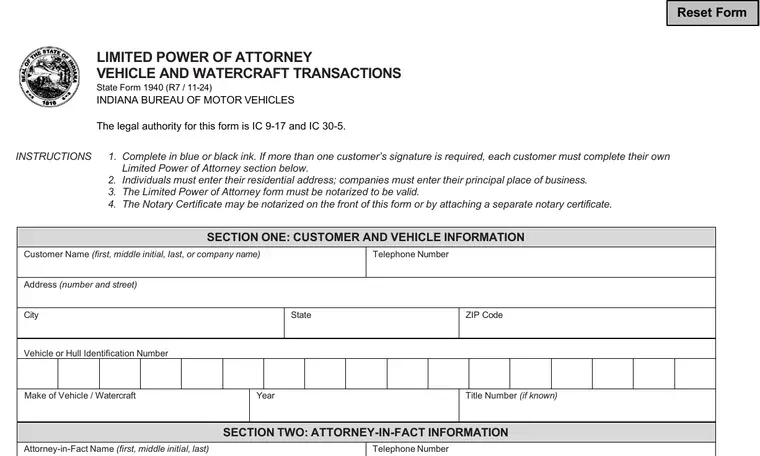
Two documents, and they are not the same thing. Take the blank State Form 1940 from the forms.in.gov copy so you get the revision that is current today.

Filled in

What a completed one looks like

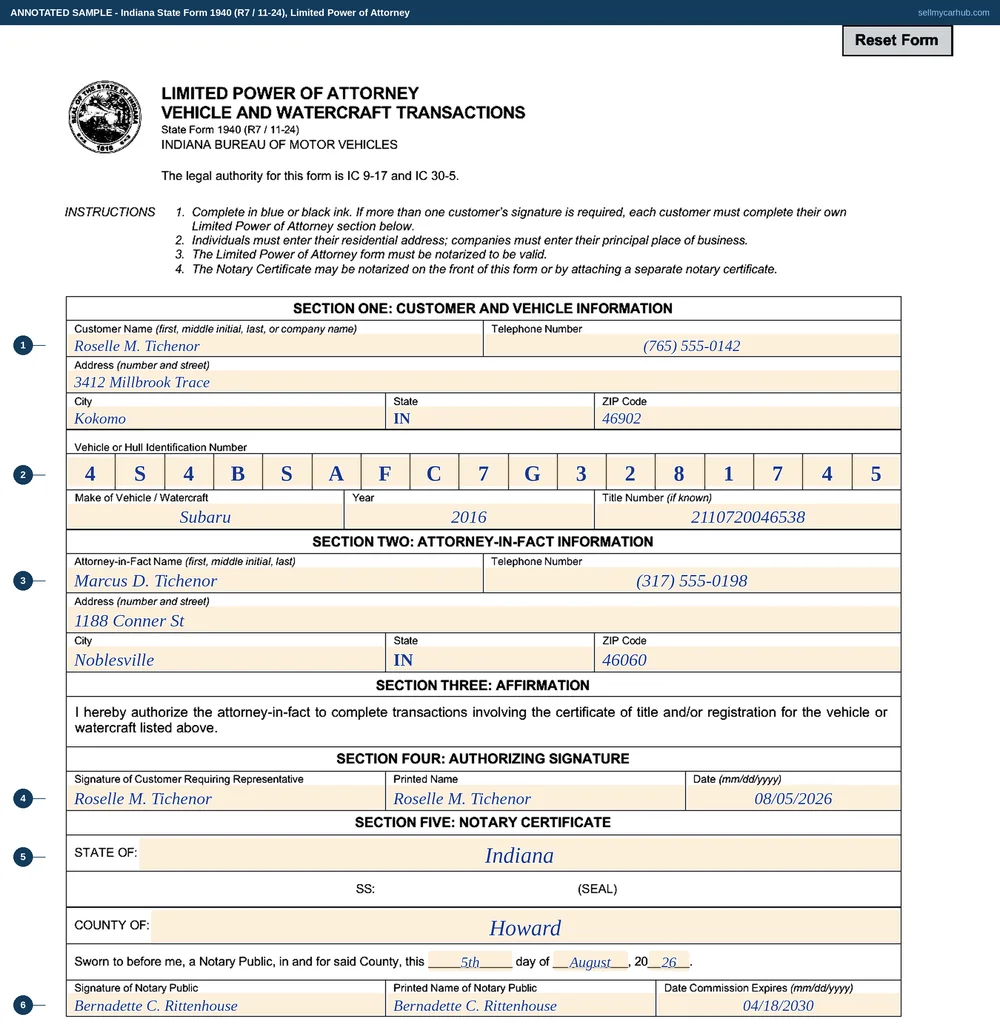
This is the actual State Form 1940, rendered from the PDF the Indiana Bureau of Motor Vehicles publishes and completed end to end: letterhead, every field, and the blocks at the foot.

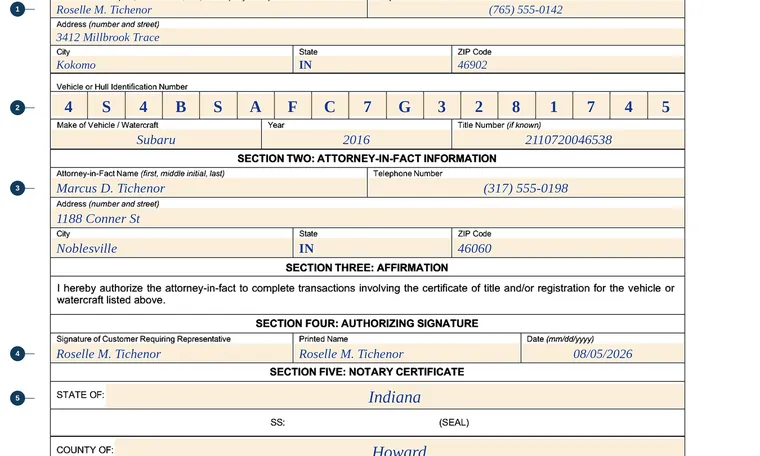
Indiana State Form 1940 filled in: customer Roselle M. Tichenor of 3412 Millbrook Trace, Kokomo, appointing her brother Marcus D. Tichenor of Noblesville as attorney-in-fact for a 2016 Subaru Outback, VIN 4S4BSAFC7G3281745, title number 2110720046538, signed 5 August 2026 and notarised the same day in Howard County by Bernadette C. Rittenhouse with a commission expiring 18 April 2030.
The whole form, notary certificate included. This is the only page in the Indiana set where the amber runs all the way to the bottom - every other form ends at a signature, and this one ends at somebody else's seal.
Field by field

Every line, in the order you meet it

  1. 1
    You fill this in

    Your details, section one

    Name in the order first, middle initial, last or company name, telephone number, and your residential address.

    Watch out: Residential, per instruction 2. A company uses its principal place of business, which is not necessarily the address on its letterhead.

  2. 2
    You fill this in

    The vehicle

    Vehicle or Hull Identification Number in its banded box, then Make, Year and the Title Number if you know it.

    Watch out: This is what limits the power of attorney. One identification number means one vehicle, and a second car needs a second form.

  3. 3
    You fill this in

    Section two, the attorney-in-fact

    Their name, telephone number and full address.

    Watch out: Fill this in yourself and fill it in before you sign. A blank in section two on a form you have already signed is a blank cheque over your title.

  4. 4
    You fill this in

    Read section three

    Nothing to complete - the printed authorisation covers transactions involving the certificate of title and/or registration for the vehicle listed above.

    Watch out: Note what it does not cover. It is not a general power of attorney and it gives nobody authority over anything except that one vehicle's paperwork.

  5. 5
    You fill this in

    Sign it in front of the notary

    Signature of Customer Requiring Representative, printed name and date, in section four.

    Watch out: In front of, not before. The certificate below says sworn to before me, and a notary who did not watch you sign should not be completing it.

  6. 6
    You fill this in

    Watch the notary complete section five

    State, county, the day, month and year, the notary's signature, printed name, commission expiry and seal - none of it yours to write, all of it yours to check.

    Watch out: Look at the commission expiry date before you leave the desk. An expired commission makes the certificate worthless, and nobody will discover that until a branch tells your buyer.

  7. 7
    You fill this in

    Hand over the original

    The completed form goes with the certificate to the branch.

    Watch out: Keep a photocopy for yourself and a photograph on your phone. This document lets somebody else dispose of your car, and you should know exactly what it says afterwards.

At a glance

What goes where

On the formWhat to put in it
SECTION ONE: CUSTOMER AND VEHICLE INFORMATIONCustomer name in the order first, middle initial, last or company name, a telephone number, the address, and then the Vehicle or Hull Identification Number with Make, Year and Title Number if known.
SECTION TWO: ATTORNEY-IN-FACT INFORMATIONThe same again for the person being appointed - name, telephone, address, city, state and ZIP.
SECTION THREE: AFFIRMATIONOne printed sentence and nothing to complete: I hereby authorize the attorney-in-fact to complete transactions involving the certificate of title and/or registration for the vehicle or watercraft listed above.
SECTION FOUR: AUTHORIZING SIGNATURESignature of Customer Requiring Representative, printed name and date. This is the signature the notary watches.
SECTION FIVE: NOTARY CERTIFICATESTATE OF and COUNTY OF with an SS: notation and a seal space, the sworn-before-me sentence with day, month and year blanks, then the notary's signature, printed name and commission expiry.
Reset FormA button top right, because this is one of the BMV's fillable forms - which matters when several of these have to be produced at once.

What gets this one rejected

Rules that decide whether it is accepted

Every line here was read off State Form 1940 (R7 / 11-24) itself — the PDF is here — and off the Indiana Bureau of Motor Vehicles pages. This is plain-language help with a form, not legal advice, and where our wording and the agency's differ, theirs governs.

Back to all Indiana seller paperwork, or what selling a car in Indiana involves.

Want the paperwork handled instead?

Get My Instant Offer → Online · about 2 minutes · free

Or send the details — we'll come to you

Deployed, hospitalised, out of state, or simply not in the same city as the car - those are all situations we can work with.

or call/text (877) 405-1808