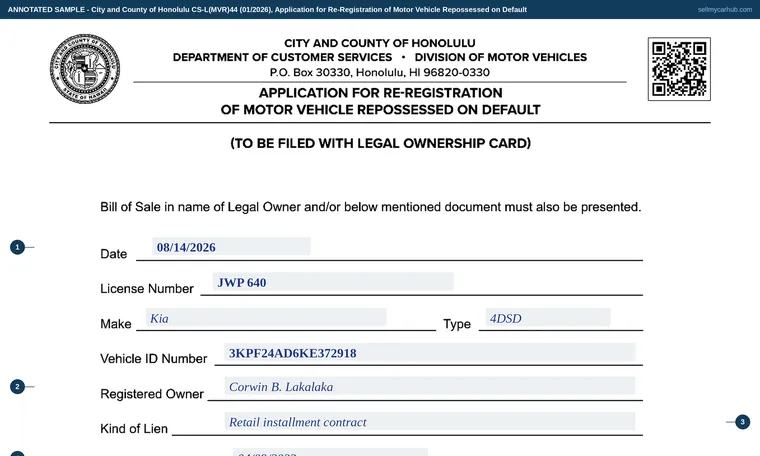
This is not your form and you should not be handed it, but it is the only lien document any Hawaii county publishes, so people looking for a release find it and assume it is the one. It is filed by the legal owner - the lender - after taking a vehicle back on default, and its instruction line says so before anything else: to be filed with legal ownership card. Its questions are about the default rather than the sale, asking the kind of lien, the date of sale or lease, the nature of the default and how long it has existed. If your lender has a lien on your certificate and you are selling normally, what you need is an endorsement in Section B on the back of the title, or a lien satisfaction letter - and neither of those is this.
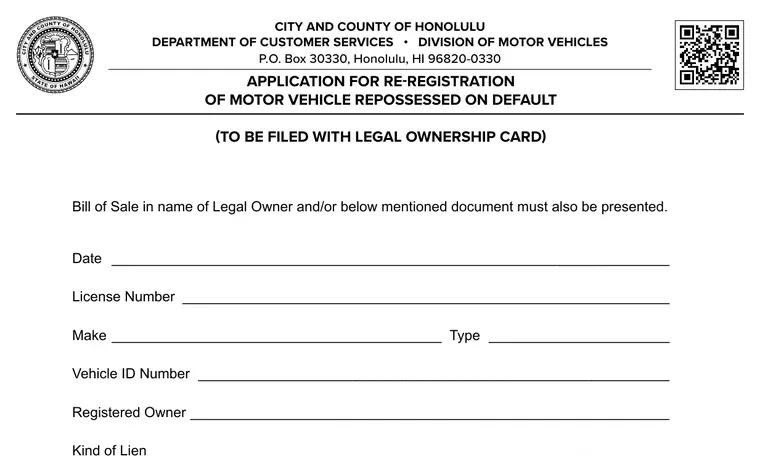
Written against CS-L(MVR)44 (01/2026), issued under City and County of Honolulu Department of Customer Services, Division of Motor Vehicles, filed by the legal owner with the legal ownership card. The reason to know this form exists is to stop looking for it. Sellers hunting for a Hawaii lien release find CS-L(MVR)44 because it is the only county form with the word lien in its subject matter, and it is a repossession application filed by a lender against a borrower. Nothing on it releases a lien on a car you still own.
Two documents, and they are not the same thing. Take the blank CS-L(MVR)44 from the www4.honolulu.gov copy so you get the revision that is current today, then print our CS-L(MVR)44 guide and keep it beside you while you fill theirs in.
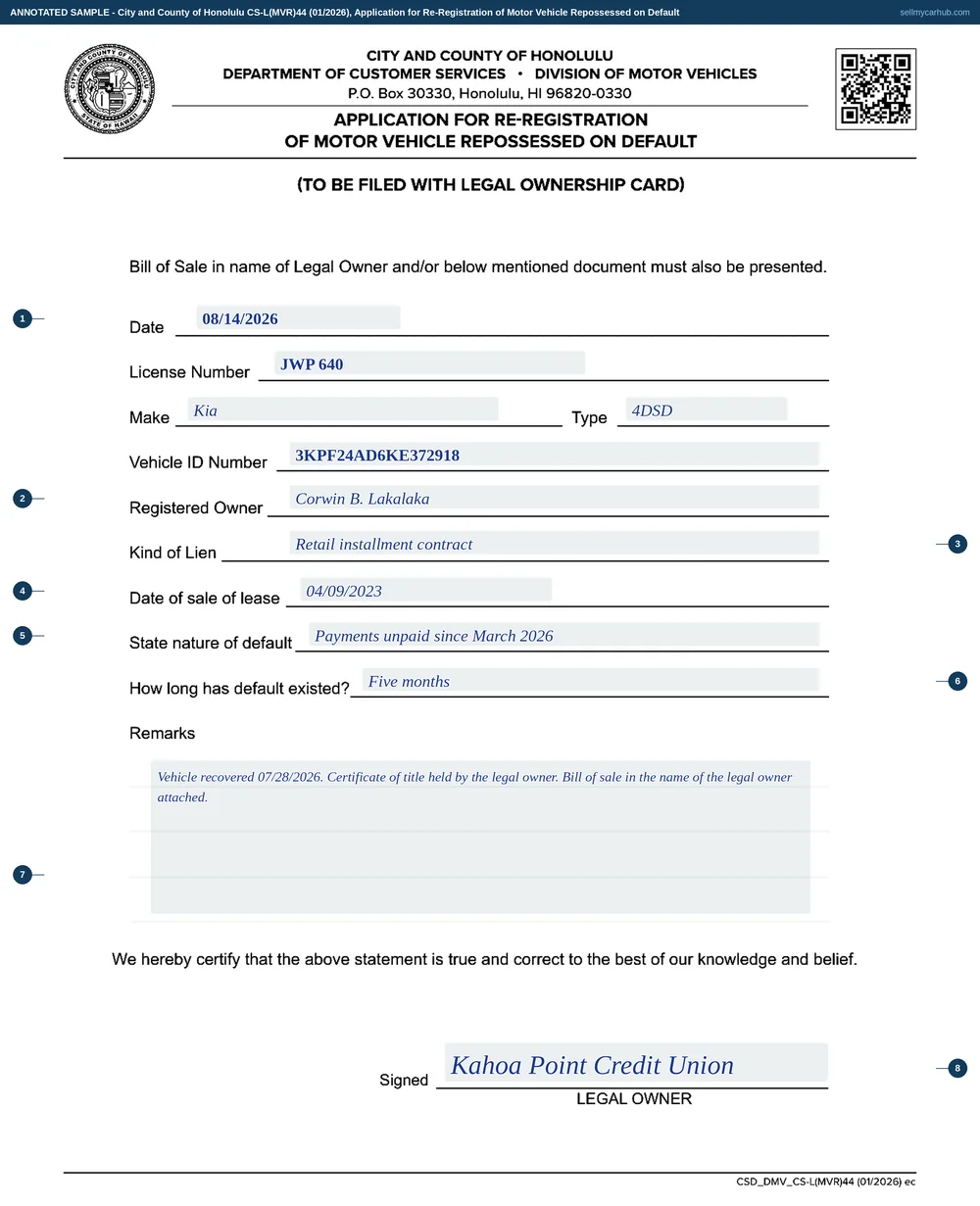
This is the actual CS-L(MVR)44, rendered from the PDF the City and County of Honolulu Division of Motor Vehicle, Licensing and Permits publishes and completed end to end: letterhead, every field, and the blocks at the foot.
The identity block: the date of the application, the plate the vehicle carried, the make and type, and the vehicle identification number.
Watch out: A seller reading this far has already gone wrong. If you still own the car, close this form and look at Section B on the back of your certificate instead.
The person the county has on record as the registered owner - the borrower whose default is being asserted.
Watch out: This is the one field that names the seller, and it names them as the subject of the application rather than as its author.
The instrument the legal owner is enforcing. It separates a finance agreement from a storage or repair lien, which reach a vehicle by a different route.
Watch out: There is no tick list. The lender writes the instrument, and the county reads it against the bill of sale in the legal owner's name that must be presented with it.
When the defaulted agreement began, not when it was breached.
Watch out: It is easy to read this as the date of the repossession sale. It is not - the next two questions cover the default itself.
What the borrower failed to do. One ruled line, and the substance of the whole application.
Watch out: The county is deciding whether to re-register a vehicle out of one person's name and into another's without that person's signature. A vague answer is not enough for that.
A duration. Together with the previous line it is the evidence that the lien matured before the vehicle was taken.
Watch out: The answer here and the date of sale or lease have to be consistent with each other and with the contract.
A deep panel for anything else - the location of the vehicle, the repossession agent, the state of the title.
Watch out: A lender using this panel to explain a missing certificate is telling the county something the boxes never asked, which is exactly what it is for.
One rule at the foot, signed by the lender. There is no signature line for the registered owner anywhere on the sheet.
Watch out: That absence is the point. If a document about your car has no place for your signature, it is not a document you are meant to be completing.
| On the form | What to put in it |
|---|---|
| Date | The date the legal owner makes the application. |
| License Number | The plate the vehicle carried before repossession. |
| Make and Type | Two boxes on one line, the county's usual description shorthand. |
| Vehicle Identification Number | One long rule, the identifier that survives a change of plate. |
| Registered Owner | The person the vehicle was registered to - the defaulting borrower, not the lender. |
| Kind of Lien | The instrument being enforced. It is the field that distinguishes a finance agreement from a mechanic's or storage lien. |
| Date of Sale or Lease | When the agreement that has been defaulted on was entered into. |
| State Nature of Default | A ruled line for what the borrower failed to do. |
| How long has default existed | A duration rather than a date. |
| Remarks | A deep panel for anything the county needs to know that the boxes do not ask. |
| Signature of Legal Owner | One signature rule at the foot. The registered owner does not sign this form at all. |
Every line here was read off CS-L(MVR)44 (01/2026) itself — the PDF is here — and off the City and County of Honolulu Division of Motor Vehicle, Licensing and Permits pages. This is plain-language help with a form, not legal advice, and where our wording and the agency's differ, theirs governs.
Back to all Hawaii seller paperwork, or what selling a car in Hawaii involves.