The one page that tells the Division of Motor Vehicles your car is gone. Delaware prints it as a detachable strip at the foot of a current certificate of title, and publishes this standalone version for everybody whose title has already been handed over or never carried one. It names you, the vehicle, the buyer, the price, the mileage and the date, and it is what a Delaware seller has instead of a notice-of-sale deadline.
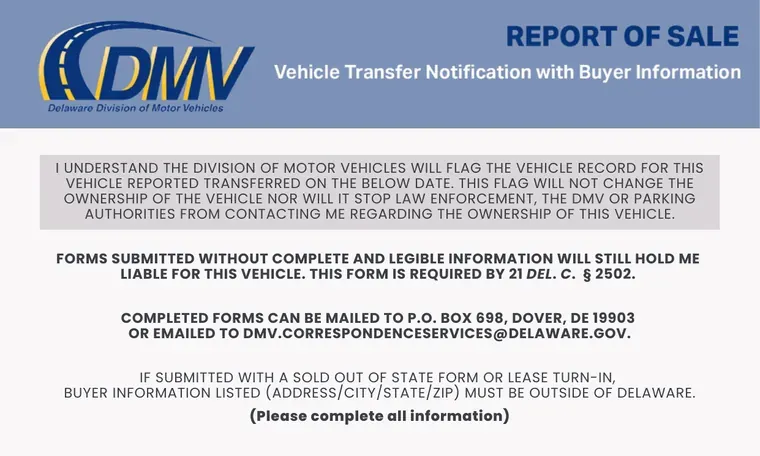
Written against Report of Sale (Rev 8/28/24), issued under 21 Del. C. s. 2502, cited on the form itself. The Division's advice, in its own words on the titling page, is that the seller transfer the title to the buyer at a Division facility - because that is the only way to be certain the buyer actually obtained a new title and your name actually came off. This notice is what you do when that was not possible. It is a flag on a record, not a discharge.
Two documents, and they are not the same thing. Take the blank Report of Sale from the dmv.de.gov copy so you get the revision that is current today, then print our Report of Sale guide and keep it beside you while you fill theirs in.
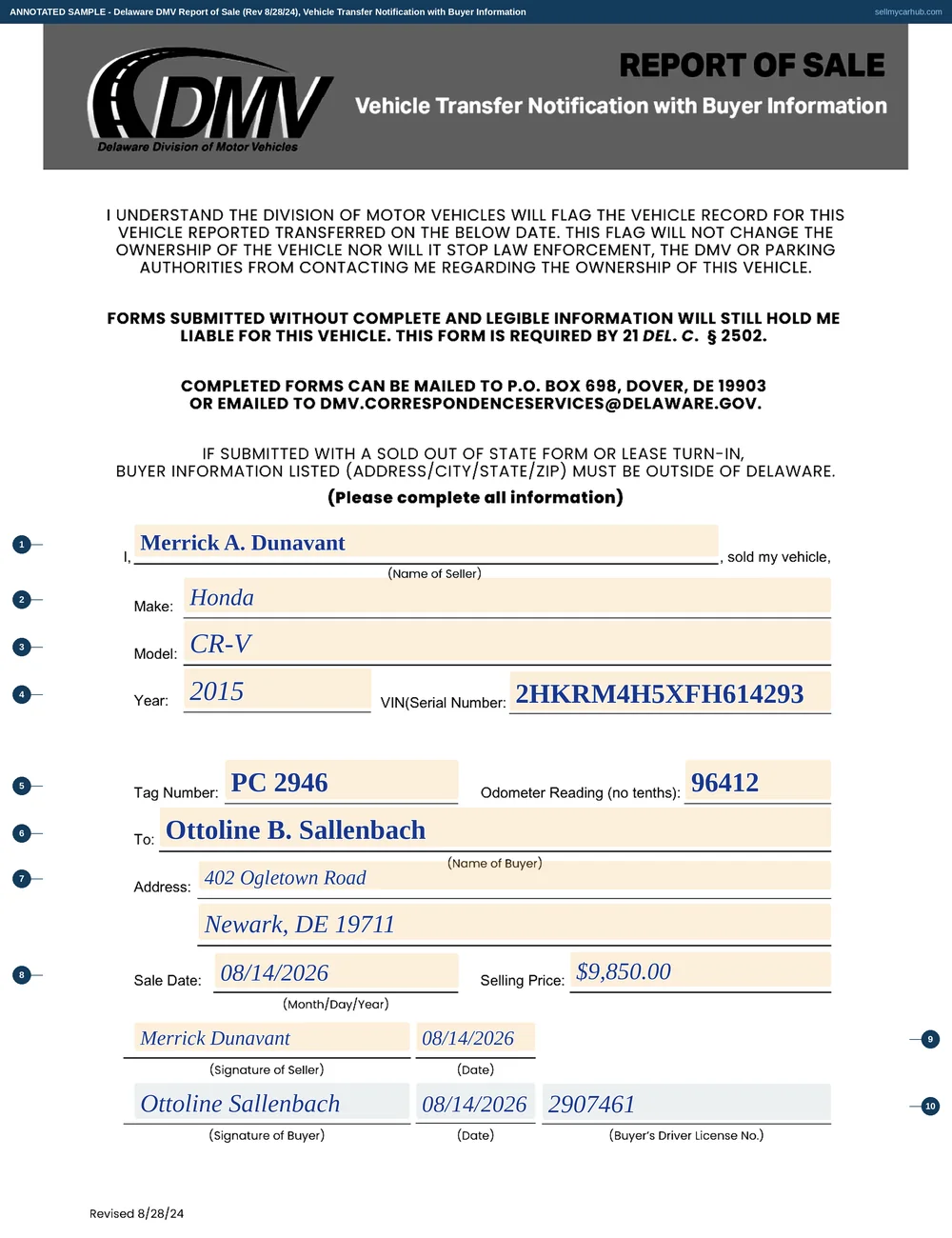
This is the actual Report of Sale, rendered from the PDF the Delaware Division of Motor Vehicles publishes and completed end to end: letterhead, every field, and the blocks at the foot.
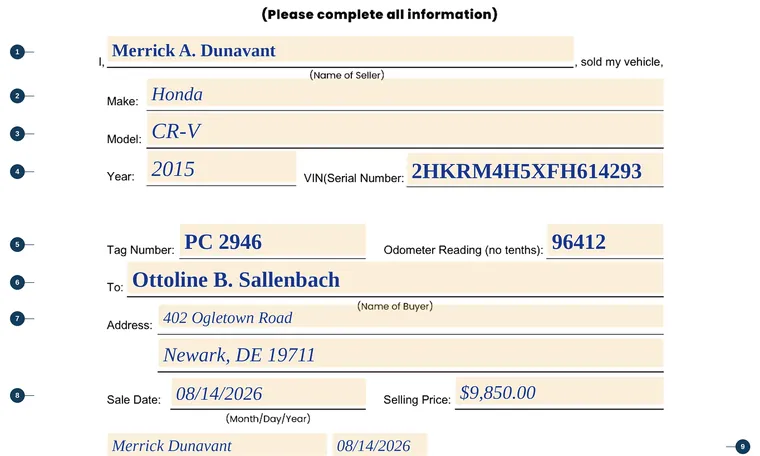
The form opens mid-sentence - I, ______, sold my vehicle - and your name completes it. Use the name as the certificate carries it.
Watch out: If two owners are on the title joined by AND, both of you were required to sign Section 1, and both names belong here too.
The manufacturer, on its own line.
Watch out: Delaware's forms split make, model and year onto three separate lines throughout. Filling one line with all three is the commonest way this comes back.
The model as it appears on the registration card, not the trim level you advertised.
Watch out: The Division matches this against its own record. A model name that is close but not the same slows the match down.
Model year on the left, the seventeen-character vehicle identification number on the right.
Watch out: Copy the VIN off the front of the certificate, character by character. Nothing else on this form identifies the car with certainty.
The plate the car was wearing, prefix included, and the mileage in whole miles with no tenths.
Watch out: This mileage should be the same figure you wrote in Section 1 on the back of the title. Two different readings on two documents dated the same day is the sort of thing an odometer investigation starts with.
Who the car went to, in full.
Watch out: Off their licence, not off the message they sent you. This is the name the Division will look for if it ever has to trace the car.
Street on the first line, city, state and ZIP on the second.
Watch out: Sending this in with a sold-out-of-state application? The form says in capitals that the buyer's address, city, state and zip must be outside of Delaware, or the two documents contradict each other.
Month, day and year, and what was actually paid.
Watch out: The same date and the same price you wrote on the back of the certificate. Two different prices on two documents is how a document-fee query starts.
Signature of Seller, with the date on the line beside it.
Watch out: Blue or black ink if you are printing it. If you are filling it in on screen to email, do that and then sign the printed copy - the Division accepts the emailed form at the address on its face.
Signature of Buyer, the date, and Buyer's Driver License No. on the same row.
Watch out: Get this before they drive off. Chasing a stranger for a signature on your own release of liability a week later is the single most avoidable problem in a Delaware private sale.
| On the form | What to put in it |
|---|---|
| I, (Name of Seller), sold my vehicle | The opening line is a sentence you complete. Your name goes in the gap, exactly as the certificate carries it. |
| Make, Model, Year | Three separate lines rather than one description. The Division reads them against its own record of the car. |
| VIN (Serial Number) | Delaware calls it that on every form in this set, and the serial number is what the record is keyed to - not the tag. |
| Tag Number | The plate the car was wearing. Include the prefix - PC, C, CL, MC - because the number on its own is not unique. |
| Odometer Reading (no tenths) | Whole miles. The same figure you wrote in Section 1 on the back of the title, not a rounded one. |
| To: (Name of Buyer) | Who took the car. The form's heading is Vehicle Transfer Notification with Buyer Information, and this is the information the heading is about. |
| Address (two lines) | Where the buyer lives. If you are sending this in with a sold-out-of-state application, the form says the buyer's address, city, state and zip must be outside of Delaware. |
| Sale Date (Month/Day/Year) and Selling Price | The day it changed hands and what was paid for it. The date is the one the buyer's thirty days will be counted from. |
| Signature of Seller and Date | Your signature and the day you signed. No notary and no witness. |
| Signature of Buyer, Date and Buyer's Driver License No. | Delaware asks the buyer to sign your notice as well, and to add their licence number. That is what separates this version of the form from the shorter one the Division publishes without buyer details. |
Every line here was read off Report of Sale (Rev 8/28/24) itself — the PDF is here — and off the Delaware Division of Motor Vehicles pages. This is plain-language help with a form, not legal advice, and where our wording and the agency's differ, theirs governs.
Back to all Delaware seller paperwork, or what selling a car in Delaware involves.