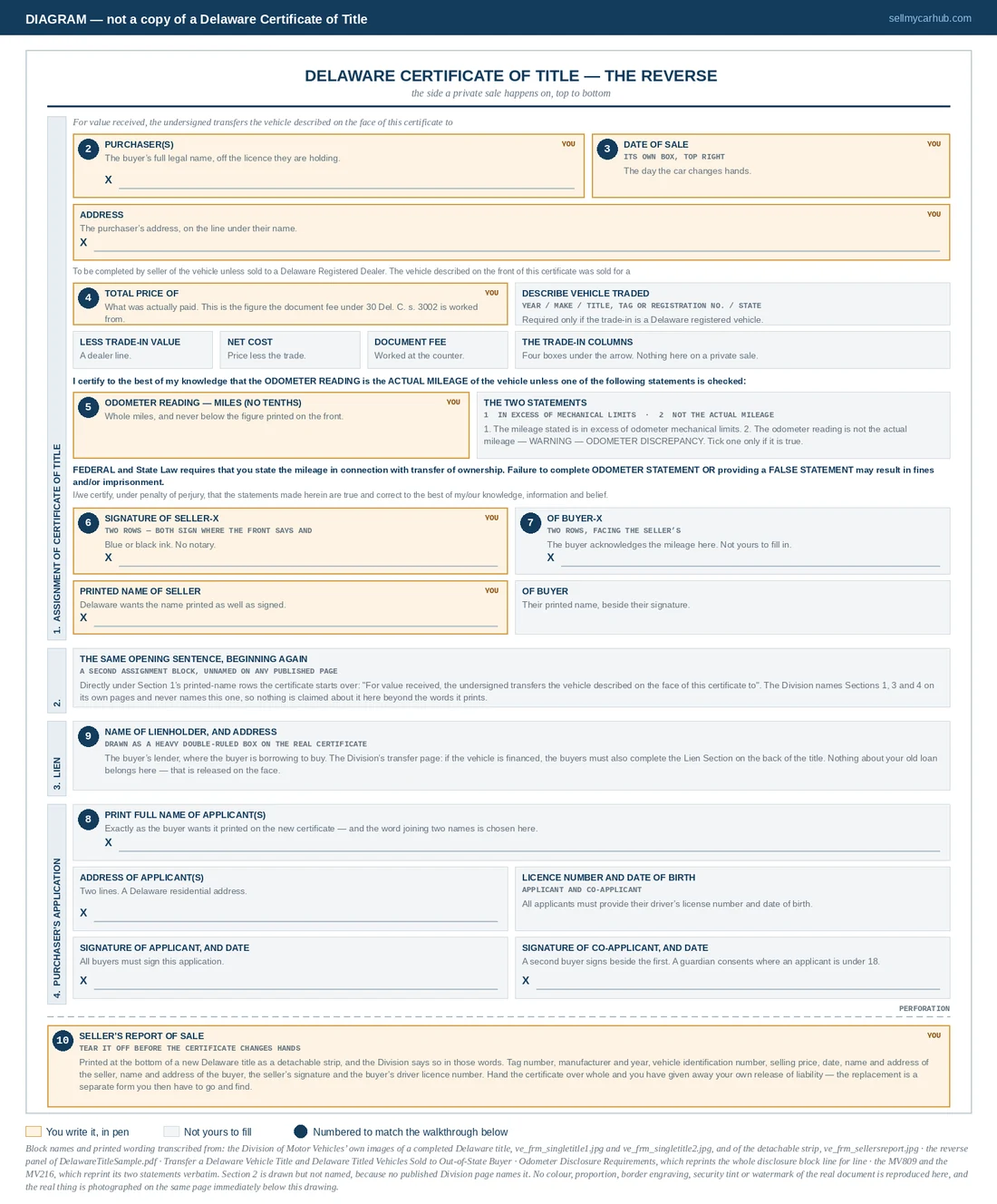
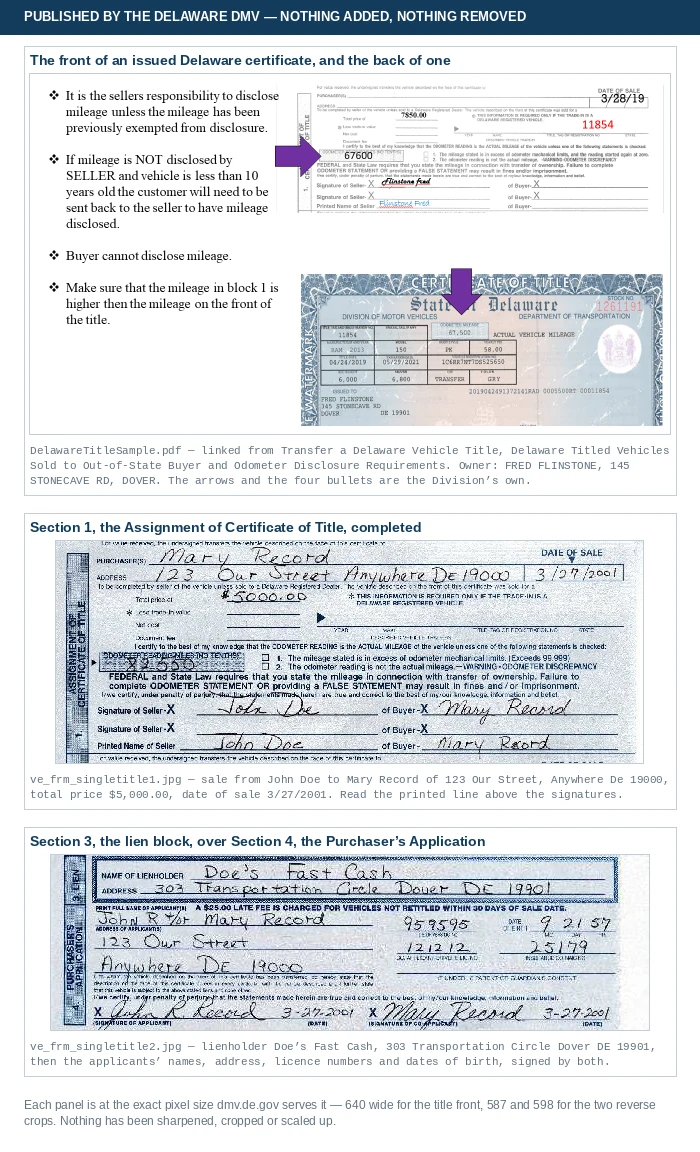
A Delaware sale happens in a block on the back of the certificate called the Assignment of Certificate of Title, which the Division refers to throughout its own pages simply as Section 1. It takes five pieces of information and two signatures, and there is a second thing on the same sheet you must not give away with it. Below is a diagram of the whole reverse, and under that the Division's own photographs of a real Delaware title.
Last updated .
Your 9 boxes
As a private seller you complete these and nothing else:
Nobody sells you a blank Delaware certificate and nobody should try. It arrives in the post from Dover on security stock with a watermark you can hold up to the light, and there is exactly one of it per car. The printable checklist above is ours and you are welcome to it.
Two things end a Delaware assignment before it starts: a mileage figure below the one printed on the front of the same certificate, and a Section 1 signed with the buyer's half left empty.
Blue or black ink, originals only, and no correcting anything. Form 212 states the rule for every document in the transaction in one line - no alterations, corrective tape, or erasable ink permitted - and the certificate is where it bites hardest, because there is one of it.
Start here
The whole reverse of a Delaware certificate, drawn to size
Every block name, heading and printed sentence on this drawing is transcribed from something the Division has published about the certificate: its transfer instructions, its sold-out-of-state instructions, the odometer page that reprints Section 1's wording line for line, its four teaching photographs of a completed title, and the MV809 and MV216, which reprint the odometer block verbatim. What it does not reproduce is the engraving, the colour, the proportions or the watermark - and the Division's own pictures of the real thing are directly below it.
Amber — you write it, in pen
Grey — not yours to fill
Numbered - each one is a step in the walkthrough under it
Click or tap the picture to open it full size.
Drawn, not copied. Block names and printed wording come from the Division's Transfer a Delaware Vehicle Title and Sold to Out-of-State Buyer pages, its Odometer Disclosure Requirements page, its four published photographs of a completed Delaware title, and the MV809 and MV216. No security feature, colour or proportion of the real document is reproduced here.
The Division's own photographs
A real Delaware title, published by the Division, with a cartoon owner on it
Delaware is one of the few states that publishes pictures of its own certificate, and these are three of them, unaltered and at the exact pixel size dmv.de.gov serves them. At the top, the Division's training slide: the reverse of a title with Section 1 completed, the front of an issued certificate under it made out to FRED FLINSTONE of 145 STONECAVE RD, DOVER, four bullets of the Division's own guidance down the left, and two purple arrows that are the Division's too. Below that, Section 1 filled in by hand for a sale from John Doe to Mary Record, and then the lien block over Section 4, the Purchaser's Application, in the same hand. Nothing on any of the three belongs to a real person - the title front even carries the diagonal VIEW WATERMARK band the Division prints across a specimen.
Click or tap the picture to open it full size.
All three come straight from dmv.de.gov with nothing added and nothing taken away. The title front is the raster embedded in the Division's own DelawareTitleSample.pdf at its native 640 pixels - extracted from the document rather than screenshotted, and checked against a 300-dpi render of the same page, which only interpolates it. The two reverse crops are the JPEGs the transfer page links as Section 1 and Section 3. Read the third bullet on the slide: buyer cannot disclose mileage.
Before you watch. It is a buyer's video, not a seller's. Nothing in it covers the two things that end a Delaware seller's exposure - the Seller's Report of Sale and the plate - and an in-state sale between two Delaware residents does not need an MV212 at all: the form's own instructions say in-state title transfers do not require form MV212 to be submitted with the Delaware title.
Seventy-nine seconds from the Division on the application your buyer fills in, published on its own channel at youtube.com/@delawaredmv and confirmed there through YouTube's oEmbed endpoint. Nothing loads from YouTube until you press play.
Step by step
Every box, in the order you meet it
1
You fill this in
Read the front before you turn it over
Two things on the face decide what happens next: the word joining the owners' names, and the odometer figure the Division printed when it issued the certificate. AND means every owner signs; AND/OR, printed as (& OR), means one will do. The mileage on the front is the floor your disclosure has to clear.
Watch out: If the front carries a brand - salvage, rebuilt, flood, reconstructed - it is coming through to the buyer's certificate too, and the Division's own buying guide tells them to look for exactly that.
2
You fill this in
Purchaser's name and address, in Section 1
The top line of the Assignment of Certificate of Title on the reverse. Full legal name and full address, as they appear on the licence the buyer is holding.
Watch out: Copy it off the licence, not off a text message. This block is read at a counter by somebody comparing it with the identification in front of them.
3
You fill this in
The date of sale
The day the car actually changes hands. The buyer's thirty days run from it, the $35 penalty attaches to it, and your Report of Sale has to carry the same date.
Watch out: Do not post-date it to help anybody. If a red-light camera catches the car the day after, this is the date the Division works from.
4
You fill this in
The total price
In figures, on the price line. This is the number the 5.25% document fee is worked from, and the document fee is the only levy on a private sale that appears anywhere in the Division's fee schedule.
Watch out: Leave it blank and the Division falls back to the NADA average trade-in value - which is usually higher than what your buyer actually paid, and lands as their bill at the counter.
5
You fill this in
The odometer reading, whole miles
Written into the disclosure block above the printed sentence certifying it is the actual mileage. No tenths. If it is over 99,999 on a five-digit instrument, or the instrument has been replaced or is lying, tick the matching box - there are two.
Watch out: The figure has to be at or above the mileage printed on the front of the same certificate. Below it, with neither box ticked, and the Division rejects the title rather than querying it.
6
You fill this in
Sign, and print your name beside the signature
Delaware asks for both, on paired rows: Signature of Seller and Printed Name of Seller. Two rows of each, because two owners joined by AND both sign. Blue or black ink. No notary.
Watch out: Sign when the money is real and the buyer is in front of you. There is no Delaware mechanism that unsigns a certificate handed to the wrong person.
7
The buyer fills this in
The buyer signs the mileage rows
Signature of Buyer and Printed Name of Buyer, in the same Section 1, acknowledging the reading you just disclosed. Both buyers sign if there will be two names on the new title.
Watch out: This is theirs to do and only theirs. Filling it in to be helpful is an alteration by somebody with no business writing in that half of the block.
8
The buyer fills this in
Section 4, the Purchaser's Application
The buyer's own application for the new certificate, on the same reverse: name or names exactly as they want them printed, address, and a driver licence number and date of birth for every applicant. All of them sign it.
Watch out: The word joining their two names is chosen here, and it will govern their sale one day exactly as it governed yours. AND needs both signatures next time; AND/OR needs one.
9
The lienholder fills this in
Section 3, if they are borrowing to buy it
The buyer's lender goes in the lien block on the reverse. The Division then mails the finished certificate to that lender rather than to the buyer.
Watch out: Nothing here concerns your old loan. Your lender's release belongs on the face of the certificate, and it should already be there before you advertise the car.
10
You fill this in
Tear off the Seller's Report of Sale before you hand it over
It is printed as a detachable strip at the foot of a current Delaware certificate. Buyer's name and address, the date and hour of sale, selling price, your signature, the buyer's licence number and the buyer's signature.
Watch out: This is the single most-missed step in a Delaware sale. Give the certificate away whole and your release of liability leaves with it - and the replacement is a standalone form you now have to go and find.
11
You fill this in
Endorse the registration card and send it in too
21 Del. C. s. 2502 wants the transferee's name and address and the date of transfer written on the registration card, and the card given or sent to the Division immediately. The back of the card has boxes printed for exactly that.
Watch out: One exception, and it is in the statute: where you sold to a dealer, the card goes to the dealer instead and only the Report of Sale comes to Dover.
12
You fill this in
Take the plate off the car
Back to any DMV facility, posted to the Uninsured Motorist Section at P.O. Box 698 in Dover, or into retention in your own name for the next car. For an out-of-state buyer with live registration, the Division will do the retention online.
Watch out: Do not cancel the insurance until the plate is physically gone. Delaware charges $100 per vehicle for the first thirty uninsured days and $5 a day after that.
Before the pen
Before you meet the buyer
Six habits worth having before you write on the only copy of a document that is also your release of liability.
Blue or black, original, no corrections
Form 212 spells the standard out for the whole transaction: application must be completed in blue or black ink ONLY, no alterations, corrective tape, or erasable ink permitted. A spoiled Delaware certificate is an MV216 and $35, not a repair.
Photograph both sides before it goes
Front and back, completed, on your phone. It is the only record you will keep of a document you are about to hand to a stranger.
Tear the strip off first
The Seller's Report of Sale lives at the foot of the certificate. Separate it, fill it in, and keep it in your hand before the rest of the sheet changes owner.
Bring the plate with you, not on the car
Whether you are retaining it or handing it back, it comes off before the buyer drives away. A Delaware registration expires at the moment of transfer anyway.
Go with them if you possibly can
The Division recommends it and gives three reasons: the buyer actually gets a title, your name actually comes off, and an associate checks the paperwork while it can still be fixed.
Write the price, even if it embarrasses you
A blank price line does not save your buyer money. It hands the Division the NADA average trade-in value to work the document fee from instead.
The ink rule is Delaware DMV's own: “The Division of Motor Vehicles recommends the seller transfer the title of the vehicle to the buyer at a Division facility”
— Delaware DMV, Transfer a Delaware Vehicle Title.
Check your source
What Delaware sellers believe, and what the Division actually publishes
Three things Delaware sellers repeat to each other. One will cost you a plate you were entitled to keep; one will land you an uninsured-motorist penalty on a car you no longer own.
"Leave the tag on it so they can get it home."
There is no Delaware version of that. The Division's own selling guide says the licence plate must be removed from the vehicle and returned to any DMV office, and warns in a footnote that a plate left on the car can bring you red-light, toll and parking violations for a car you no longer own. What the buyer gets instead is a $20 temporary tag from any DMV facility.
"Cancel the insurance as soon as the money clears."
Not until the plate is out of your hands. The Division's insurance FAQ puts the order in one line - licence plates must be surrendered to the Division prior to cancelling insurance - and prices the mistake at $100 per vehicle for the first thirty days uninsured, then $5 a day, with the registration and every owner's driver licence suspended if you ignore the audit letter.
It does not, and the Division says so in five words in the middle of its own transfer instructions: Delaware titles do not require notary. What Delaware does notarise is a power of attorney, a plate-switch affidavit, a retained-plate release, a low-digit tag affidavit and an odometer correction - and the last of those will take a DMV employee as a witness instead.
Who holds the pen depends on one word printed between the names on the front of the certificate, and on whether that person can get to the room:
Every owner, where the front says AND
All sellers sign Section 1 and print their names in the blocks beside the signatures. There is no shortcut and no affidavit that stands in for the second signature.
Any one owner, where the front says AND/OR
Printed on the certificate as (& OR). One seller signs, one seller prints, and the assignment is complete - though the tag, if you retain it, still comes back in both names.
Somebody holding your power of attorney
Only on an original, notarised MV386, and only if they sign it the way the Division prescribes: the owner's name, hand-printed, then 'by', then their own name, then POA.
The buyer, for the mileage
Delaware makes the buyer acknowledge the odometer disclosure by signing and printing in the buyer's rows of the same Section 1. The Division's training slide is blunt about the other half of that: buyer cannot disclose mileage. Only you can.
A surviving family member
Not on the certificate. A Delaware car passing at death moves under 21 Del. C. s. 2506 or on a transfer-on-death designation, and the MV14 is what keeps it legally on the road in the meantime.
Nobody, in front of a notary
The Division's transfer page settles it in five words - Delaware titles do not require notary. Every notarised form in this set is somebody standing in for a person who is not there or swearing to something that is not on the title.
Once it is signed
Signing Section 1 is the middle of a Delaware sale. The plate is still on the car, the registration is still in your name in the Division's record, and the insurance is still running - and that last one is the piece that costs money if you get the order wrong.