Sell My Car Hub

How to fill out Delaware MV809

For a mileage figure that went onto the title wrong. The form's own first line limits it: it may only be used to make a correction to odometer information incorrectly stated on the title or manufacturer's statement of origin, and the seller of the vehicle must state the reason a correction is needed and make a correct disclosure. It is a seller's form from beginning to end, and it is the one document in the Delaware set that a private seller has to get sworn.
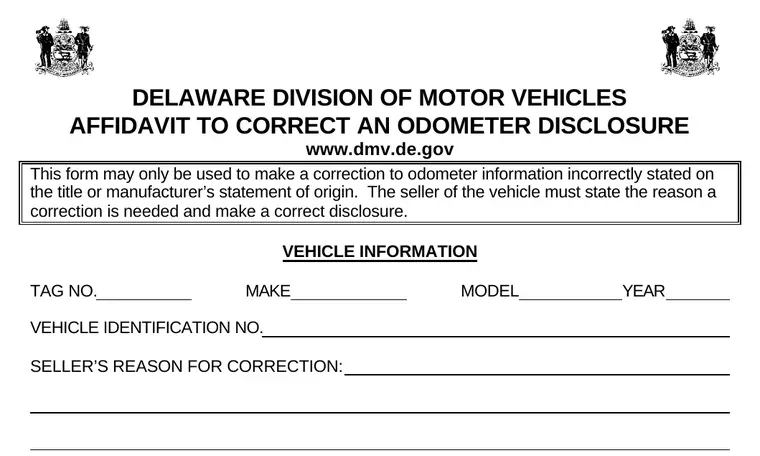
Written against MV809 (Rev 4/2001), issued under the Division of Motor Vehicles, as the correction it will accept against a disclosure already made on a title or a manufacturer's statement of origin. Get the figure right the first time and you never meet this form. The disclosure on the back of a Delaware certificate has to be at or above the mileage the Division printed on the front of the same certificate, and if it is not, the title is rejected rather than corrected at the counter - which turns a five-minute transfer into an affidavit needing two sworn signatures.

Two documents, and they are not the same thing. Take the blank MV809 from the dmv.de.gov copy so you get the revision that is current today, then print our MV809 guide and keep it beside you while you fill theirs in.

Filled in

What a completed one looks like

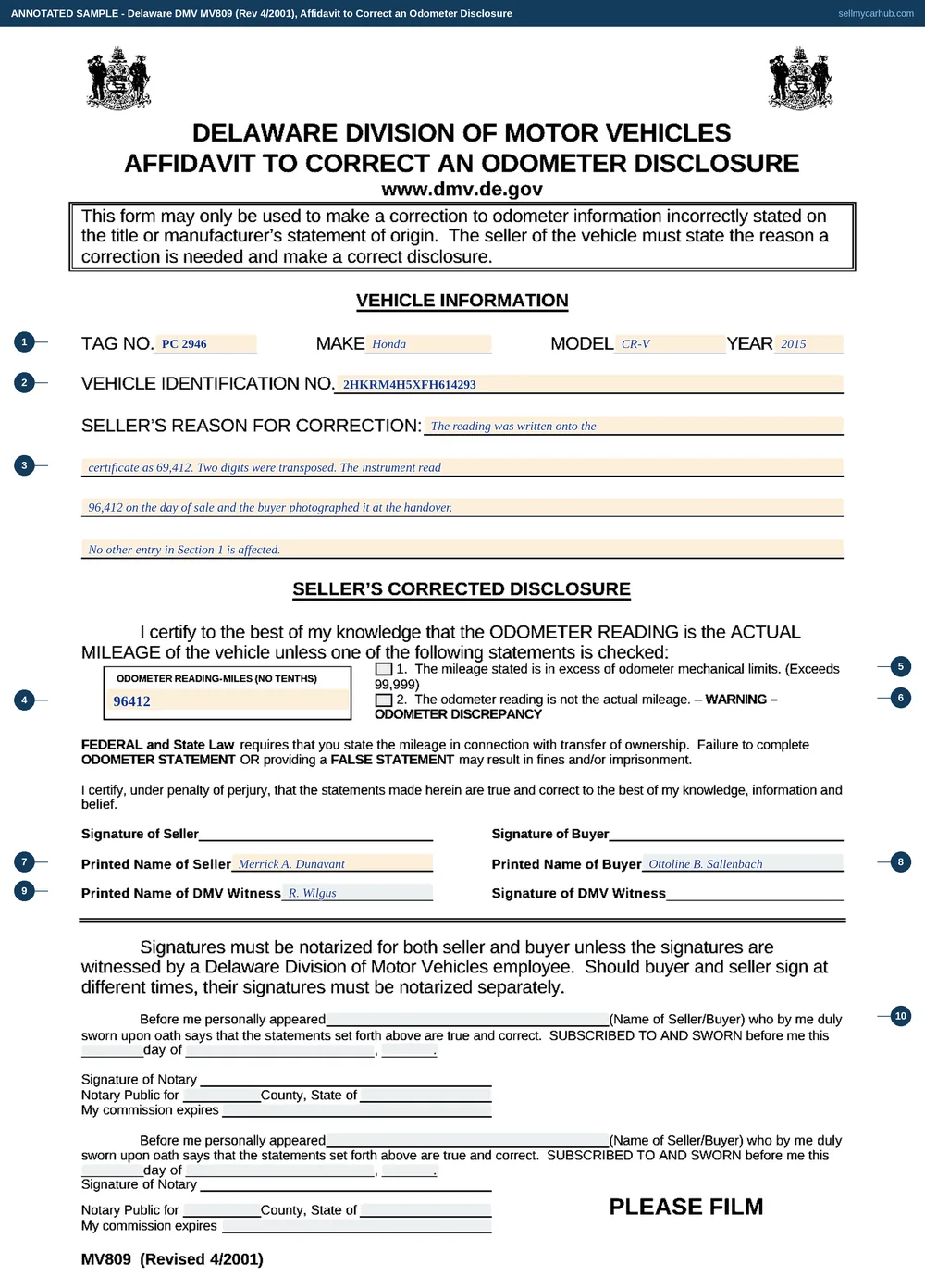
This is the actual MV809, rendered from the PDF the Delaware Division of Motor Vehicles publishes and completed end to end: letterhead, every field, and the blocks at the foot.

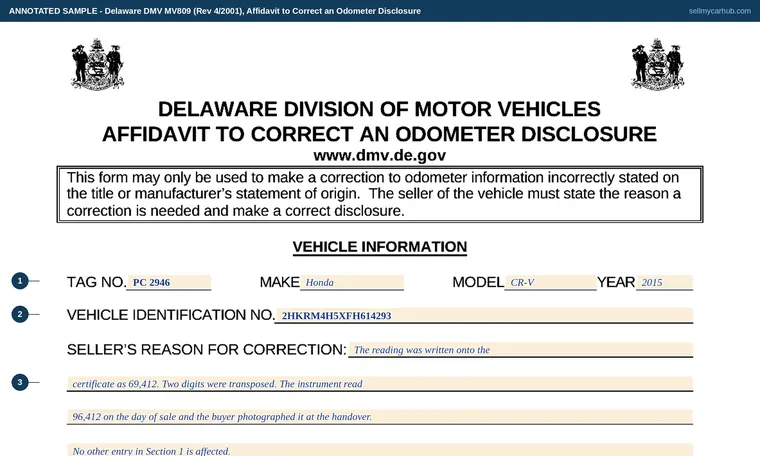
A Delaware MV809 Affidavit to Correct an Odometer Disclosure filled in for a 2015 Honda CR-V, tag PC 2946, VIN 2HKRM4H5XFH614293, with a handwritten reason explaining that the reading was transposed on the certificate, a corrected odometer reading of 96412 with neither exception box ticked, printed names for seller Merrick A. Dunavant and buyer Ottoline B. Sallenbach, and the DMV witness block completed instead of the notarial blocks.
Completed the way it is meant to be done - printed, filled in, and carried to a Division counter with the buyer, which is why the two notarial blocks at the foot are grey. The four signature rules are deliberately still empty: on this form nobody signs until a notary or a DMV employee is watching, and a signature already on the page when you arrive is one nobody saw you make. The four ruled lines in the middle are the substance of the form - the Division cannot act on a correction that does not say what went wrong.
Field by field

Every line, in the order you meet it

  1. 1
    You fill this in

    Tag number, make, model, year

    The identifying row across the top. Tag number with its prefix.

    Watch out: Use the tag that was on the car at the time of the disclosure you are correcting, even if the plate has since gone into retention.

  2. 2
    You fill this in

    Vehicle identification number

    The full seventeen characters, from the front of the certificate.

    Watch out: This is what ties the affidavit to the record. A single wrong character and the correction attaches to nothing.

  3. 3
    You fill this in

    Seller's reason for correction

    Four lines, in your own words: what the first figure was, what it should have been, and how the mistake happened.

    Watch out: Write plainly and factually - transposed two digits, read the trip meter, wrote the buyer's figure. This is a sworn statement about an odometer, which is a subject federal law takes seriously.

  4. 4
    You fill this in

    The corrected odometer reading

    Whole miles, no tenths, in the block under the printed certification.

    Watch out: Read the certification above the box before you write. Filling that box in is a statement that the number is the actual mileage unless you tick one of the two boxes beside it.

  5. 5
    You fill this in

    Box 1, over the mechanical limit

    Tick it only if a five-digit instrument has passed 99,999 and started again.

    Watch out: This is the box for an old car with a low reading, not for a car with high mileage. A modern six-digit odometer never needs it.

  6. 6
    You fill this in

    Box 2, not the actual mileage

    Tick it if the instrument was replaced, has been broken, or for any other reason is not showing what the car has done.

    Watch out: Ticking it brands the certificate permanently. It is also the honest answer where the honest answer is that nobody knows, and the Division would rather have it than a guess.

  7. 7
    You fill this in

    Sign, and print your name

    Signature of Seller and Printed Name of Seller. Do not sign until you are in front of whoever is going to witness it.

    Watch out: A signature already on the page when you reach the counter is a signature the witness did not see you make, and the block above it says witnessed.

  8. 8
    The buyer fills this in

    The buyer signs and prints too

    Signature of Buyer and Printed Name of Buyer, acknowledging the corrected figure exactly as they acknowledged the original.

    Watch out: If they cannot come with you, their signature has to be notarised separately - the form provides a second notarial block for precisely that.

  9. 9
    Somebody else fills this in

    The DMV witness block

    Printed Name of DMV Witness and Signature of DMV Witness, completed by the Division employee who watched you both sign.

    Watch out: This is the cheap route. Take the buyer, the certificate and a photo ID each to any of the four facilities and it costs you a queue instead of two notary fees.

  10. 10
    Somebody else fills this in

    The two notarial blocks

    Before me personally appeared ______, with day, month, year, the notary's county and state, and a commission expiry - one block for each party.

    Watch out: Only used if you are not doing it in front of the Division. Two people signing on two days need two separate notarisations, and the form is built assuming that is what will happen.

At a glance

What goes where

On the formWhat to put in it
Vehicle InformationTag number, make, model, year on one row and the vehicle identification number under them. Enough to tie the affidavit to the certificate it is amending.
Seller's Reason for CorrectionFour ruled lines and no prompts. This is the substance of the form: why the first figure was wrong, in your own words.
Seller's Corrected DisclosureThe odometer block, reprinted from the back of the certificate word for word - I certify to the best of my knowledge that the ODOMETER READING is the ACTUAL MILEAGE of the vehicle unless one of the following statements is checked - with the same two boxes beside it.
Odometer reading, miles, no tenthsThe figure as it should have been written. Whole miles.
Box 1 and Box 2The mileage stated is in excess of odometer mechanical limits (exceeds 99,999), and the odometer reading is not the actual mileage, WARNING, ODOMETER DISCREPANCY.
Four signature and name linesSignature of Seller and Signature of Buyer, then Printed Name of Seller and Printed Name of Buyer. Both sides sign a correction, exactly as both sides signed the original disclosure.
Printed Name of DMV Witness and Signature of DMV WitnessThe alternative to a notary, and the reason to do this at a counter.
Two notarial blocksBefore me personally appeared ______, who by me duly sworn upon oath says that the statements set forth above are true and correct. One block for the seller and one for the buyer, because the form contemplates them signing on different days.

What gets this one rejected

Rules that decide whether it is accepted

Every line here was read off MV809 (Rev 4/2001) itself — the PDF is here — and off the Delaware Division of Motor Vehicles pages. This is plain-language help with a form, not legal advice, and where our wording and the agency's differ, theirs governs.

Back to all Delaware seller paperwork, or what selling a car in Delaware involves.

Want the paperwork handled instead?

Get My Instant Offer → Online · about 2 minutes · free

Or send the details — we'll come to you

Mileage muddle, a brand you did not expect, or a title the Division has already sent back once? Tell us what happened and we will make an offer on the car as it is.

or call/text (877) 405-1808