The paper release, for the shrinking number of Arizona liens that were never electronic. ADOT is specific about its scope: it is to be used for a private party lienholder to release a lien on a vehicle, and not to be used for Electronic Lien and Title purposes. If your loan came from a bank or a credit union, the release will almost certainly arrive at MVD without anybody signing anything.
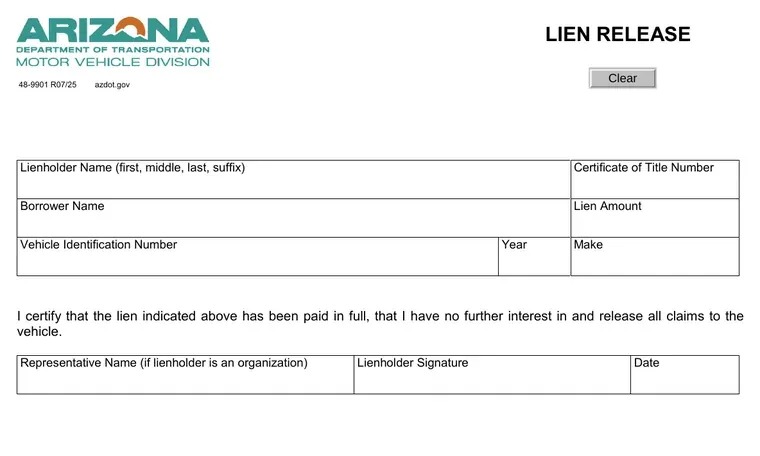
Step 1 · the form itself
Blank 48-9901 — Lien Release
PDF at apps.azdot.gov · new tab
View the blank 48-9901
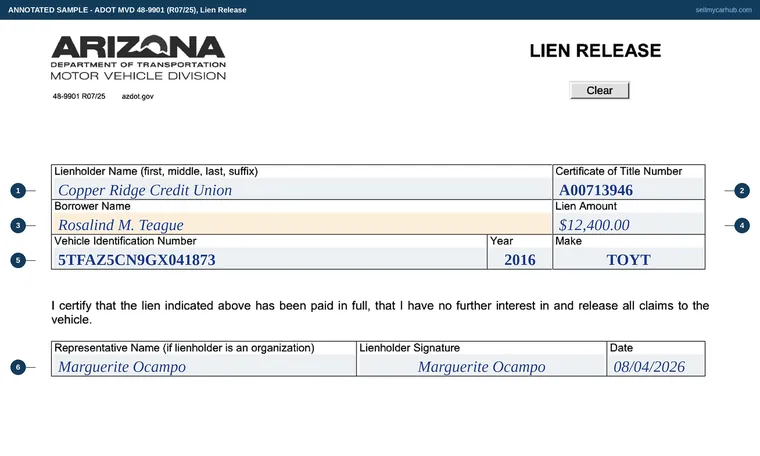
Step 2 · how to fill it in
Our filled-in 48-9901 guide
PDF · 2 pages · 350 KB · new tab
See our filled-in example
Two documents, and they are not the same thing. Take the blank 48-9901 from the apps.azdot.gov copy so you get the revision that is current today, then print our 48-9901 guide and keep it beside you while you fill theirs in.
Written against 48-9901 (R07/25), issued under A.R.S. 28-2134. Check the record before you assume you need this form at all. The Title Viewer service on AZ MVD Now shows whether a lien is still recorded against an Arizona vehicle, and a lien that is already released does not need a piece of paper saying so.
Last updated .
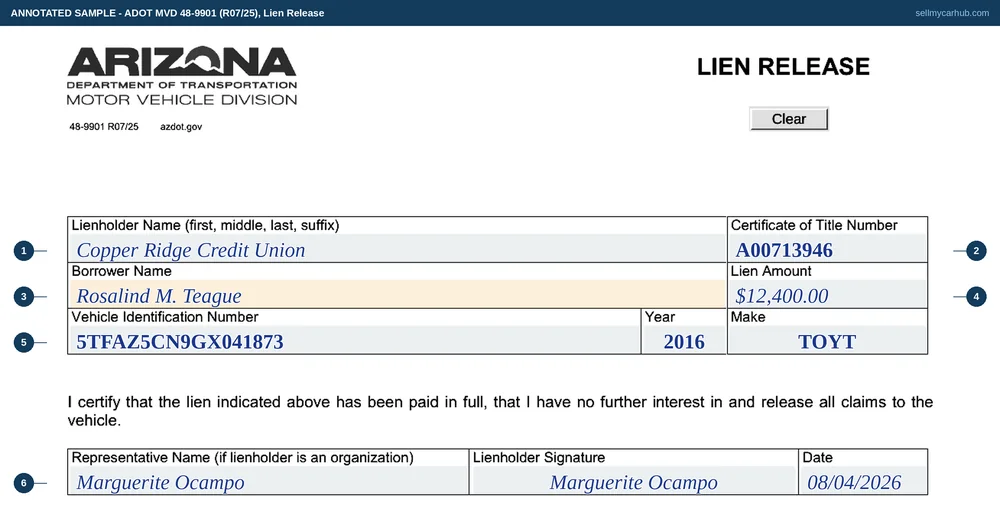
This is the actual 48-9901, rendered from the PDF the Arizona Department of Transportation, Motor Vehicle Division publishes and completed end to end: letterhead, every field, and the blocks at the foot.
Click or tap the picture to open it full size.
Download or print this example PDF · 2 pages · 350 KB
The lender as it is recorded on the title, not a branch name or a servicing company.
Watch out: If the loan was sold on, the release has to come from whoever is on the MVD record - which may not be who took your last payment.
The Arizona title number the lien was recorded against.
Watch out: It is on the face of a paper title in the Title Number field, and in AZ MVD Now if there is no paper.
You, as the loan was written.
Watch out: This is the one line on the form a seller can usefully check. A borrower name that does not match the owner name on the title stops the release.
The amount the lien secured.
Watch out: It is the original recorded amount, not the balance you paid off. The two are rarely the same number.
The vehicle the lien sits on.
Watch out: Read the VIN character by character against the title. A release against a mistyped VIN releases nothing.
The individual signing on behalf of the organisation, then the signature and the date.
Watch out: There is no notary block on this form. What makes it valid is that it came from the lienholder, which is why a seller cannot chase it any faster by having it witnessed.
| On the form | What to put in it |
|---|---|
| Lienholder Name (first, middle, last, suffix) and Certificate of Title Number | Who holds the lien, and the title number it is recorded against. |
| Borrower Name and Lien Amount | You, and the sum the lien secured. |
| Vehicle Identification Number, Year, Make | Three fields, no model and no plate. |
| The release sentence | Printed above the signature: I certify that the lien indicated above has been paid in full, that I have no further interest in and release all claims to the vehicle. |
| Representative Name (if lienholder is an organization), Lienholder Signature, Date | Three fields in one row at the foot. The signature is the lienholder's, never the borrower's. |
Every line here was read off 48-9901 (R07/25) itself — the PDF is here — and off the Arizona Department of Transportation, Motor Vehicle Division pages. This is plain-language help with a form, not legal advice, and where our wording and the agency's differ, theirs governs.
Taking the signed release to the counter in Yuma? Check the Yuma MVD office's appointments and its noon opening on second Wednesdays before you go.
Back to all Arizona seller paperwork, or what selling a car in Arizona involves.