The other side of the same coin: the form that puts a lien onto an Arizona title. A private seller meets it in one situation - when they are financing the buyer themselves and want the record to show it. It is signed by the registered owner rather than by the lender, which is the opposite of what most people expect.
Written against 48-9902 (R07/25), issued under A.R.S. 28-2132. Financing a private sale yourself is not the same as writing an IOU. Unless the lien is actually recorded on this form and the record shows it, the buyer owns the car outright the moment the title transfers, and there is nothing to repossess.
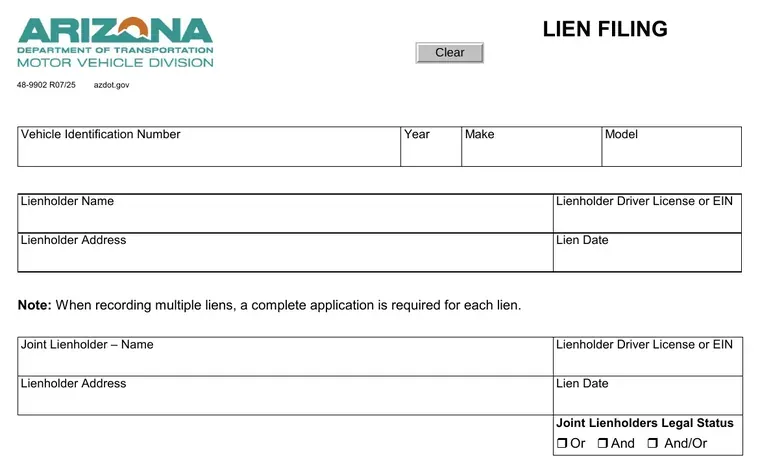
Two documents, and they are not the same thing. Take the blank 48-9902 from the apps.azdot.gov copy so you get the revision that is current today.
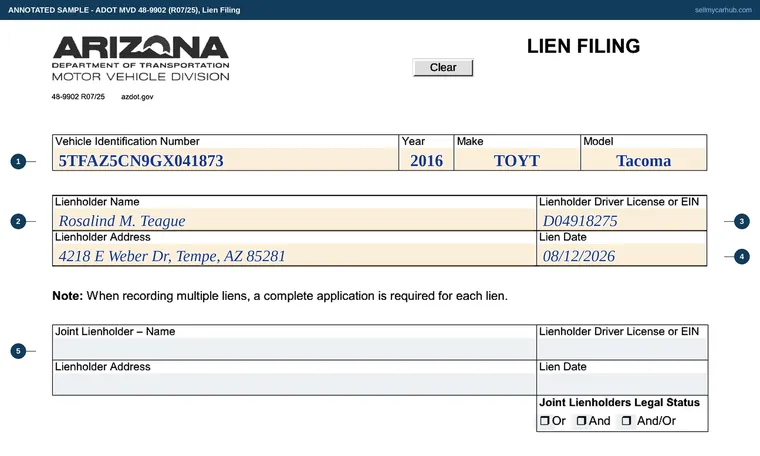
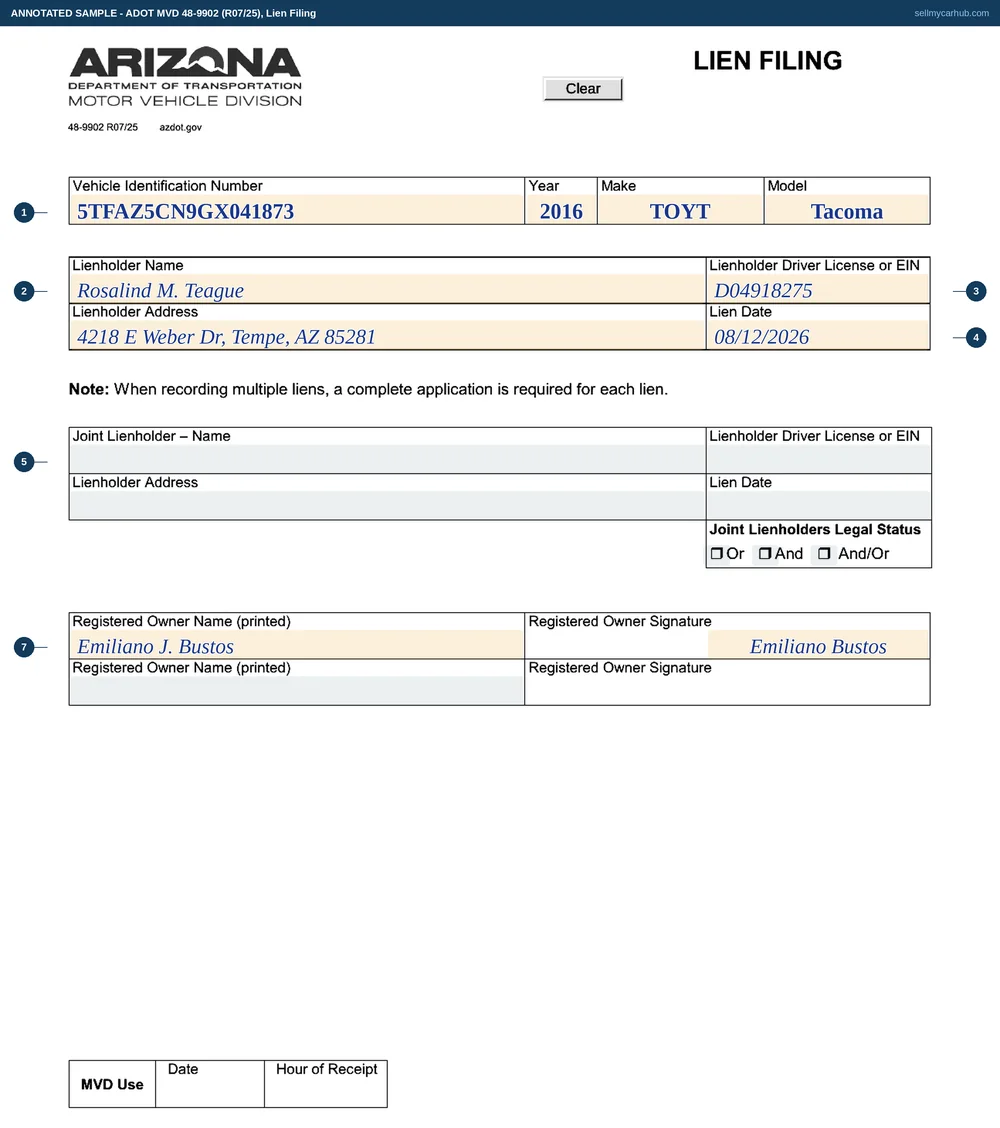
This is the actual 48-9902, rendered from the PDF the Arizona Department of Transportation, Motor Vehicle Division publishes and completed end to end: letterhead, every field, and the blocks at the foot.
The vehicle the lien is being recorded against.
Watch out: It has to be the same vehicle as the title transaction this form travels with. A lien filed against a VIN that is not being transferred goes nowhere.
Whoever is owed the money - on a seller-financed sale, you.
Watch out: Use your full legal name as it appears on your Arizona licence. A nickname on a lien record is a lien you may have trouble enforcing.
A driver licence number for an individual, a federal EIN for a business.
Watch out: This is not optional for a private lienholder. It is the only thing distinguishing you from every other person with your name.
Where notices should reach you, and the date the lien takes effect.
Watch out: The lien date is normally the sale date. If it is later, there is a window in which the buyer owns the car free of any recorded claim.
A second lender, with its own licence or EIN, address, lien date and legal status.
Watch out: Leave it empty on an ordinary seller-financed sale. Filling it in with the buyer's details is a common and expensive misreading.
Or, And or And/Or, only where there are two lienholders.
Watch out: Or lets either of them release the lien alone. And means the buyer will need both signatures before they can ever sell the car.
The owner - after the sale, the buyer - printing and signing to have the lien recorded.
Watch out: Two owners means two signatures here, whatever the legal status on the title says. This is a claim being recorded against both of them.
| On the form | What to put in it |
|---|---|
| Vehicle Identification Number, Year, Make, Model | The vehicle the lien will attach to. |
| Lienholder Name and Lienholder Driver License or EIN | Who is being recorded. A private individual uses their driver licence number; a company uses an EIN. |
| Lienholder Address and Lien Date | Where the lienholder is, and the date the lien takes effect. |
| Joint Lienholder name, licence or EIN, address and lien date | A second block for a co-lender, with its own legal status. |
| Joint Lienholders Legal Status | Or, And, And/Or - the same three words that govern owners, applied to lenders. |
| Registered Owner Name (printed) and Registered Owner Signature | Two rows, so a jointly owned vehicle can carry two owner signatures. |
| MVD Use: Date and Hour of Receipt | A department block at the foot. The hour matters because priority between competing liens runs from it. |
Every line here was read off 48-9902 (R07/25) itself — the PDF is here — and off the Arizona Department of Transportation, Motor Vehicle Division pages. This is plain-language help with a form, not legal advice, and where our wording and the agency's differ, theirs governs.
Back to all Arizona seller paperwork, or what selling a car in Arizona involves.