Sell My Car Hub

How to fill out an Alaska title

One sheet, printed both sides, and it is the only document in an Alaska private sale that actually moves the vehicle. Everything on the front was set in Anchorage the day the certificate was produced. The back carries the Assignment of Vehicle Title by Owner, which is the part you write on, and the bottom edge carries a strip you are supposed to tear off and post. The Division publishes a picture of the front and nothing at all of the back, so this page shows you the real front and a drawn diagram of the reverse, each labelled for what it is.

You cannot download an Alaska certificate of title - the only copy in existence is the one that came to you from Anchorage, and if it is lost the Division wants a notarised Form 809 before anything else can happen. What you can do is learn the sheet before you are standing in a driveway with a buyer waiting, which is what this page is for.

The certificate carries its own rule along the bottom edge of the face, in the smallest type on the document: any alteration, erasure, or defacing voids this title.

The Division's shorthand for a correctly signed certificate is properly released: signed by one or more of the owners shown on the front, with the number of signatures decided by the conjunction printed between their names.

The reverse, drawn

The back of the certificate, where the only lines that are yours live

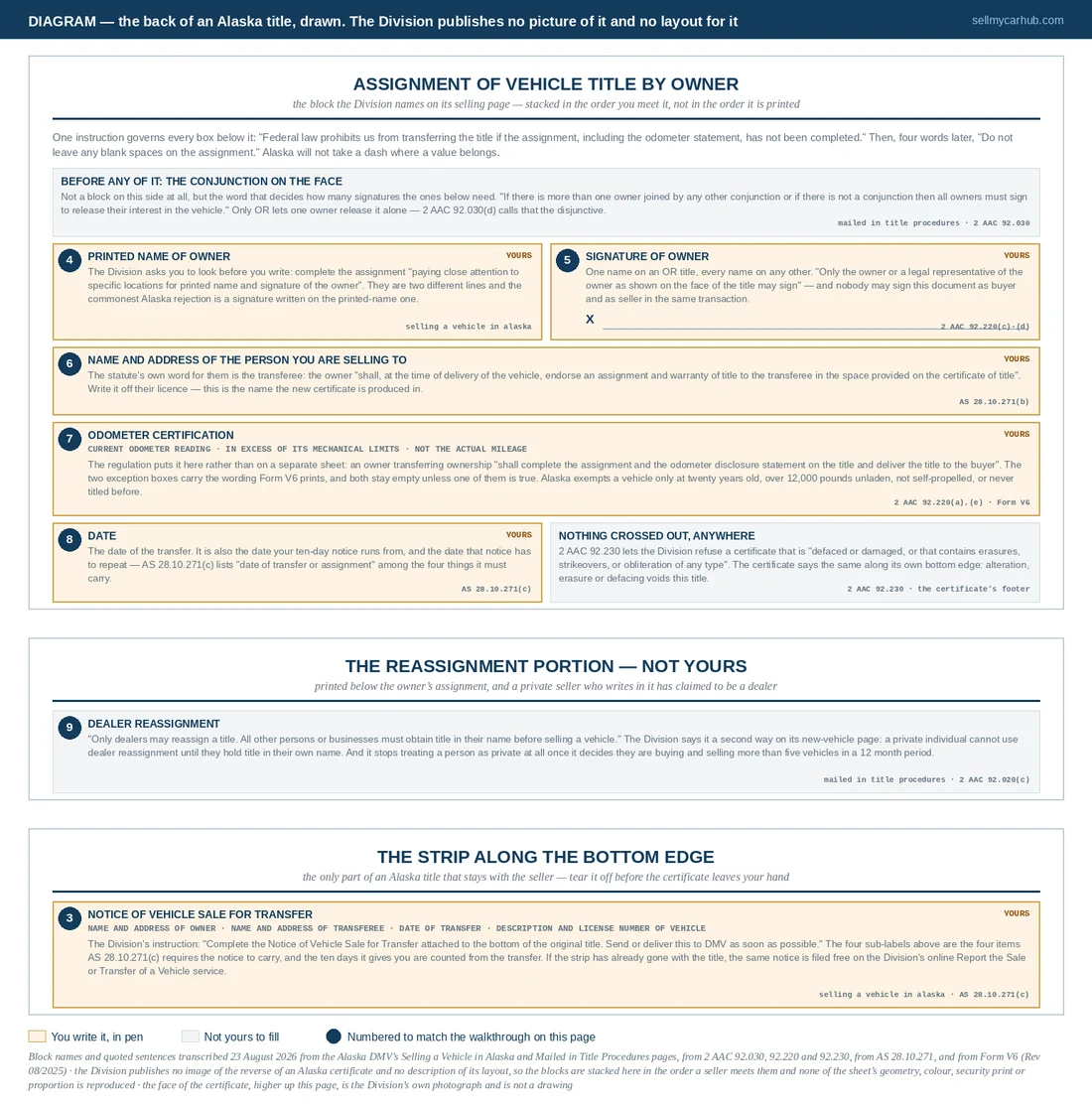
The Division publishes no picture of the reverse of an Alaska title, so this is a diagram and says so across the top of the image. Every block name on it is transcribed from a source that is cited under the picture; nothing has been invented to fill a gap, and where a block's internal layout is not published the diagram shows the block without pretending to know what is printed inside it.

A labelled diagram of the back of an Alaska Certificate of Vehicle or Boat Title, marked as a drawing rather than a photograph. The Assignment of Vehicle Title by Owner fills the upper half in amber - printed name of owner, signature of owner, buyer name and address, odometer certification and date - with dealer reassignment blocks below it in grey, and the tear-off Notice of Vehicle Sale for Transfer strip across the bottom edge in amber.
Drawn, not photographed, and labelled as a diagram on the image itself. The block names come from the Division's own words on Selling a Vehicle in Alaska - Assignment of Vehicle Title by Owner, the reassignment portion, and the Notice of Vehicle Sale for Transfer attached to the bottom of the original title - from 2 AAC 92.220 for the odometer certification, and from AS 28.10.271(c) for the four items the notice strip must carry.
The front, as the Division publishes it

A real Alaska certificate, with the Division's own invented owner on it

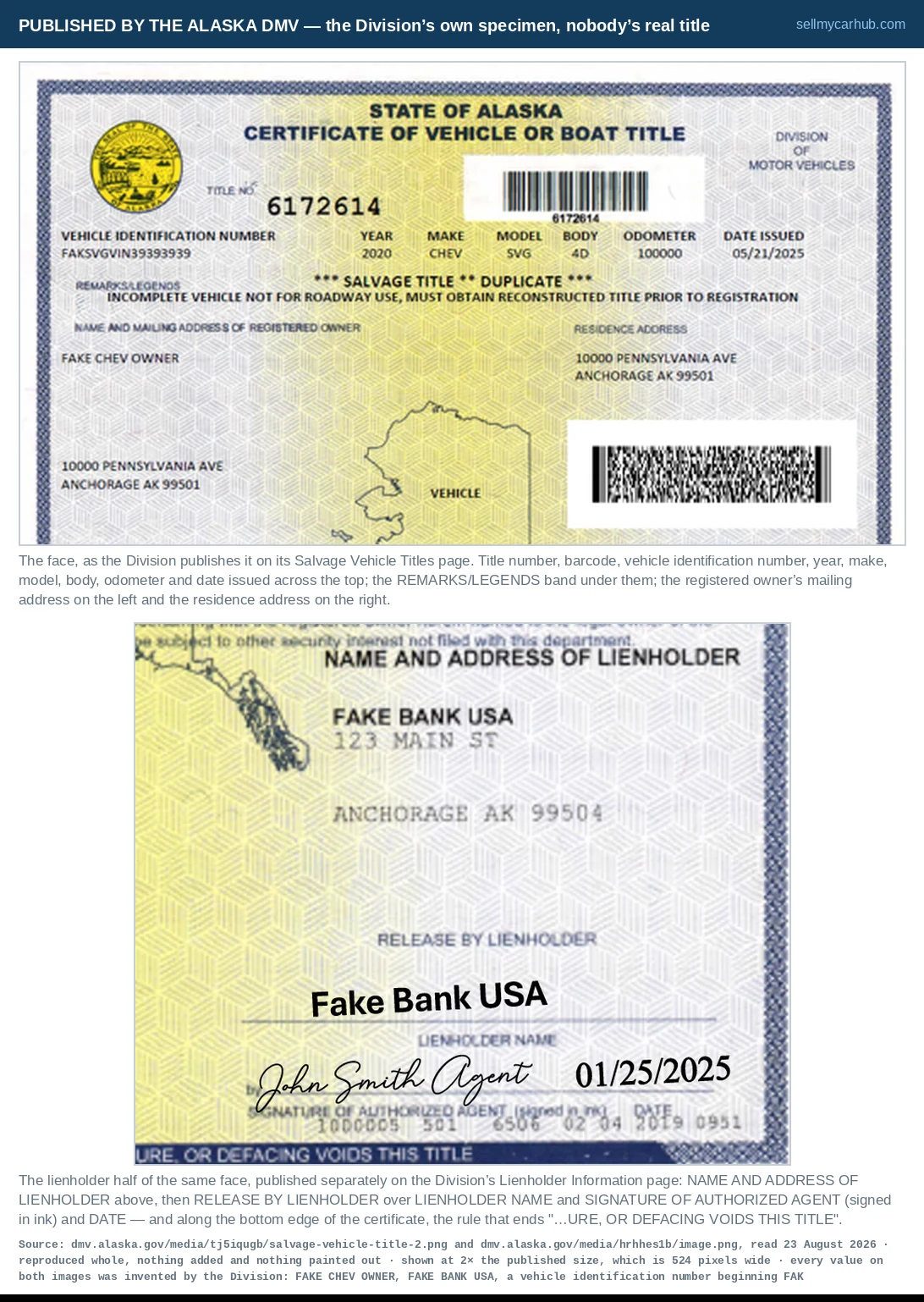
This is not our drawing and not a member of the public's document. It is two pictures the Alaska DMV publishes of its own certificate, reproduced whole and stacked: the whole face, from the Division's Salvage Vehicle Titles page, and the lienholder half of the same face, from its Lienholder Information page. Every value on both was made up by the Division: the owner is FAKE CHEV OWNER, the lender is FAKE BANK USA, the vehicle identification number begins with the letters FAK, and the address is 10000 Pennsylvania Ave. The brands across the middle of the first are there because the Division chose a salvage duplicate to illustrate; an ordinary certificate has the same blocks with that band empty.

Two images the Alaska DMV publishes of the front of a Certificate of Vehicle or Boat Title, one above the other. The first is the whole face: title number 6172614 with its barcode, vehicle identification number FAKSVGVIN39393939, year 2020, make CHEV, model SVG, body 4D, odometer 100000, date issued 05/21/2025, a remarks band reading SALVAGE TITLE DUPLICATE over an incomplete-vehicle warning, and the registered owner FAKE CHEV OWNER of 10000 Pennsylvania Ave, Anchorage. The second is a close crop of the lienholder area of the same face: NAME AND ADDRESS OF LIENHOLDER over FAKE BANK USA of 123 Main St, Anchorage, then RELEASE BY LIENHOLDER with the lender name written in, a signature reading John Smith Agent, the date 01/25/2025, and the certificate's bottom rule ending in the words OR DEFACING VOIDS THIS TITLE.
Look at the remarks band. That strip is where a brand lands, and it is the first thing to read on any Alaska certificate somebody hands you — on this one it carries both SALVAGE and DUPLICATE. The Division published the whole face at dmv.alaska.gov to show what its new salvage title looks like, and the lienholder crop under it on its Lienholder Information page to show what a release signed on the face looks like. Both are shown here at twice the size the Division publishes them, which the image says on itself; nothing has been added and nothing painted out.

Before you watch. The other one worth knowing about is not embedded here: How to Complete a V1 Application, from the same channel, which the Division links from its Titles page. Everything else that comes up searching for an Alaska title transfer belongs to somebody selling a service.

The Division publishes four videos in total and embeds this one on the page it sends buyers to. It walks the certificate and the V1 together, which is the pairing that actually completes an Alaska transfer. Nothing loads from YouTube until you press play.

Step by step

Every box, in the order you meet it

  1. 0
    You fill this in

    Before anything: read the conjunction on the front

    Find the owner names on the face of the certificate and look at the word between them. OR means one signature. AND, anything else, or nothing at all means every owner signs.

    Watch out: This decides whether the sale can happen today. If the certificate says AND and the co-owner is in Bethel, you need Form 847 notarised before the buyer arrives, not after.

  2. 1
    You fill this in

    Check the remarks and legends band

    The strip across the upper part of the face where the Division prints brands. On the specimen above it reads SALVAGE TITLE and DUPLICATE.

    Watch out: A brand follows the vehicle onto every certificate it is ever issued. If yours carries one, say so in the advert - a buyer who discovers it at the counter walks, and you have already handed over the title.

  3. 2
    You fill this in

    Check the lienholder block

    Name and address of lienholder on the face, with a RELEASE BY LIENHOLDER block under it carrying LIENHOLDER NAME, SIGNATURE OF AUTHORIZED AGENT (signed in ink) and DATE.

    Watch out: An unreleased lender on the face stops the transfer even if the loan was cleared years ago. The Division's words: a PAID stamp alone is not acceptable.

  4. 3
    You fill this in

    Tear off the Notice of Vehicle Sale for Transfer

    The strip along the bottom edge of the certificate. Detach it before you hand the title over, because once the title is gone the strip goes with it.

    Watch out: This is the single most commonly skipped step in an Alaska sale, and it is the one with a criminal consequence attached. If it has already gone, file the same notice online instead - it takes about a minute.

  5. 4
    You fill this in

    Printed name of owner, on the assignment

    Print your name as the front of the certificate has it, in the Assignment of Vehicle Title by Owner on the reverse.

    Watch out: The Division's instruction is to pay close attention to specific locations for printed name and signature of the owner. They are two different lines and putting the signature on the printed-name line is a rejection.

  6. 5
    You fill this in

    Signature of owner

    Sign on the signature line, in ink, as many owners as the conjunction requires.

    Watch out: Only the owner shown on the face may sign, or that owner's legal representative. Nobody may sign as both buyer and seller in the same transaction - which is what 2 AAC 92.220(d) is aimed at.

  7. 6
    The buyer fills this in

    The buyer's name and address

    The transferee's full name and address, written into the assignment before either party signs.

    Watch out: Write it from their licence, not from a text message. This is the name the new certificate is produced in, and correcting it later means an erasure on a document that erasures void.

  8. 7
    You fill this in

    The odometer certification

    The reading in whole miles, in the certification section printed on the certificate, with the two exception boxes left alone unless one of them is true.

    Watch out: Do not guess. The Division's warning on that reading is exactly that - do not guess - because a wrong figure recorded here cannot be corrected once the certificate is issued, and a missing one becomes the permanent word Unknown.

  9. 8
    You fill this in

    The date

    The date of the transfer, which is also the date your ten-day clock starts.

    Watch out: Put the real date on it. The notice you file has to carry the same one, and a date written to suit somebody's insurance is a false statement on a document the Division treats as sworn.

  10. 9
    Dealers only

    The reassignment portion, which is not yours

    The dealer blocks printed below the owner's assignment on the reverse. A licensed Alaska dealer uses these to pass the vehicle on without titling it.

    Watch out: A private seller who writes in this area has claimed to be a dealer. The Division's rule is that only dealers may reassign a title, and a private individual cannot use dealer reassignment until they hold title in their own name.

  11. 10
    You fill this in

    Hand over the title and the registration

    Both documents, at the moment the vehicle changes hands. The statute names both.

    Watch out: Sellers keep the registration card out of habit and the buyer then cannot prove the vehicle is registered to anybody. Give it to them with the title and the tear-off strip already in your pocket.

Before the pen

Read this before you pick up a pen in Alaska

Six habits for an Alaska certificate, and the first two exist because this state has no tolerance at all for a blank or a crossing-out.

No blank spacesThe Division's instruction, verbatim, and the reason it gives is that federal law prohibits it from transferring a title whose assignment is incomplete. Fill every box you are given.
No erasures, no strikeovers2 AAC 92.230 lets the Division refuse a certificate carrying obliteration of any type. A slip costs a notarised affidavit of explanation or a duplicate title - so slow down on the VIN.
Ink, and the originalThe V1 has to be completed in full in ink and signed by the vehicle owner. The power of attorney goes further: only the original, notarized document is acceptable.
Whole miles, no guessingThe reading goes in as a whole number, and the Division's own caution beside it is do not guess as this cannot be changed.
Print and sign in different placesThe assignment gives you a printed-name line and a signature line and the Division specifically asks you to look at which is which before writing.
A notary or a DMV counter, either oneEvery notarised Alaska vehicle form prints the same alternative - sign in front of Notary Public or DMV Representative - so a trip to the office saves the notary fee.

The ink rule is the Alaska DMV's own: “Do not leave any blank spaces on the assignment.” — Alaska DMV, Selling a Vehicle in Alaska.

Check your source

Four things people repeat about Alaska titles that are not so

Four things repeated confidently about selling a car in Alaska. One of them is repeated by the Division itself, on three of its own pages, and it is still wrong. Each correction links the Alaska source it comes from.

"Take your plates with you when you sell the car."

That is the rule in Nevada and Texas and it is the opposite of Alaska's. The statute is explicit: on a transfer the registration of the vehicle expires; however, the registration plates remain on the vehicle. The Division adds that standard issue plates are non transferable, so there is not even a mechanism for moving one. Only personalized and specialty plates come off, and the buyer is issued a fresh set at no charge.

AS 28.10.271, transfer of vehicle by owner

"You only have to certify the odometer if the car is under ten years old."

The Division's own selling page still says that, and it stopped being true on 1 January 2021. Alaska's regulation now exempts a vehicle only where it is twenty years old or older, weighs more than 12,000 pounds unladen, is not self-propelled, or has never been titled. Form V6, revised in August 2025, prints the transition on its own face: a vehicle that is 10 years old or older until December 31, 2020, and as of January 1, 2021, all vehicles that are 20 years old or older.

2 AAC 92.220(e), the odometer exemptions

"A bill of sale is enough to transfer a car in Alaska."

It is not, and the Division says so in five words: a Bill of Sale is not valid for ownership transfer. It then recommends taking one anyway and lists what belongs on it - the serial number and description of the vehicle, both printed names, the date of the sale and both signatures - because it protects you if the buyer collects parking tickets before titling. The exception is off-highway: ATVs and snowmachines are never titled here, and a bill of sale genuinely is how they change hands.

Alaska DMV, selling a vehicle in Alaska

"The buyer has thirty days, so I have thirty days."

Two different clocks, and yours is the short one. The buyer gets thirty days under AS 28.10.321(a) to present the endorsed certificates and apply. You get ten under AS 28.10.271(c) to notify the Division of the transfer, and under AS 28.10.493(a) an owner who transfers a vehicle and fails to comply with AS 28.10.271 is guilty of a class B misdemeanour. Nothing the buyer does starts or stops your ten days.

AS 28.10.493, misdemeanors relating to transfers
Who has to sign

Who signs an Alaska certificate is decided by one word printed between the owners' names on the front of it:

One owner, or two joined by ORA single signature releases the certificate. 2 AAC 92.030(d) calls that the disjunctive, and it is the only case where one name is enough.
Two owners joined by ANDBoth sign. So does everyone named where the conjunction is anything else, and so does everyone named where there is no conjunction printed at all.
An attorney-in-factForm 847, notarised, naming the vehicle. The Division takes only the original, in ink, and it must be completed in full.
A personal representative of an estateSigns as executor, in one of three formats the Division sets out, with letters testamentary, letters of administration or a letter of appointment attached.
A successor under the small-estate affidavitSigns Form 827 in front of a notary or a DMV representative, and then has to title the vehicle in their own name before selling it to anybody.
The lienholder, releasingSigns the RELEASE BY LIENHOLDER block on the face over LIENHOLDER NAME and SIGNATURE OF AUTHORIZED AGENT (signed in ink), with the date - or sends a notarised letter on its own letterhead instead.

Once it is signed

Signing is the middle of the job, not the end of it. In Alaska the plates stay bolted to the car, and the clock that belongs to you is ten days long - not the thirty the buyer gets, which is a different deadline with a different consequence.

The two things that follow a signed title — what happens to the plates and telling the Alaska DMV the car is gone — are set out in full on the Alaska paperwork page rather than repeated here.

The forms that go with it: the V1, which is the application your buyer files, the ten-day notice, which is the one that is yours alone and the duplicate, if the certificate has gone missing.

Every field description here is taken from the Alaska DMV, Selling a Vehicle in Alaska and the Alaska Division of Motor Vehicles, Department of Administration title pages, current as of 2026-08-23. Plain-language help with a form, not legal advice, and where our wording and the agency's differ, theirs governs.

Back to all Alaska paperwork, or what selling a car in Alaska involves.

Or let someone else do the paperwork

Get My Instant Offer → Online · about 2 minutes · free

Or send the details — we'll come to you

Expired tabs, a title somewhere in a storage unit in Wasilla, a rig that has not turned over since March - tell us what you actually have and we will tell you the shortest way out of it.

or call/text (877) 405-1808