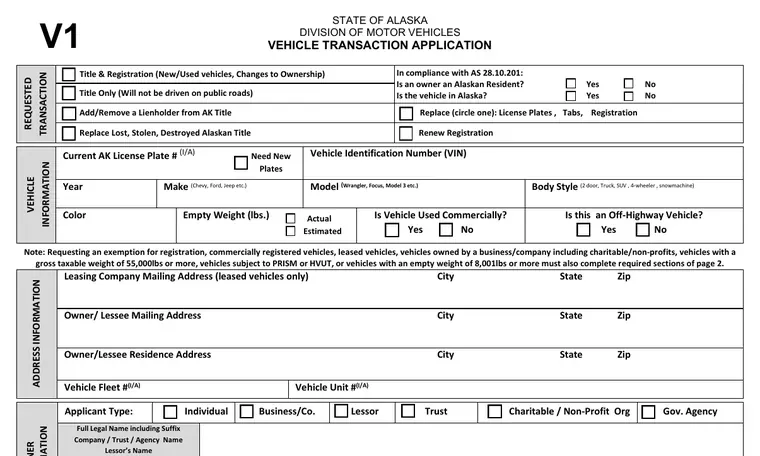
One form does almost everything in Alaska, and this is it: title and registration, title only, adding or removing a lienholder, replacing a lost title, renewing. Your buyer files it with the certificate you assigned to them, and the reason a seller should read it is that almost every line is copied off that certificate - a name that disagrees with the one you printed, or a conjunction ticked the other way, is discovered at the counter and traced back to your kitchen table. Two things are not on it at all: there is no purchase-price box anywhere on the V1, because Alaska levies no state sales tax on the sale, and there is no notice of your sale on it either. That one is yours to file separately.
Written against Form V1 (Rev 03/24), issued under AS 28.10.201, the provision the form invokes on its own face when it asks whether an owner is an Alaskan resident and whether the vehicle is in Alaska. Two live pages on the Division's own website, and one live Division form, still send readers to an Application for Title and Registration numbered 812. There is no 812 in the Division's published index - every current page that names the application calls it the V1, and this is the form the counter expects. If you find instructions telling your buyer to download an 812, they are reading a page the Division has not updated.
Two documents, and they are not the same thing. Take the blank Form V1 from the dmv.alaska.gov copy so you get the revision that is current today, then print our Form V1 guide and keep it beside you while you fill theirs in.
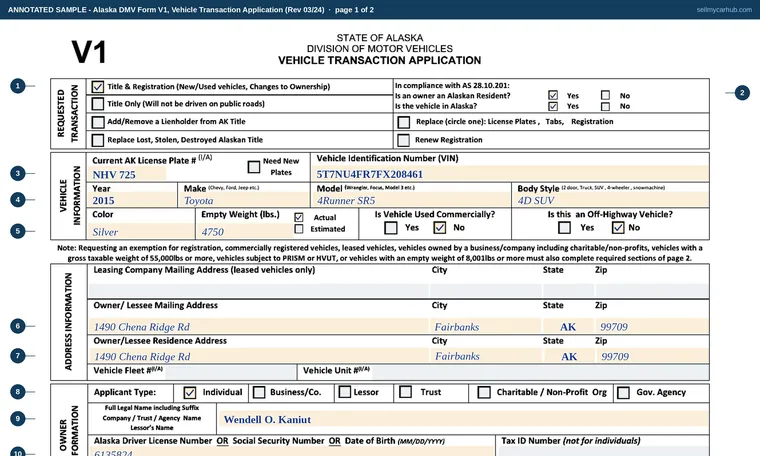
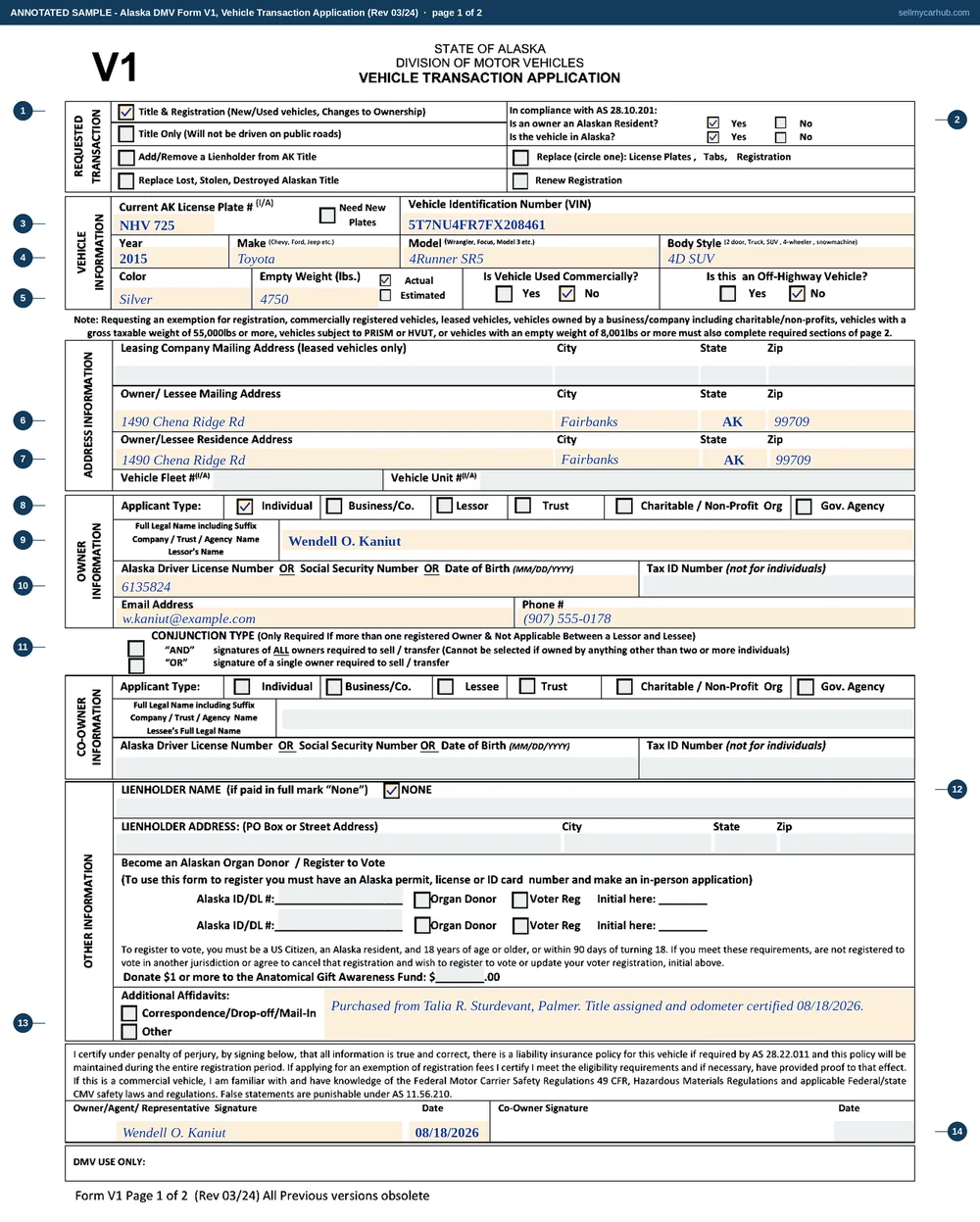
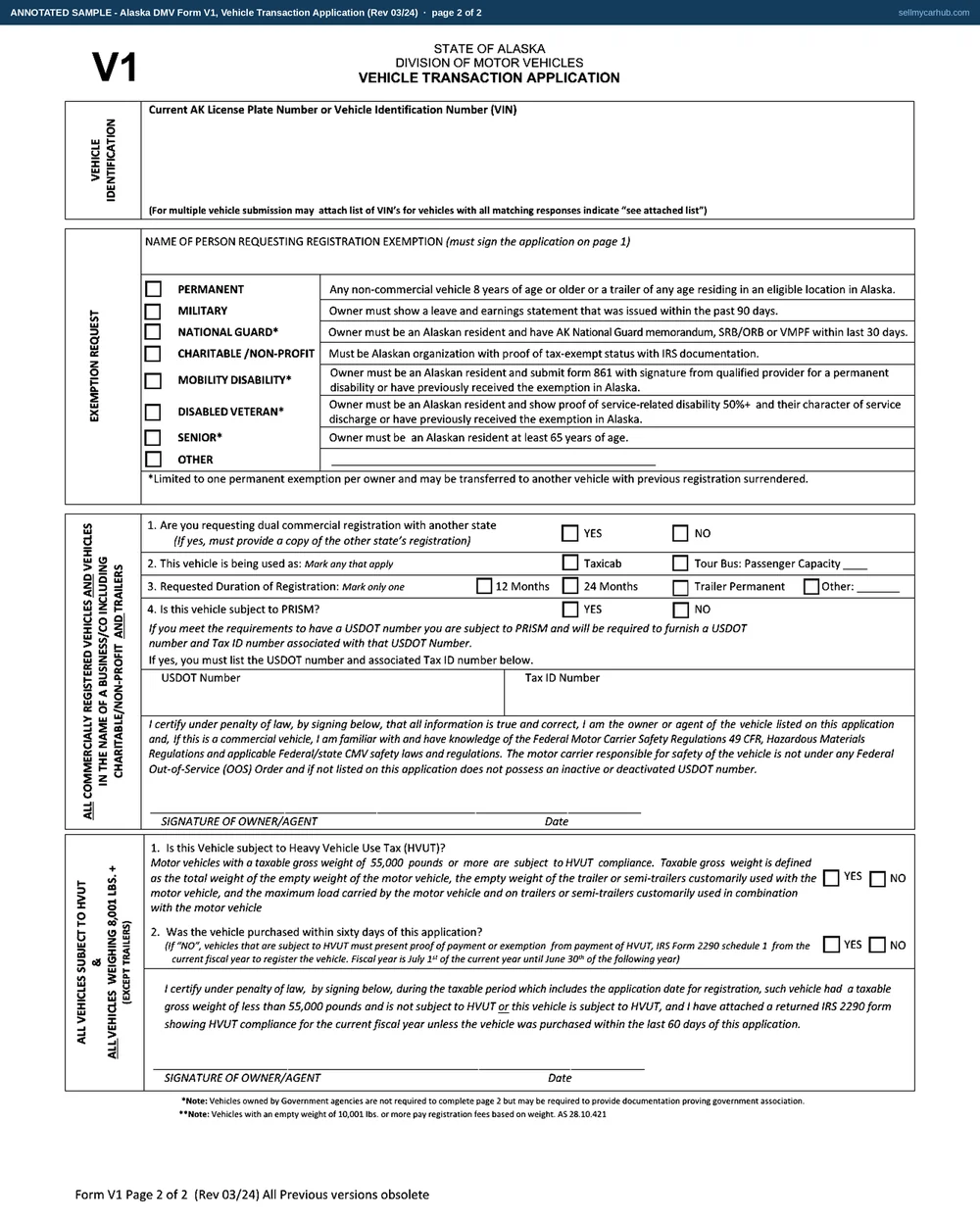
This is all 2 pages of the actual Form V1, rendered from the PDF the Alaska Division of Motor Vehicles, Department of Administration publishes and completed end to end: letterhead, every field, and the blocks at the foot.
Title & Registration (New/Used vehicles, Changes to Ownership) - the top box, and the one a private purchase always uses.
Watch out: Title Only is the box people tick by mistake when the car is not being driven yet. It produces a certificate and no plates or tabs, and a second visit to put that right.
Is an owner an Alaskan Resident, and is the vehicle in Alaska. Both answered, both at the top right.
Watch out: These are not a formality. A vehicle outside the state cannot be titled here under these procedures, and the Division's advice to anyone in that position is to get an ownership document in the state where the vehicle actually sits.
Seventeen characters, copied from the certificate rather than from the dashboard.
Watch out: Copy it from the title you were handed and then check it against the plate through the windscreen. A digit adrift here produces a certificate for a vehicle that does not exist, and correcting it costs a duplicate title.
The four description boxes, filled as the certificate has them rather than as the manufacturer's brochure has them.
Watch out: Use the certificate's spelling of the model. The Division's record is what is being changed here, and a new description that disagrees with the old one is a question the counter has to stop and ask.
Colour and empty weight, with Actual or Estimated ticked, then commercial use and off-highway both answered.
Watch out: Empty weight is what the registration fee is worked from once a vehicle is over 10,001 lbs., so an estimate is fine for a car and worth getting right on a truck.
Where the Division should post the certificate and the registration.
Watch out: If a lender is going on the title, this address gets the registration and the lender gets the certificate. Alaska posts a lien-carrying title to the lienholder, not to the owner.
Where the vehicle and the owner actually live, written out even when it repeats the line above.
Watch out: This is the line that decides whether a municipal vehicle registration tax applies, so a mailing address in one borough and a driveway in another are two different facts and the form wants both.
Individual, for a private buyer. The other five - business, lessor, trust, charitable or non-profit, government agency - all pull page two into the packet.
Watch out: Ticking Business/Co. because the car will sometimes be used for work is how a private buyer accidentally signs up for the commercial band on page two.
The name as it will be printed on the certificate, matching the name written into the assignment.
Watch out: Suffixes count. A Jr. on the licence and no Jr. on the title is the kind of variance that surfaces years later, when the vehicle is sold again and the signature no longer matches the face of the certificate.
One of the three, as the label offers them, plus a tax identification number where the owner is not an individual.
Watch out: An Alaska licence number is the one that resolves fastest at the counter, because it already ties to a record the Division holds.
Only completed where the vehicle is going into two names. AND means everyone signs the next sale; OR means one signature releases it.
Watch out: A single buyer leaves this alone. A couple should decide it now rather than at the next sale - OR is what lets one of them sell the car when the other is on the slope or out of state.
Marked None where the vehicle is paid for; the lender's name and address where it is financed.
Watch out: A financed buyer pays a lien recording fee on top of the title fee, and the certificate is then posted to the lender. Neither is the seller's problem, but both surprise a buyer who was not told.
Where the packet explains itself: who the vehicle came from, on what date, and anything unusual the counter would otherwise have to ask about.
Watch out: It is also where a personalized plate transfer is requested, with the plate number and a copy of the last registration attached. Nothing else on the form has room for either.
The owner's signature and the date, under the certification about insurance and the truth of the application.
Watch out: The date belongs to the application, not to the sale. The sale date is the one on the certificate's assignment, and it is the one both of your thirty-day and ten-day clocks run from.
| On the form | What to put in it |
|---|---|
| Transaction Requested | Six choices down the left of the header. Title & Registration (New/Used vehicles, Changes to Ownership) is the private-sale one; Title Only (Will not be driven on public roads) sits under it, then Add/Remove a Lienholder from AK Title, Replace Lost, Stolen, Destroyed Alaskan Title, Replace (circle one): License Plates, Tabs, Registration, and Renew Registration. |
| In compliance with AS 28.10.201 | Two yes-or-no questions at the top right, and both have to be answered: is an owner an Alaskan resident, and is the vehicle in Alaska. They decide whether the Division may title the vehicle at all. |
| Vehicle Information | Current AK License Plate # (I/A), a Need New Plates tick, and the vehicle identification number across the top row; year, make, model and body style across the second - the form's own examples are Chevy, Ford, Jeep for make and Wrangler, Focus, Model 3 for model. |
| Colour, empty weight, and three questions | Colour and Empty Weight (lbs.) with an Actual or Estimated tick beside them, then Is Vehicle Used Commercially? and Is this an Off-Highway Vehicle? A yes to either sends the applicant to page two. |
| Address Information | Three address lines: a leasing company's mailing address for leased vehicles only, the owner or lessee's mailing address, and the owner or lessee's residence address. Alaska wants both of the last two, and a post-office box on its own will not do for the residence. |
| Owner Information | Applicant Type first - Individual, Business/Co., Lessor, Trust, Charitable / Non-Profit Org or Gov. Agency - then Full Legal Name including Suffix, a company or trust name where one applies, and identification: Alaska Driver License Number OR Social Security Number OR Date of Birth. Email and phone close the block. |
| Conjunction Type | The two ticks that will govern the next sale of this vehicle. AND: signatures of ALL owners required to sell / transfer, which the form notes cannot be selected if owned by anything other than two or more individuals. OR: signature of a single owner required to sell / transfer. Only required where there is more than one registered owner. |
| Co-Owner Information | The same applicant type, name and identification block again for a second owner, and nothing else. A co-owner is created here or not at all. |
| Lienholder | Name and address, with the instruction printed into the label: if paid in full mark None. Where a lender is named the new certificate is posted to the lender rather than to your buyer. |
| Other Information | The organ donor and voter registration block, usable only with an Alaska permit, licence or ID card number and only on an in-person application, each line initialled; then an optional donation of $1 or more to the Anatomical Gift Awareness Fund. |
| Additional Affidavits | Two ticks - Correspondence/Drop-off/Mail-In, and Other - over an open ruled area. This is where a buyer asks to transfer a personalized plate onto the vehicle, and where anything the packet needs explaining gets explained. |
| Certification and signatures | One paragraph carrying three certifications at once: that the information is true, that there is a liability insurance policy for this vehicle if required by AS 28.22.011 and that it will be maintained during the entire registration period, and knowledge of the federal safety regulations where the vehicle is commercial. False statements are punishable under AS 11.56.210. Owner signature and date on the left, co-owner signature and date on the right. |
| Page two, in three bands | The registration exemption request - Permanent, Military, National Guard, Charitable/Non-Profit, Mobility Disability, Disabled Veteran, Senior or Other, each with the proof it needs; the commercial band, with dual registration, taxicab and tour bus, the 12 or 24 month duration choice and the PRISM and USDOT questions; and the heavy-vehicle band for anything over 8,001 lbs., which asks about Heavy Vehicle Use Tax and IRS Form 2290. A private buyer of an ordinary car leaves all three alone. |
Every line here was read off Form V1 (Rev 03/24) itself — the PDF is here — and off the Alaska Division of Motor Vehicles, Department of Administration pages. This is plain-language help with a form, not legal advice, and where our wording and the agency's differ, theirs governs.
Back to all Alaska seller paperwork, or what selling a car in Alaska involves.