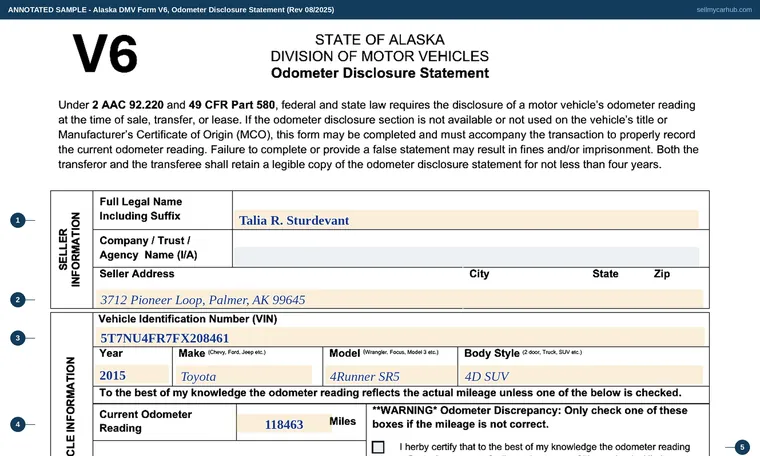
A one-page substitute for a block that is already printed on your title, and the form exists for exactly one situation: the certificate's own odometer section is missing, unusable or already used. The V6 says so itself - if the odometer disclosure section is not available or not used on the vehicle's title or Manufacturer's Certificate of Origin, this form may be completed and must accompany the transaction. If your certificate has a clean certification block, use it and leave this alone. What makes the V6 worth reading anyway is the list printed across its foot, because that list is the current Alaska exemption rule, and three of the Division's own web pages still print the superseded one.
Written against Form V6 (Rev 08/2025), issued under 2 AAC 92.220 and 49 CFR Part 580, the state regulation and the federal rule the form cites together on its own first line. The exemption list on this form is printed in a way that trips people: item five reads as a rule about ten-year-old vehicles and then corrects itself in the same sentence. What it means is that the ten-year rule died on 31 December 2020 and the twenty-year rule has applied since 1 January 2021. Certify anything nineteen model years old or newer. The Division's Selling a Vehicle in Alaska page still says ten years, and it is wrong.
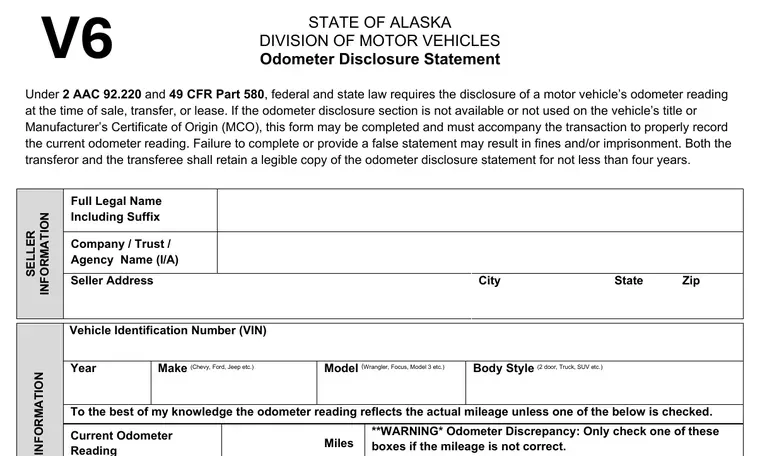
Two documents, and they are not the same thing. Take the blank Form V6 from the dmv.alaska.gov copy so you get the revision that is current today, then print our Form V6 guide and keep it beside you while you fill theirs in.
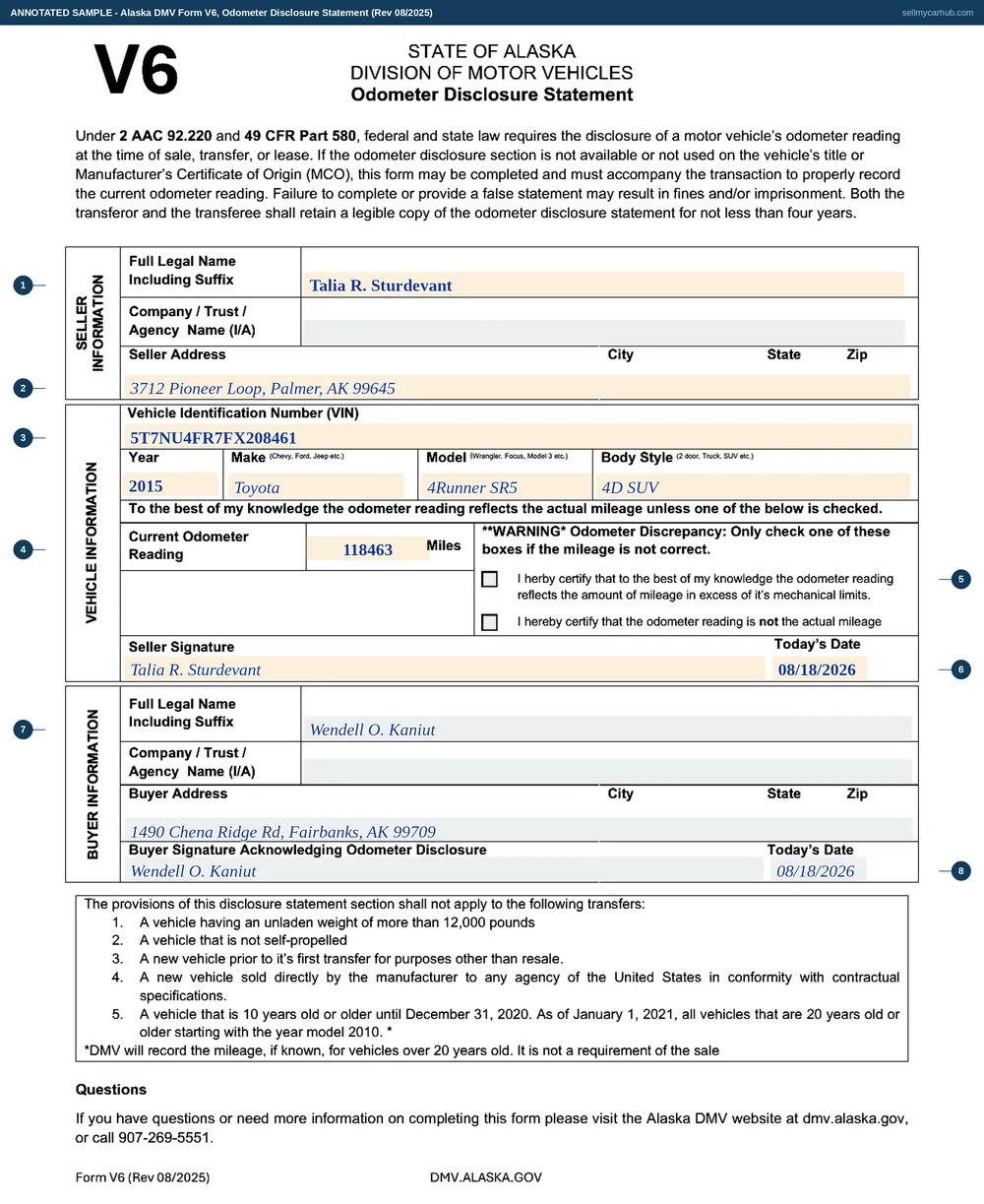
This is the actual Form V6, rendered from the PDF the Alaska Division of Motor Vehicles, Department of Administration publishes and completed end to end: letterhead, every field, and the blocks at the foot.
Name including suffix, as the face of the certificate has it.
Watch out: This is the name the buyer's application will be read against. If the title says a maiden name and the licence says a married one, the packet needs an explanation before it needs this form.
Street, city, state and zip on the single seller address line.
Watch out: Give the address the Division already holds for you. A new address here and an old one on the registration is one more thing for the counter to reconcile.
Copied from the certificate into the long box, then checked against the vehicle.
Watch out: This form travels loose. The VIN is what stops it being filed against the wrong car, so it matters here more than it does on paper that is stapled to the title.
Whole miles, exactly as the instrument shows them, in the box marked Miles.
Watch out: Read it in daylight with the ignition on rather than from memory. A wrong figure recorded on a title cannot be corrected afterwards, and the Division's own advice on the reading is not to guess.
One for a reading in excess of the odometer's mechanical limits, one for a reading that is not the actual mileage. Neither is ticked on a working, honest clock.
Watch out: If one of them is true, tick it and say so in the advert as well. A buyer who finds out at the counter walks away, and by then you have handed over the title.
Your signature and the date, on the lines directly under the reading.
Watch out: Sign it in front of the buyer with the odometer visible. The whole document exists so that neither of you has to remember what the mileage was.
Their full legal name including suffix and their address, in the lower block.
Watch out: Take it off their licence while they are standing there. This sheet has to name a transferee before it means anything at all.
Their signature and date on the line headed Buyer Signature Acknowledging Odometer Disclosure.
Watch out: Photograph the completed sheet before it leaves with them. You are the other party to a document you both have to keep for four years, and the copy you keep is the one that answers a later dispute.
| On the form | What to put in it |
|---|---|
| Seller Information | Full legal name including suffix, a company, trust or agency name where one applies, then the seller's address, city, state and zip on one line. |
| Vehicle Identification Number | One long box across the width of the sheet. It is the only thing tying this loose page to the transaction it must accompany. |
| Year, make, model, body style | Four boxes under the VIN, with the form's own worked examples printed in the labels - Chevy, Ford, Jeep; Wrangler, Focus, Model 3; 2 door, Truck, SUV. |
| Current Odometer Reading | The figure, in miles, under the sentence that governs it: to the best of my knowledge the odometer reading reflects the actual mileage unless one of the below is checked. |
| The two discrepancy boxes | Headed WARNING - Odometer Discrepancy: only check one of these boxes if the mileage is not correct. The first certifies that the reading reflects the amount of mileage in excess of its mechanical limits; the second that the odometer reading is not the actual mileage. Both stay empty on an honest, working odometer. |
| Seller Signature and Today's Date | Your signature and the date, immediately under the reading. The person signing here has to be the owner shown on the face of the title or that owner's legal representative. |
| Buyer Information | The transferee's full legal name including suffix, any company name, and their address, city, state and zip - completed by the buyer, not by you. |
| Buyer Signature Acknowledging Odometer Disclosure | The buyer's own signature and date. The heading is the point: they are acknowledging what you disclosed, which is what makes the document a two-party record rather than a statement. |
| The exemptions, printed at the foot | Five numbered transfers the disclosure does not apply to: a vehicle having an unladen weight of more than 12,000 pounds; a vehicle that is not self-propelled; a new vehicle prior to its first transfer for purposes other than resale; a new vehicle sold directly by the manufacturer to an agency of the United States under contract; and a vehicle that is 10 years old or older until December 31, 2020, with the note that as of January 1, 2021 the rule is all vehicles that are 20 years old or older starting with the year model 2010. |
| The four-year retention line | Printed in the header block: both the transferor and the transferee shall retain a legible copy of the odometer disclosure statement for not less than four years. That duty is yours as well as your buyer's. |
Every line here was read off Form V6 (Rev 08/2025) itself — the PDF is here — and off the Alaska Division of Motor Vehicles, Department of Administration pages. This is plain-language help with a form, not legal advice, and where our wording and the agency's differ, theirs governs.
Back to all Alaska seller paperwork, or what selling a car in Alaska involves.