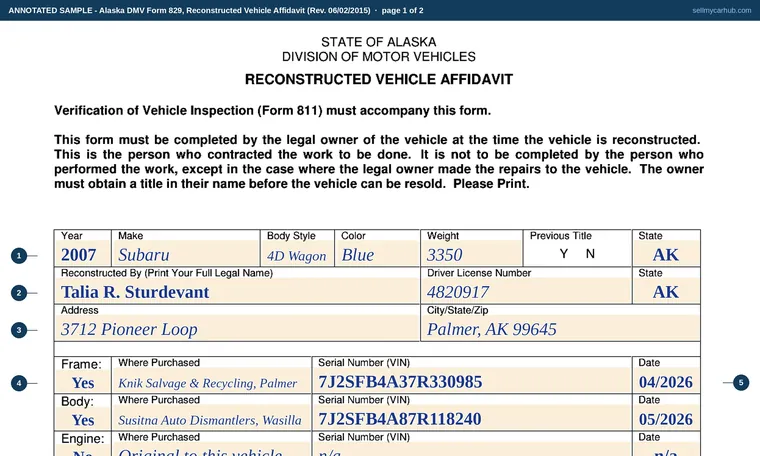
How a vehicle built out of other vehicles - or rebuilt after a brand - becomes a registrable Alaskan vehicle again. Two pages: a sworn affidavit naming where the frame, the body and the engine came from, and an operational affidavit certifying that twenty-three items of required equipment are installed and working. It has to be completed by the legal owner at the time the vehicle was reconstructed - the person who contracted the work, not the person who did it, unless they are the same person. And it comes with a sentence that governs the whole exercise: the owner must obtain a title in their name before the vehicle can be resold.
Written against Form 829 (Rev 06/02/2015), issued under 2 AAC 92.080(d), which defines a reconstructed vehicle as one that has been completely restored to operational, street legal condition. The title requirements list on page two tells you to complete an Application for Title and Registration, Form 812. There is no 812 in the Division's published index any more - the current application is the Vehicle Transaction Application, and that is what belongs in the packet. This is one of three places on the Division's own material where the retired number is still printed, so an applicant who goes looking for the form named here will not find it and should not assume they have missed something.
Two documents, and they are not the same thing. Take the blank Form 829 from the dmv.alaska.gov copy so you get the revision that is current today, then print our Form 829 guide and keep it beside you while you fill theirs in.
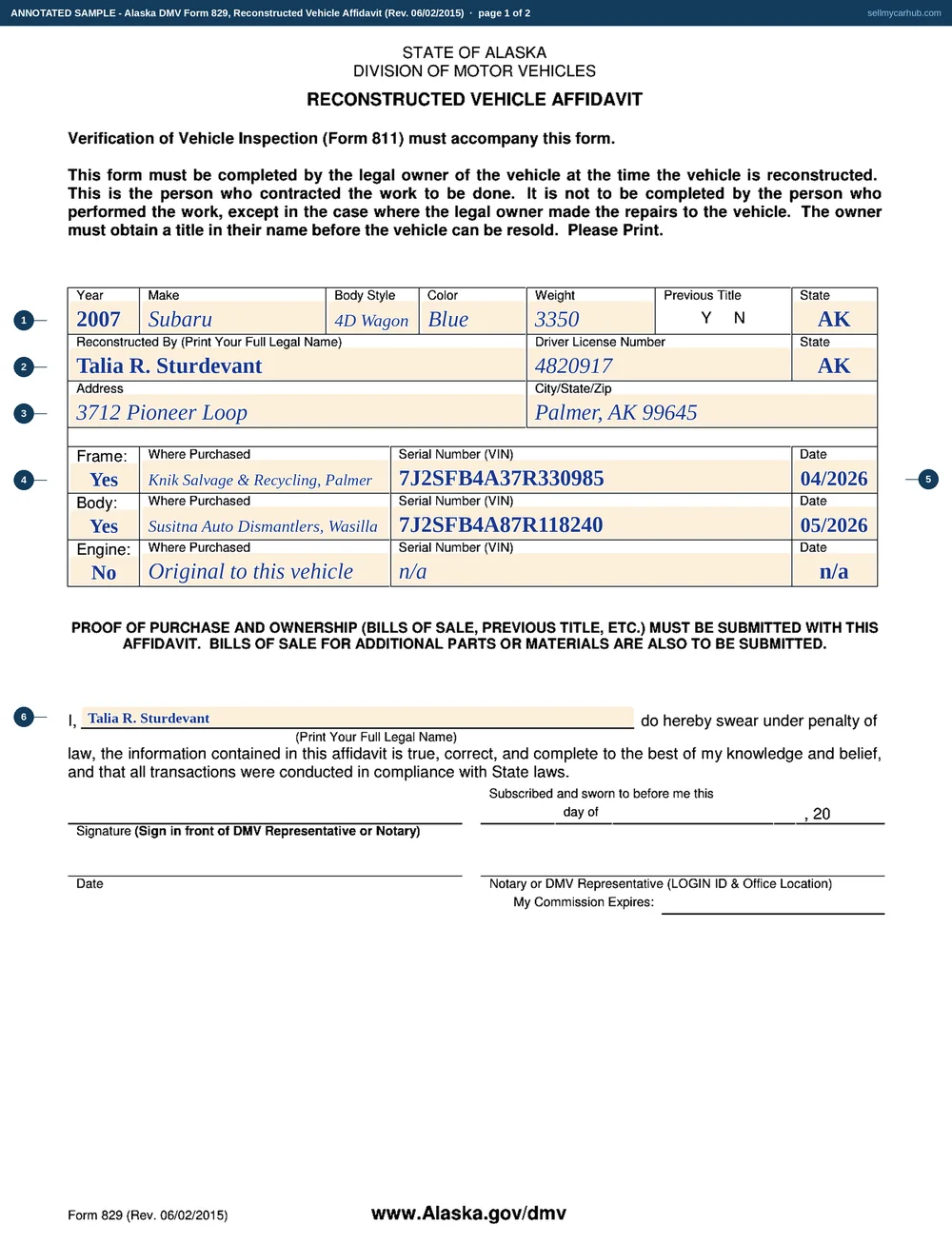
This is all 2 pages of the actual Form 829, rendered from the PDF the Alaska Division of Motor Vehicles, Department of Administration publishes and completed end to end: letterhead, every field, and the blocks at the foot.
Year, make, body style, colour and weight, then the previous-title question and the state that issued it.
Watch out: A previous Alaskan title is what ties this build to an existing record. A no here means the Division is creating a record from scratch, and it will want more of the paperwork trail.
Your full legal name, printed, with your driver licence number and state.
Watch out: This is the person who contracted the work, not the shop that did it - unless you did it yourself, which is the one case where they are the same name.
Your street address, then city, state and zip on the line beneath.
Watch out: Use the address the Division already holds. The title that comes out of this is posted to it.
Where the frame was purchased, its serial number, and the date - the first of the three essential parts.
Watch out: Bills of sale for every one of these go in the envelope. The row is an index to the attachments rather than a substitute for them.
The number carried by that part, which on a frame is usually the donor vehicle's own identification number.
Watch out: The inspector will look for it. If the frame came from a vehicle returned to the Division as junked, the record will already show that number and this row should match it.
Print your full legal name into the oath, sign in front of a DMV representative or notary, and date it.
Watch out: Sign the operational affidavit on page two at the same visit. One certifies where the parts came from and the other certifies that the finished vehicle works - the Division wants both.
| On the form | What to put in it |
|---|---|
| The inspection requirement, printed first | Verification of Vehicle Inspection must accompany this form. The vehicle is physically inspected by a DMV representative, and that sheet travels with this one. |
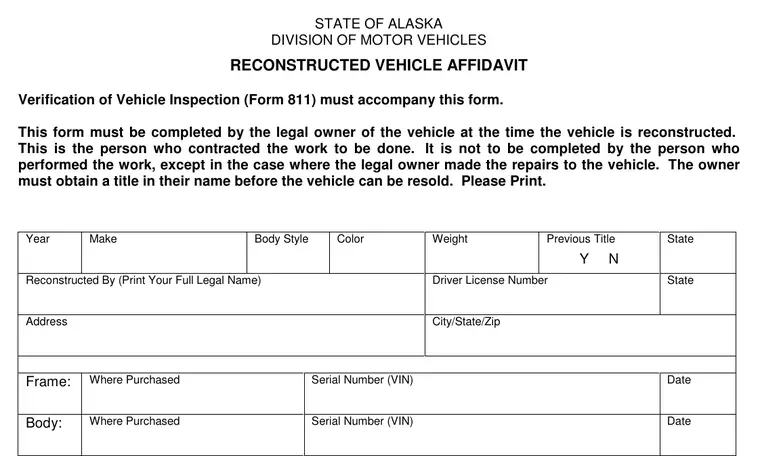
| Who completes it | Spelled out at the head: the legal owner of the vehicle at the time the vehicle is reconstructed - the person who contracted the work to be done - and not the person who performed the work, except where the owner made the repairs themselves. |
| Year, make, body style, colour, weight | The description row, followed by a previous-title yes or no and the state that title was issued in. |
| Reconstructed By (print your full legal name) | With a driver licence number and state beside it, then address and city, state and zip on the next row. |
| Frame - where purchased, serial number, date | The first of the three essential-parts rows. Where the part came from, its own serial number, and when it was acquired. |
| Body - where purchased, serial number, date | The second row, filled the same way. A body from a different vehicle carries a different serial number, and that is the point of asking. |
| Engine - where purchased, serial number, date | The third. Where a part is original to the vehicle rather than bought in, that is what the row should say. |
| The documents that must be attached | In capitals between the rows and the oath: proof of purchase and ownership - bills of sale, previous title and so on - must be submitted with the affidavit, and bills of sale for additional parts or materials are also to be submitted. |
| The sworn statement | I, (print your full legal name), do hereby swear under penalty of law that the information contained in this affidavit is true, correct and complete to the best of my knowledge and belief, and that all transactions were conducted in compliance with State laws - signed in front of a DMV representative or notary, dated, with the officer's block beside it. |
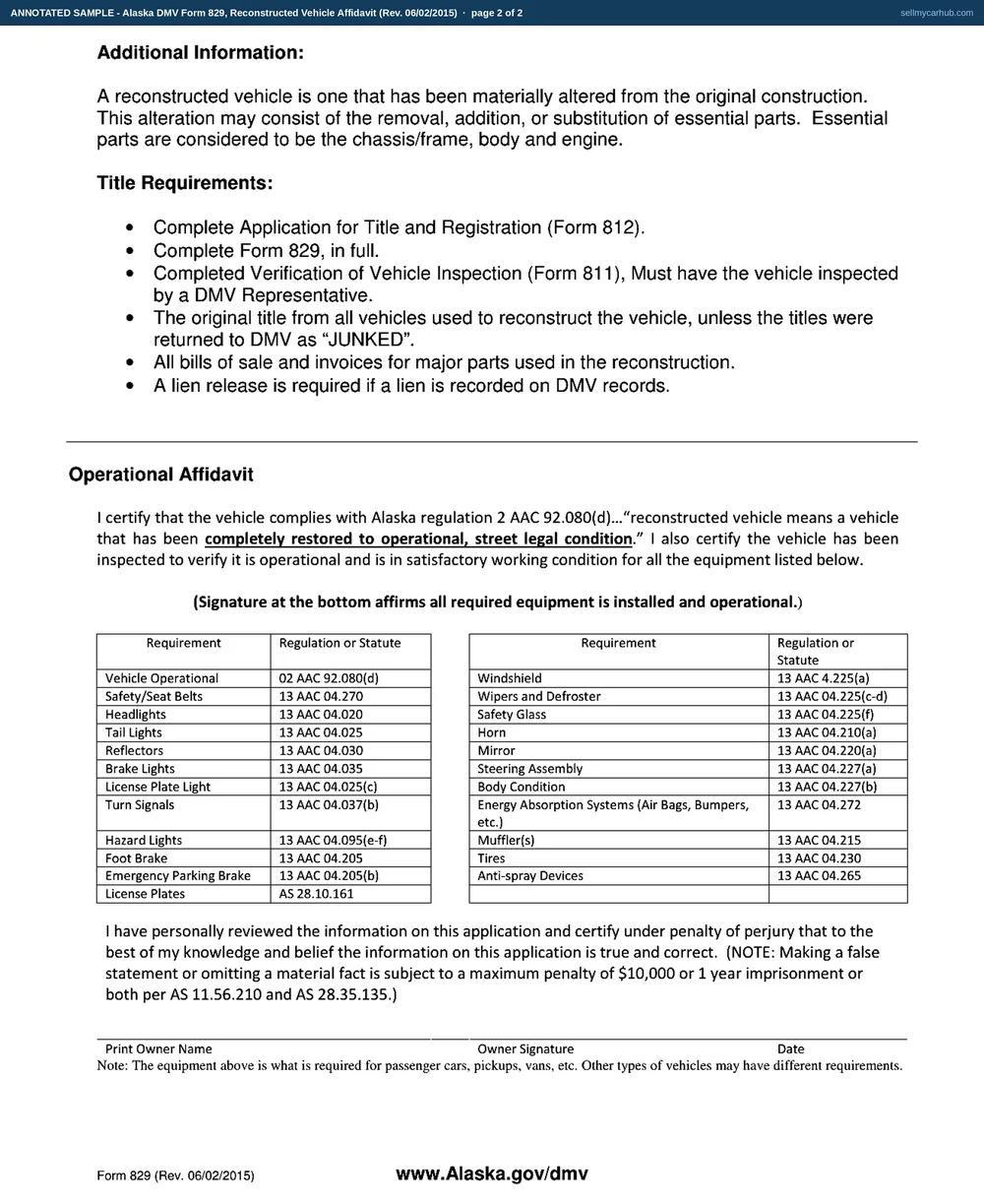
| Page two: what reconstructed means | The definition, in the Division's words: a vehicle that has been materially altered from the original construction, by the removal, addition or substitution of essential parts - and essential parts are the chassis or frame, the body and the engine. |
| Page two: the title requirements list | Six items - a completed application for title and registration, this affidavit completed in full, a completed Verification of Vehicle Inspection with the vehicle inspected by a DMV representative, the original title from all vehicles used to reconstruct the vehicle unless those titles were returned to DMV as JUNKED, all bills of sale and invoices for major parts, and a lien release where a lien is recorded. |
| Page two: the Operational Affidavit | A certification against 2 AAC 92.080(d), over a table of required equipment and the regulation for each: seat belts, headlights, tail lights, reflectors, brake lights, licence plate light, turn signals, hazard lights, foot brake, emergency parking brake, windshield, wipers and defroster, safety glass, horn, mirror, steering assembly, body condition, energy absorption systems, mufflers, tyres, anti-spray devices and licence plates. The signature at the bottom affirms all of it is installed and operational. |
Every line here was read off Form 829 (Rev 06/02/2015) itself — the PDF is here — and off the Alaska Division of Motor Vehicles, Department of Administration pages. This is plain-language help with a form, not legal advice, and where our wording and the agency's differ, theirs governs.
Back to all Alaska seller paperwork, or what selling a car in Alaska involves.