Sell My Car Hub

How to fill out Alaska Form 827

When a sole owner dies, or two owners joined by AND, the vehicle becomes part of the estate and normally goes through probate. This one page is the way round that for small estates - a sworn affidavit by the successor, with three certifications on it, that lets the Division move the vehicle without a court-appointed representative. Two conditions govern whether it is available at all: the value of the estate, and the fact that no personal representative has been appointed or applied for anywhere. And one sentence on it governs what happens next: the vehicle must be titled in the successor's name before it can be sold to anybody.
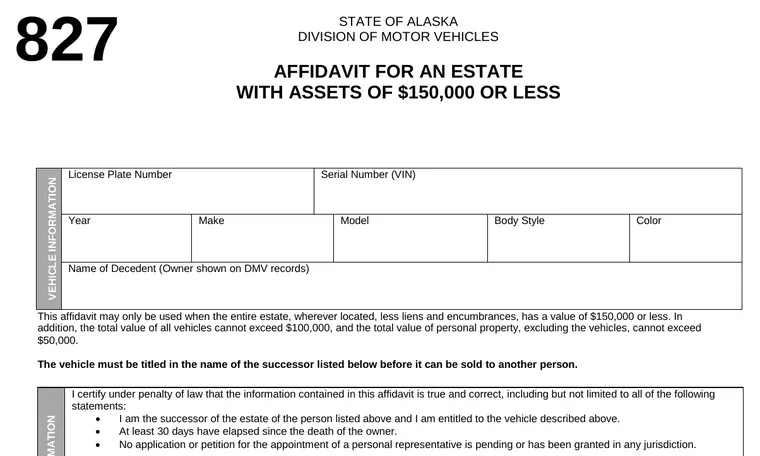
Written against Form 827 (Rev 1/2018), issued under 2 AAC 92.060 and AS 13.16.680, the small-estate collection by affidavit provisions the Division relies on. The one thing to establish before anything else is which side of the conjunction the certificate falls on, because it changes the whole job. An OR title needs no affidavit, no waiting period and no valuation of an estate - the surviving owner signs the assignment and the sale proceeds like any other. An AND title, or a sole owner, is where this page starts, and where a family sometimes discovers that the quickest route to selling a car is a court appointment rather than a form.

Two documents, and they are not the same thing. Take the blank Form 827 from the dmv.alaska.gov copy so you get the revision that is current today, then print our Form 827 guide and keep it beside you while you fill theirs in.

Filled in

What a completed one looks like

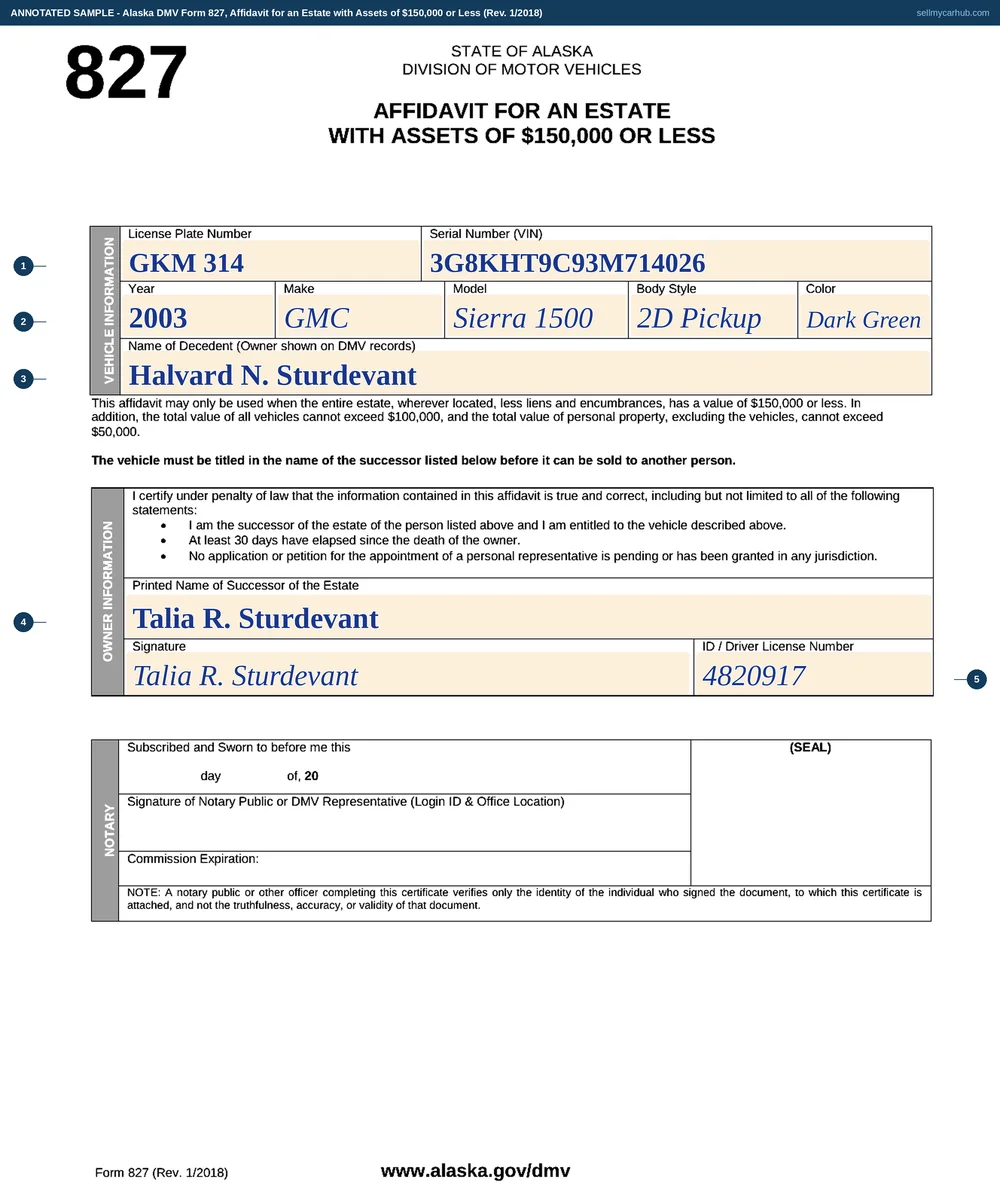
This is the actual Form 827, rendered from the PDF the Alaska Division of Motor Vehicles, Department of Administration publishes and completed end to end: letterhead, every field, and the blocks at the foot.

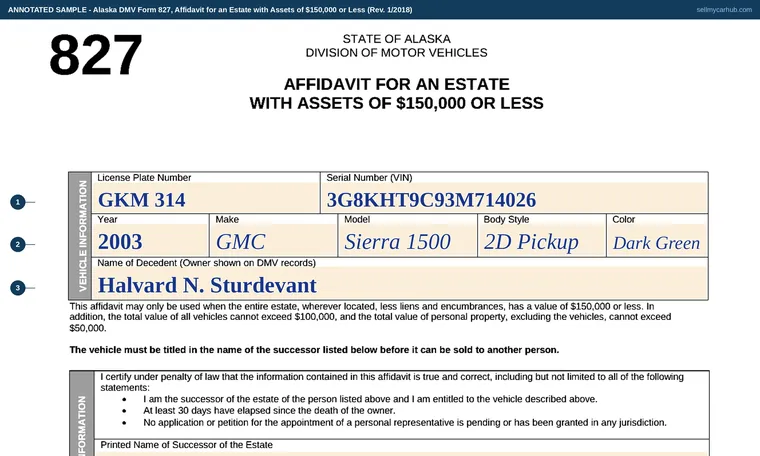
A completed Alaska DMV Form 827, Affidavit for an Estate with Assets of $150,000 or Less. The vehicle block carries plate GKM 314, serial number 3G8KHT9C93M714026, year 2003, make GMC, model Sierra 1500, body style 2D Pickup, colour Dark Green. The decedent named as owner shown on DMV records is Halvard N. Sturdevant. The successor of the estate is Talia R. Sturdevant, with her signature and Alaska identification number beneath. The notary block at the foot is empty.
Rendered from the Division's own PDF and completed by the one person the form makes room for - a single successor, swearing three things about the estate. Amber is the successor's; the notary block is grey because the officer completes it while watching the signature. Every name, plate and identification number is invented, and the vehicle identification number identifies no vehicle.
Field by field

Every line, in the order you meet it

  1. 1
    You fill this in

    Plate and serial number

    The vehicle as the Division's record identifies it.

    Watch out: Take these off the certificate if the family has it, and off the vehicle if they do not. A missing certificate is a second problem and has its own form.

  2. 2
    You fill this in

    Year, make, model, body style, colour

    The description row under the identification numbers.

    Watch out: Match the record rather than the vehicle's current appearance - a repaint does not change what the certificate says.

  3. 3
    You fill this in

    Name of decedent

    The owner as DMV records show them, which the label spells out.

    Watch out: If the record holds a maiden name, a middle initial or a suffix the death certificate does not, sort that out with the Division before filing rather than guessing at a match.

  4. 4
    You fill this in

    Printed name of the successor

    The person entitled to the vehicle, who will hold the new certificate.

    Watch out: One name. If two children are inheriting jointly, this form and the conjunction question behind it need thinking about before anybody signs.

  5. 5
    You fill this in

    Sign, and give your identification number

    Signature and ID or driver licence number, witnessed by the notary public or DMV representative below.

    Watch out: You are swearing three things at once, and the middle one - that at least thirty days have elapsed - is a date the officer's own block will sit next to.

At a glance

What goes where

On the formWhat to put in it
Vehicle InformationLicence plate number and serial number, then year, make, model, body style and colour - the vehicle as the Division's record has it rather than as the family describes it.
Name of Decedent (Owner shown on DMV records)The label carries the qualification: the owner as DMV records show them. A name that differs from the death certificate needs explaining before this form will move anything.
The value test, in three figuresPrinted as a paragraph rather than a field, and all three limits must hold: the entire estate, wherever located, less liens and encumbrances, has a value of $150,000 or less; the total value of all vehicles cannot exceed $100,000; and the total value of personal property, excluding the vehicles, cannot exceed $50,000.
The sale restrictionOne sentence on its own line: the vehicle must be titled in the name of the successor listed below before it can be sold to another person. The estate cannot sell it directly to a buyer.
The three certificationsBulleted under a penalty-of-law heading: that you are the successor of the estate of the person listed above and are entitled to the vehicle; that at least 30 days have elapsed since the death of the owner; and that no application or petition for the appointment of a personal representative is pending or has been granted in any jurisdiction.
Printed Name of Successor of the EstateThe person the vehicle will be titled to. One name - this form makes one successor, not a family.
Signature and ID / Driver License NumberSide by side under the printed name, with the signature witnessed by the officer in the block below.
Notary blockSubscribed and sworn to before me this day of, 20 __, a seal, the signature of the notary public or DMV representative with a login ID and office location, and a commission expiry, over the standard identity-only note.

What gets this one rejected

Rules that decide whether it is accepted

Every line here was read off Form 827 (Rev 1/2018) itself — the PDF is here — and off the Alaska Division of Motor Vehicles, Department of Administration pages. This is plain-language help with a form, not legal advice, and where our wording and the agency's differ, theirs governs.

Back to all Alaska seller paperwork, or what selling a car in Alaska involves.

Want the paperwork handled instead?

Get My Instant Offer → Online · about 2 minutes · free

Or send the details — we'll come to you

Clearing a parent's estate and the car is the last thing left on the drive? We buy from successors once the title is in their name, and we can tell you in one call which of Alaska's two routes yours needs.

or call/text (877) 405-1808