The document that sets the number everything else in a bonded-title packet is built on. An appraiser looks at the vehicle in person, in Alaska, writes down what it is worth at fair market retail - not trade-in, and the form says so in capitals - and signs. The bond is then written for one and one-half times that figure. Two pages: the appraisal itself, and a page of instructions that is really a list of the ways an appraisal gets rejected. Read the second page first, because it is where the disqualifications live.
Written against Form 825 (Rev 04/2025), issued under 2 AAC 92.010(b), which requires a bona fide appraisal reasonably conforming to nationally recognized used-vehicle valuations, for a complete street legal vehicle physically present in this state. The number written in the fair market retail box is not a negotiating position - it is multiplied by one and a half and becomes the bond you buy, so a generous appraisal costs you money and a mean one costs you the whole application. What the Division is checking is whether the figure reasonably conforms to nationally recognised used-vehicle valuations for a vehicle in that condition, which is exactly what the attached printout and the four condition lines are for.
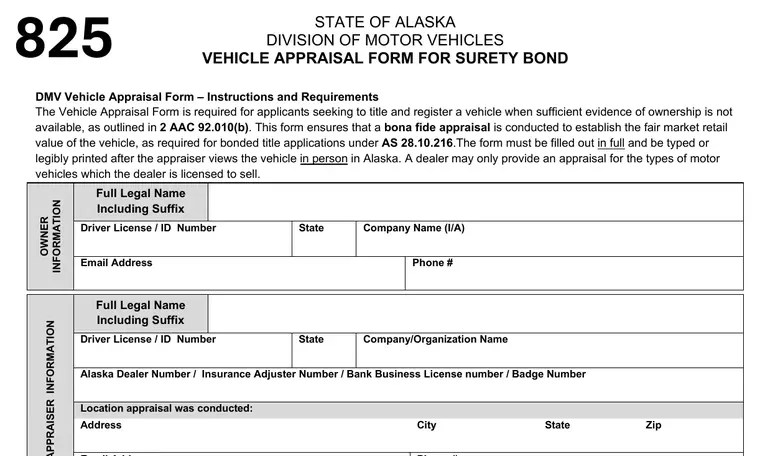
Two documents, and they are not the same thing. Take the blank Form 825 from the dmv.alaska.gov copy so you get the revision that is current today, then print our Form 825 guide and keep it beside you while you fill theirs in.
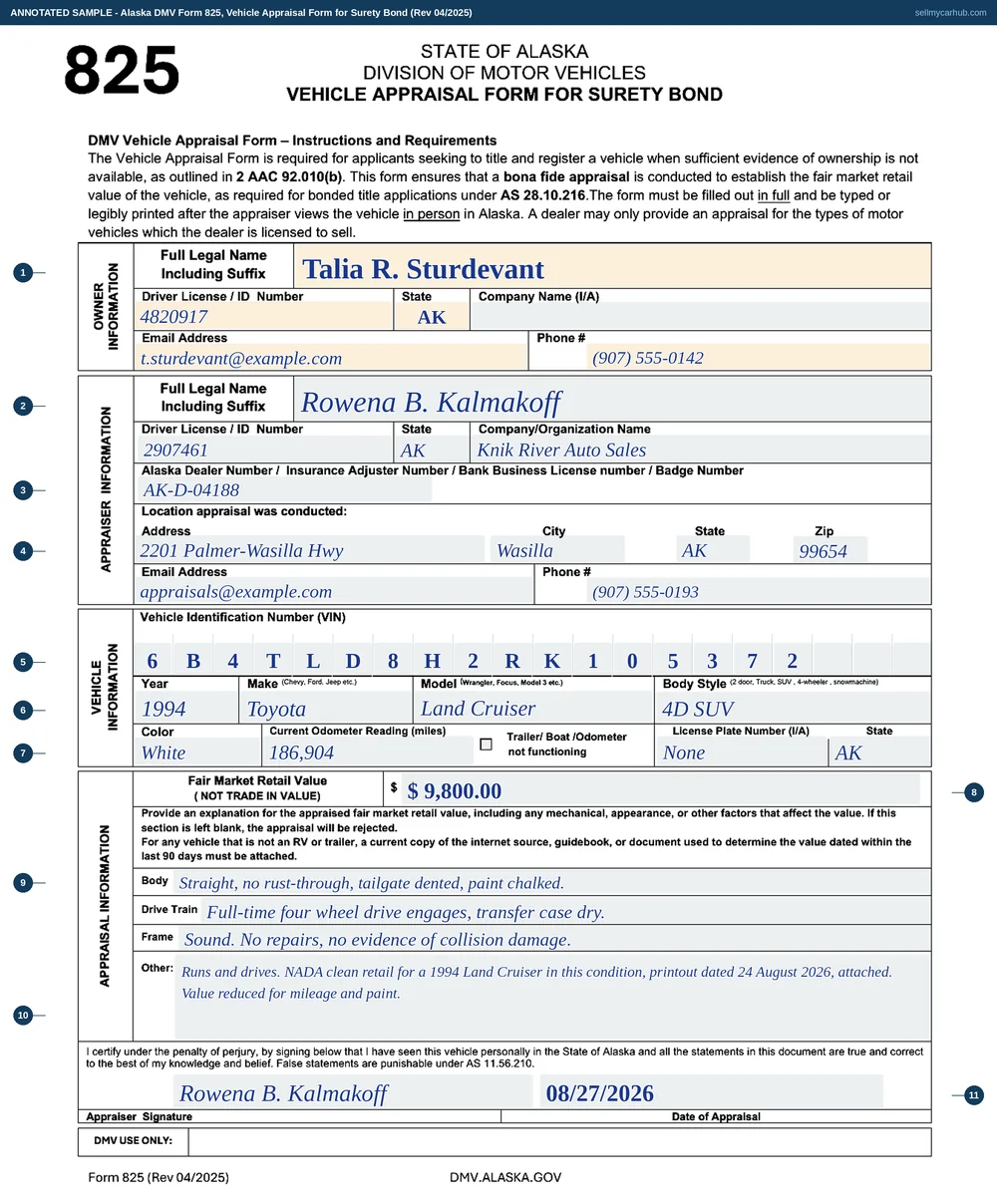
This is the actual Form 825, rendered from the PDF the Alaska Division of Motor Vehicles, Department of Administration publishes and completed end to end: letterhead, every field, and the blocks at the foot.
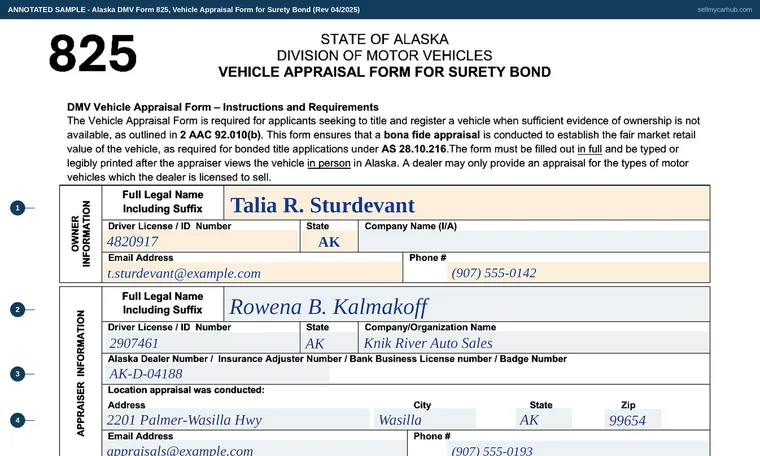
Your name, licence number and contact details in the owner block at the top.
Watch out: The same name that will appear on the bond and the affidavit. This is the only block on the form that is yours.
Their full legal name, licence or ID number and state, and the company they appraise for.
Watch out: Get this filled in properly at the time. Chasing an appraiser for a missing credential number a fortnight later is how appraisals expire.
An Alaska dealer number, insurance adjuster number, bank business licence number or badge number - whichever applies to them.
Watch out: If the person looking at your vehicle cannot fill this line in, they are not one of the three kinds of appraiser the instructions allow.
The address at which the vehicle was physically viewed, with city, state and zip.
Watch out: It has to be an Alaskan address. This line is the evidence for the regulation's requirement that the appraiser saw the vehicle here, in person.
One character per cell across the sheet.
Watch out: Watch for the characters that are never used in a VIN. An I where a 1 belongs makes this appraisal describe a different vehicle from the bond.
The description row, written as the rest of the packet writes it.
Watch out: Agree the wording with whoever is preparing the bond. Small differences across the packet are what the counter notices first.
Current mileage, with a tick beside it where the odometer does not work or the item is a trailer or boat.
Watch out: On a vehicle old enough to be exempt from odometer disclosure, the reading still belongs here - it is part of what the value is being justified by.
The figure, in the box marked NOT TRADE IN VALUE.
Watch out: This is the number your bond is one and one-half times, so it is worth understanding how the appraiser got to it before they sign.
Three condition lines, each describing what actually affects the value.
Watch out: Specific beats flattering. Torn upholstery, missing components and damaged safety glass are the examples the instructions give, and they are what makes a low figure defensible.
The fourth line, plus the guidebook or internet valuation the figure came from, attached and dated within 90 days.
Watch out: Ask for the printout in the envelope, not emailed to you later. Without it the appraisal is a number with no working shown.
Signature and date of appraisal, under the certification that they have seen this vehicle personally in the State of Alaska.
Watch out: The date is the start of the ninety days. Do not collect the appraisal weeks before the surety is ready to write.
| On the form | What to put in it |
|---|---|
| Owner Information | Full legal name including suffix, driver licence or ID number and state, a company name where one applies, then email and phone. This is you, the person applying for the bonded title. |
| Appraiser Information | The same identity block for the person doing the valuing: full legal name, licence or ID number and state, and the company or organisation they work for. |
| Alaska Dealer Number / Insurance Adjuster Number / Bank Business License number / Badge Number | One line, four possible credentials, and it is the line that decides whether the appraisal counts at all. The instructions name who may appraise: a licensed dealer, an insurance appraiser or a bank - and if none of those is available in your area, check with DMV for other options. |
| Location appraisal was conducted | Address, city, state and zip. The state box has one acceptable answer, because the regulation requires the vehicle to be physically inspected by the appraiser in Alaska, not from photos. |
| Vehicle Identification Number | A comb of individual cells across the sheet, one character each. |
| Year, make, model, body style | The description row, with the form's usual worked examples printed into the labels. |
| Colour, odometer, plate | Colour and current odometer reading in miles, a tick for trailer, boat or a non-functioning odometer, and the plate number and state where there is one. |
| Fair Market Retail Value | One boxed figure, labelled in capitals with what it is not: NOT TRADE IN VALUE. |
| The explanation, in four parts | Body, Drive Train, Frame and Other, each on its own line, under an instruction printed in bold: provide an explanation for the appraised fair market retail value, including any mechanical, appearance, or other factors that affect the value. If this section is left blank, the appraisal will be rejected. |
| The attachment requirement | Printed in the same block: for any vehicle that is not an RV or trailer, a current copy of the internet source, guidebook, or document used to determine the value, dated within the last 90 days, must be attached. The instructions name the kind - Kelly Blue Book, NADA, Carfax. |
| Appraiser Signature and Date of Appraisal | Signed by the person who performed the appraisal, under a certification that they have seen this vehicle personally in the State of Alaska. False statements are punishable under AS 11.56.210. |
| The instruction page | A checklist of its own: value must be fully justified; retail rather than wholesale or trade-in; the applicant and appraiser must not be the same individual or company; the seller and appraiser must not be the same individual or company; the form must be filled out in full; appraisals must not be over 90 days old; any alterations or changes to the appraisal form after completion void the form in its entirety. |
Every line here was read off Form 825 (Rev 04/2025) itself — the PDF is here — and off the Alaska Division of Motor Vehicles, Department of Administration pages. This is plain-language help with a form, not legal advice, and where our wording and the agency's differ, theirs governs.
Back to all Alaska seller paperwork, or what selling a car in Alaska involves.