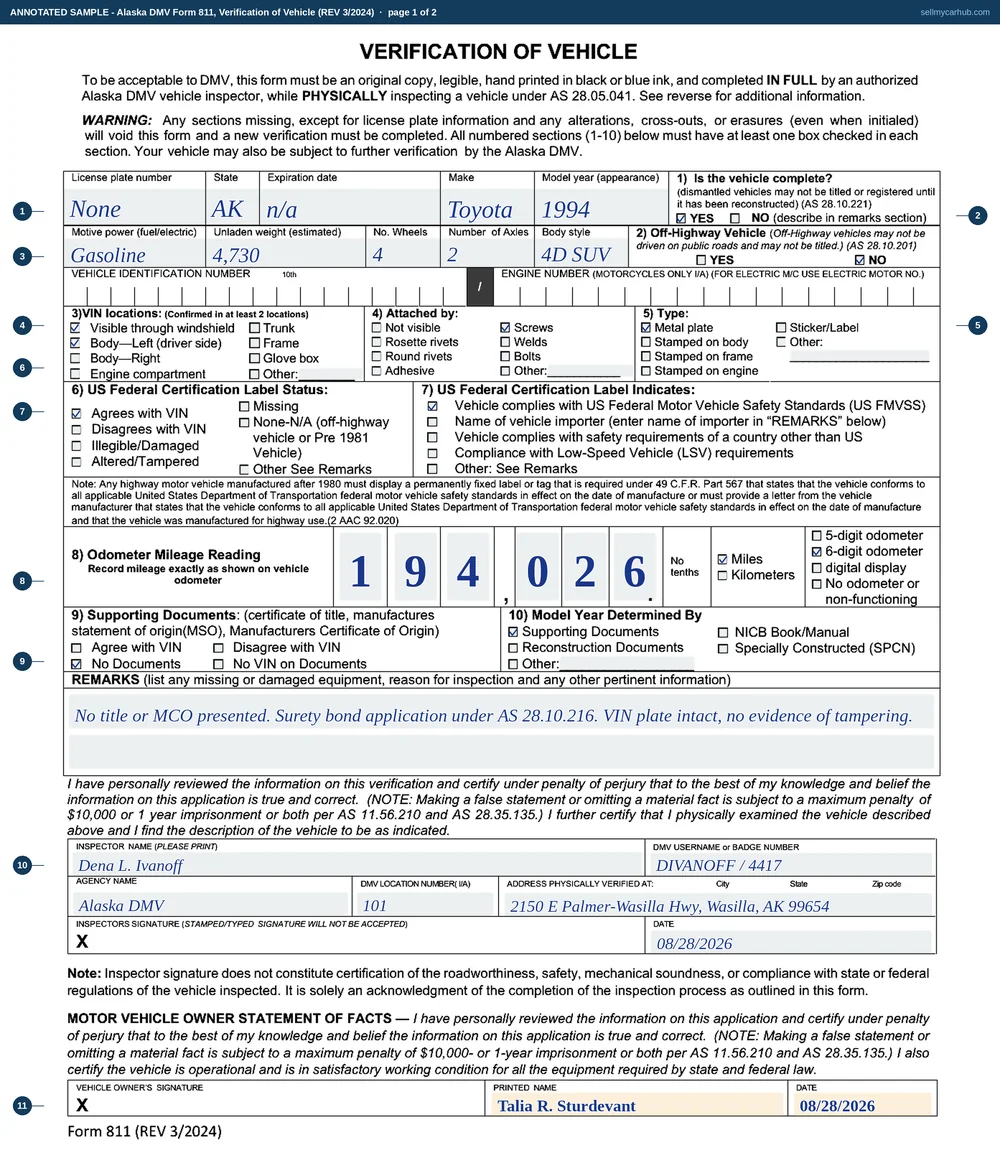
| The header conditions | Four of them, before any box: the form must be an original copy, legible, hand printed in black or blue ink, and completed IN FULL by an authorized Alaska DMV vehicle inspector while PHYSICALLY inspecting a vehicle. |
|---|
| Plate, state, expiration, make, model year | The identification row. Model year is qualified as (appearance) - what the vehicle looks like, which may not be what the documents claim. |
|---|
| 1) Is the vehicle complete? | Yes or no, with a note that dismantled vehicles may not be titled or registered until reconstructed, citing AS 28.10.221. A no goes into the remarks section. |
|---|
| Motive power, unladen weight, wheels, axles, body style | The physical description row: fuel or electric, an estimated unladen weight, the number of wheels and axles, and the body style. |
|---|
| 2) Off-Highway Vehicle | Yes or no, with the consequence printed beside it - off-highway vehicles may not be driven on public roads and may not be titled. |
|---|
| Vehicle identification number, 10th digit, engine number | The VIN comb, a separate cell for the tenth character, and an engine number box for motorcycles - for an electric motorcycle, the electric motor number. |
|---|
| 3) VIN locations, confirmed in at least 2 locations | Nine tick boxes: visible through windshield, body left, body right, engine compartment, trunk, frame, glove box, other, and not visible. Two must be found. |
|---|
| 4) Attached by | How the VIN plate is fixed: screws, rosette rivets, round rivets, adhesive, welds, bolts or other. It is a tamper check written as a multiple choice. |
|---|
| 5) Type | What the VIN actually is: a metal plate, a sticker or label, stamped on body, stamped on frame, stamped on engine, or other. |
|---|
| 6) US Federal Certification Label Status | Agrees with VIN, disagrees with VIN, illegible or damaged, altered or tampered, missing, none, or other. The note under it sets out the 49 CFR Part 567 requirement for any highway motor vehicle manufactured after 1980. |
|---|
| 7) US Federal Certification Label Indicates | What the label says: compliance with US Federal Motor Vehicle Safety Standards, the name of an importer, compliance with another country's requirements, low-speed vehicle compliance, or other. |
|---|
| 8) Odometer Mileage Reading | Recorded exactly as shown on the vehicle, with ticks for no tenths, miles or kilometres, and for a 5-digit, 6-digit or digital display, or no odometer or a non-functioning one. |
|---|
| 9) Supporting Documents | Whether the certificate of title, manufacturer's statement of origin or certificate of origin agrees with the VIN, disagrees, is absent, or carries no VIN at all. |
|---|
| 10) Model Year Determined By | Supporting documents, the NICB book or manual, reconstruction documents, specially constructed, or other. |
|---|
| Remarks | Missing or damaged equipment, the reason for the inspection, and anything else pertinent. On a bonded-title inspection this is where the absence of a title is recorded. |
|---|
| Inspector's certification | Printed name, DMV username or badge number, agency name, DMV location number, the address physically verified at, signature - a stamped or typed signature will not be accepted - and date. The note under it is careful: the signature is not a certification of roadworthiness, safety or mechanical soundness, only an acknowledgment that the inspection was completed. |
|---|
| Motor Vehicle Owner Statement of Facts | The last block on the page and the only one that is yours: the owner's signature, printed name and date, certifying under penalty of perjury that the information is true and that the vehicle is operational and in satisfactory working condition for all the equipment required by state and federal law. |
|---|
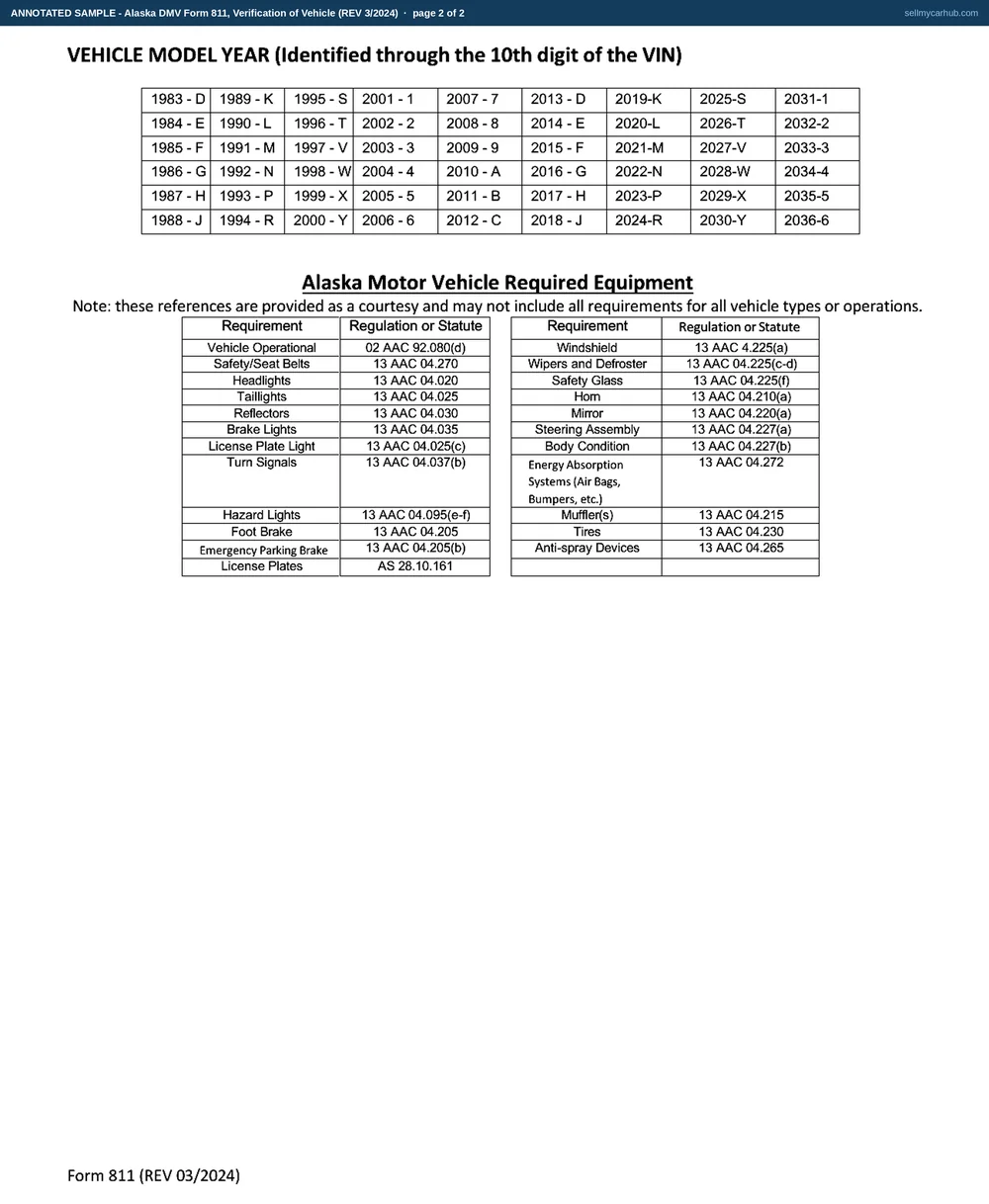
| The reverse | Two reference tables rather than anything to fill in: the model-year letter for the tenth digit of a VIN from 1983 to 2036, and the Alaska required-equipment list with the regulation for each item, from headlights at 13 AAC 04.020 to anti-spray devices at 13 AAC 04.265. |
|---|
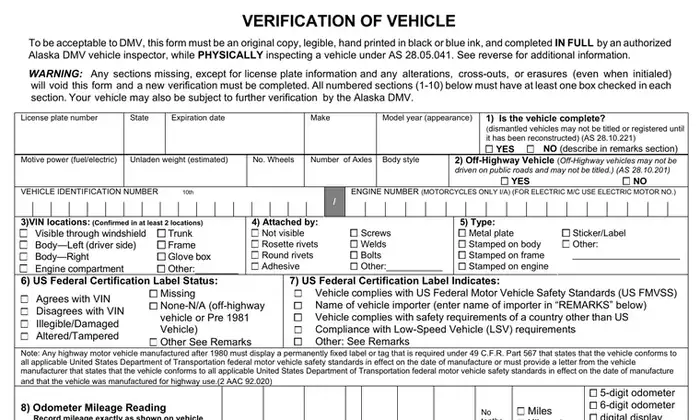 Step 1 · the form itself
Blank Form 811 — Verification of Vehicle
PDF at dmv.alaska.gov · new tab
View the blank Form 811
Step 1 · the form itself
Blank Form 811 — Verification of Vehicle
PDF at dmv.alaska.gov · new tab
View the blank Form 811
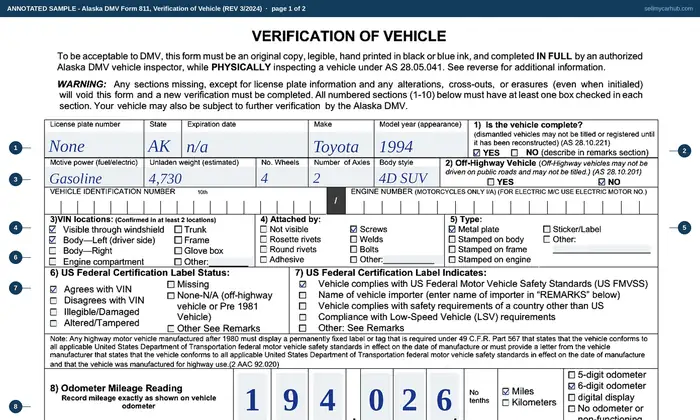 Step 2 · how to fill it in
Our filled-in Form 811 guide
PDF · 4 pages · 840 KB · new tab
See our filled-in example
Step 2 · how to fill it in
Our filled-in Form 811 guide
PDF · 4 pages · 840 KB · new tab
See our filled-in example