What is filed after an insurer settles a theft claim on a car that was never found. Alabama treats a theft settlement as a total loss, so the vehicle has to leave the owner's name even though nobody can produce it. The insurer completes most of the sheet; the owner at the time of the theft completes the certification at the bottom, and only where the certificate itself is lost or stolen along with the car - which, given that the certificate is usually in the house rather than the glovebox, is not automatic.
Written against MVT 40-1E (2/24), issued under Code of Ala. 1975, Section 32-8-87(b)(1)d. If your car was stolen and you are still the registered owner, the plate is still registered to you as well. Alabama has no notice of sale and no automatic link between a police report and the registration, so the insurance verification machinery keeps running on a vehicle that no longer exists. Surrendering the plate at the county office is what stops that, and it is a separate errand from the insurance claim.
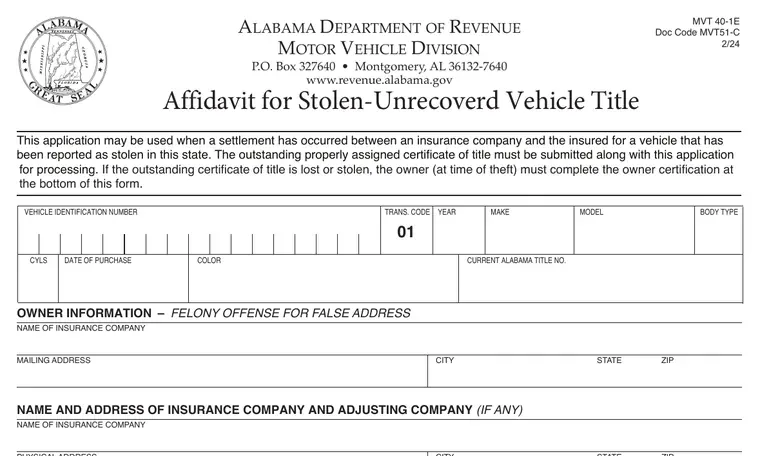
Two documents, and they are not the same thing. Take the blank MVT 40-1E from the revenue.alabama.gov copy so you get the revision that is current today.
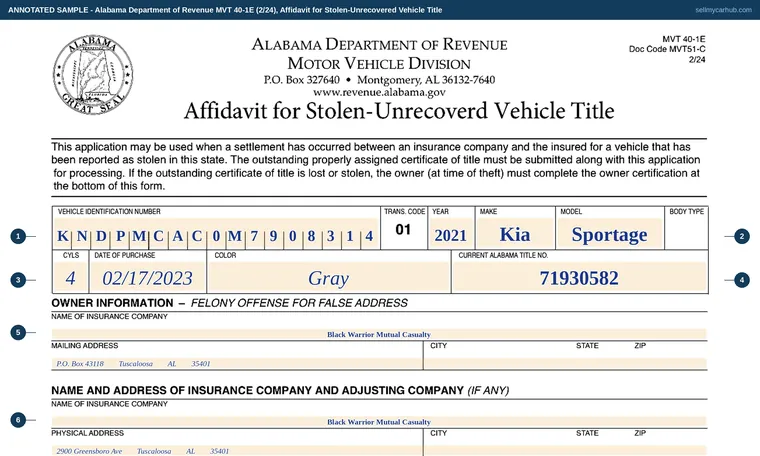
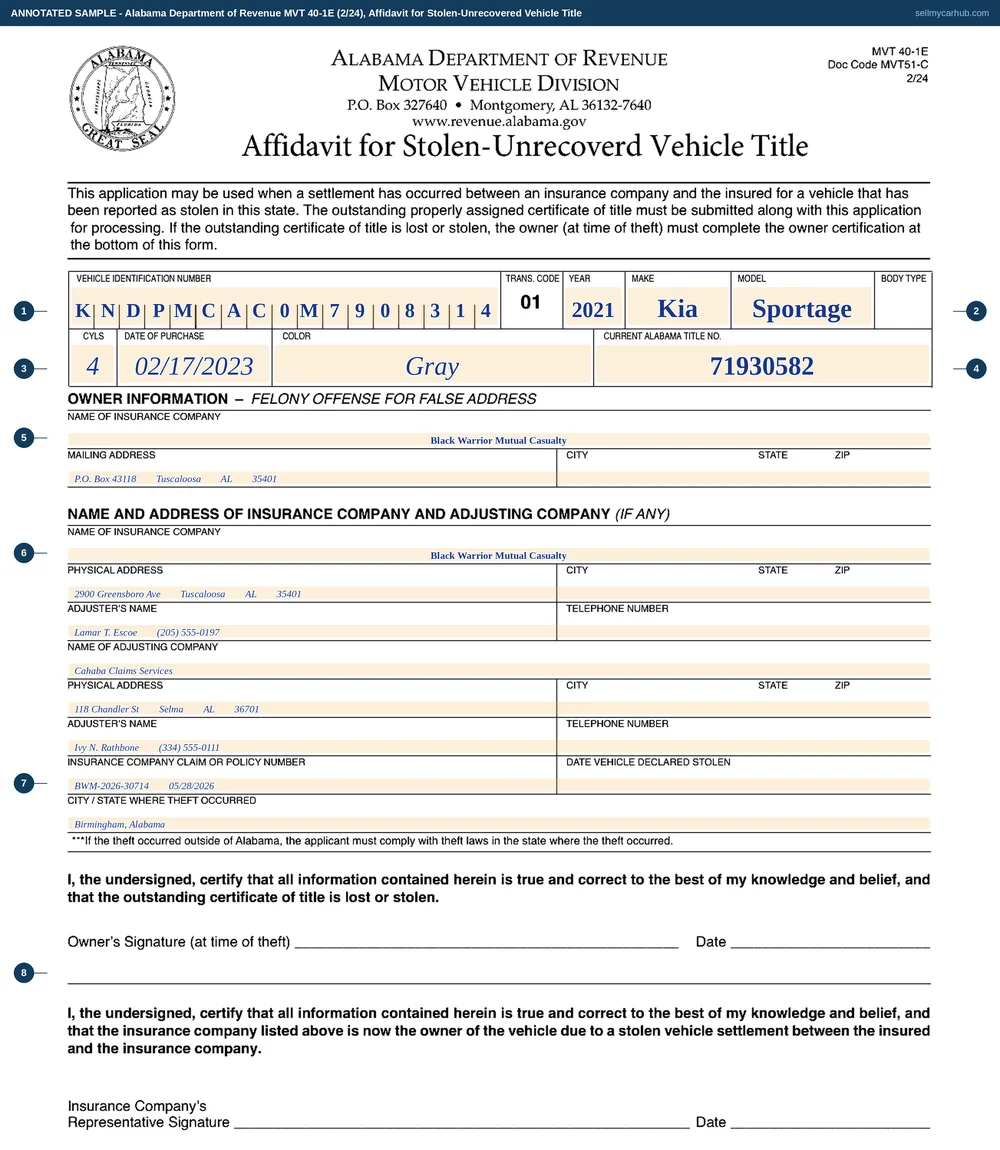
This is the actual MVT 40-1E, rendered from the PDF the Alabama Department of Revenue, Motor Vehicle Division publishes and completed end to end: letterhead, every field, and the blocks at the foot.
Seventeen characters, one to a box, in the comb across the head of the form.
Watch out: One character per box. A VIN written continuously through a comb is the single most common reason a scanned Alabama form comes back.
Four fields to the right of the preprinted transaction code.
Watch out: The transaction code is already printed as 01 and is not yours to change. It tells the Department which kind of title transaction this is.
Three fields on the second row, describing the vehicle as the certificate describes it.
Watch out: Date of purchase is when you bought the car, not the date of the theft or of the settlement. Three dates live on this form and they are all different.
The number of the certificate that is being replaced, at the right-hand end of the vehicle band.
Watch out: If you cannot find it, a designated agent can. It is what connects this affidavit to a real record rather than to a VIN.
The insurance company's name and mailing address, because after a settlement the insurer is the owner.
Watch out: The block is headed FELONY OFFENSE FOR FALSE ADDRESS in italics, and that heading is on the block a company completes, not the one you do.
Names, physical addresses, adjuster names and telephone numbers for the insurer and, if there is one, the adjusting company.
Watch out: Two adjusters can appear on one claim. The form gives each of them a name and a number because the Department may well ring one of them.
The insurance company claim or policy number, and the date the vehicle was declared stolen.
Watch out: Declared stolen, not reported stolen. Insurers use both dates and only one of them belongs here.
You sign and date, certifying the information is true and that the outstanding certificate of title is lost or stolen.
Watch out: Only sign this if the certificate really is gone. If it is in a drawer at home, the insurer needs it properly assigned instead, and this block stays empty.
| On the form | What to put in it |
|---|---|
| Vehicle identification number and transaction code | The VIN in a comb of boxes across the top, with the transaction code preprinted as 01. |
| Year, make, model, body type | Four fields on the same row as the transaction code. |
| Cylinders, date of purchase, colour, current Alabama title number | The second row of the vehicle band. |
| Owner information | Headed with a warning in italics - FELONY OFFENSE FOR FALSE ADDRESS - and asking for the name of the insurance company and its mailing address, because after settlement the insurer is the owner. |
| Name and address of insurance company and adjusting company | A second, longer block: the insurer's name and physical address, the adjuster's name and telephone, then the same four fields again for an adjusting company if one is involved. |
| Claim details | Insurance company claim or policy number, and the date the vehicle was declared stolen. |
| City and state where the theft occurred | One line, followed by a warning that if the theft occurred outside of Alabama, the applicant must comply with theft laws in the state where the theft occurred. |
| Owner's certification | A paragraph signed by the owner at the time of the theft, certifying that all information contained herein is true and correct and that the outstanding certificate of title is lost or stolen, with a signature and date. |
| Insurance company's representative certification | A second paragraph and signature block, certifying that the insurance company listed above is now the owner of the vehicle due to a stolen vehicle settlement between the insured and the insurance company. |
Every line here was read off MVT 40-1E (2/24) itself — the PDF is here — and off the Alabama Department of Revenue, Motor Vehicle Division pages. This is plain-language help with a form, not legal advice, and where our wording and the agency's differ, theirs governs.
Back to all Alabama seller paperwork, or what selling a car in Alabama involves.