Sell My Car Hub

How to fill out an Alabama title

Everything a seller writes on an Alabama certificate is on the reverse, in one block headed with a warranty sentence. The Department of Revenue publishes a picture of the front and none of the back, so this page does both: its own specimen of the face, unaltered, and a drawn diagram of the assignment block with every printed phrase transcribed from the Department's own correction form for it.

There is no blank Alabama certificate to download and there never has been. It is secure stock printed by the Department of Revenue and posted to the owner, or to the lienholder if one is recorded, ten to fifteen days after an application is processed. The Department does not print titles on demand at a counter.

Any alteration or erasure voids the assignment - printed as a legal notice on the Department's own correction form, and backed by rule 810-5-75-.39, which refuses any document that has been altered.

The Department gives no numbered field guide for the certificate. The order below is the order the block is printed in, top to bottom, as it appears on the MVT 5-7 correction affidavit and the MVT 8-3 reassignment supplement - both of which reproduce the same block in the same words because their whole purpose is to replace it.

The half you actually fill in

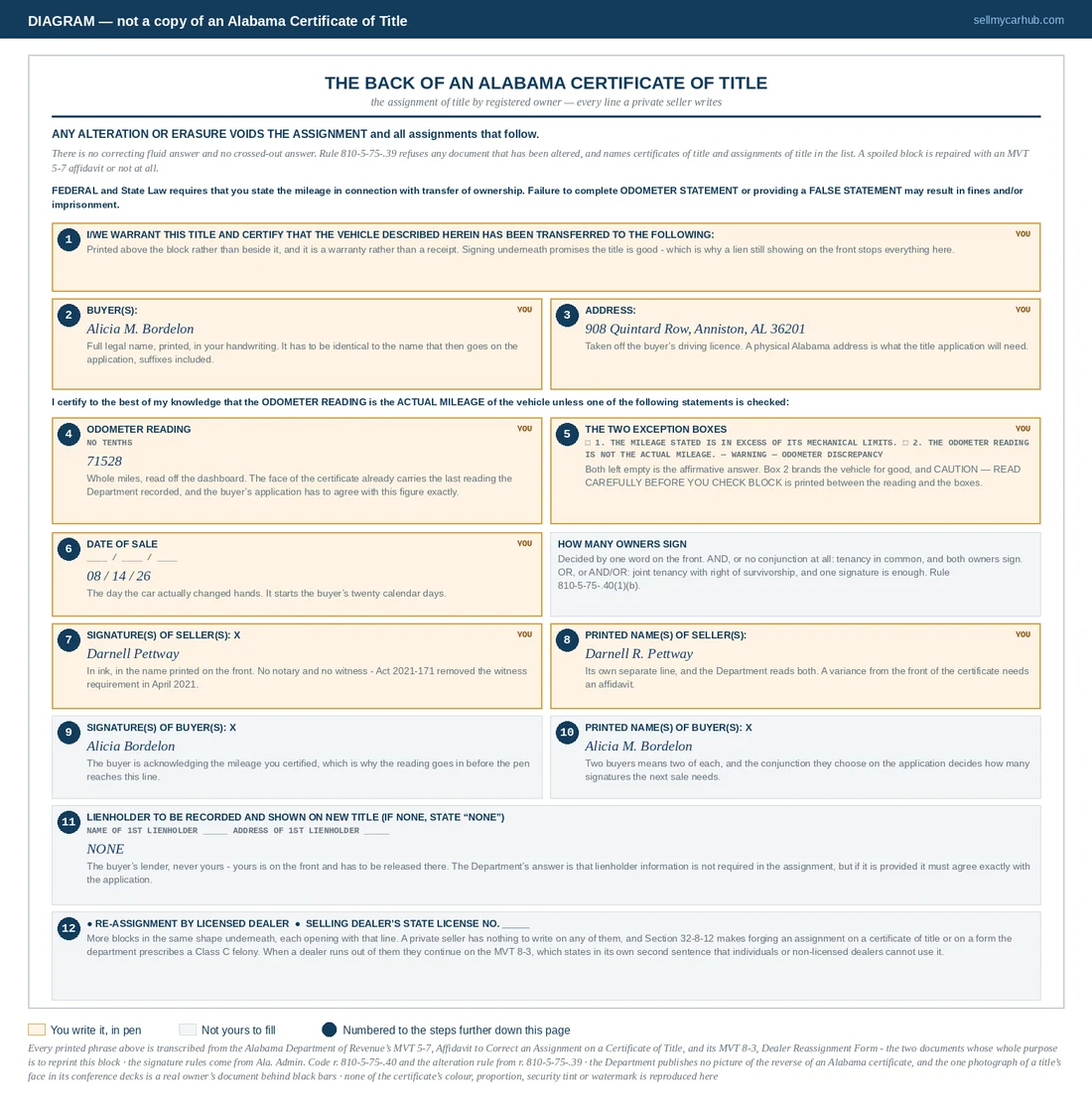
The assignment block on the back, drawn line for line

The Department publishes no picture of the reverse of an Alabama title. What it does publish is two forms whose entire job is to replace this block when it goes wrong - the MVT 5-7 correction affidavit and the MVT 8-3 dealer reassignment supplement - and both reproduce it phrase for phrase. Every printed sentence in the diagram below is transcribed from one of those two documents or from the rule that governs it. Nothing is copied from a certificate, and none of the certificate's colour, security tint or proportion is reproduced.

A diagram of the assignment block on the back of an Alabama certificate of title, filled in: the buyer's name and address, an odometer reading of 71528 with neither exception box ticked, a date of sale, the seller's signature and printed name, the buyer's signature and printed name, and NONE written on the lienholder line.
Marked DIAGRAM across the top because that is what it is. The wording is the Department's; the layout is ours, drawn so the order of the lines is right rather than so the sheet looks like a title.
A real Alabama title, front only

What the Department does publish a picture of

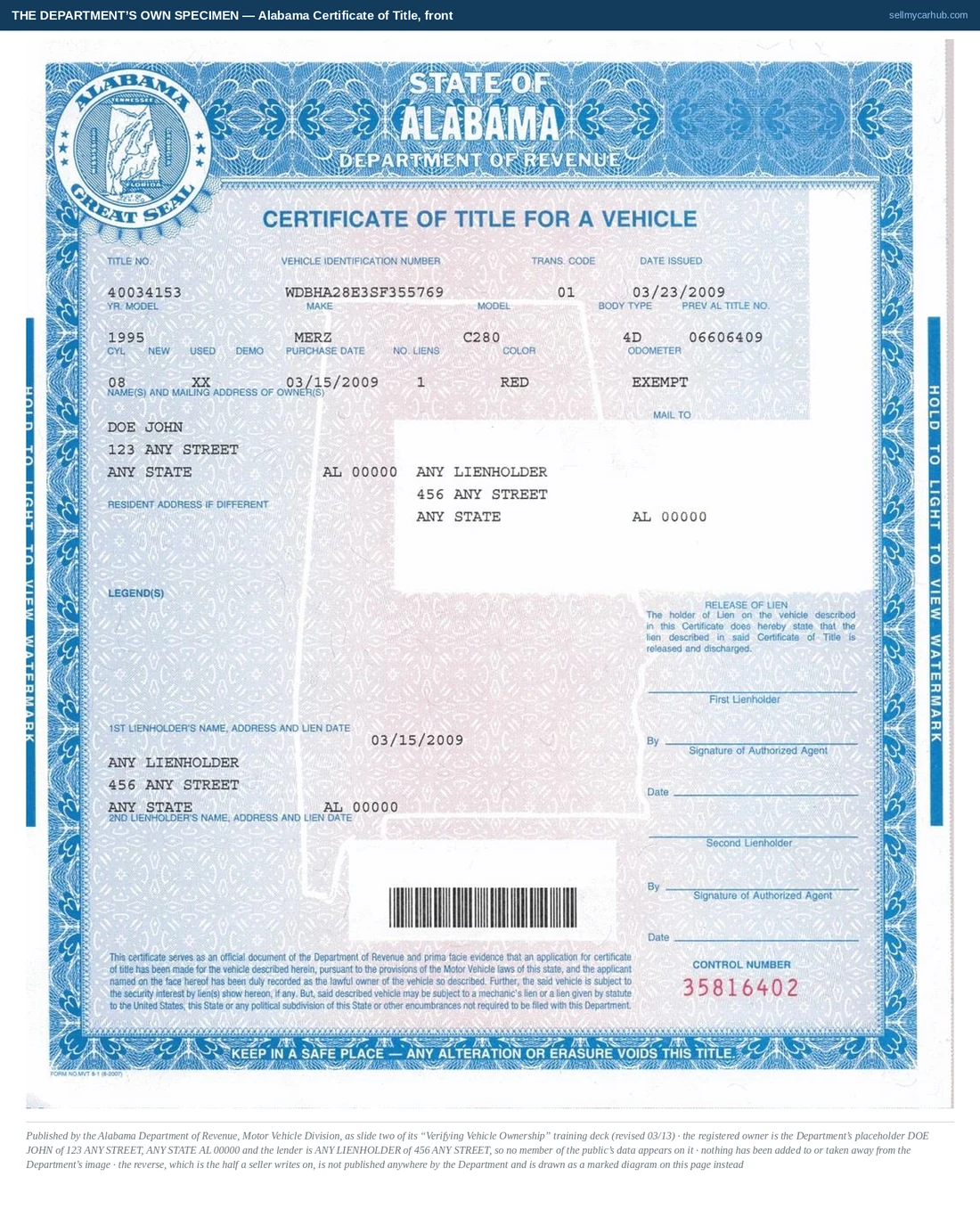
This is the Alabama Department of Revenue's own specimen of a Certificate of Title for a Vehicle, lifted from slide two of its Verifying Vehicle Ownership training deck. The owner block reads DOE JOHN of 123 ANY STREET, ANY STATE AL 00000, and the lienholder is ANY LIENHOLDER at 456 ANY STREET - the Department's placeholders, not a member of the public's data. Read the bottom band before you turn it over: KEEP IN A SAFE PLACE - ANY ALTERATION OR ERASURE VOIDS THIS TITLE.

The front of an Alabama Certificate of Title for a Vehicle published by the Department of Revenue as a training sample. The State of Alabama Great Seal sits top left, the heading CERTIFICATE OF TITLE FOR A VEHICLE runs across the middle, and the data band shows a title number, vehicle identification number, transaction code, date issued, year model, make, model, body type, previous Alabama title number, cylinders, purchase date, number of liens, colour and odometer. The owner is shown as DOE JOHN at 123 ANY STREET and the first lienholder as ANY LIENHOLDER. A release of lien block runs down the right-hand side and a control number is printed at the foot.
None of this face is yours to write on. Two things on it matter to a seller anyway: the odometer figure the Department already holds, which the mileage you write on the back will be read against, and the 1ST LIENHOLDER block - if a lender is named there and the release beside it is empty, the car cannot be sold until that is fixed.
Step by step

Every box, in the order you meet it

  1. 1
    You fill this in

    The warranty sentence above the block

    Nothing to write - but read it, because signing underneath is agreeing to it. It says: I/we warrant this Title and certify that the vehicle described herein has been transferred to the following.

    Watch out: Warrant is the operative word. You are not just recording a sale, you are promising the title is good. That is why a lien printed on the front and not released on the front stops everything here.

  2. 2
    You fill this in

    Buyer(s)

    The buyer's full legal name, printed, in your handwriting rather than theirs.

    Watch out: It has to match what goes on the application afterwards, down to the suffix. The Department's own answer: the owner name(s) on the title application must be identical to the owner name(s) in the assignment of the MSO, title or any other supporting document. This includes suffixes (Jr., III, etc.).

  3. 3
    You fill this in

    Address

    The buyer's address on the same line, taken off their driving licence rather than off a text message.

    Watch out: A physical Alabama address is what the application will need. A buyer whose only address is a post office box has a problem coming, and it is easier to find that out now than at the counter.

  4. 4
    You fill this in

    Odometer reading, no tenths

    Whole miles, read off the dashboard. The certification printed above it says the reading is the actual mileage unless one of the two boxes beside it is ticked.

    Watch out: This figure is checked twice. The face of the certificate carries the reading the Department recorded last time, and the application the buyer signs has to agree exactly with what you write here - the Department's words are that the mileage on the application must agree exactly with the mileage listed in the title assignment.

  5. 5
    You fill this in

    The two exception boxes

    Box 1 is that the mileage stated is in excess of its mechanical limits. Box 2 is that the odometer reading is not the actual mileage, and the form prints WARNING - ODOMETER DISCREPANCY under it.

    Watch out: Ticking nothing is the affirmative answer, not an omission. Tick box 2 and the discrepancy follows the vehicle onto every certificate it is issued afterwards, so it is not a box to use to be helpful about a broken cable.

  6. 6
    You fill this in

    Date of sale

    The day the car actually changed hands, in the three-part date field beside the mileage.

    Watch out: This is the day the buyer's twenty calendar days start running. Backdating it to be kind shortens their clock and hands them a $15.00 penalty.

  7. 7
    You fill this in

    Signature(s) of seller(s)

    Signed in ink, in the name printed on the front of the certificate. If two owners are named and joined by AND, both signatures go here.

    Watch out: No notary and no witness. What there is instead is a designated agent who will identify the person signing the application and verify the signature - so a signature that does not resemble the name on the front is a conversation, not a formality.

  8. 8
    You fill this in

    Printed name(s) of seller(s)

    Printed beside the signature, on its own line. The block asks for both and the Department reads both.

    Watch out: Print it exactly as the front of the certificate has it. A variance between the two needs an affidavit attesting to the variance in the name, which is a form and a return trip.

  9. 9
    The buyer fills this in

    Signature(s) of buyer(s)

    The buyer signs, acknowledging the mileage certification you have just made.

    Watch out: They are signing your figure, not their own. That is the reason the reading goes in before the pen ever reaches this line.

  10. 10
    The buyer fills this in

    Printed name(s) of buyer(s)

    Printed beside the buyer's signature, closing the block.

    Watch out: Two buyers means two signatures and two printed names, and the conjunction they choose on the application - AND or OR - decides how many signatures the next sale will need.

  11. 11
    The buyer fills this in

    Lienholder to be recorded and shown on new title

    The buyer's lender, if they are financing it. The printed instruction is explicit: if none, state NONE.

    Watch out: This is the buyer's lender, never yours. Yours is on the front and has to be released there. And an empty line is not the same as NONE - the Department's answer is that the lienholder information is not required in the assignment, but if it is provided it must agree exactly with the application.

  12. 12
    Dealers only

    The reassignment blocks underneath

    More blocks in the same shape, each opening with RE-ASSIGNMENT BY LICENSED DEALER and a line for the selling dealer's state licence number.

    Watch out: Not yours, at any price. When a dealer runs out of them they continue on the MVT 8-3, which states in its own second sentence that individuals or non-licensed dealers cannot use this form to re-assign a certificate of title.

Before the pen

Six habits for the block on the back

Six habits, and the first one is about a figure the Department can already check against its own file.

Nothing may be tidied up afterwardsNo white-out, no strike-through, no initialled correction. The repair is an MVT 5-7 attached to the application, and only for the assignment - an error on the face of the certificate needs a whole new one.
Read the front before you write on the backThe conjunction between two owners' names decides whether one signature transfers the car or two are needed, and the lienholder block decides whether it can be sold at all today.
Write the mileage off the dashboardThe Department already holds the last reading and prints it on the face. The application will be compared against what you write, exactly, not approximately.
Write NONE on the lienholder lineThe block says to. A blank line invites somebody else to fill it in later, and the buyer's lender is the only name that belongs there.
Make a bill of sale even though the title is signedRule 810-5-1-.246 lists eleven things one has to carry, the licensing official will want it for the tax, and it is the document that proves the date you stopped owning the car.
Take the plate off before they leaveIt is yours. It is also still registered to you, which is what makes the insurance notice arrive months later.

The ink rule is the Motor Vehicle Division's own: “The department will not accept any document that has been altered (i.e. correction fluid, strike throughs). This includes, but is not limited to, applications for title, certificates of title, manufacturer's certificates of origin, assignments of titles and certificates of origin, bills of sale, affidavits and all forms required by the department” — Alabama Department of Revenue, Motor Vehicle title FAQs.

Check your source

Three Alabama rules that get repeated backwards

Three things said with total confidence about selling a car in Alabama. Each one has a source under it, and each one costs a seller either a wasted certificate or a suspension letter.

"The tag stays on the car - the law says you hand it over with the keys."

It said that once, and the sentence is still in the Code. Section 32-8-47(c), written into the 1973 title act and never repealed, does tell a transferor to deliver the license plate to the transferee - and then adds a proviso: provided, that the license plate does not have to be delivered where a provision of law allows such plate to be retained by the owner of the vehicle. Section 40-12-260(a)(1), effective 1 January 1998, is that provision of law, and it says the plate shall be removed from the vehicle and retained by the original plate owner. Read only Chapter 8 and you will get Alabama's plate rule exactly backwards.

Code of Alabama 1975, Sections 32-8-47 and 40-12-260

"Old car, no paperwork - just sign the title over and forget it."

There may be no title to sign. Section 32-8-31(13) says no certificate of title shall be issued for any motor vehicle more than 35 model years old, counted against the current calendar year and reset every 1 January, so through 2026 nothing built for 1990 or earlier has one. What transfers such a car is a bill of sale meeting the eleven requirements in rule 810-5-1-.246, and the county licensing official has to physically inspect the vehicle and the ownership documentation before issuing a registration on it.

Alabama Department of Revenue, what vehicles are required to be titled

"Once the title is signed the car is off my hands, so I can cancel the insurance."

The title and the registration are two different records, and only one of them moved. The Department verifies insurance against registrations, and yours is still live until the plate comes off it - which is why an insurance verification notice can land on a car you sold in the spring. Its own instruction is to provide documentation (bill of sale, etc.) and surrender the license plate to the local licensing official to complete the revocation process. Thirty days of silence suspends the registration, and lifting that costs $200 the first time and $400 after.

Alabama Department of Revenue, insurance verification on a vehicle already sold
Who has to sign

Six rules about who signs, and the first two are decided by one word printed on the front:

Every owner joined by ANDRule 810-5-75-.40(1)(b): two owners joined by the conjunction and, or with no conjunction between the names, have tenancy in common ownership rights, and both owners are required to sign the title assignment.
One owner where it says ORThe same rule: two owners joined by the conjunction or or and/or have joint tenancy ownership rights with rights of survivorship and only one owner is required to sign.
The seller, printed as well as signedThe block carries two separate lines - signature of seller(s) and printed name(s) of seller(s) - and the Department reads both.
The buyer, in the same blockSignature and printed name, under the seller's, acknowledging the mileage the seller has just certified.
Nobody in front of a notaryNo stamp, no seal, no witness line. Act 2021-171 took the witness requirement out in April 2021 and the notary was never there.
Not a dealer, unless one is actually sellingThe reassignment blocks carry a selling dealer's state licence number. A private seller who writes in one has claimed to hold a dealer licence on a document Section 32-8-12 makes a felony to falsify.

Once it is signed

Signing is the middle of the job in Alabama, not the end. What follows is the plate coming off the car and the registration coming off your name, in that order, before you ring the insurer.

The two things that follow a signed title — what happens to the plates and telling the Motor Vehicle Division the car is gone — are set out in full on the Alabama paperwork page rather than repeated here.

The forms that go with it: the separate mileage statement, for when the title has no room left, the repair for a block you have already spoiled and the plate side, once the car has gone.

Every field description here is taken from the Alabama Department of Revenue, Motor Vehicle title FAQs and the Alabama Department of Revenue, Motor Vehicle Division title pages, current as of 2026-08-23. Plain-language help with a form, not legal advice, and where our wording and the agency's differ, theirs governs.

Back to all Alabama paperwork, or what selling a car in Alabama involves.

Or let someone else do the paperwork

Get My Instant Offer → Online · about 2 minutes · free

Or send the details — we'll come to you

Lost certificate, a credit union still holding it, or a truck that has not moved since the tag ran out - tell us what you have and we will tell you the shortest way out of it.

or call/text (877) 405-1808