A single page that carries the mileage certification when the certificate of title cannot. Alabama prints an odometer block inside the assignment on the back of every title, so on an ordinary sale this form is not needed at all - it comes out when the block has been spoiled, when the title is being replaced, when a power of attorney is doing the signing, or when the certificate simply has no assignment space left. It is signed by both of you, and both halves have to be there.
Written against MVT 5-5 (4/25), issued under Federal Truth in Mileage Act of 1986; 49 CFR 580. Do not treat this page as the mileage disclosure on an ordinary Alabama sale. The disclosure that matters is the one printed inside the assignment block on the back of the certificate, and a title arriving with that block blank and this form attached invites the question of why the block could not be used. Where the answer is a good one - the block was spoiled, the title is a replacement, an attorney-in-fact is signing - say so in the paperwork that goes with it.
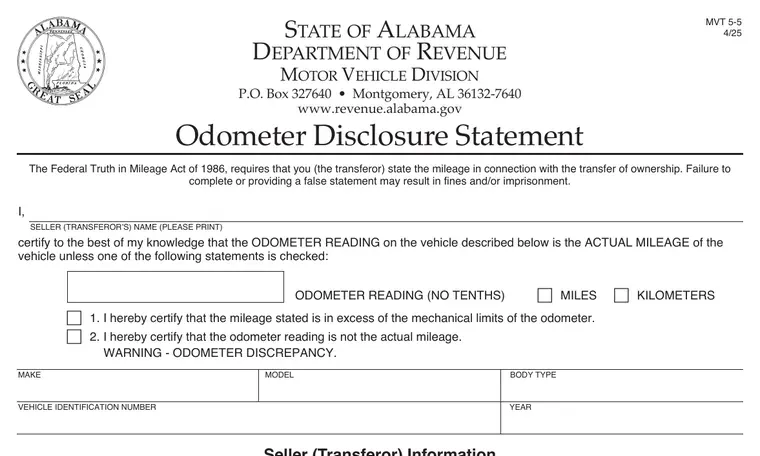
Two documents, and they are not the same thing. Take the blank MVT 5-5 from the revenue.alabama.gov copy so you get the revision that is current today.
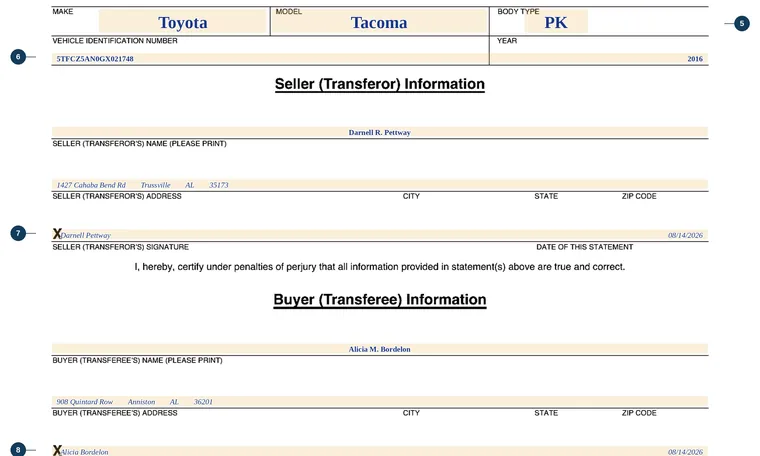
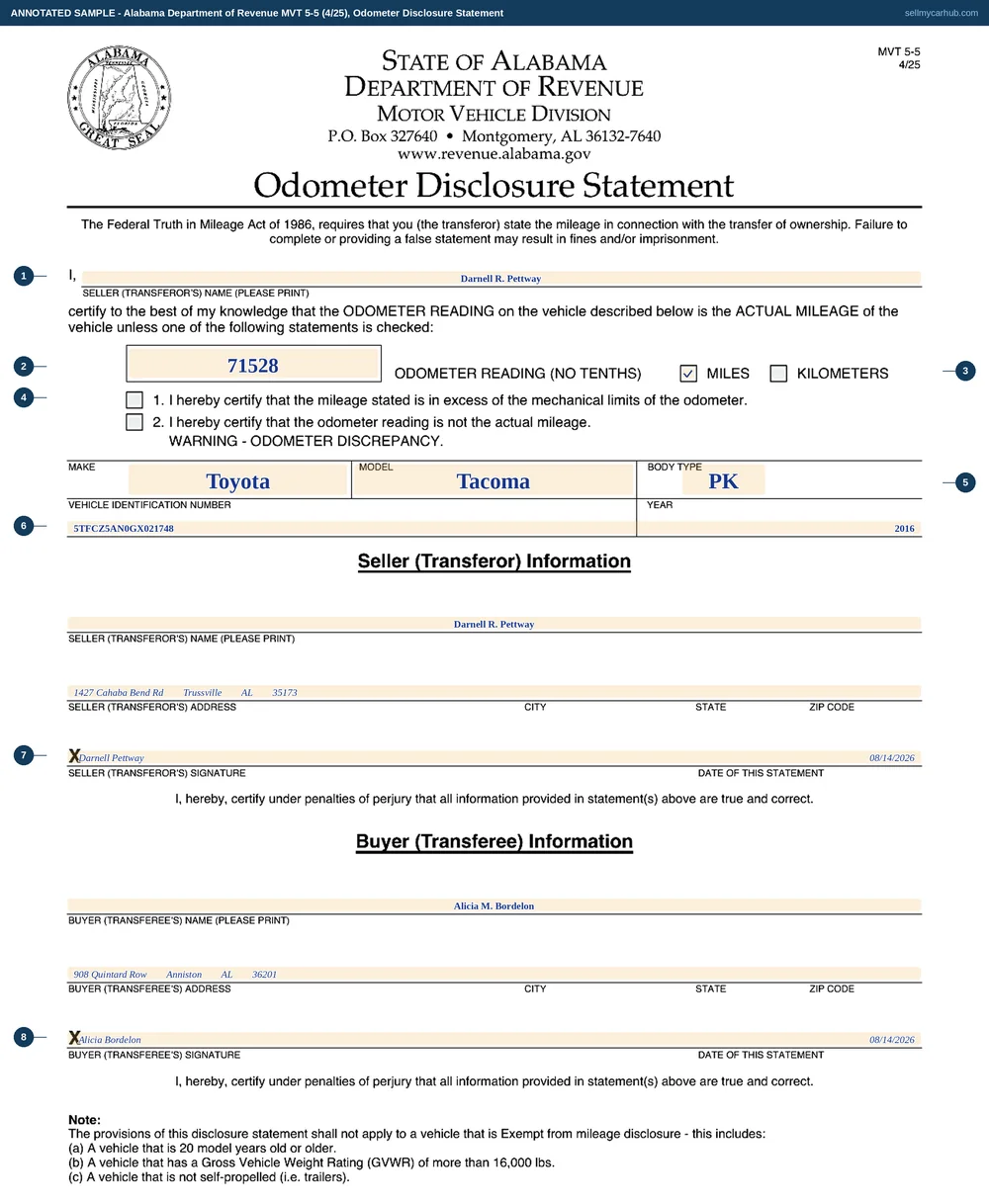
This is the actual MVT 5-5, rendered from the PDF the Alabama Department of Revenue, Motor Vehicle Division publishes and completed end to end: letterhead, every field, and the blocks at the foot.
Your printed name, on the rule at the top, above the label SELLER (TRANSFEROR'S) NAME (PLEASE PRINT).
Watch out: Print it the way the front of the certificate has it. This form travels with a title application, and the Department compares the names on every document in the packet.
The whole-mile figure off the dashboard, in the wide box left of the label.
Watch out: Read it, do not remember it. This figure will be compared with the one already recorded on the face of the certificate and with the one on the buyer's application.
Tick MILES for an ordinary American car. KILOMETERS exists for vehicles imported with a metric instrument.
Watch out: An unticked pair leaves the reading ambiguous, and on a car imported from Canada that ambiguity is a forty percent difference.
Leave both empty if the reading is genuine. Tick 1 if the odometer has rolled past its mechanical limit; tick 2 if the reading is not the actual mileage.
Watch out: Statement 2 brands the vehicle. It follows the car onto every certificate issued afterwards, so it is not a box to tick out of caution about a cable that was replaced years ago.
Three fields across the middle of the page, taken off the certificate of title.
Watch out: Body type is the Department's abbreviation from the face of the title, not a description. Copy what is printed there rather than writing pickup or estate.
The full seventeen characters and the model year, on the row below.
Watch out: Check the VIN against the dashboard plate as well as the title. A designated agent will do exactly that at the counter, and a mismatch found there stops the whole application.
Printed name, street address, city, state and ZIP, then sign on the line marked X and date it.
Watch out: The date of this statement is the date you signed, which should be the date of sale on the title. Two documents in one packet giving two different days is a question the buyer will have to answer without you.
The buyer prints their name and address, signs on their own X line and dates it.
Watch out: They are certifying under penalty of perjury that what you wrote is what they were told. Get it signed before the car leaves - chasing a signature afterwards is how a sale turns into three weeks of telephone calls.
| On the form | What to put in it |
|---|---|
| The opening certification | Your printed name in the gap after the word I, then a sentence you are adopting by signing: certify to the best of my knowledge that the ODOMETER READING on the vehicle described below is the ACTUAL MILEAGE of the vehicle unless one of the following statements is checked. |
| Odometer reading, and the unit | One box for the figure, labelled ODOMETER READING (NO TENTHS), then two small boxes beside it - MILES and KILOMETERS. Almost nobody ticks the second one and almost everybody forgets to tick the first. |
| The two exception statements | Numbered 1 and 2. The first is that the mileage stated is in excess of the mechanical limits of the odometer; the second is that the odometer reading is not the actual mileage, with WARNING - ODOMETER DISCREPANCY printed under it in capitals. |
| Vehicle description | Make, model and body type on one row; the vehicle identification number and the year on the row beneath. Four fields and a VIN, taken off the certificate rather than off the advert. |
| Seller (Transferor) Information | Printed name, address, city, state and ZIP, then a signature line marked with an X and the date of this statement. Under it: I, hereby, certify under penalties of perjury that all information provided in statement(s) above are true and correct. |
| Buyer (Transferee) Information | The identical block again, in the buyer's hand, with its own perjury certification. The form is not complete with only the top half done. |
| The exemption note at the foot | Three lettered exemptions: a vehicle that is 20 model years old or older, a vehicle with a Gross Vehicle Weight Rating of more than 16,000 lbs, and a vehicle that is not self-propelled, with trailers given as the example. |
Every line here was read off MVT 5-5 (4/25) itself — the PDF is here — and off the Alabama Department of Revenue, Motor Vehicle Division pages. This is plain-language help with a form, not legal advice, and where our wording and the agency's differ, theirs governs.
Back to all Alabama seller paperwork, or what selling a car in Alabama involves.