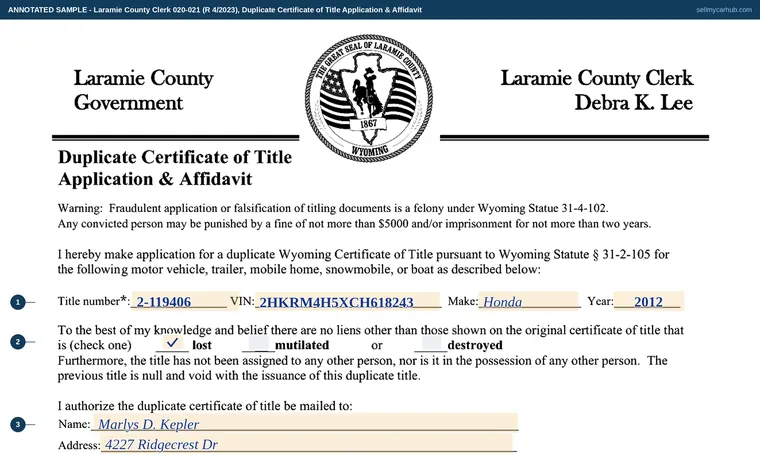
A Wyoming certificate of title is secure stock issued over a county clerk's signature and seal, so there is nothing to reprint at home and nothing to download when yours has gone. What the statute asks for instead is an affidavit describing the loss, filed with the clerk who issued the original - and because it is a county affidavit rather than a state application, the sheet you fill in is your county's own. This is the Laramie County Clerk's, and every Wyoming version does the same four things: identifies the title, swears to what became of it, says where to post the replacement, and gives any lienholder a place to consent to their lien being carried across. The replacement is not a clean sheet: the statute makes the clerk print, in capitals on the face, that it is a duplicate and may be subject to the rights of a person or persons under the original certificate.
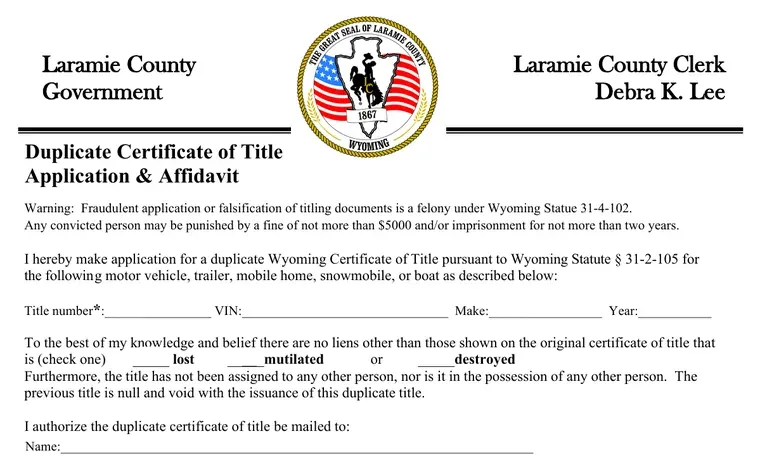
Written against 020-021 (R4/2023), issued under Laramie County Clerk, Cheyenne, on the affidavit W.S. 31-2-105(a) requires; the $15.00 fee is set by W.S. 31-3-102(a)(vii). The line about the previous title being null and void is doing real work, and it is the reason a duplicate is worth taking seriously rather than treating as a reprint. From the moment the duplicate issues, the certificate in the drawer you finally found last week is waste paper - and if you sell on the strength of it, your buyer will be turned away at the counter. Post the old one back to the clerk, or destroy it, and never sign an assignment on both.
Two documents, and they are not the same thing. Take the blank 020-021 from the laramiecountywy.gov copy so you get the revision that is current today, then print our 020-021 guide and keep it beside you while you fill theirs in.
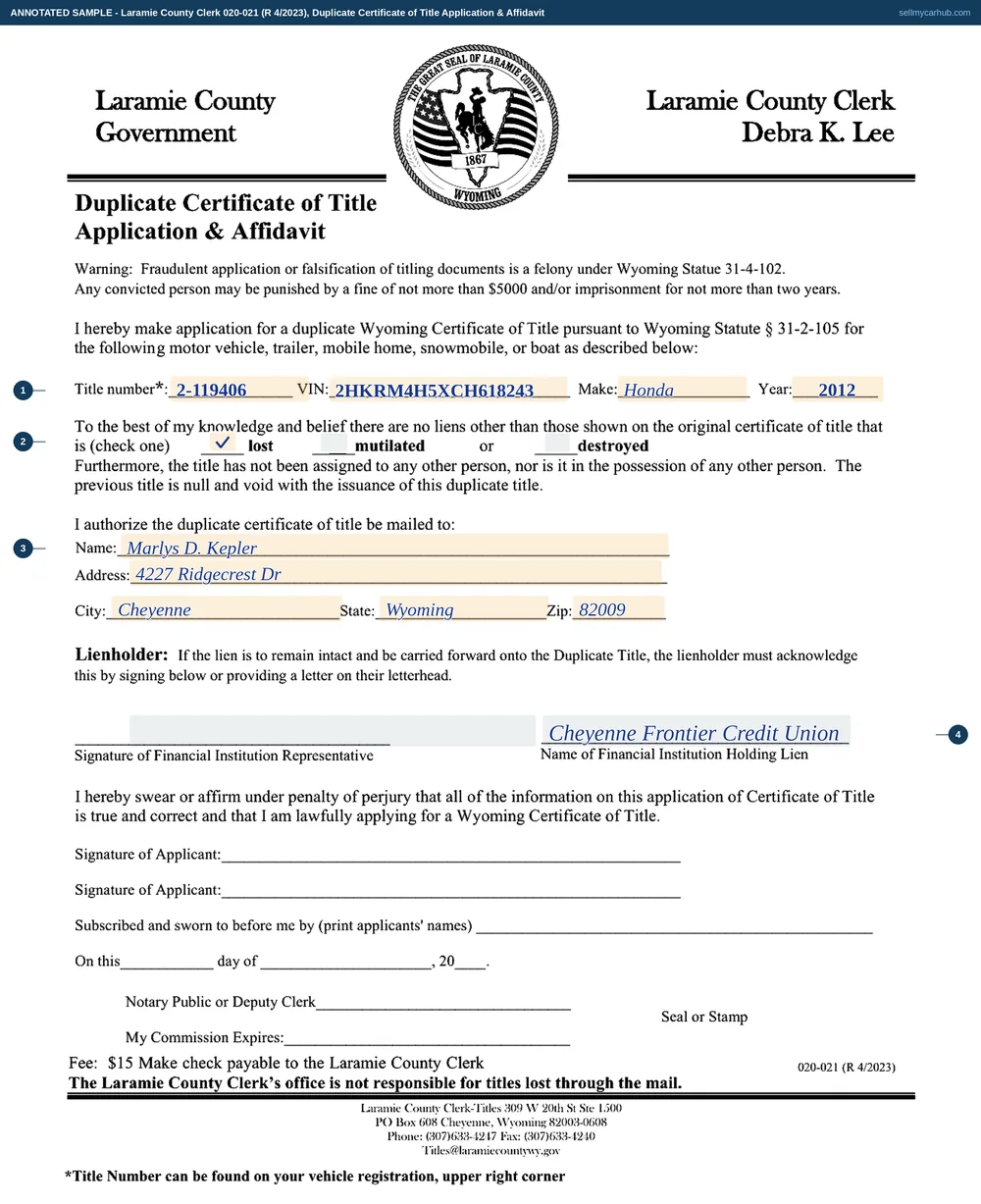
This is the actual 020-021, rendered from the PDF the Wyoming Department of Transportation, Motor Vehicle Services publishes and completed end to end: letterhead, every field, and the blocks at the foot.
Wyoming title numbers open with the county's own prefix number, and the same number opens your plate. Three is Sheridan, two is Laramie, one is Natrona.
Watch out: If you cannot find a title number anywhere, look at the upper right corner of the vehicle registration - the county prints it there, which is the whole reason this form footnotes it.
Title number, identification number, make and year, copied off the registration rather than off memory.
Watch out: The clerk matches all four against the county record. A make written as the trim name on the tailgate rather than the manufacturer is the commonest reason a match fails.
Lost, mutilated or destroyed - one of the three, and it is the sworn part of the affidavit.
Watch out: Mutilated wants the remains handed in with the application. If you are holding a torn or water-damaged certificate, bring it; the clerk would rather take it off you than wonder where it is.
The name and postal address for the duplicate, which need not be the owner's if a lender or an agent is receiving it.
Watch out: A post office box is fine here and safer than a rural route. The county's own footer says plainly that it is not responsible for titles lost in the post.
A representative of the financial institution signs, and the institution is named beside the signature - or supplies a letter on its own letterhead instead.
Watch out: Ask for the letter. A lender's title department will produce one faster than it will get an officer to a Wyoming counter, and the clerk accepts either.
Both applicant lines are used where two people are applying, and the acknowledgement underneath is completed by a notary public or a deputy clerk.
Watch out: Doing this at the clerk's own counter collapses two errands into one: the deputy takes the acknowledgement, takes the fee, and starts the duplicate the same morning.
| On the form | What to put in it |
|---|---|
| Title number, identification number, make and year | One row across the top. The county's own footnote tells you where to find the first of them - the title number is printed in the upper right corner of your vehicle registration. |
| Lost, mutilated or destroyed | Three tick boxes, one of which is the affidavit. Mutilated means you still have it and it is unreadable; destroyed means you know what happened to it; lost means you do not. |
| The no-other-liens sentence | Printed above the tick boxes: to the best of the applicant's knowledge there are no liens other than those shown on the original certificate. It is not a formality - it is the sentence that lets the clerk reissue without hunting the record. |
| The null-and-void sentence | That the title has not been assigned to any other person, nor is it in the possession of any other person, and that the previous title becomes null and void when the duplicate issues. |
| Where to post it | Name, address, city, state and zip. This is a separate block from the owner's name because the two are so often different - a lender, an agent, or an owner who has moved since the title was issued. |
| Lienholder acknowledgement | A signature line for a representative of the financial institution and a line naming the institution, used only where a lien is to remain intact and be carried forward onto the duplicate. The county will take a letter on the lender's own letterhead instead. |
| Applicant signatures | Two lines, sworn under penalty of perjury, above the statement that the applicant is lawfully applying for a Wyoming certificate of title. |
| The notary or deputy clerk block | Subscribed and sworn to before me by, with the applicants' printed names, the day and year, the officer's signature, commission expiry and seal. The county's own staff can take the acknowledgement - the line reads Notary Public or Deputy Clerk. |
Every line here was read off 020-021 (R4/2023) itself — the PDF is here — and off the Wyoming Department of Transportation, Motor Vehicle Services pages. This is plain-language help with a form, not legal advice, and where our wording and the agency's differ, theirs governs.
Back to all Wyoming seller paperwork, or what selling a car in Wyoming involves.