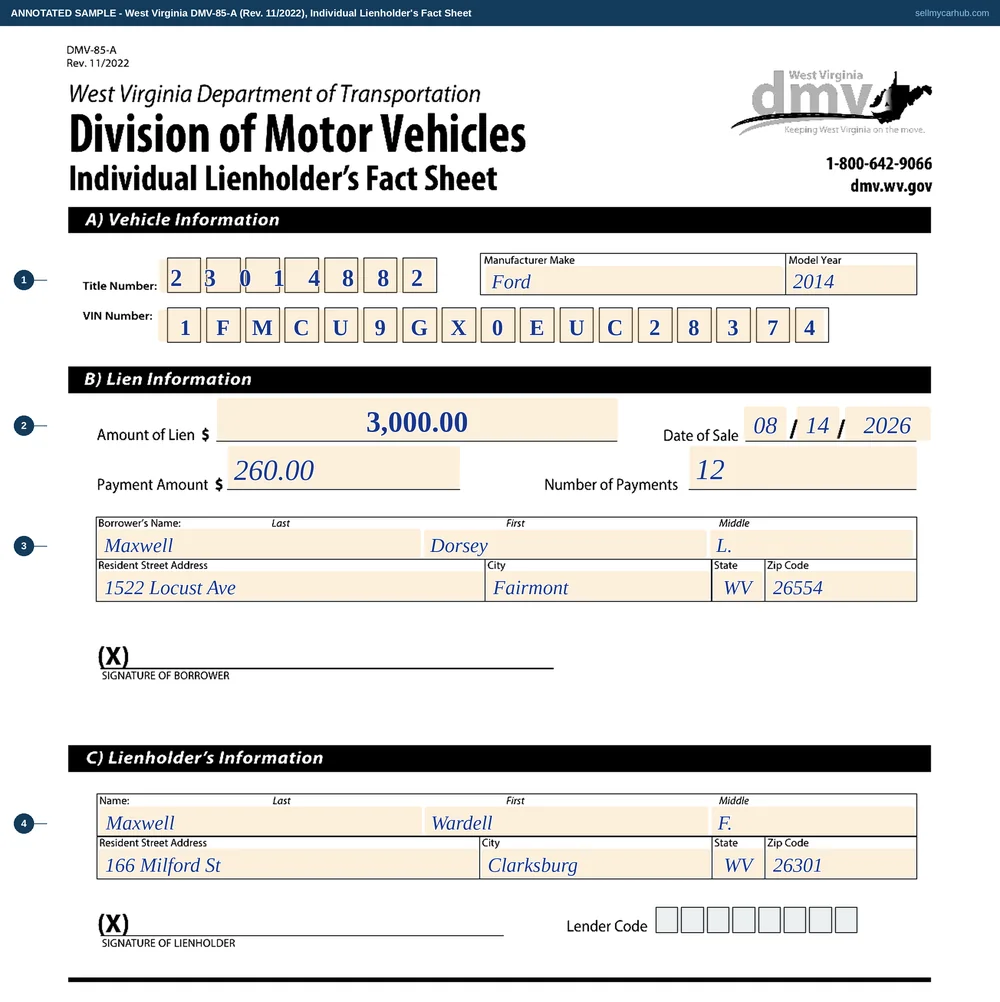
How to fill out West Virginia DMV-85-A
One page of questions the Division asks before it will write a private person's name into the lienholder slot of a certificate - the slot banks occupy. It is the seller-financer's form: sell your car on payments and this sheet records what the deal actually is, in both parties' hands - the amount of the lien, the date of sale, the payment amount and the number of payments - each certifying by signature. The titles page sets the condition around it: any title listing an individual rather than a financial institution as a lienholder must include a physical copy of the signed loan agreement or contract.
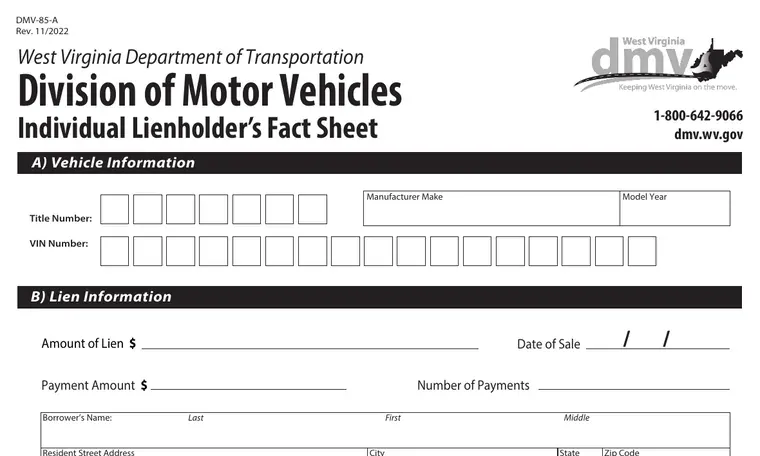 Step 1 · the form itself
Blank DMV-85-A — Individual Lienholder's Fact Sheet
PDF at webapps.transportation.wv.gov · new tab
View the blank DMV-85-A
Step 1 · the form itself
Blank DMV-85-A — Individual Lienholder's Fact Sheet
PDF at webapps.transportation.wv.gov · new tab
View the blank DMV-85-A
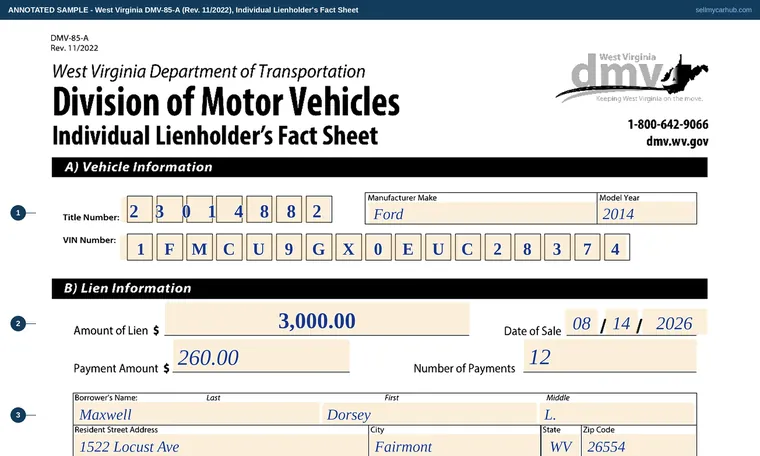 Step 2 · how to fill it in
Our filled-in DMV-85-A guide
PDF · 2 pages · 430 KB · new tab
See our filled-in example
Step 2 · how to fill it in
Our filled-in DMV-85-A guide
PDF · 2 pages · 430 KB · new tab
See our filled-in example
Two documents, and they are not the same thing. Take the blank DMV-85-A from the webapps.transportation.wv.gov copy so you get the revision that is current today, then print our DMV-85-A guide and keep it beside you while you fill theirs in.
Written against DMV-85-A (Rev 11/2022), issued under W. Va. Code 17A-4A-1. Write the numbers from the contract, not from memory of the conversation. The lien amount here is what the Division records and what any later dispute is measured against - and if the deal changes midway, a repriced handshake with an unamended record leaves the certificate carrying a debt neither of you can prove was paid.
Last updated .