Sell My Car Hub

How to fill out West Virginia DMV-12-A-TR

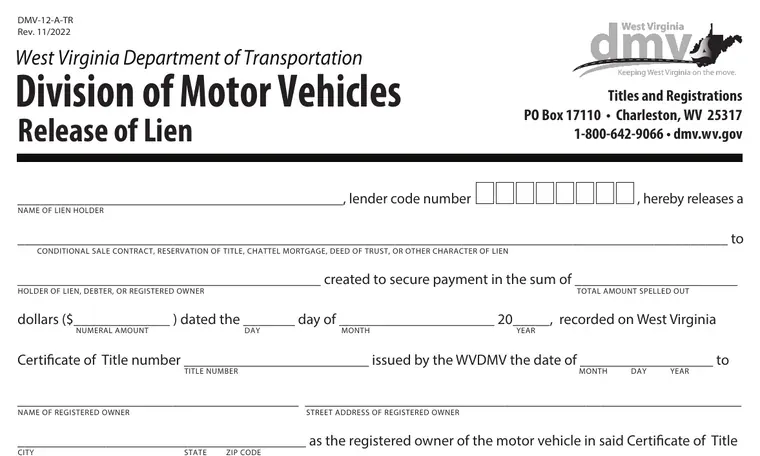
The lender's sworn statement that its claim on your car is over, written as one long legal sentence with blanks in it: the named lien holder, with its lender code number, releases a conditional sale contract, reservation of title, chattel mortgage, deed of trust, or other character of lien created to secure payment of a spelled-out sum, dated, recorded on a numbered West Virginia certificate. A seller needs it in two situations the Division's own titles page describes: when the paper title never came back after payoff, and always before a duplicate can issue clean - if a title is lost while a lien is on file, a formal release from the original lender must be obtained before a duplicate can be printed.
Written against DMV-12-A-TR (Rev 11/2022), issued under W. Va. Code 17A-4A-7. Chase this paper the week the loan ends, not the week a buyer appears. Lenders merge, rename and close - the officer and corporate name the acknowledgement wants must be the current holder of the old lien, and finding who that is years later is the slowest step in every stuck West Virginia sale we hear about.

Two documents, and they are not the same thing. Take the blank DMV-12-A-TR from the webapps.transportation.wv.gov copy so you get the revision that is current today, then print our DMV-12-A-TR guide and keep it beside you while you fill theirs in.

Filled in

What a completed one looks like

This is the actual DMV-12-A-TR, rendered from the PDF the West Virginia Division of Motor Vehicles publishes and completed end to end: letterhead, every field, and the blocks at the foot.

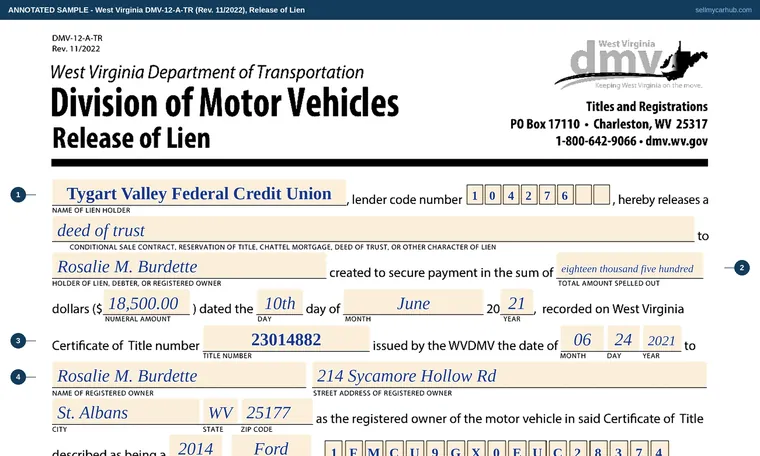
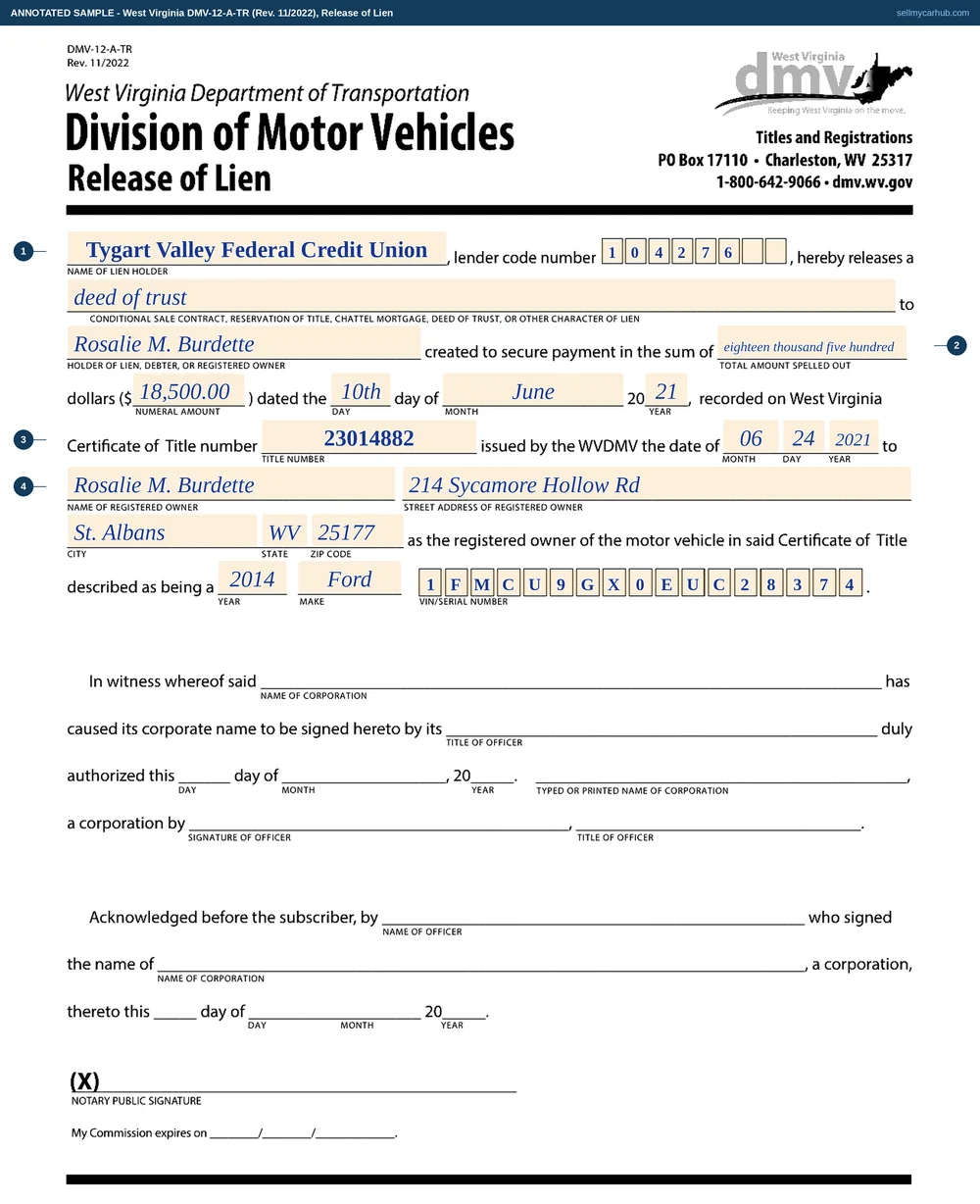
The West Virginia DMV-12-A-TR release of lien filled in: Tygart Valley Federal Credit Union releases a deed of trust of eighteen thousand five hundred dollars on Rosalie M. Burdette's 2014 Ford Escape, with the corporate execution and acknowledgement blocks left for the officer and the notary.
The credit union's release for the loan on the sold Escape, ready for its officer's execution. The sum appears twice, words then figures, because the form checks itself.
Field by field

Every line, in the order you meet it

  1. 1
    The lienholder fills this in

    Lender name and code

    The lienholder writes itself into the opening of the sentence, with its Division lender code.

    Watch out: As the borrower, verify the name matches the lien on your certificate. A lender that rebranded since the loan must explain the chain, not just sign the new name.

  2. 2
    The lienholder fills this in

    The character and amount of the lien

    Which instrument secured the debt, and the sum in words and figures with its date.

    Watch out: These come from the original filing, not from the payoff letter. The release describes the lien as recorded, whatever the final balance was.

  3. 3
    The lienholder fills this in

    Certificate, owner and vehicle

    Title number, issue date, the registered owner's name and address, and the year, make and VIN.

    Watch out: Read your certificate to the officer if you must - every identifier here has to match the state's record, and you hold the document that shows it.

  4. 4
    The lienholder fills this in

    Corporate signature

    The corporation's name signed by its authorised officer, with title and date.

    Watch out: Ask who is authorised before the appointment. Branch staff often are not, and an unauthorised signature is the polite word for a worthless one.

  5. 5
    Somebody else fills this in

    The acknowledgement

    A notary records that the named officer appeared and signed for the corporation, then signs with a commission expiry.

    Watch out: Then file it - with your clear title application, or inside the duplicate-title packet. A release in a drawer clears nothing.

At a glance

What goes where

On the formWhat to put in it
The lienholder and the lienName of lien holder and lender code number, then the character of the lien - conditional sale contract, reservation of title, chattel mortgage, deed of trust or other - as the original filing described it.
The debtHolder of lien, debter, or registered owner as the form spells it, then the secured sum twice: the total amount spelled out in words and the numeral amount in figures, with the day, month and year the lien was dated.
The certificateThe West Virginia certificate of title number, the date the WVDMV issued it, and the registered owner's name and full address as that certificate records them.
The vehicleYear, make and VIN/serial number, closing the sentence that began with the lender's name.
The corporate executionIn witness whereof: the corporation's name, the title of the officer authorised to sign, the date, and the officer's signature - a corporate act, not a teller's initials.
The acknowledgementAcknowledged before the subscriber by the named officer who signed the corporation's name, with the notary public signature and commission expiry date at the foot.

What gets this one rejected

Rules that decide whether it is accepted

Every line here was read off DMV-12-A-TR (Rev 11/2022) itself — the PDF is here — and off the West Virginia Division of Motor Vehicles pages. This is plain-language help with a form, not legal advice, and where our wording and the agency's differ, theirs governs.

Back to all West Virginia seller paperwork, or what selling a car in West Virginia involves.

Want the paperwork handled instead?

Get My Instant Offer → Online · about 2 minutes · free

Or send the details — we'll come to you

Car paid off but the record still shows the bank? We buy around exactly this kind of snag - tell us where it stands.

or call/text (877) 405-1808