Sell My Car Hub

How to fill out Washington 420-042

Not your form, and worth knowing about for exactly that reason. When a lender takes a financed vehicle back, this is what it files to put the vehicle into its own name - and a seller who is still listed as the registered owner of a car that was repossessed months ago is looking at the document that should already have been lodged. Its first line names its author: lienholders use this form to report repossession of a vehicle or vessel.
Written against 420-042 (R/8/18), issued under RCW 46.12.680 and chapter 62A.9A RCW. A repossessed vehicle is one of the few Washington situations where filing a Report of Sale is the wrong move. You did not sell it and there is no buyer to name - what you want is evidence of the date the lender took it, and the lender's own affidavit is the document that carries that date.

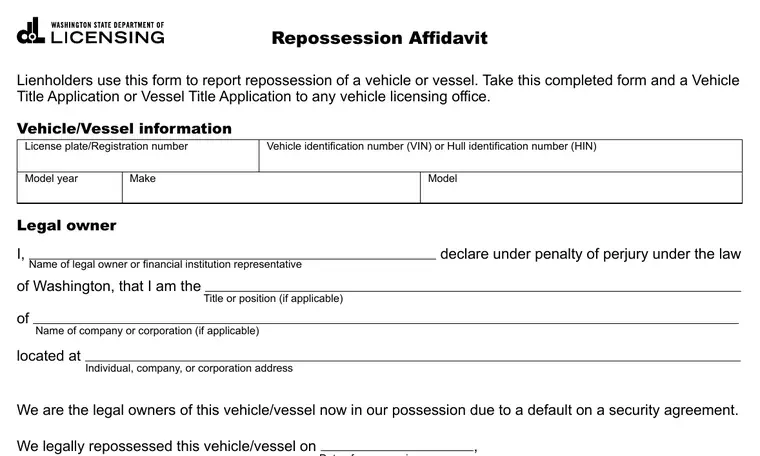
Two documents, and they are not the same thing. Take the blank 420-042 from the dol.wa.gov copy so you get the revision that is current today.

Filled in

What a completed one looks like

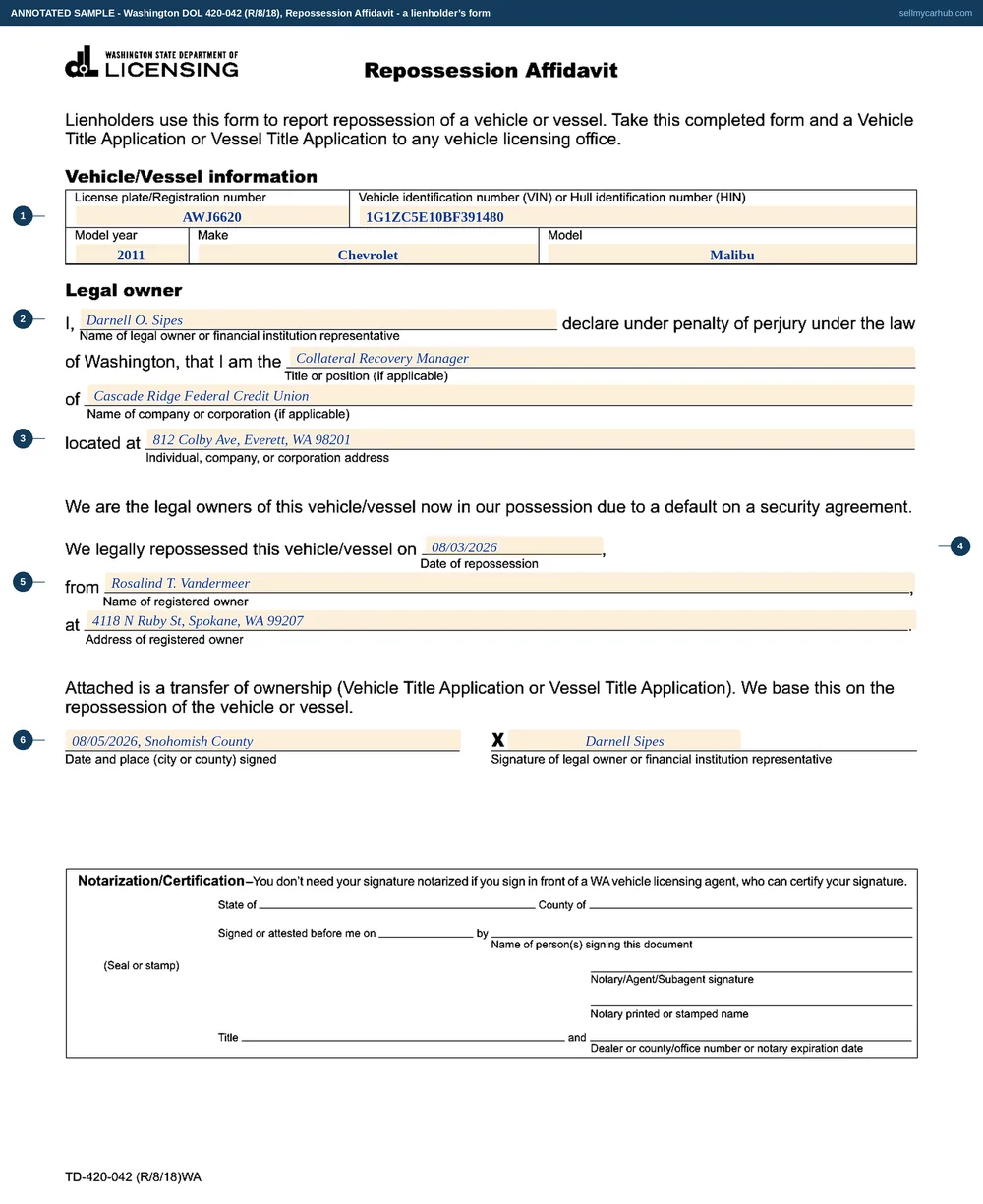
This is the actual 420-042, rendered from the PDF the Washington State Department of Licensing publishes and completed end to end: letterhead, every field, and the blocks at the foot.

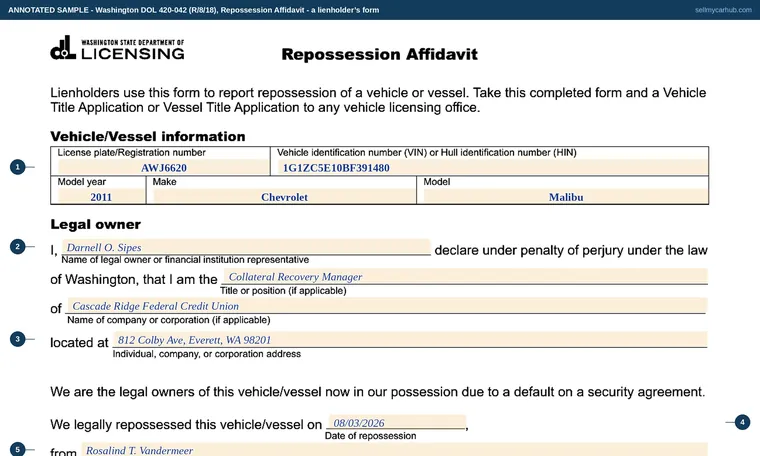
A completed Washington Repossession Affidavit, form 420-042, for a 2011 Chevrolet Malibu: the plate and identification numbers, Cascade Ridge Federal Credit Union of Everett named as legal owner through its collateral recovery manager, a repossession date of 3 August 2026, the former registered owner and address, and the notary block below left empty for the witness.
The lender's form, filled in as a lender would file it. Everything in amber here is written by somebody other than the seller - the only block on the page that concerns you at all is the registered owner block in the middle, and its function is to name you as the person the vehicle was taken from.
Field by field

Every line, in the order you meet it

  1. 1
    The lienholder fills this in

    The vehicle band

    Plate or registration number, identification number, model year, make and model.

    Watch out: A seller reading this can check one thing usefully: that the identification number on the affidavit is the vehicle that was actually taken.

  2. 2
    The lienholder fills this in

    Who is swearing it

    The name of the legal owner or the financial institution's representative, with their title and the company's name.

    Watch out: A company cannot swear an affidavit. If the name line carries only an institution and no person, the form is incomplete.

  3. 3
    The lienholder fills this in

    The lender's address

    Individual, company or corporation address in one block.

    Watch out: This becomes the address on the vehicle record afterwards, which is where any further correspondence about the vehicle goes.

  4. 4
    The lienholder fills this in

    Date of repossession

    The date the vehicle was taken into the lender's possession.

    Watch out: This is the date that matters to a former owner. From here on, tickets and towing bills are somebody else's - but only once the affidavit and the title application are lodged.

  5. 5
    The lienholder fills this in

    The registered owner block

    Your name and your address, as the person the vehicle was repossessed from.

    Watch out: Read it if you are ever shown a copy. A misspelt name or an old address is how a repossession fails to detach from the wrong person's record.

  6. 6
    The lienholder fills this in

    Date, place and signature

    Signed under penalty of perjury, with the city or county where it was signed.

    Watch out: The perjury declaration is the lender's, not yours. It is the reason a repossession affidavit carries weight without your involvement.

  7. 7
    The lienholder fills this in

    The notarisation block

    State, county, date, name of the person signing, and the notary or agent's details.

    Watch out: A licensing agent may certify instead of a notary here as elsewhere, which is why lenders often lodge the affidavit and the application at the same counter.

At a glance

What goes where

On the formWhat to put in it
License plate/Registration numberThe plate on the vehicle when it was taken.
Vehicle identification number (VIN) or Hull identification number (HIN)One box covering both, because the same form serves boats.
Model year, Make, ModelThree boxes describing the vehicle, taken from the department's record rather than from the repossession agent.
Name of legal owner or financial institution representativeThe person swearing the affidavit, which is a named human being rather than a company.
Title or position, and Name of company or corporationTwo lines that turn the individual into an authorised signer for the lender.
Individual, company, or corporation addressWhere the lender is, which becomes the address on the new record.
Date of repossessionThe date the vehicle was taken, and the date from which the lender rather than you is the owner of record.
Name of registered owner and address of registered ownerYou, and where you were. This block is why a seller ends up reading this form.
Date and place (city or county) signed, and SignatureSigned under penalty of perjury under the law of Washington by the legal owner or financial institution representative.
Notarization / CertificationCompleted by the notary or licensing agent who watched the lender's representative sign: a place, a date, the representative named, and the witness's own signature, printed name, title and number.

What gets this one rejected

Rules that decide whether it is accepted

Every line here was read off 420-042 (R/8/18) itself — the PDF is here — and off the Washington State Department of Licensing pages. This is plain-language help with a form, not legal advice, and where our wording and the agency's differ, theirs governs.

Back to all Washington seller paperwork, or what selling a car in Washington involves.

Want the paperwork handled instead?

Get My Instant Offer → Online · about 2 minutes · free

Or send the details — we'll come to you

If a lender took the car and your name is still on the record, that is worth sorting out before it collects tickets. Tell us what happened and we will tell you what the vehicle is worth if it comes back.

or call/text (877) 405-1808