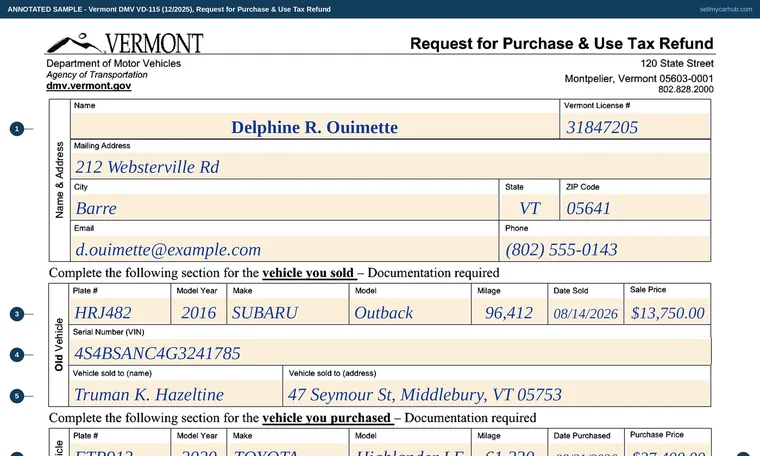
The one Vermont form on this site that puts money back in a seller's pocket. If you sold a Vermont-registered car on which Vermont purchase and use tax was paid, and you bought another vehicle within three months of that sale, the tax on the car you sold comes back at 6% of its J.D. Power clean trade-in value. It is not automatic, nobody at the counter offers it, and the department gives you one year from paying the tax on the new car to ask.
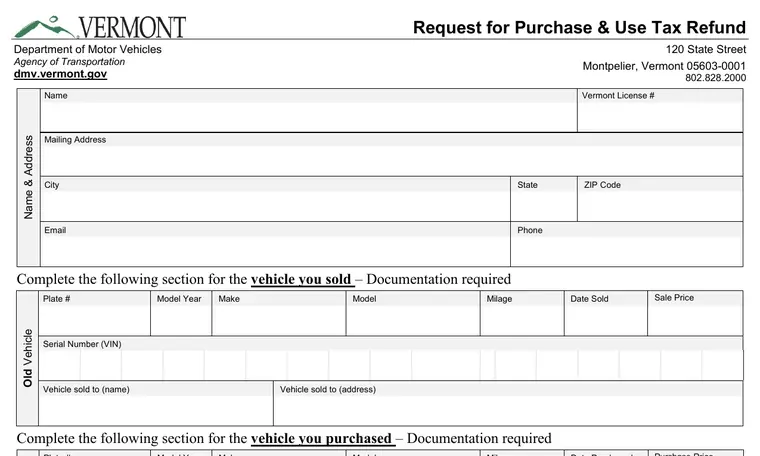
Written against VD-115 (12/2025), issued under 32 V.S.A. s. 8902(5), which sets the credit at the J.D. Power clean trade-in value of the vehicle sold, and s. 8914, which gives one year to claim it; affirmed under penalties of 23 V.S.A. s. 201. Nobody prompts you. The tax is paid by your buyer at their counter and the refund on the car you sold is claimed by post, months later, by you - so the moment to note this is the day you buy the replacement, not the day you get round to the filing.
Two documents, and they are not the same thing. Take the blank VD-115 from the dmv.vermont.gov copy so you get the revision that is current today, then print our VD-115 guide and keep it beside you while you fill theirs in.
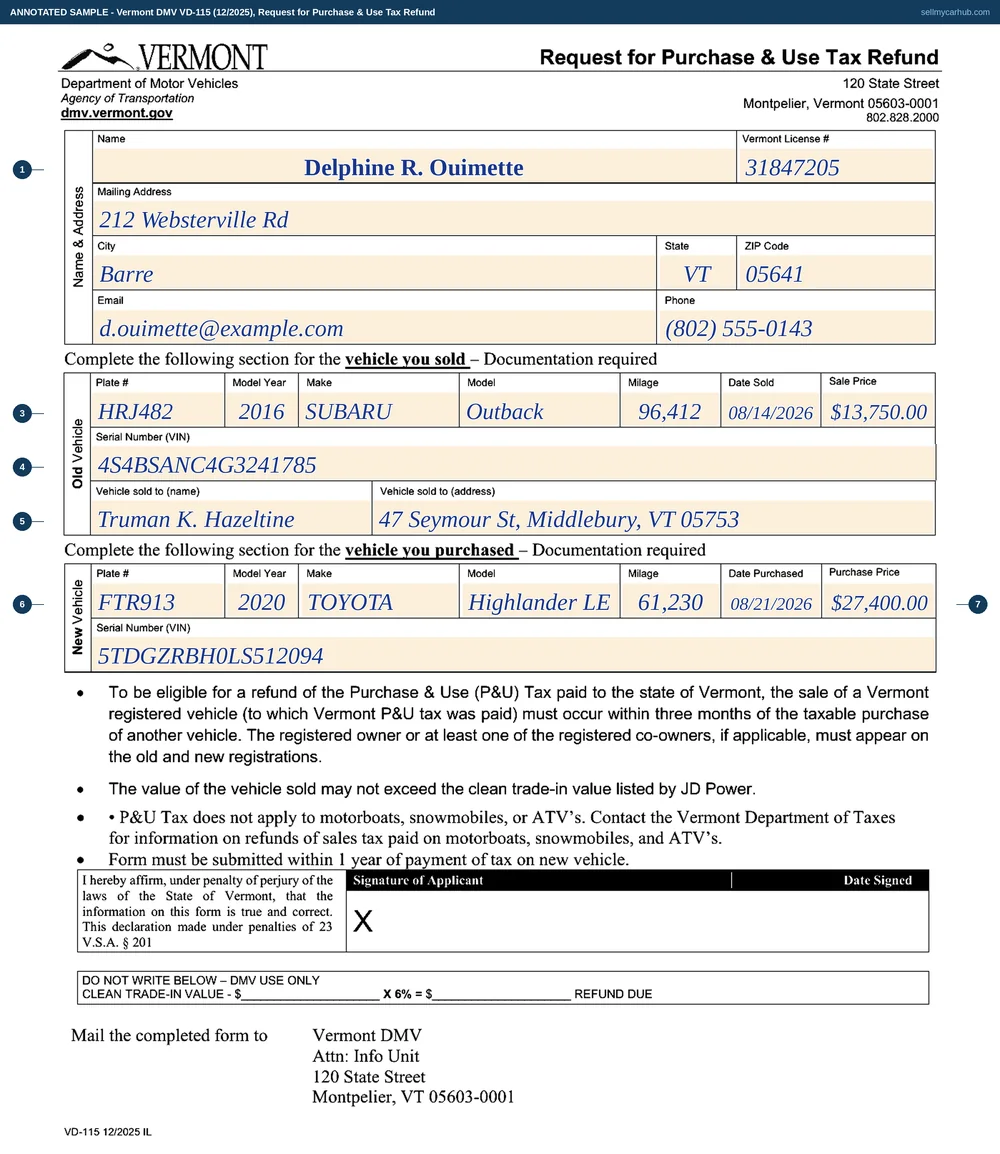
This is the actual VD-115, rendered from the PDF the Vermont Department of Motor Vehicles, Agency of Transportation publishes and completed end to end: letterhead, every field, and the blocks at the foot.
Your name, as it appears on both registrations.
Watch out: If the old car was in two names and the new one is in one, make sure the name here is the one on both. That single overlap is the eligibility test.
Where the refund is posted.
Watch out: Use the address the department already holds for you. A claim that has to be verified against a new address is a claim that waits.
The car you sold, on one row.
Watch out: The date sold is the date on your bill of sale and on the assignment. It is one of the two dates the three-month rule is measured between, so it needs to be the same date everywhere.
Seventeen characters for the car that has gone.
Watch out: Copy it from your photocopy of the bill of sale. This is the second reason for taking that copy before the buyer drives away.
The buyer, named and located.
Watch out: Straight off the bill of sale. The department is confirming that a real sale happened rather than a transfer between your own vehicles.
The replacement you paid Vermont purchase and use tax on.
Watch out: The tax has to have been paid before there is anything to refund against. A dealer purchase where the tax went through their paperwork still counts - what matters is that it was paid.
The replacement's identification number.
Watch out: The department matches this against the tax it collected. A digit wrong here looks like a claim against a vehicle that paid nothing.
One signature, under penalty of perjury.
Watch out: Post it with your documentation to the Info Unit at 120 State Street, Montpelier, inside a year of paying the tax on the new car. Nobody will remind you when the year is nearly up.
| On the form | What to put in it |
|---|---|
| Name, Vermont License # | The claimant. At least one registered owner has to appear on both the old and the new registration, so the name here has to be on each. |
| Mailing Address, City, State, ZIP Code | Where the cheque goes. |
| Email, Phone | Two contact boxes for the queries that follow an incomplete claim. |
| Old Vehicle: Plate #, Model Year, Make, Model, Milage, Date Sold, Sale Price | Seven boxes describing the car you sold, on one row. Documentation is required with them. |
| Old Vehicle: Serial Number (VIN) | One wide box. It is what the department matches against its own record of the tax you paid. |
| Vehicle sold to (name), Vehicle sold to (address) | Who bought it. On a private sale this comes straight off your bill of sale. |
| New Vehicle: Plate #, Model Year, Make, Model, Milage, Date Purchased, Purchase Price | The replacement, in the same seven boxes. The two dates are what the three-month rule is measured between. |
| New Vehicle: Serial Number (VIN) | The replacement's identification number. |
| The eligibility paragraph | Printed on the face of the form: the sale must occur within three months of the taxable purchase, and the registered owner or at least one co-owner must appear on both registrations. |
| Signature of Applicant, Date Signed | One signature, under an affirmation made under penalty of perjury per 23 V.S.A. s. 201. |
| DO NOT WRITE BELOW - DMV USE ONLY | The department's own calculation strip: clean trade-in value multiplied by 6% equals the refund due. It is not yours to complete and it shows you exactly how the figure is arrived at. |
Every line here was read off VD-115 (12/2025) itself — the PDF is here — and off the Vermont Department of Motor Vehicles, Agency of Transportation pages. This is plain-language help with a form, not legal advice, and where our wording and the agency's differ, theirs governs.
Back to all Vermont seller paperwork, or what selling a car in Vermont involves.