Sell My Car Hub

How to fill out Utah TC-814

A single-sided disclosure that has to travel with a damaged car every time it changes hands. Its own note is the clearest statement of that: the following disclosure statement must be given by the seller to the buyer every time this vehicle is knowingly resold with a salvage certificate or total loss history. Private sellers are inside it as much as dealers - what a private seller does not have to do is tape it to the windscreen while the car is on the drive.
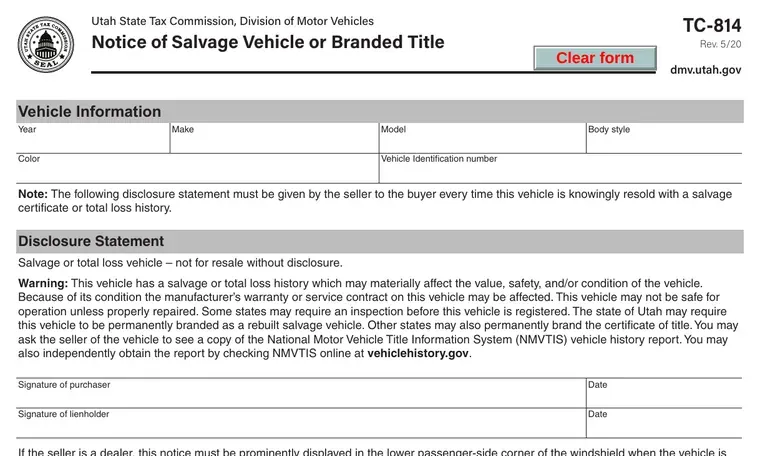
Written against TC-814 (Rev 5/20), issued under Utah Code 41-1a-1004 and 41-1a-1005.3. A manufacturer buyback is a different brand with different words, and Utah publishes the wording separately: a vehicle repurchased under the state's lemon law is branded MANUFACTURER BUYBACK NONCONFORMING VEHICLE, and the disclosure that goes with it has to be given in a clear and conspicuous manner every time the vehicle is resold.

Two documents, and they are not the same thing. Take the blank TC-814 from the files.tax.utah.gov copy so you get the revision that is current today.

Filled in

What a completed one looks like

This is the actual TC-814, rendered from the PDF the Utah State Tax Commission, Motor Vehicle Division publishes and completed end to end: letterhead, every field, and the blocks at the foot.

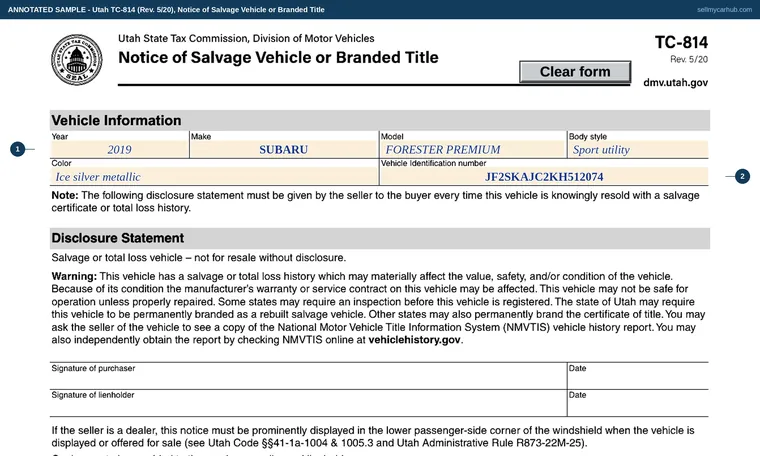
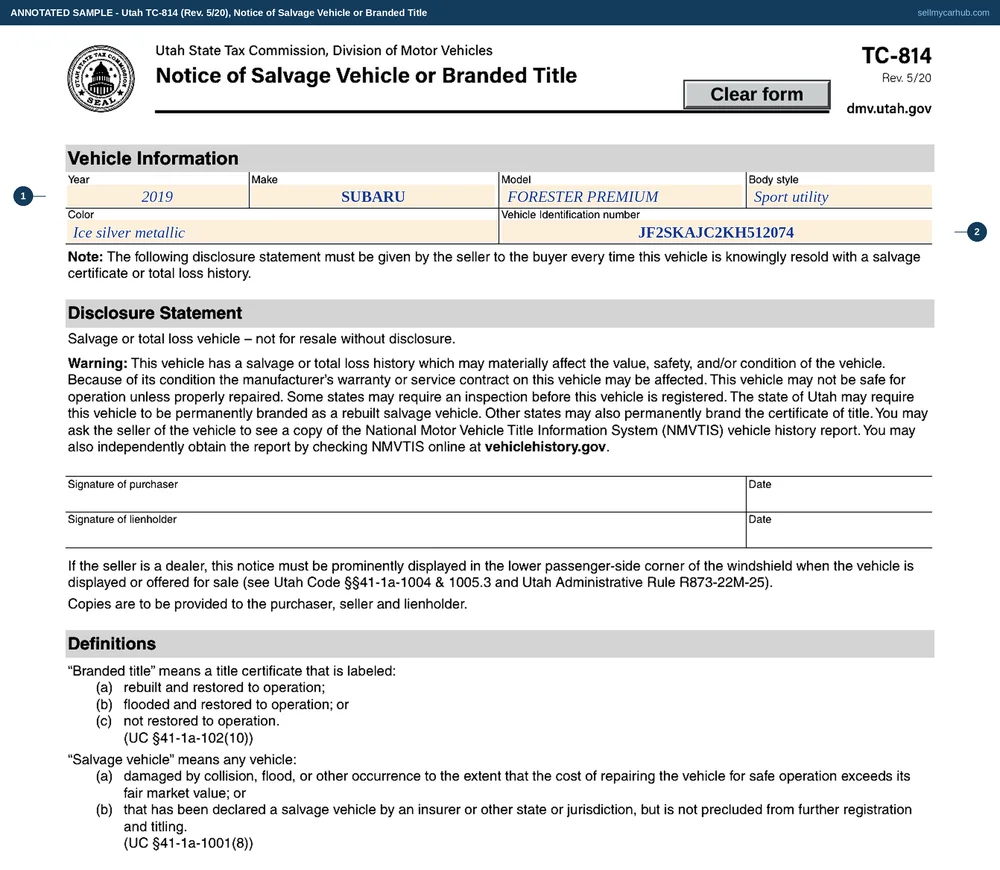
Utah form TC-814 filled in for a rebuilt vehicle: a 2019 Subaru Forester, silver, with identification number JF2SKAJC2KH512074, and the purchaser signing to acknowledge the salvage and total loss disclosure on 18 August 2026.
Six boxes at the top and a signature at the foot - the rest of the sheet is the warning itself, printed by the Tax Commission. The lienholder line is washed grey because this buyer paid cash.
Field by field

Every line, in the order you meet it

  1. 1
    You fill this in

    Vehicle Information

    Year, make, model, body style, colour and the identification number.

    Watch out: Copy the identification number from the certificate rather than the dashboard, because this disclosure will be read against the title's brand line.

  2. 2
    You fill this in

    Read the disclosure aloud before you hand it over

    The printed paragraph about value, safety, condition and warranty.

    Watch out: The obligation is to disclose before the sale. Producing the sheet as the buyer drives away is not disclosure, and the buyer's signature is dated.

  3. 3
    The buyer fills this in

    Signature of purchaser

    The buyer signs and dates the notice.

    Watch out: This signature is your evidence, not theirs. Keep the copy - the form says copies go to purchaser, seller and lienholder.

  4. 4
    The lienholder fills this in

    Signature of lienholder

    The buyer's lender signs where one is taking security over the vehicle.

    Watch out: Leave it blank on a cash sale rather than signing it yourself. A lender's line signed by a seller is a false statement on a disclosure form.

  5. 5
    You fill this in

    The history report

    Nothing to fill in - but the sheet tells the buyer they may ask you for the vehicle history report.

    Watch out: Have it ready. A rebuilt car sells faster with a printed history beside it than with an argument about whether the brand matters.

At a glance

What goes where

On the formWhat to put in it
Vehicle InformationYear, make, model, body style, colour and the identification number. Six boxes and nothing else on the applicant's side of the sheet.
The note above the disclosureThat the statement must be given by the seller to the buyer every time this vehicle is knowingly resold with a salvage certificate or total loss history.
Salvage or total loss vehicle - not for resale without disclosureThe heading of the disclosure block, printed rather than written.
The warning paragraphThat the vehicle has a salvage or total loss history which may materially affect the value, safety, and/or condition of the vehicle, and that because of its condition the manufacturer's warranty or service contract may be affected.
The safety and inspection sentencesThat the vehicle may not be safe for operation unless properly repaired, that some states may require an inspection before it is registered, and that Utah may require it to be permanently branded as a rebuilt salvage vehicle.
The history-report sentencesThat the buyer may ask the seller to see a copy of the National Motor Vehicle Title Information System vehicle history report, and may obtain the report independently at vehiclehistory.gov.
Signature of purchaser and DateThe buyer signs the notice. The seller's job is to hand it over and keep a copy.
Signature of lienholder and DateA second line, because a lender taking security over a branded vehicle is entitled to the same warning.
The windscreen rule, printed at the footIf the seller is a dealer, this notice must be prominently displayed in the lower passenger-side corner of the windshield when the vehicle is displayed or offered for sale.
Who gets a copyCopies are to be provided to the purchaser, seller and lienholder - three copies of a one-page form.
DefinitionsBranded title, defined as a title labelled rebuilt and restored to operation, flooded and restored to operation, or not restored to operation; and salvage vehicle, defined as one damaged to the extent that the cost of repairing it for safe operation exceeds its fair market value, or declared a salvage vehicle by an insurer or another jurisdiction.

What gets this one rejected

Rules that decide whether it is accepted

Every line here was read off TC-814 (Rev 5/20) itself — the PDF is here — and off the Utah State Tax Commission, Motor Vehicle Division pages. This is plain-language help with a form, not legal advice, and where our wording and the agency's differ, theirs governs.

Back to all Utah seller paperwork, or what selling a car in Utah involves.

Want the paperwork handled instead?

Get My Instant Offer → Online · about 2 minutes · free

Or send the details — we'll come to you

Branded title making buyers walk away? We buy salvage and rebuilt vehicles with the brand disclosed up front.

or call/text (877) 405-1808