The other half of the plate question. Because a Tennessee plate belongs to the owner and moves from car to car, a plate that has been lost, stolen or corroded past legibility is a problem that follows you rather than the vehicle you sold. Ten dollars at a county clerk, and one section of the form applies only where law enforcement has been involved.
Written against F-1315301 (Rev 4-23), issued under Tenn. Code Ann. 55-4-103(g). The plate is registered to you and it is what the state's insurance verification looks at. A plate that has quietly become unreadable is a stop waiting to happen on your record, not on the car's.
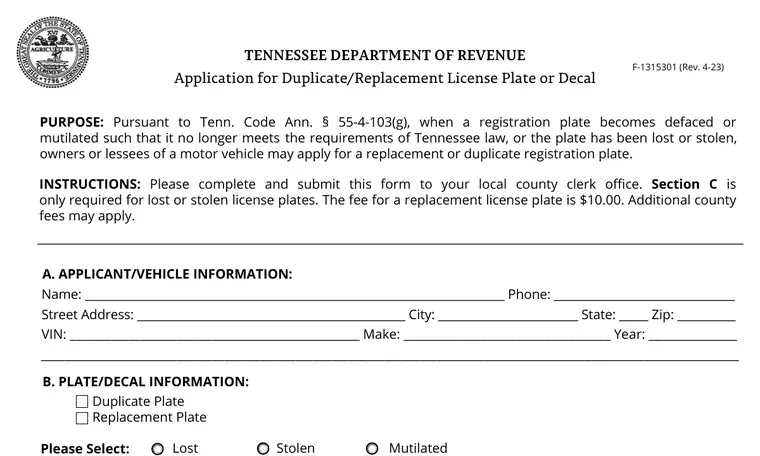
Two documents, and they are not the same thing. Take the blank F-1315301 from the tn.gov copy so you get the revision that is current today.
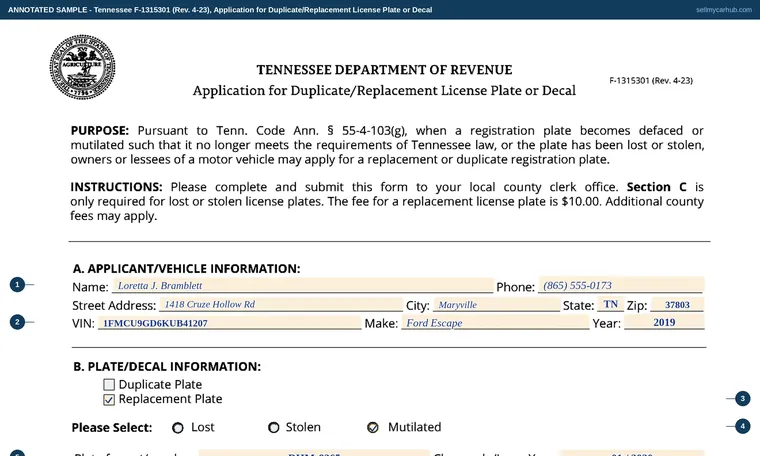
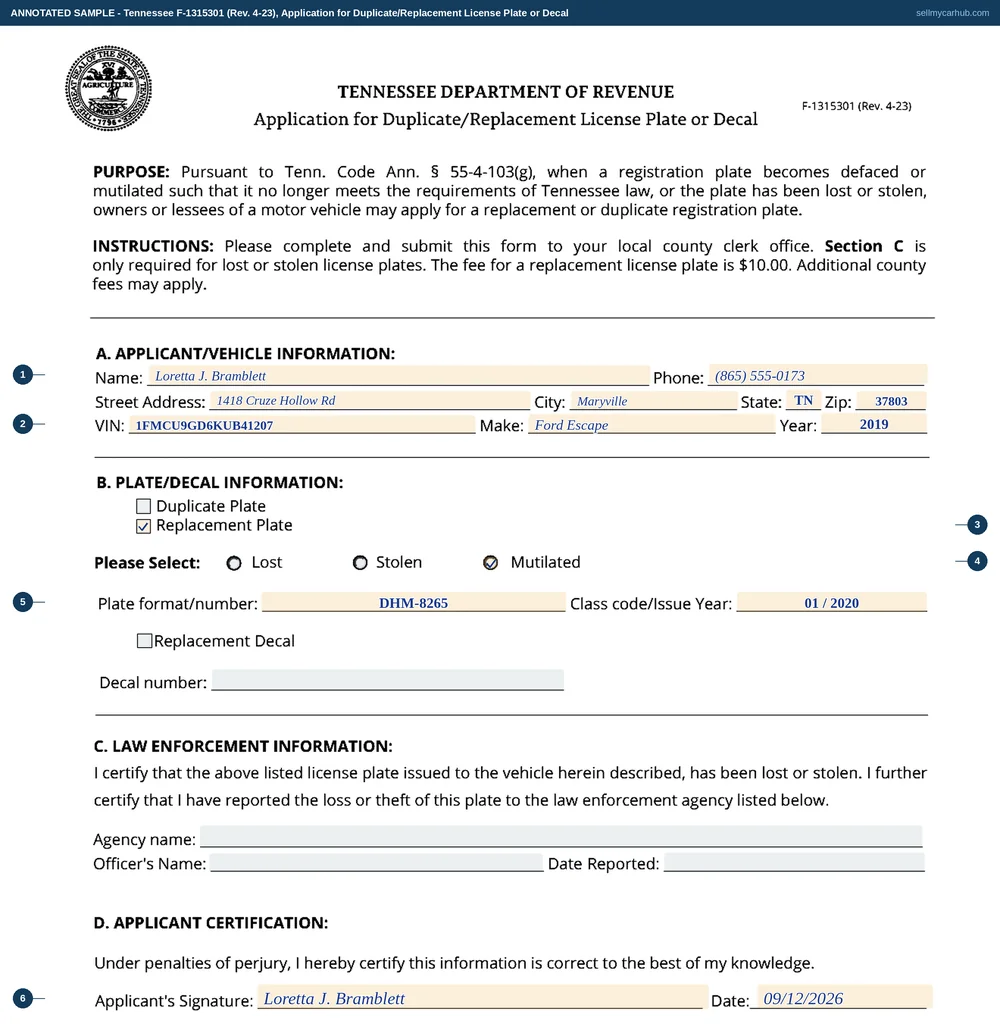
This is the actual F-1315301, rendered from the PDF the Tennessee Department of Revenue publishes and completed end to end: letterhead, every field, and the blocks at the foot.
Name, phone, address, then the vehicle identification number, make and year of the car the plate is currently on.
Watch out: The vehicle here is where the plate lives now, not where it lived when it was issued. In Tennessee those are often different cars.
Two boxes at the head of block B, and they are different transactions.
Watch out: A duplicate reproduces a plate you still hold; a replacement issues one for a plate that has gone or is no longer legible. Tick the one that describes what is actually in your hand.
The Please Select row, and it decides whether section C applies.
Watch out: Mutilated covers a plate that has corroded, faded or bent past legibility. It is the option that keeps you out of the law-enforcement block.
Plate format and number, then the class code and issue year, both from the registration.
Watch out: The class code says what kind of plate it was - passenger, motorcycle, a specialty design - and it decides what you are issued in its place.
Agency name, officer's name and the date the loss or theft was reported.
Watch out: Report it before you fill this in, not afterwards. The block asks for a date reported, which means a report that already exists.
Block D under the penalties-of-perjury line, then the form and $10 to your local county clerk's office.
Watch out: Unlike the cancellation form, this one is a counter transaction. The clerk hands the new plate over, so go in person if you want it the same day.
| On the form | What to put in it |
|---|---|
| A. Applicant and vehicle information | Name, phone, street address, city, state and ZIP; then vehicle identification number, make and year. |
| B. Plate and decal information | Duplicate plate or replacement plate, then a Please Select row with three options - lost, stolen, mutilated - followed by the plate format and number and the class code and issue year. Underneath, a separate replacement decal box with a decal number line. |
| C. Law enforcement information | A certification that the plate has been lost or stolen and that the loss or theft has been reported, with the agency name, the officer's name and the date reported. |
| D. Applicant certification | Under penalties of perjury, a signature and a date. |
Every line here was read off F-1315301 (Rev 4-23) itself — the PDF is here — and off the Tennessee Department of Revenue pages. This is plain-language help with a form, not legal advice, and where our wording and the agency's differ, theirs governs.
Back to all Tennessee seller paperwork, or what selling a car in Tennessee involves.