Sell My Car Hub

How to fill out Pennsylvania MV-1

The other half of the pair, and the one a Pennsylvania seller meets when the car is not already titled here - an out-of-state certificate, a manufacturer's statement of origin, a repossession or a court order. Like the MV-4ST it is issued to authorized agents only, and unlike the MV-4ST it carries its own notarisation block at the foot of the page.

Written against MV-1 (not published online), issued under 75 Pa.C.S. 1103.1. The department will accept an odometer reading on this form that differs from the one on the proof of ownership - it happens when the title application comes later than the transfer. What gets recorded on PennDOT's system in that case is the reading from the ownership document, not the one on this form.

There is no download link for the MV-1 here because there is not one anywhere - PennDOT does not publish it. The card below explains where it does come from.

Filled in

What a completed one looks like

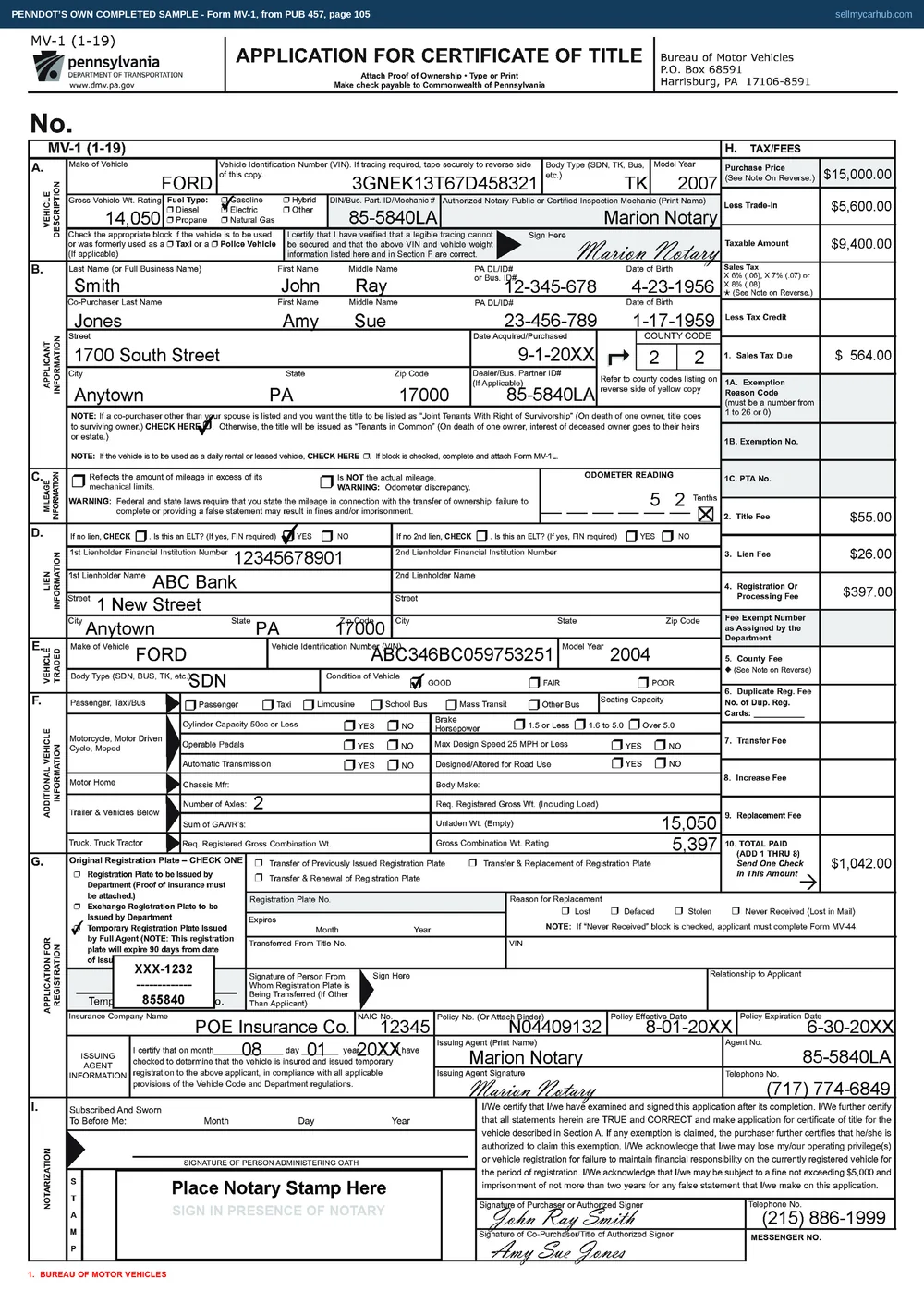
This is the actual MV-1, rendered from the PDF the Pennsylvania Department of Transportation publishes and completed end to end: letterhead, every field, and the blocks at the foot.

PennDOT's own completed sample of Form MV-1 from the Agent Services Handbook: Section A describing a 2007 Ford with a verified VIN and a notary's printed name, Section B naming Smith and a co-owner Jones with a county code, Section C the mileage block with the discrepancy warning, Section D recording a lien to ABC Bank, Section F the additional vehicle information, Section G the registration application with a temporary plate number and insurance details, Section H the fee column reaching 1,042 dollars, and Section I the notarisation block reading Place Notary Stamp Here.
PennDOT's completed specimen from page 105 of PUB 457, revision 5-25 - the same invented cast the department uses throughout: Smith, Jones, Anytown, Marion Notary, and years written 20XX. Look at the bottom left: an entire block of the form is a notary's stamp, which is the difference between this and the MV-4ST.
Field by field

Every line, in the order you meet it

  1. 1
    The buyer fills this in

    Section A, the vehicle

    Make, VIN, body type, model year, weight rating and fuel type, taken off the proof of ownership and checked against the plate on the car.

    Watch out: Compare the two numbers character by character. If they disagree, the instruction is to contact the selling dealer or the nearest Pennsylvania State Police station, and the discrepancy has to be resolved before anything is submitted.

  2. 2
    The buyer fills this in

    Section A, the VIN tracing

    A pencil rubbing of the VIN plate, taped to the reverse of the white copy, where the vehicle comes from outside Pennsylvania or is a truck, truck-tractor or motor home.

    Watch out: If the plate is defaced, altered or missing, the tracing is not the answer - a state replacement VIN plate application and a State Police verification are.

  3. 3
    The buyer fills this in

    Section B, the applicant

    The first person to whom ownership was assigned on the proof of ownership. Name as it reads on the Pennsylvania photo credential, ID number, date of birth, address and county code.

    Watch out: On an out-of-state car the applicant is the first Pennsylvania resident to whom ownership is assigned - not whoever ends up with the car three assignments later.

  4. 4
    You fill this in

    Section C, mileage

    The reading on the odometer, plus a box for mileage that exceeds mechanical limits and a box for a reading that is not the actual mileage.

    Watch out: Once written it is fixed. The instruction says the information may not be erased or otherwise altered, and no separate odometer statement is attached - the disclosure on the ownership document carries it.

  5. 5
    The buyer fills this in

    Section D, lien information

    If nobody is lending, the if-no-lien box must be checked. Otherwise the lienholder's name and address, whether they are in the electronic programme, and their Financial Institution Number.

    Watch out: Where two liens are recorded, the certificate goes to the first lienholder rather than to the buyer - so the buyer should expect not to see it.

  6. 6
    The buyer fills this in

    Section F, what kind of vehicle it is

    Seating capacity, cylinder capacity, axles or chassis manufacturer, depending on what is being titled.

    Watch out: Skip it entirely for a mobile home - the instruction sheet says so in a note at the top of the section.

  7. 7
    The buyer fills this in

    Section G, registration

    New plate, exchange, temporary plate, or a transfer of an existing one, plus insurance details and the agent's dated certification.

    Watch out: Temporary registration cannot be issued on this form for a reconstructed, specially constructed or recovered theft vehicle, or where a court order is the proof of ownership. The car stays off the road until the credentials arrive.

  8. 8
    The buyer fills this in

    Section H, tax and fees

    Purchase price, trade-in, taxable amount, tax at 6, 7 or 8 per cent, credit for tax properly paid to a reciprocal state, then the fees.

    Watch out: A credit needs proof of payment from the state where the tax was paid attached. Without it there is no credit, whatever the buyer says they already paid.

  9. 9
    You fill this in

    Section I, the seal

    Signatures in front of the notary, the applicant's telephone number, and the notarisation completed by the authorised agent on the white copy only.

    Watch out: This is signed last, after the whole form is complete and the fees are paid. Verification in lieu of notarisation is open only to agents with a dealer identification or business partner number who issue temporary plates.

At a glance

What goes where

On the formWhat to put in it
Section A, vehicle descriptionMake, the complete VIN as shown on the plate the manufacturer attached, body type as a department abbreviation, model year, gross vehicle weight rating, fuel type, and a place for the VIN tracing or the verifier's certification. Two tick boxes ask whether the vehicle was ever a taxi or a police vehicle.
Section B, applicant informationThe buyer's full legal name, PA driver's licence or photo ID number, date of birth, dealer or business partner ID if there is one, a co-purchaser, the date acquired, street address, city, state, ZIP and county code, plus the joint-ownership and leased-vehicle ticks.
Section C, mileage informationThe reading shown on the odometer, with two boxes for a reading that differs from actual mileage or exceeds mechanical limits. Once listed, the instruction says, this information may not be erased or otherwise altered.
Section D, lien informationAn if-no-lien box, then first and second lienholder blocks with an electronic lien and title indicator and a Financial Institution Number.
Section E, vehicle tradedMake, VIN, model year, body type and condition of anything traded in.
Section F, additional vehicle informationSeating capacity for a passenger vehicle, taxi, limousine or bus; cylinder capacity and brake horsepower for a motorcycle; chassis manufacturer for a motor home; axles and weights for a trailer.
Section G, application for registrationThe same registration block the MV-4ST carries - new plate, exchange, temporary plate, or a transfer - plus insurance details and the issuing agent's dated certification.
Section H, tax and feesPurchase price, trade-in, taxable amount, sales tax at 6%, 7% or 8%, any credit for tax paid in a reciprocal state, then the title, lien, registration, county and transfer fees.
Section I, seal and application for titleWhere the MV-4ST simply has a certification, this has a notary block. The application must be signed in the presence of a notary public, or of an employee of a dealership authorized to verify signatures, and the stamp goes on the white copy.

What gets this one rejected

Rules that decide whether it is accepted

Every line here was read off MV-1 (not published online) itself — the PDF is here — and off the Pennsylvania Department of Transportation pages. This is plain-language help with a form, not legal advice, and where our wording and the agency's differ, theirs governs.

Back to all Pennsylvania seller paperwork, or what selling a car in Pennsylvania involves.

Want the paperwork handled instead?

Get My Instant Offer → Online · about 2 minutes · free

Or send the details — we'll come to you

Out-of-state title, no title, a repossession you inherited - if the paperwork already needs two forms and a notary, ask us what the car is worth as it stands.

or call/text (877) 405-1808