Sell My Car Hub

How to fill out Pennsylvania MV-3

The form that appears when the price looks low. If the purchase price is under 80% of the vehicle's average fair market value, or the car is over 15 years old and the price is under $500, the agent has to establish what the vehicle is actually worth and both parties have to explain the number in writing, under oath.
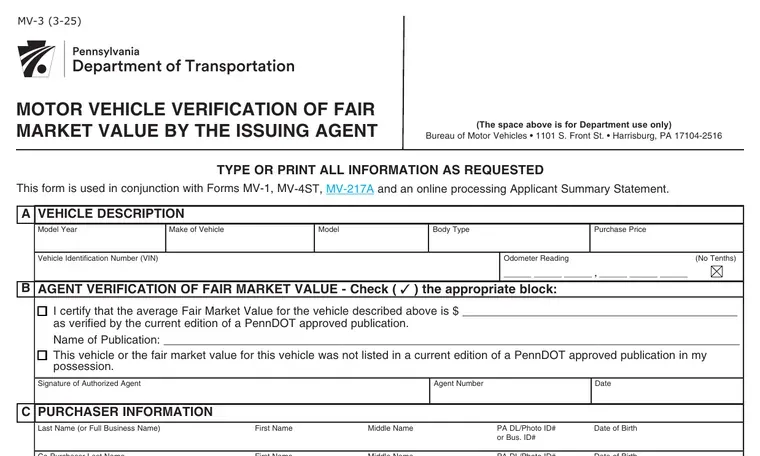
Written against MV-3 (3-25), issued under 75 Pa.C.S. 1318. PennDOT's own Buying or Selling fact sheet states this trigger backwards, as a vehicle sold for 80% less than the fair market value. The form says what it means: a purchase price that is less than 80% of the average fair market value. A car sold for seven-tenths of what the guide says it is worth is inside the trigger, not outside it - and a seller who reads the fact sheet instead of the form will not see it coming.

Two documents, and they are not the same thing. Take the blank MV-3 from the pa.gov copy so you get the revision that is current today.

Filled in

What a completed one looks like

This is all 3 pages of the actual MV-3, rendered from the PDF the Pennsylvania Department of Transportation publishes and completed end to end: letterhead, every field, and the blocks at the foot.

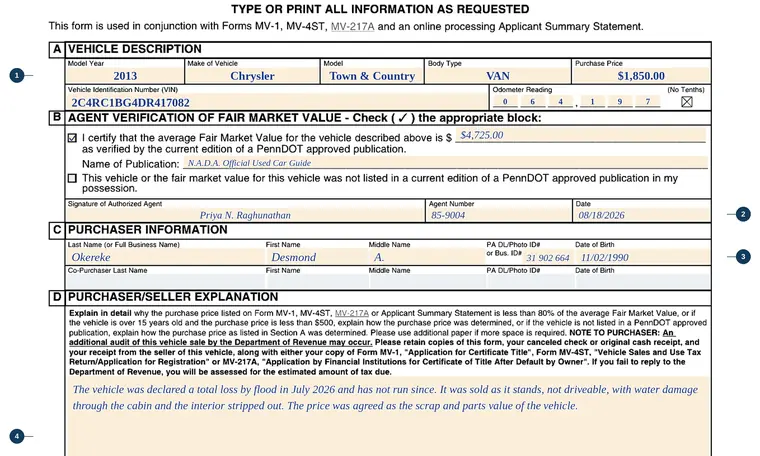
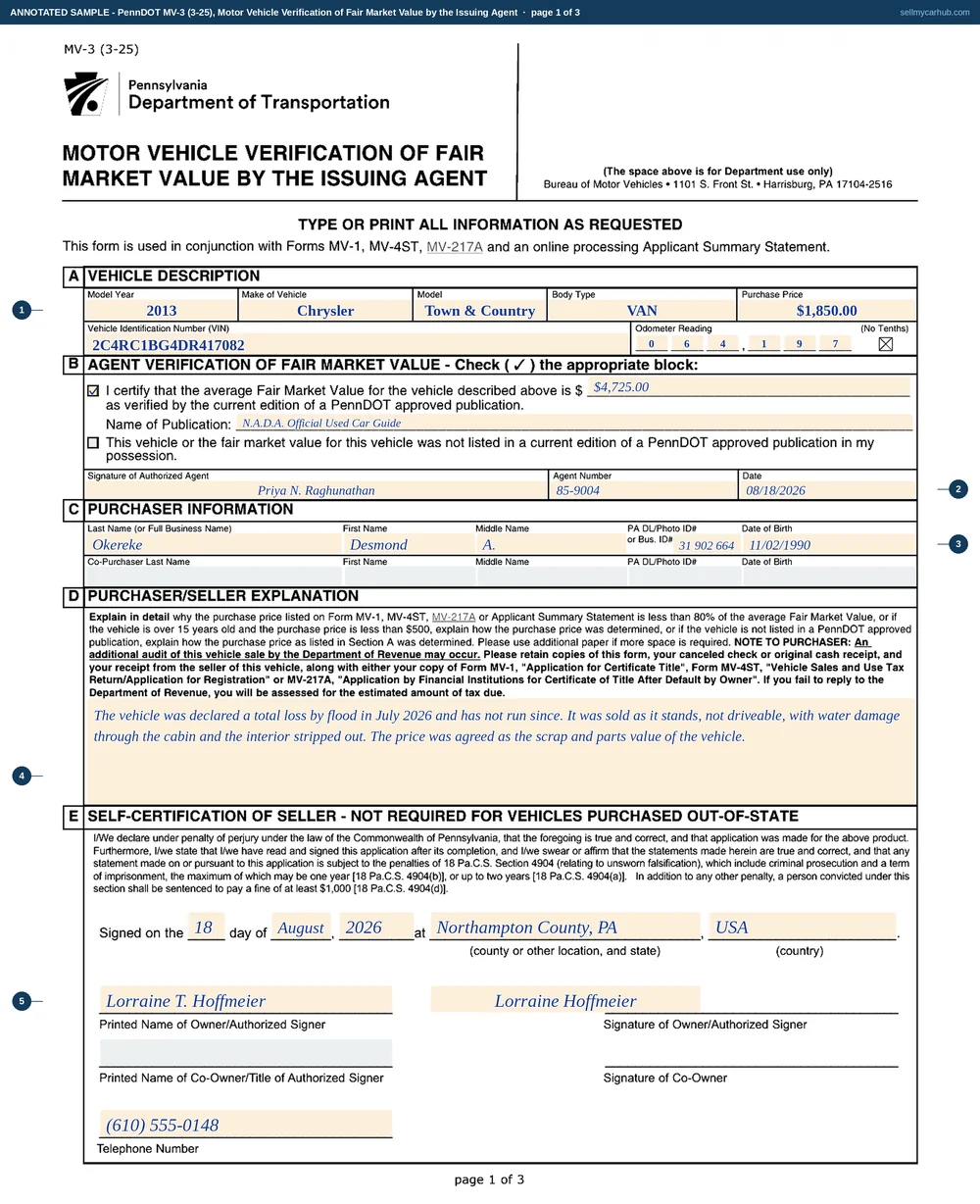
The Pennsylvania MV-3 filled in for a low-price private sale: a 2013 Chrysler Town and Country with a boxed odometer reading, the agent's certification of a fair market value figure from a named publication, purchaser details for Desmond A. Okereke, a written explanation of why the price is low, and self-certification blocks signed by both seller and purchaser.
Page 1 of 3. Sections A to E. The agent’s fair market value in Section B, the buyer’s details in C, the written explanation in D, and the seller’s notarised self-certification in E.
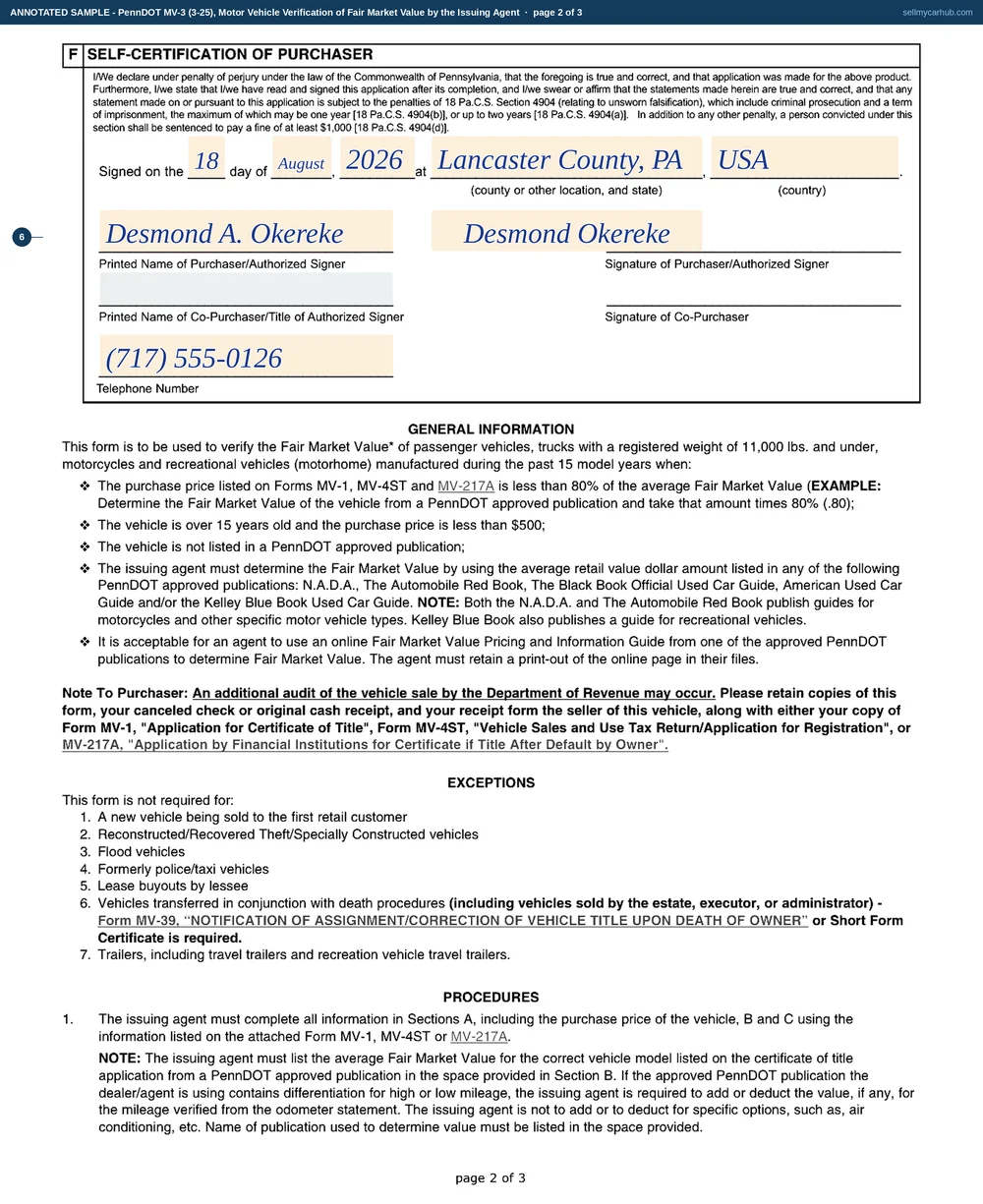
The Pennsylvania MV-3 filled in for a low-price private sale: a 2013 Chrysler Town and Country with a boxed odometer reading, the agent's certification of a fair market value figure from a named publication, purchaser details for Desmond A. Okereke, a written explanation of why the price is low, and self-certification blocks signed by both seller and purchaser.
Page 2 of 3. Section F, the purchaser’s self-certification - the only one of the two that is never optional - followed by the general information and the list of approved valuation guides.
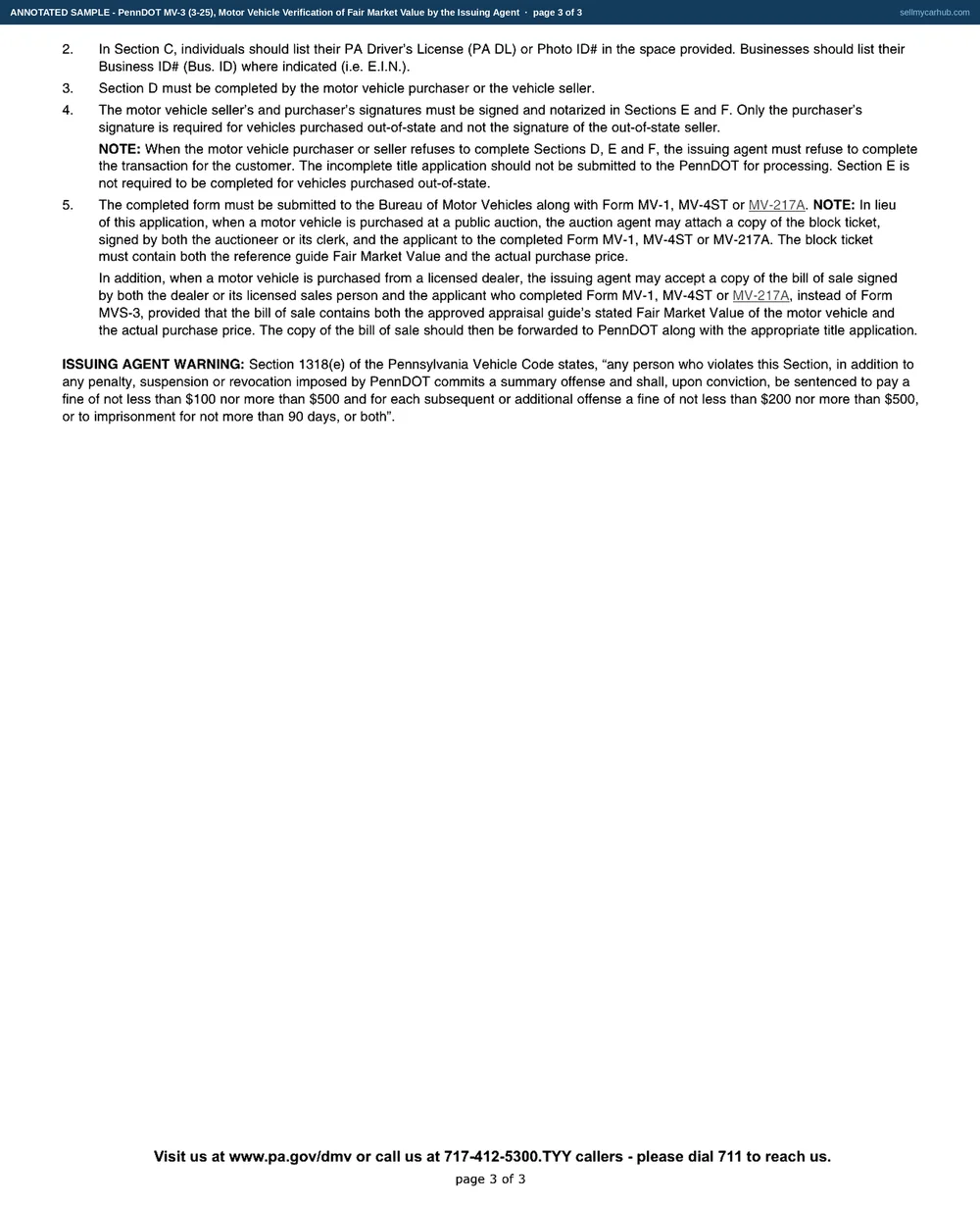
The Pennsylvania MV-3 filled in for a low-price private sale: a 2013 Chrysler Town and Country with a boxed odometer reading, the agent's certification of a fair market value figure from a named publication, purchaser details for Desmond A. Okereke, a written explanation of why the price is low, and self-certification blocks signed by both seller and purchaser.
Page 3 of 3. The exceptions and procedures. Seven situations where this form is not required at all, and the warning to the issuing agent about their own liability.
Field by field

Every line, in the order you meet it

  1. 1
    The buyer fills this in

    Section A, the vehicle and the price

    Model year, make, model, body type, the purchase price and the VIN, then the odometer reading in a row of boxes with no tenths.

    Watch out: The price here has to be the same one written on the title application. Two different numbers on two forms in the same envelope is what starts the audit.

  2. 2
    Dealers only

    Section B, the agent's figure

    The average fair market value from a PennDOT approved guide, with the guide named, or a tick to say the vehicle was not listed in one.

    Watch out: An online guide is acceptable, but the agent has to keep a print-out of the page in their files. Do not offer to look the number up for them.

  3. 3
    The buyer fills this in

    Section C, the purchaser

    Names, PA driver's licence or photo ID number and dates of birth for the purchaser and any co-purchaser.

    Watch out: A business writes its business identification number here instead - an employer identification number, not somebody's licence.

  4. 4
    You fill this in

    Section D, the explanation

    Why the price is what it is, written out. Rust, a failed inspection, a family arrangement, a car that has not run in two years - whatever is true.

    Watch out: The form says use additional paper if more space is required. It means it - one line reading "sold cheap" is what gets the transaction looked at.

  5. 5
    You fill this in

    Section E, the seller's self-certification

    Printed name, signature, co-owner if there is one, telephone number, and the day, month, year, county and country of signing.

    Watch out: Skipped only where the vehicle was purchased out of state - then the out-of-state seller's signature is not required and the purchaser's alone carries the form.

  6. 6
    The buyer fills this in

    Section F, the purchaser's self-certification

    The identical block for the buyer, always required, signed and notarised.

    Watch out: The declaration above it is an unsworn falsification under 18 Pa.C.S. 4904 - a fine of at least $1,000 and up to two years.

At a glance

What goes where

On the formWhat to put in it
Section A, vehicle descriptionModel year, make, model, body type, purchase price, the VIN, and a boxed odometer reading with no tenths.
Section B, agent verification of fair market valueThe agent ticks one of two statements: that the average fair market value is a stated figure as verified by the current edition of a PennDOT approved publication, naming the publication - or that the vehicle or its value was not listed in one they hold. Then their signature, agent number and date.
Section C, purchaser informationLast, first and middle name of the purchaser and any co-purchaser, PA driver's licence or photo ID number, and dates of birth.
Section D, purchaser and seller explanationA free-text block. Explain in detail why the price is less than 80% of the average fair market value, or how the price was arrived at on a vehicle over 15 years old sold for less than $500, or how it was determined if the vehicle is not in an approved guide.
Section E, self-certification of sellerYour printed name, signature, a co-owner line, a telephone number, and the day, month, year, county and country you signed in. Not required where the vehicle was purchased out of state.
Section F, self-certification of purchaserThe same block again for the buyer, and this one is never optional.

What gets this one rejected

Rules that decide whether it is accepted

Every line here was read off MV-3 (3-25) itself — the PDF is here — and off the Pennsylvania Department of Transportation pages. This is plain-language help with a form, not legal advice, and where our wording and the agency's differ, theirs governs.

Back to all Pennsylvania seller paperwork, or what selling a car in Pennsylvania involves.

Want the paperwork handled instead?

Get My Instant Offer → Online · about 2 minutes · free

Or send the details — we'll come to you

Selling cheap to a friend and finding the paperwork now wants a sworn explanation? Get a straight offer and skip the fair-market-value conversation entirely.

or call/text (877) 405-1808