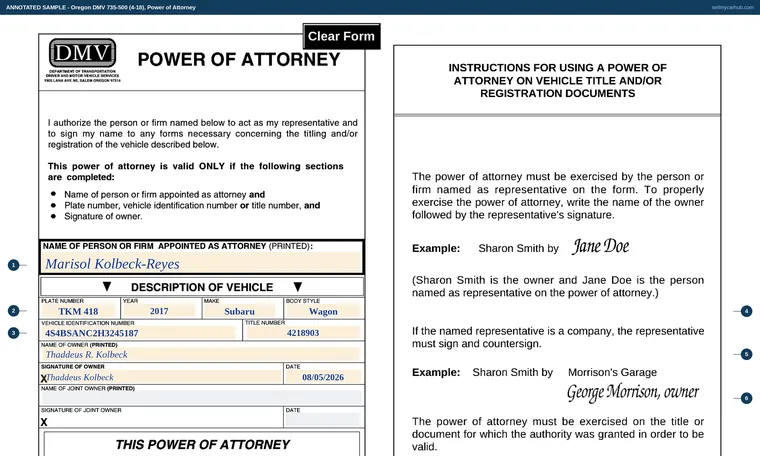
A single sheet that lets somebody else sign your name on the title and registration documents for one described vehicle. Oregon's version is unusually blunt about its own limits: it is valid only if three specific things are filled in, it cannot be handed on to anybody else, and it has to be used on the very document the authority was granted for. The back of the form carries a worked example of how to sign with it, which is worth reading, because a power of attorney exercised the wrong way is a signature DMV will not accept.
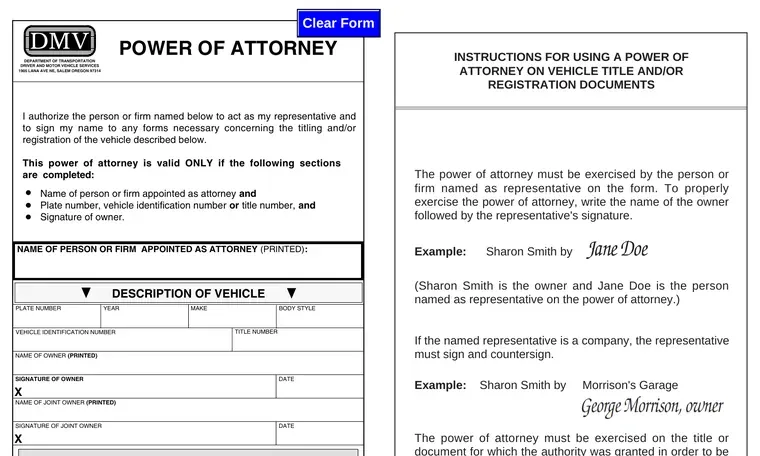
Written against 735-500 (4-18), issued under ORS 803.075 and DMV Title & Registration Handbook Chapter G. Revised April 2018. Read the instructions on the reverse before anybody signs anything: the way the authority is exercised matters as much as the way it is granted, and both are on the same sheet.
Two documents, and they are not the same thing. Take the blank 735-500 from the oregon.gov copy so you get the revision that is current today.
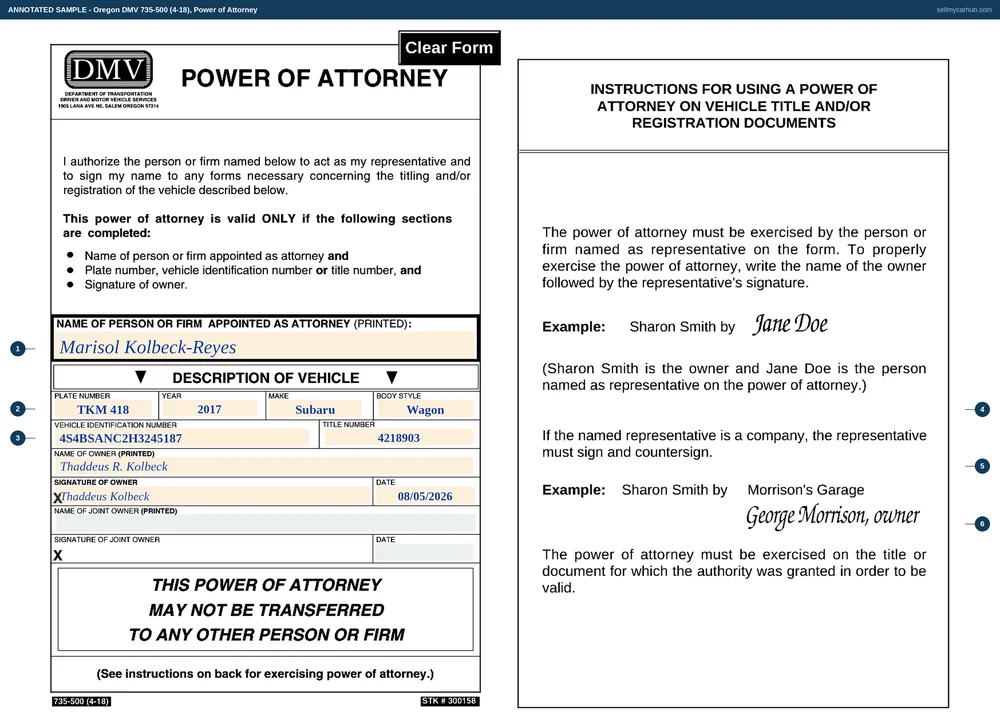
This is the actual 735-500, rendered from the PDF the Oregon Department of Transportation, Driver and Motor Vehicle Services Division publishes and completed end to end: letterhead, every field, and the blocks at the foot.
One line, near the foot of the front. The first of the three sections that make the document valid.
Watch out: Print the name exactly as the person will sign it. When the authority is exercised, that name has to follow the word by, and a mismatch there is what stops it working.
Three boxes describing the car, copied from the certificate.
Watch out: The description is not decoration. It is what limits the authority to one vehicle, which is the reason a signed blank power of attorney is such a bad idea.
Two more boxes, and the second of the three required sections.
Watch out: The form accepts a plate number, a VIN or a title number as the identifier. Fill in all three you have and the question never arises.
The plate currently on the vehicle.
Watch out: If you have already taken the plates off to keep them, write the number that was on it anyway. It is still the number DMV's record carries.
A printed name, a signature on the X, and a date. The third required section.
Watch out: Original ink. A power of attorney is not one of the two documents Oregon accepts a carbon copy of, and a photocopied grant of authority is no authority at all.
A second pair of lines with its own date.
Watch out: Empty on a one-owner title. On a two-owner title, an authority signed by one owner only carries one owner's signature — the other still has to release their own interest somehow.
Not a field: how the authority is exercised, with the example Sharon Smith by Jane Doe.
Watch out: This is the half people skip and the half that gets rejected. The representative writes the owner's name, then by, then signs — and a firm signs and countersigns.
| On the form | What to put in it |
|---|---|
| I authorize the person or firm named below | The opening sentence: to act as my representative and to sign my name to any forms necessary concerning the titling and/or registration of the vehicle described below. |
| Name of person or firm appointed as attorney (printed) | The first of the three things that make the document valid. |
| Description of vehicle | Year, make, body style, vehicle identification number, plate number and title number — the second of the three. |
| Name of owner (printed) and signature of owner | The third. A printed name and a signature on an X, with a date beside it. |
| Name of joint owner and signature of joint owner | A second pair of lines with its own date, for a vehicle titled in two names. |
| The validity note | Printed above the boxes: this power of attorney is valid ONLY if the following sections are completed — the name of the person or firm appointed as attorney, the plate number, vehicle identification number or title number, and the signature of owner. |
| The non-transfer note | Set in its own block: THIS POWER OF ATTORNEY MAY NOT BE TRANSFERRED TO ANY OTHER PERSON OR FIRM. |
| The instructions on the back | How to exercise it — write the name of the owner followed by the representative's signature, with the example Sharon Smith by Jane Doe, and a second example for a firm, Sharon Smith by Morrison's Garage, where the representative must sign and countersign. |
Every line here was read off 735-500 (4-18) itself — the PDF is here — and off the Oregon Department of Transportation, Driver and Motor Vehicle Services Division pages. This is plain-language help with a form, not legal advice, and where our wording and the agency's differ, theirs governs.
Back to all Oregon seller paperwork, or what selling a car in Oregon involves.