Sell My Car Hub

How to fill out North Dakota SFN 18609

North Dakota is one of a small number of states that makes a private seller sign a separate body-damage disclosure for almost every modern car. The form's first line is the rule: it must be completed by the transferor (seller) for all vehicles less than nine (9) model years old, signed by the seller, given to and signed by the buyer, and it must accompany the application for title. Three numbered questions step down through the severity of any damage in the past eight years, and a false statement on it is a Class A Misdemeanor.
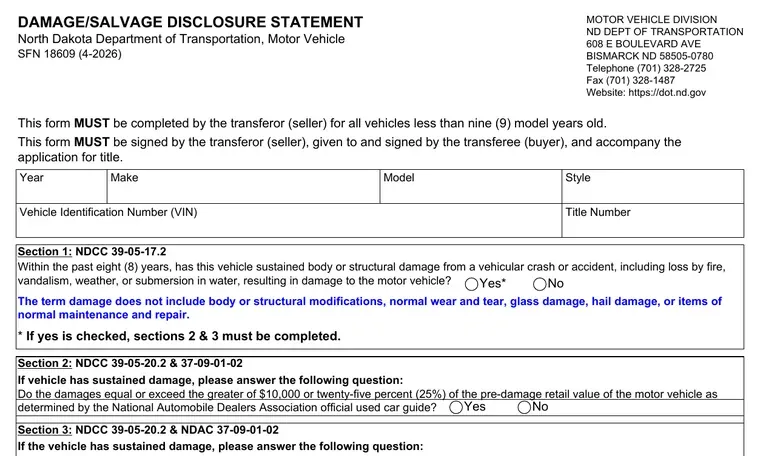
Written against SFN 18609 (4-2026), issued under NDCC 39-05-17.2 and 39-05-20.2 with NDAC 37-09-01-02, all three cited on the face of the form. The penalty on this form sits directly under the damage explanation box, and it is heavier than most of the department's: any person who makes a false statement on this form is guilty of a Class A Misdemeanor. It is not a form to complete optimistically. If you genuinely do not know whether a repair before your ownership crossed the 25 percent line, the honest answers are on 3A - I acquired the vehicle with unrepaired damage, or damage occurred prior to my ownership and I acquired it in a repaired condition - which is exactly what those options are for.

Two documents, and they are not the same thing. Take the blank SFN 18609 from the dot.nd.gov copy so you get the revision that is current today, then print our SFN 18609 guide and keep it beside you while you fill theirs in.

Filled in

What a completed one looks like

This is all 2 pages of the actual SFN 18609, rendered from the PDF the North Dakota Department of Transportation, Motor Vehicle Division publishes and completed end to end: letterhead, every field, and the blocks at the foot.

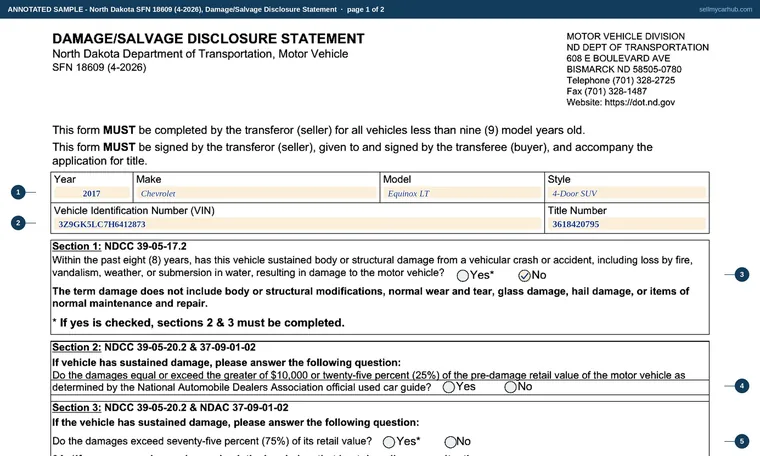
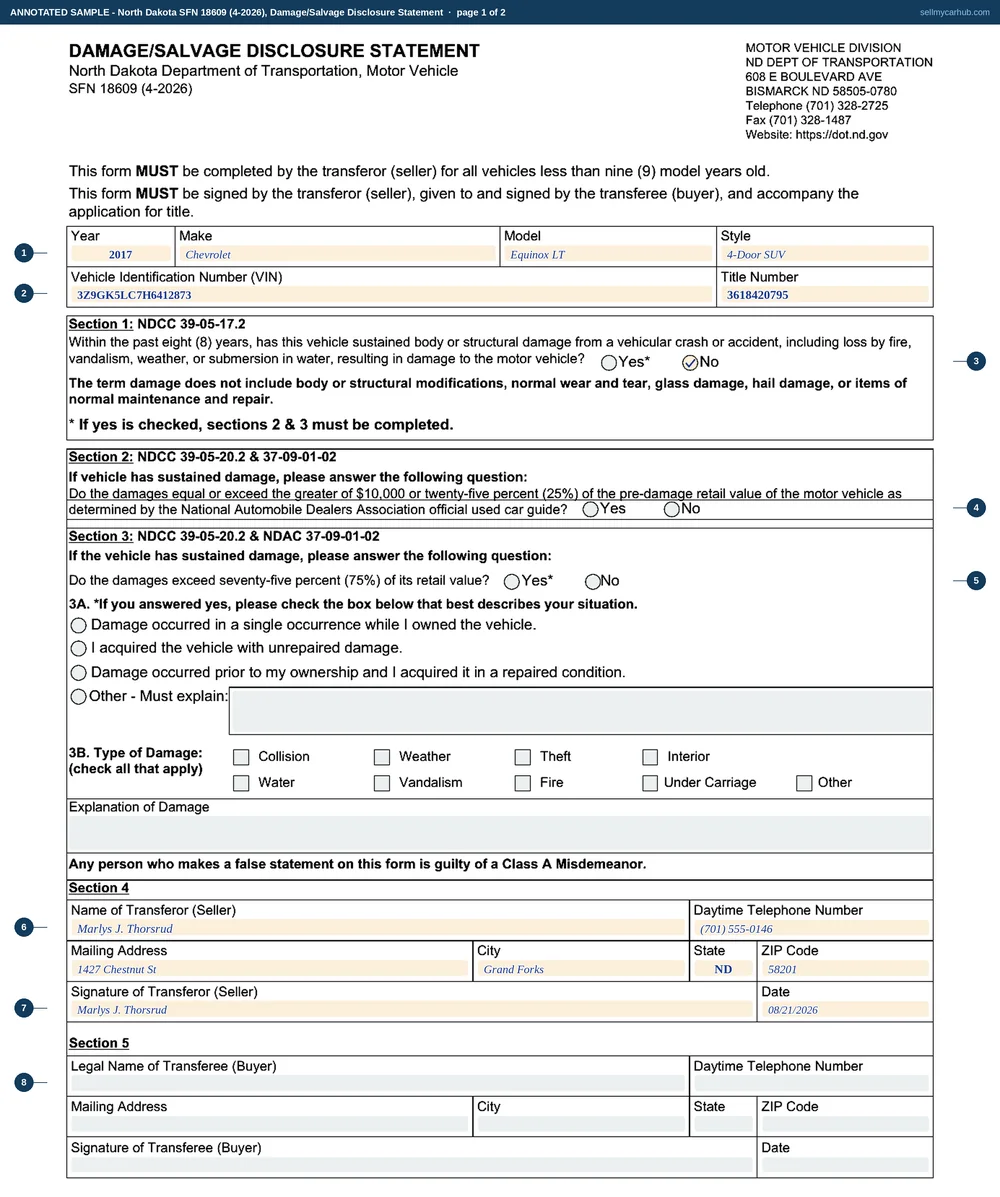
A completed North Dakota SFN 18609, Damage/Salvage Disclosure Statement, page one. The vehicle rows name a 2017 Chevrolet Equinox LT, 4-Door SUV, with its vehicle identification number and title number. In Section 1 the No box is ticked. Sections 2, 3, 3A and 3B and the explanation of damage box are shaded grey. Section 4 names the transferor Marlys J. Thorsrud of 1427 Chestnut St, Grand Forks, North Dakota 58201, with her signature and the date 08/21/2026. Section 5, the transferee block, is shaded grey.
Page 1 of 2. The disclosure itself, completed for a car with no reportable damage: Section 1 answered No, sections 2 and 3 left grey because the No closes them, the seller's block filled and signed, and Section 5 grey because the buyer only signs where an answer is Yes.
A completed North Dakota SFN 18609, Damage/Salvage Disclosure Statement, page one. The vehicle rows name a 2017 Chevrolet Equinox LT, 4-Door SUV, with its vehicle identification number and title number. In Section 1 the No box is ticked. Sections 2, 3, 3A and 3B and the explanation of damage box are shaded grey. Section 4 names the transferor Marlys J. Thorsrud of 1427 Chestnut St, Grand Forks, North Dakota 58201, with her signature and the date 08/21/2026. Section 5, the transferee block, is shaded grey.
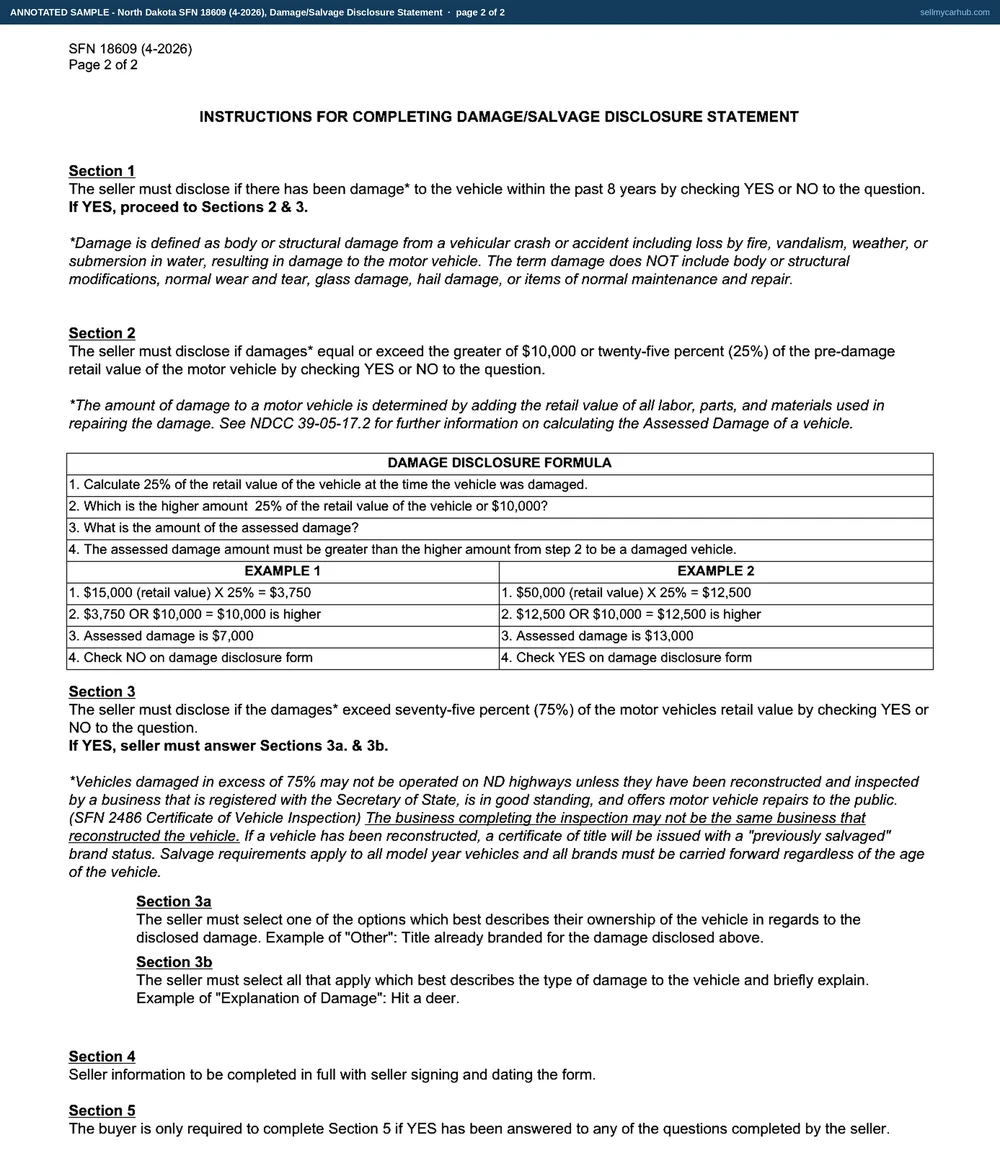
Page 2 of 2. The instruction page, shown because the form cannot be answered without it - the definition of assessed damage, the four-step damage disclosure formula, and the two worked examples that decide the Section 2 answer.
Field by field

Every line, in the order you meet it

  1. 1
    You fill this in

    The vehicle rows

    Year, make, model and style, then the vehicle identification number and title number.

    Watch out: Style means body style - the department's own word for it on this form - and it should match what the certificate of title says rather than what the manufacturer's brochure said.

  2. 2
    You fill this in

    VIN and title number

    Both copied from the face of the certificate.

    Watch out: This sheet is filed with the title application, so a transposed digit here is a mismatch the counter finds immediately.

  3. 3
    You fill this in

    Section 1, the eight-year question

    Yes or No: body or structural damage from a crash or accident in the past eight years, including loss by fire, vandalism, weather or submersion in water.

    Watch out: Read the exclusions printed under it before you answer. Glass damage, hail damage, modifications and normal maintenance and repair are not damage for this purpose - a stone chip and a replaced windscreen do not make this a Yes.

  4. 4
    You fill this in

    Section 2, the 25 percent test

    Only reached after a Yes above. Do the damages equal or exceed the greater of $10,000 or 25 percent of the pre-damage retail value on the NADA guide?

    Watch out: Work the formula on page two rather than eyeballing it - the worked examples show a $7,000 repair on a $15,000 car answering No and a $13,000 repair on a $50,000 car answering Yes.

  5. 5
    You fill this in

    Section 3, and the 3A and 3B blocks under it

    Whether the damage exceeded 75 percent of retail value, then which of the four ownership situations applies and every type of damage that applies, with a brief explanation.

    Watch out: A Yes here means the vehicle is in the salvage system, not the ordinary sale system, and the department's own example of an Other in 3A is a title already branded for the damage disclosed above.

  6. 6
    You fill this in

    Section 4, your name and address

    Name of the transferor, daytime telephone number, mailing address, city, state and ZIP code.

    Watch out: The department's instruction for this section is that seller information is to be completed in full - a partial address is a reason to send the form back.

  7. 7
    You fill this in

    Section 4, your signature and date

    Sign and date it. Your signature is what makes the disclosure a disclosure.

    Watch out: The Class A Misdemeanor warning printed just above this line applies to what you signed, not to what you meant. If an answer is uncertain, say so in the explanation box rather than picking the easier box.

  8. 8
    The buyer fills this in

    Section 5, the buyer's block

    The buyer's name, telephone, address, signature and date - required only where the seller answered Yes to any of the questions above.

    Watch out: If every answer above was No, leave it empty. Filling it in anyway is not helpful; it is a set of entries on a form the instructions say does not need them.

At a glance

What goes where

On the formWhat to put in it
Vehicle identificationYear, make, model and style on the first row; vehicle identification number and title number on the second.
Section 1: NDCC 39-05-17.2The threshold question. Within the past eight (8) years, has this vehicle sustained body or structural damage from a vehicular crash or accident, including loss by fire, vandalism, weather, or submersion in water, resulting in damage to the motor vehicle? Yes or No - and a Yes opens sections 2 and 3.
What damage is notPrinted under the question, and it matters as much as the question: the term damage does not include body or structural modifications, normal wear and tear, glass damage, hail damage, or items of normal maintenance and repair.
Section 2: the 25 percent testDo the damages equal or exceed the greater of $10,000 or twenty-five percent (25%) of the pre-damage retail value of the motor vehicle as determined by the National Automobile Dealers Association official used car guide? Answered only where Section 1 was Yes.
Section 3: the 75 percent testDo the damages exceed seventy-five percent (75%) of its retail value? A Yes here takes the vehicle out of an ordinary sale and into the salvage system.
3A, whose damage it wasFour choices: damage occurred in a single occurrence while I owned the vehicle; I acquired the vehicle with unrepaired damage; damage occurred prior to my ownership and I acquired it in a repaired condition; or Other, which must be explained.
3B, Type of DamageCheck all that apply from Collision, Weather, Theft, Interior, Water, Vandalism, Fire, Under Carriage and Other, with an Explanation of Damage box beneath. The instruction page's own example of an explanation is Hit a deer.
Section 4The seller's block - name of transferor, daytime telephone number, mailing address, city, state, ZIP code, signature and date.
Section 5The buyer's block, in the same shape. The instructions restrict it: the buyer is only required to complete Section 5 if YES has been answered to any of the questions completed by the seller.
Page 2, the instructions and the formulaA full page of instructions including a worked damage disclosure formula with two examples - a $15,000 vehicle with $7,000 of damage answers No, a $50,000 vehicle with $13,000 of damage answers Yes.

What gets this one rejected

Rules that decide whether it is accepted

Every line here was read off SFN 18609 (4-2026) itself — the PDF is here — and off the North Dakota Department of Transportation, Motor Vehicle Division pages. This is plain-language help with a form, not legal advice, and where our wording and the agency's differ, theirs governs.

Back to all North Dakota seller paperwork, or what selling a car in North Dakota involves.

Want the paperwork handled instead?

Get My Instant Offer → Online · about 2 minutes · free

Or send the details — we'll come to you

A disclosed-damage car is the hardest sort to sell privately, because every buyer reads Section 3 before they read the price. We buy them with the disclosure in front of us.

or call/text (877) 405-1808