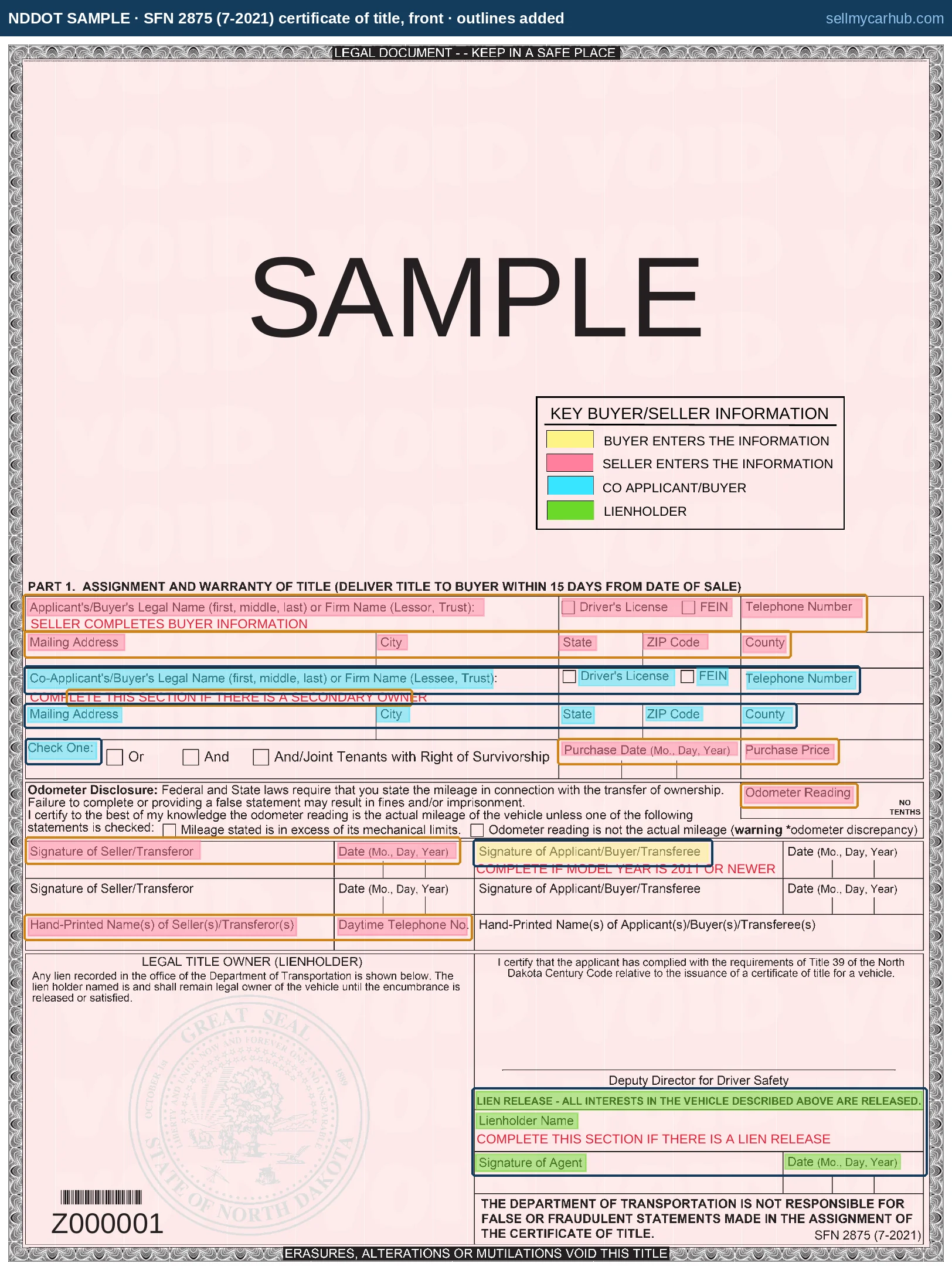
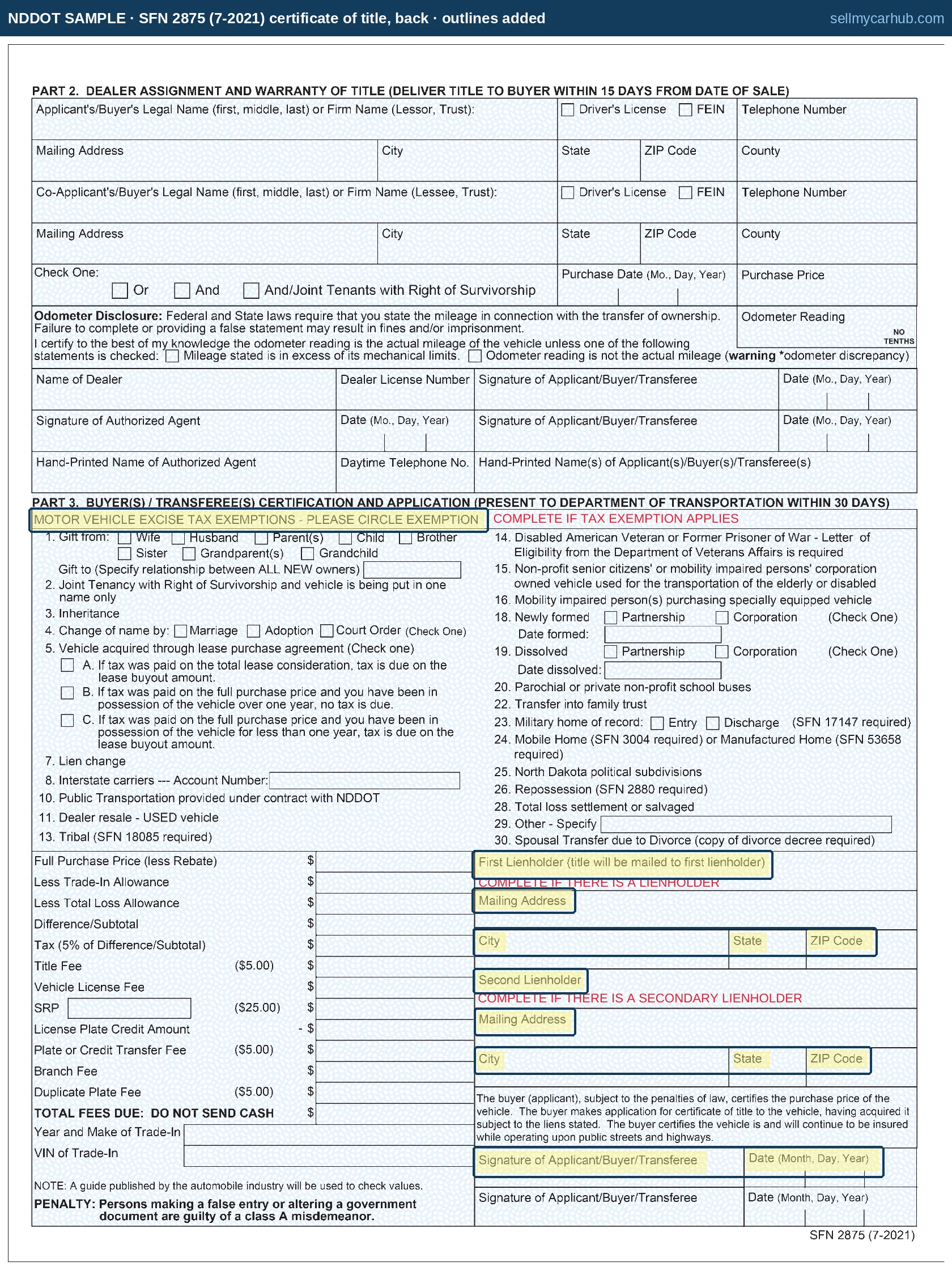
North Dakota numbers the transfer for you. The certificate carries three parts - Part 1 the seller's assignment and warranty, Part 2 a dealer re-assignment, Part 3 the purchaser's certification and application - and a private sale uses the first and the third. The department publishes a specimen of the certificate with those parts washed in four colours against its own printed key, and the boxes below follow that key exactly: pink is what the seller enters, yellow the buyer, blue the co-applicant, green the lienholder.
As a private seller you complete these and nothing else:
North Dakota is one of the easier states to show honestly, because the department publishes a picture of its own certificate and colours in who fills what. What follows is that specimen - void, watermarked, control number Z000001 - with an outline drawn around each block of colour NDDOT applied.
ERASURES, ALTERATIONS OR MUTILATIONS VOID THIS TITLE - printed along the bottom edge of the certificate itself.
Part 1 is headed ASSIGNMENT AND WARRANTY OF TITLE, and the parenthesis after it is the deadline the document in your hand imposes: DELIVER TITLE TO BUYER WITHIN 15 DAYS FROM DATE OF SALE.
No hunt through procedure manuals was needed for this one and none was made: NDDOT links a three-page Color-Coded North Dakota Sample Title with Checklist straight from its Motor Vehicle page. Page one is the front of the certificate on its security stock - VOID through the pantograph, SAMPLE across the printed-data half, control number Z000001, form number SFN 2875 (7-2021) at the foot - with Part 1 washed in the department's four colours against its own key. Nothing on it belongs to a member of the public: the owner block is blank stock.
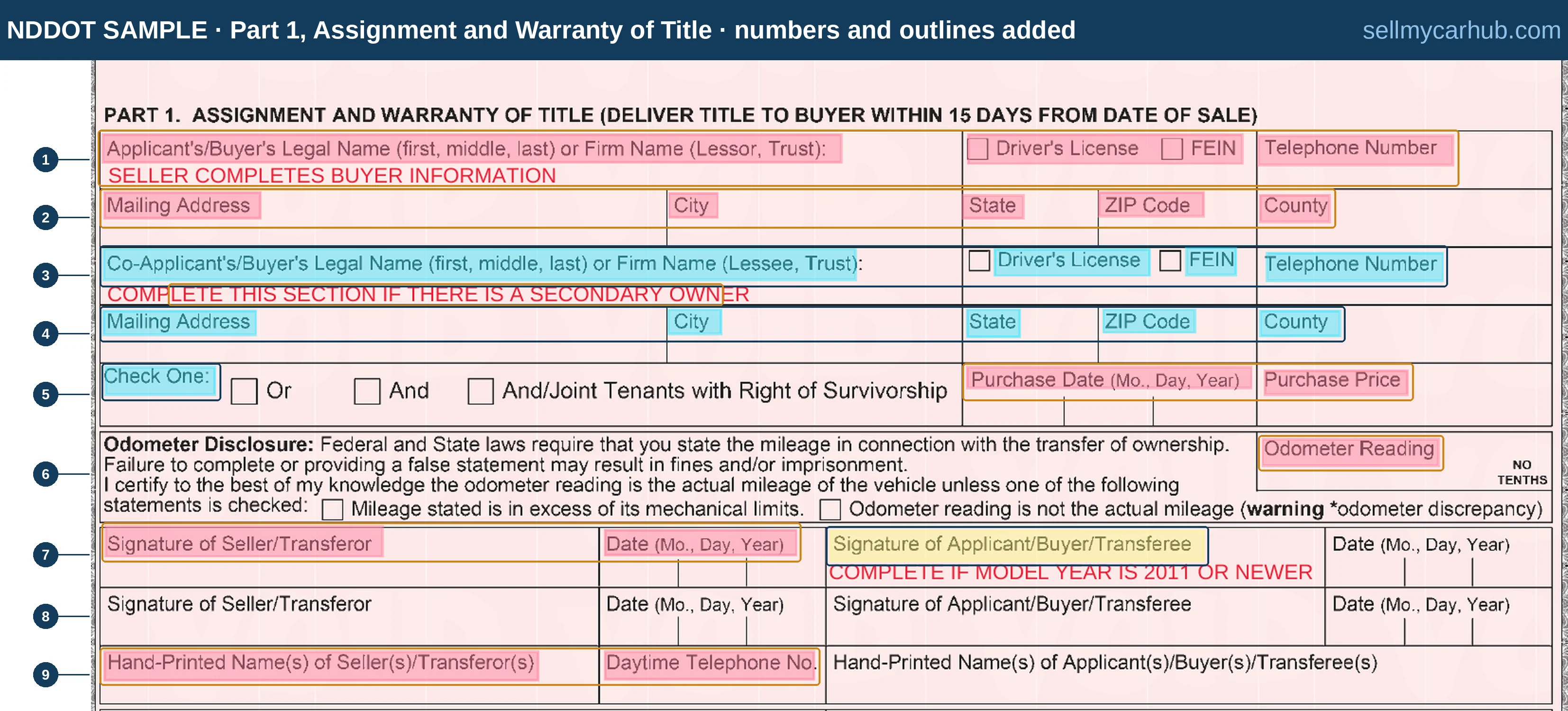
The same sample's Part 1, cropped and enlarged, with each row of the department's own table rules marked and numbered one to nine. Pink is yours, yellow the buyer's, blue the co-applicant's. NDDOT has written three instructions across it in red - seller completes buyer information, complete this section if there is a secondary owner, and complete if model year is 2011 or newer - and those three sentences are most of what a North Dakota seller needs to know.
Just under four minutes from the department on filling in the certificate itself, which is where a North Dakota sale lives. Nothing loads from YouTube until you press play.
The first row of Part 1, and NDDOT prints its instruction across it in red on the sample: SELLER COMPLETES BUYER INFORMATION. Their legal name - first, middle, last - or a firm name for a lessor or trust, a driver's licence or FEIN number with one of the two boxes ticked, and a daytime telephone number.
Watch out: Legal name means the name on their licence, and the department defines the acceptable identifiers by name in its manual. Copy it from the document rather than from how they introduced themselves.
Mailing address, city, state, ZIP code and county, still in your handwriting.
Watch out: The county box is the one people skip, and North Dakota asks for it on every application it publishes. A blank there is an incomplete entry, and the certificate voids itself if you go back and squeeze it in later.
The second owner's legal name, their driver's licence or FEIN, and a telephone number - the department's red note on the sample reads COMPLETE THIS SECTION IF THERE IS A SECONDARY OWNER.
Watch out: Leave the whole block alone where one person is buying. Half a co-applicant - a name with no identifier, or an identifier with no conjunction ticked below - is worse than none.
A full second address block: mailing address, city, state, ZIP and county for the co-applicant.
Watch out: This is where the certificate differs from the loose Part 1 the department publishes as SFN 2877, which gives a co-buyer no address of their own. On the certificate they get one, so fill it in even when the two buyers live together.
Three boxes - Or, And, And/Joint Tenants with Right of Survivorship - and, on the same row, Purchase Date (Mo., Day, Year) and Purchase Price.
Watch out: The certificate calls it a purchase date and a purchase price where the loose form calls them date of sale and selling price. They are the same two figures, they set the buyer's excise tax and their thirty-day clock, and the conjunction beside them decides who has to sign the next time this car is sold.
The certification block: that the reading is the actual mileage unless one of two boxes is checked - mileage stated is in excess of its mechanical limits, or odometer reading is not the actual mileage, marked warning odometer discrepancy - with the reading itself in the box to the right, which is labelled NO TENTHS.
Watch out: Whole miles only, exactly as that label says, and read off the cluster with the car in front of you. The block carries the department's own warning that failing to complete it or providing a false statement may result in fines and imprisonment.
Signature of Seller/Transferor on the left with the date next to it; Signature of Applicant/Buyer/Transferee on the right with its own date. NDDOT's red note runs under the buyer's half: COMPLETE IF MODEL YEAR IS 2011 OR NEWER.
Watch out: That note is the whole odometer rule in one line - on a 2011-or-newer vehicle the buyer's signature here is what certifies the mileage you entered above, and the transfer is incomplete without it. On an older car their signature is not wanted in this box at all.
An identical row underneath: a second Signature of Seller/Transferor with a date, and a second buyer's signature with a date.
Watch out: Used when the face of the certificate joins its owners with and, or when two people are buying. A title that names two sellers and carries one signature is not assigned, whatever else is filled in.
Hand-Printed Name(s) of Seller(s)/Transferor(s) with a daytime telephone number, and the buyer's hand-printed names in the half beside them.
Watch out: Print, do not sign again - this row exists so the counter can read what the signature row says. Print the name exactly as the face of the certificate has it, even if you have married, divorced or otherwise changed it since.
Six habits for a certificate that voids itself over a correction, starting with the one the department prints along its own bottom edge.
| Read the whole of Part 1 before the pen touches it | The warning is printed on the certificate, not buried in a manual, and the department's checklist repeats it as a condition of acceptance: no write-overs, cross-outs, or mutilations. There is no correction fluid in North Dakota's system, only a notarised statement of error and a wait. |
|---|---|
| Write the buyer in yourself, legibly | Part 1 asks for the new owner's legal name and address typed or printed legibly, and it is the seller's line to complete. The form warns in its own footer that incomplete or illegible entries may be returned to the owner for correction or for completion of a new form. |
| Date it the day possession actually changed | The date of sale starts the buyer's thirty-day clock at the department, it is the date you will quote if you ever move the plate credit, and it is one of the four entries the department will only correct on a form signed by the seller. |
| Do the odometer with the car in front of you | Model year 2011 or newer means a reading in whole miles and a certification, with the buyer countersigning it. Once a wrong figure is printed on a new title the route back runs through the original certificate, a notarised correction, and service records from either side of the error. |
| Take the plates off before the car moves | This is a pen rule in North Dakota because it is part of the transfer, not a tidying-up afterwards. The registration expires the moment you sign, and the plate in your hand is the credit against your next registration. |
| Keep your copy of the bill of sale | There is no notice of sale to file, so the signed bill of sale is your entire record of the transaction - and the department may ask about a below-guide price at any time, which is exactly what its comments box exists to answer. |
The ink rule is NDDOT Motor Vehicle Division's own: “ERASURES, ALTERATIONS OR MUTILATIONS VOID THIS TITLE” — NDDOT, Color-Coded North Dakota Sample Title with Checklist.
Three things North Dakota sellers repeat with confidence that the department's own pages contradict. Each correction links its source.
“Get the title notarised or the transfer will not stand.”
Nothing on a North Dakota certificate asks for a notary. Part 1 takes the seller's signature and printed name and nothing else, the Registration Manual's Title Transfer section never mentions one, and neither does NDCC 39-05-17. The confusion is real, because the notary is everywhere around the edges: the lien release, the repossession affidavit, the affidavit of non-receipt, the statement of error, the odometer correction, the decedent's affidavit, the seller's certificate and the two untitled-vehicle affidavits all print sign before a Notary Public or Authorized Officer. The two documents in an ordinary sale - the certificate's own Part 1 and the Private Party Vehicle Bill of Sale - do not.
“Leave the plates on so the buyer can drive it home.”
Wrong twice over. The statute makes removing them your act - the registration of the vehicle expires and the transferor shall remove the number plates - so a plate left on the car is your number on a vehicle you no longer own, on a registration that has already expired. And the buyer needs nothing from you to drive it home: NDCC 39-04-36(3) gives them five days from the date of purchase with no plate and no registration at all, provided a dated bill of sale or a dated copy of the certificate is in the vehicle. What leaving the plates on actually costs is your licence fee credit, which the statute then requires you to use anyway on your next vehicle.
“File the release of liability within a few days or the buyer's tickets are yours.”
North Dakota has no such filing. Not a notice of sale, not a report of sale, not a release of liability - we enumerated all 337 rows of the department's forms index, read the manual's transfer, plate and sale sections, and searched Century Code chapters 39-04 and 39-05 for each phrase. Nothing. The state solved the problem physically instead: your registration expires at the moment of transfer and the plates leave with you, so there is no live registration in your name for a citation to attach to. The deadlines people half-remember belong elsewhere - fifteen or thirty days for handing the title over, thirty days for the buyer to file it.
North Dakota decides signatures with one word on the face of the certificate, and sends none of them to a notary:
| Every owner the face of the title names, according to its conjunction | Or lets one sign alone. And needs both. And/Joint Tenants with Right of Survivorship needs both while both live, and the survivor alone with a certified death certificate afterwards. |
|---|---|
| A company, twice over | A certificate in a company's name must be countersigned - the manual's example is John Jones, President of Northwest Trucking Inc., with the agent's title and the business name both shown. |
| The buyer, under your odometer entry | On a model year 2011 or newer vehicle the new owners sign and print their names certifying the mileage you stated. It is part of the transfer, not a formality. |
| Nobody in front of a notary | Not on the certificate, and not on the Private Party Vehicle Bill of Sale either. The notary block belongs to the department's affidavits - the lien release, the decedent's affidavit, the untitled-vehicle route - and never to an ordinary assignment. |
| The name printed on the title, even if it is no longer yours | Married, divorced or otherwise renamed since you bought the car, you sign as the certificate has you. The manual makes it a rule of its own. |
Two things happen the moment Part 1 is signed. The plates come off the car and go home with you, because the statute makes that your act - and there is no form to file afterwards, because North Dakota does not publish one.
The two things that follow a signed title — what happens to the plates and telling NDDOT Motor Vehicle Division the car is gone — are set out in full on the North Dakota paperwork page rather than repeated here.
The forms that go with it: the bill of sale that doubles as the buyer's five-day proof of ownership, the damage disclosure, required on anything under nine model years old and the Statement of Fact that moves your plate credit onto the next car.
Every field description here is taken from the NDDOT, Color-Coded North Dakota Sample Title with Checklist and the North Dakota Department of Transportation, Motor Vehicle Division title pages, current as of 2026-08-24. Plain-language help with a form, not legal advice, and where our wording and the agency's differ, theirs governs.
Back to all North Dakota paperwork, or what selling a car in North Dakota involves.