One short page in which a lender confirms that the debt is gone and that it has no further interest in the vehicle. NCDMV's index calls it a release of financial interest; the form's own heading calls it an affidavit by a North Carolina lienholder. It is the document a seller chases when the loan was paid off and the certificate never came back.
Written against MVR-46D (Rev 04/26), issued under N.C. General Statute 20-58.4. Start this before you advertise the car, not after a buyer has agreed a price. A release from a lender that has since been bought by another bank can take weeks to track down, and the buyer's 28 days do not pause while you do it.
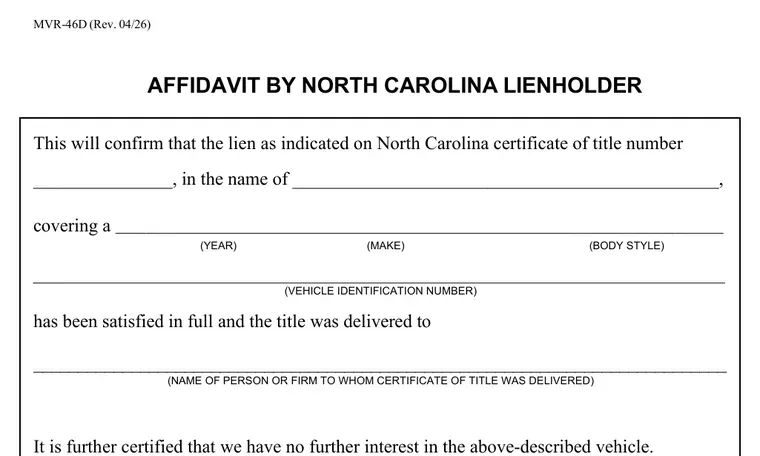
Two documents, and they are not the same thing. Take the blank MVR-46D from the ncdot.gov copy so you get the revision that is current today, then print our MVR-46D guide and keep it beside you while you fill theirs in.
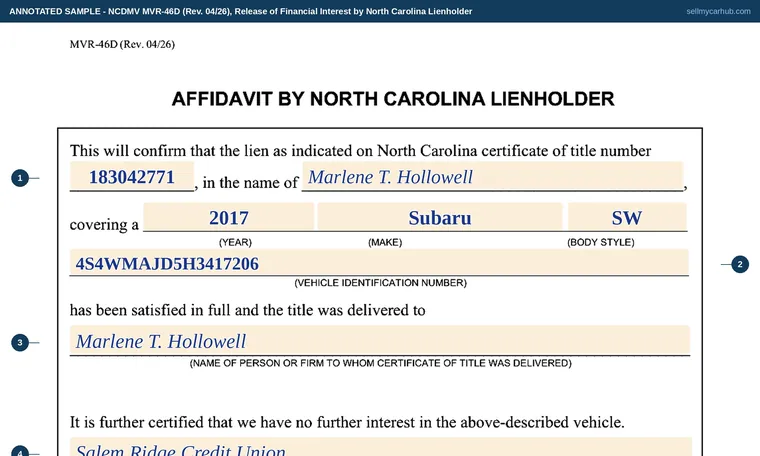
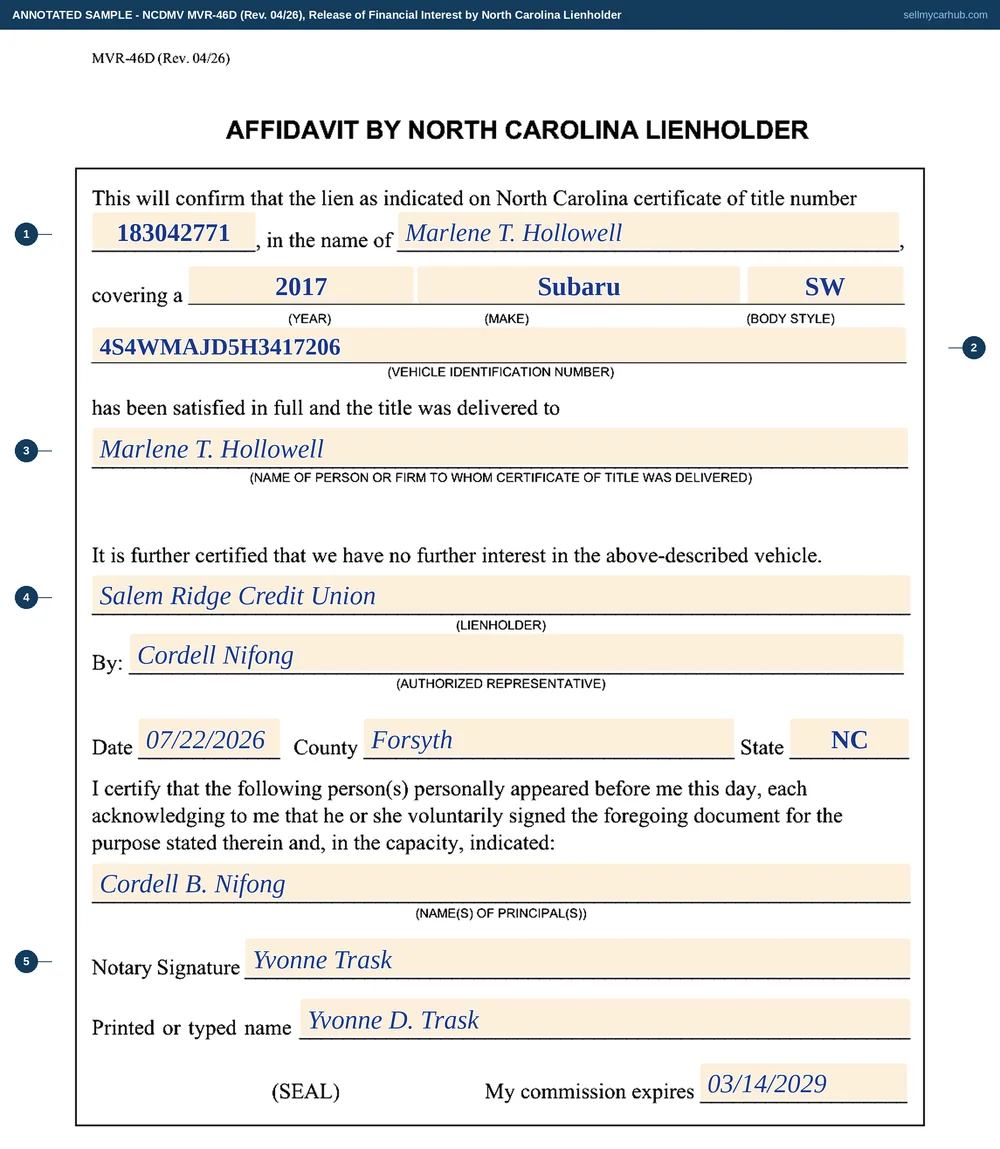
This is the actual MVR-46D, rendered from the PDF the North Carolina Division of Motor Vehicles publishes and completed end to end: letterhead, every field, and the blocks at the foot.
The number of the North Carolina title the lien is recorded on, in the blank inside the opening sentence.
Watch out: It is printed on the face of your certificate under the vehicle identification number. If the title is missing as well as the lien, deal with the duplicate first.
Year, make and body style on one row, VIN on the next.
Watch out: The VIN on this form has to match the one on the record the lien sits against, which is not always the one on the loan agreement if the loan was refinanced.
The name of the person or firm to whom the certificate of title was delivered.
Watch out: If the lender says the title went to you and you never received it, this line is the evidence you need for an MVR-4 — and the lender may have to swear to that separately on the affidavit at the foot of the MVR-4.
The institution's name, and the individual signing for it underneath.
Watch out: The certification above these lines says the lien has been satisfied in full and that we have no further interest in the vehicle. A junior clerk cannot make that statement on behalf of a bank; find the titles department.
Date, county and state, the names of the principals, the notary's signature and printed name, seal and commission expiry.
Watch out: Lenders usually have a notary on staff. Asking whether theirs is available before you send the form is what turns a three-week wait into an afternoon.
| On the form | What to put in it |
|---|---|
| The opening sentence | A single paragraph that carries most of the form: this will confirm that the lien as indicated on North Carolina certificate of title number, then a blank for that number, then in the name of, and a blank for the registered owner. |
| The vehicle description | Year, make, body style across one row, with the vehicle identification number on the row beneath it. |
| Delivered to | Name of the person or firm to whom the certificate of title was delivered. This is where you find out whether the paper went to you, to a dealer, or nowhere at all. |
| The further certification | It is further certified that we have no further interest in the above-described vehicle — printed, not optional, and the reason this form does more than acknowledge a payment. |
| Lienholder and authorised representative | Two lines: the institution's name, and underneath it the individual signing on its behalf. |
| Date, county and state | Where and when the acknowledgment was taken. It is the lender's county, not yours. |
| The notary block | Names of the principals, notary signature, printed or typed name, seal and commission expiry — the same acknowledgment North Carolina takes on almost every document in this set. |
Every line here was read off MVR-46D (Rev 04/26) itself — the PDF is here — and off the North Carolina Division of Motor Vehicles pages. This is plain-language help with a form, not legal advice, and where our wording and the agency's differ, theirs governs.
Back to all North Carolina seller paperwork, or what selling a car in North Carolina involves.