Sell My Car Hub

How to fill out New York MV-912

The document the NYS DMV asks a private seller to sign alongside the certificate, and the only piece of paper you keep afterwards that proves when the car stopped being yours. One page, fourteen boxes, no notary. The department asks for it even when the vehicle is a gift.
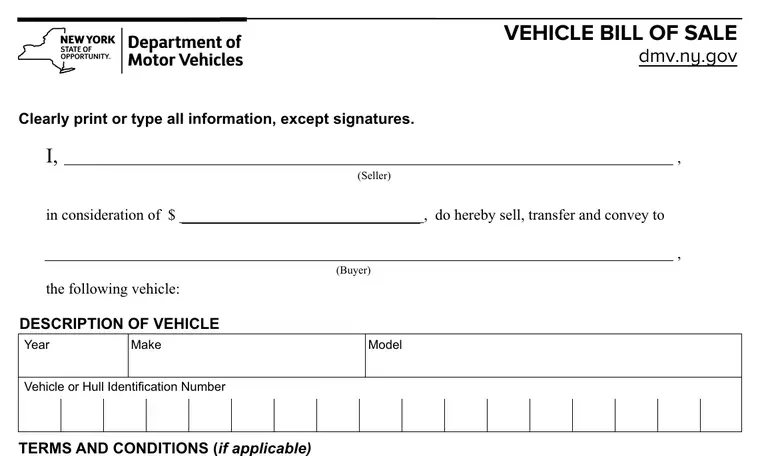
Written against MV-912 (11/21), issued under the NYS DMV's proof-of-sale requirement for a private transfer. This is the form that survives the sale. Everything else you sign leaves with the buyer or goes to Albany; this is the one you file at home, and it is what the DMV asks for if an insurance-lapse letter ever lands on your mat.

Two documents, and they are not the same thing. Take the blank MV-912 from the dmv.ny.gov copy so you get the revision that is current today, then print our MV-912 guide and keep it beside you while you fill theirs in.

Filled in

What a completed one looks like

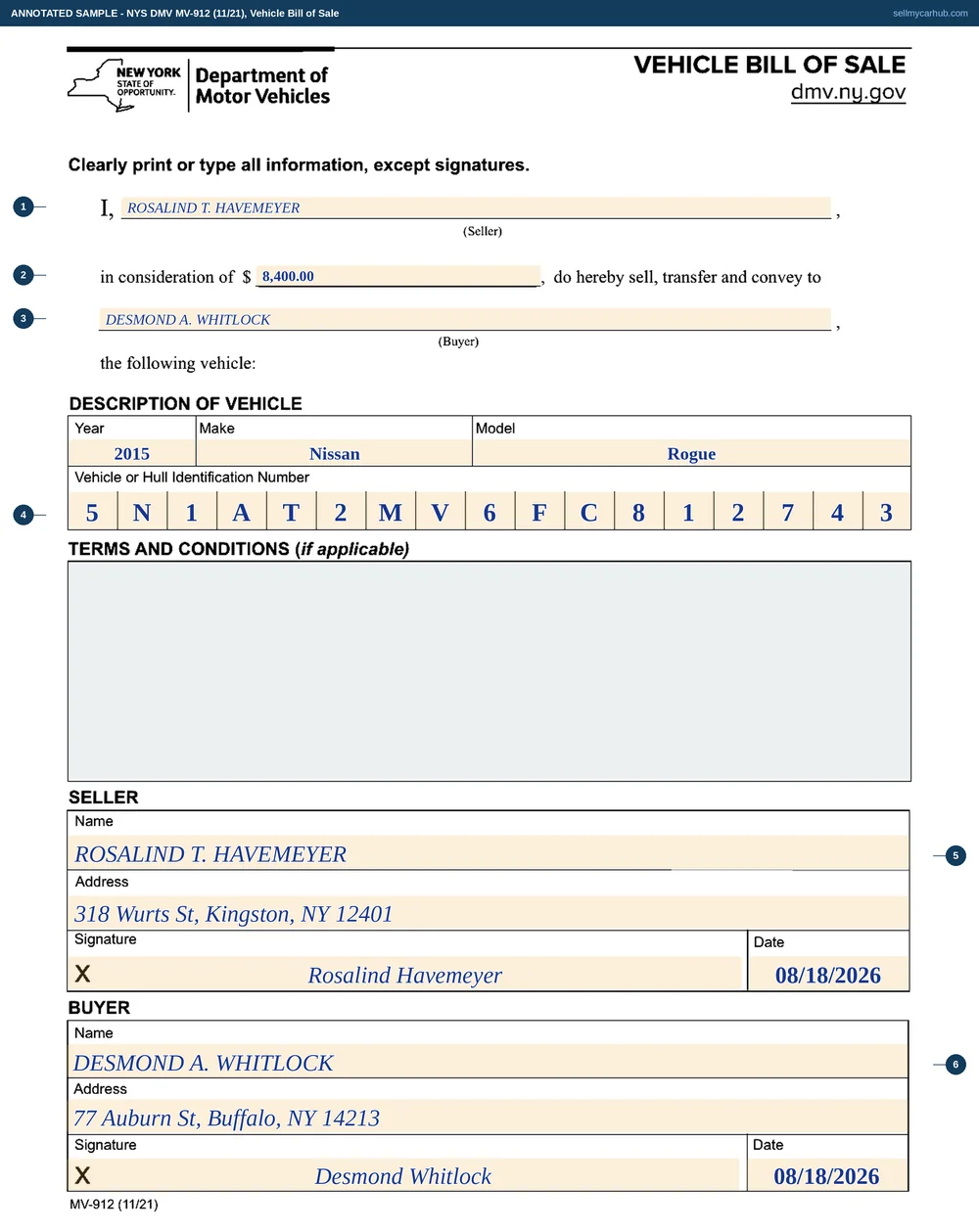
This is the actual MV-912, rendered from the PDF the New York State Department of Motor Vehicles publishes and completed end to end: letterhead, every field, and the blocks at the foot.

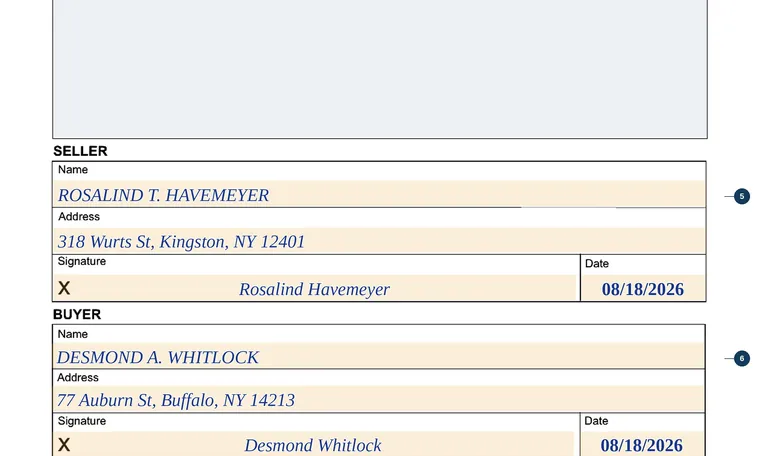
A New York MV-912 bill of sale filled in for one private sale: seller Rosalind T. Havemeyer, a price of 8,400 dollars, buyer Desmond A. Whitlock, a 2015 Nissan Rogue with the identification number 5N1AT2MV6FC812743 written one character per printed box, both parties' names and addresses, both signatures, and both dated 18 August 2026.
The actual MV-912 from dmv.ny.gov. Two things worth copying: the identification number goes one character to a box rather than as a run of text, and the terms and conditions panel is deliberately grey here because nothing was agreed beyond the price - which on this form is itself an answer.
Field by field

Every line, in the order you meet it

  1. 1
    You fill this in

    I, ____

    Your name on the first rule, printed rather than signed. The signature comes later and lower.

    Watch out: Use the name as the front of the certificate has it. A bill of sale in one version of your name and a title in another is the kind of mismatch a clerk has to stop and resolve.

  2. 2
    You fill this in

    in consideration of $

    The amount actually paid, written on the rule that follows the dollar sign.

    Watch out: This figure and the one the buyer writes on their tax form should be the same number. If it is a gift, this is where the zero goes, and the DMV wants the word gift on the form too.

  3. 3
    You fill this in

    do hereby sell, transfer and convey to

    The buyer's name, in full, on the third rule.

    Watch out: Whoever is named here is who the vehicle went to. If two people are buying it together, both names belong on this line and both belong in the BUYER block at the foot.

  4. 4
    You fill this in

    Description of vehicle

    Year, make and model across three cells, and the vehicle or hull identification number in the row of printed boxes beneath them.

    Watch out: One character per box. Copy the number off the certificate rather than off the dashboard - if the two ever disagree, the certificate is what the DMV reads.

  5. 5
    You fill this in

    The SELLER block

    Your name, your address, your signature on the rule marked X, and the date.

    Watch out: Date it the day the car actually changed hands. This date and the Date of Statement on the back of the certificate should match.

  6. 6
    The buyer fills this in

    The BUYER block

    The same four cells for the buyer: name, address, signature and date.

    Watch out: Do not let them leave with an unsigned copy. A bill of sale carrying only your signature proves you offered the car, not that anyone took it.

At a glance

What goes where

On the formWhat to put in it
I, ____ (Seller)Your name, printed on the opening line. The form's instruction across the head is to clearly print or type all information, except signatures.
in consideration of $ ____What was actually paid. On a gift the DMV's guidance is to enter the purchase price as zero here and to indicate on the form that the vehicle is a gift.
do hereby sell, transfer and convey to ____ (Buyer)The buyer, on the second rule. These two lines are the operative sentence - everything below them describes the thing being conveyed.
Description of vehicleYear, make and model in three ruled cells, then the vehicle or hull identification number in a row of seventeen printed boxes underneath.
Terms and conditions (if applicable)A deep empty box. It is where anything agreed beyond the price goes - a deposit, a date the car is to be collected, a part that is coming with it - and it is the only free-text space on the form.
Seller: name, address, signature, dateFour cells in a block headed SELLER. The signature rule carries a printed X.
Buyer: name, address, signature, dateThe same four cells again, headed BUYER. Both parties sign the same sheet.

What gets this one rejected

Every line here was read off MV-912 (11/21) itself — the PDF is here — and off the New York State Department of Motor Vehicles pages. This is plain-language help with a form, not legal advice, and where our wording and the agency's differ, theirs governs.

Back to all New York seller paperwork, or what selling a car in New York involves.

Want the paperwork handled instead?

Get My Instant Offer → Online · about 2 minutes · free

Or send the details — we'll come to you

If a private buyer, a bill of sale and an argument about the price is not how you want to spend the month, tell us about the car instead.

or call/text (877) 405-1808