New York puts the whole private transfer on one side of one document: Section I on the reverse of the certificate, headed Transfer by Owner. Four lines are yours and everything above them is a certification you are making by signing. Every block below is transcribed from the NYS DMV's own specimen of the MV-999, which it publishes as an appendix to its dealer regulations.
Last updated .
Your 9 boxes
As a private seller you complete these and nothing else:
There is no blank New York title to download and never will be - the Title Bureau prints it in Albany and posts it to the registered owner. What the department does publish is the picture above: its own sample certificate, front and back, out of the appendix to its dealer regulations. The download beside this note is ours - a one-page checklist to keep beside you while you complete the real one.
ANY CHANGE OR ERASURE WILL VOID THIS TITLE -- ANY FALSE STATEMENT IS A MISDEMEANOR. That is the first line on the reverse, above everything else.
The certificate tells you to leave the front alone, and the DMV repeats it: complete the Transfer by Owner section on the back, do not write on or mark the front, and do not fill in any information until you actually make the transfer.
The real certificate
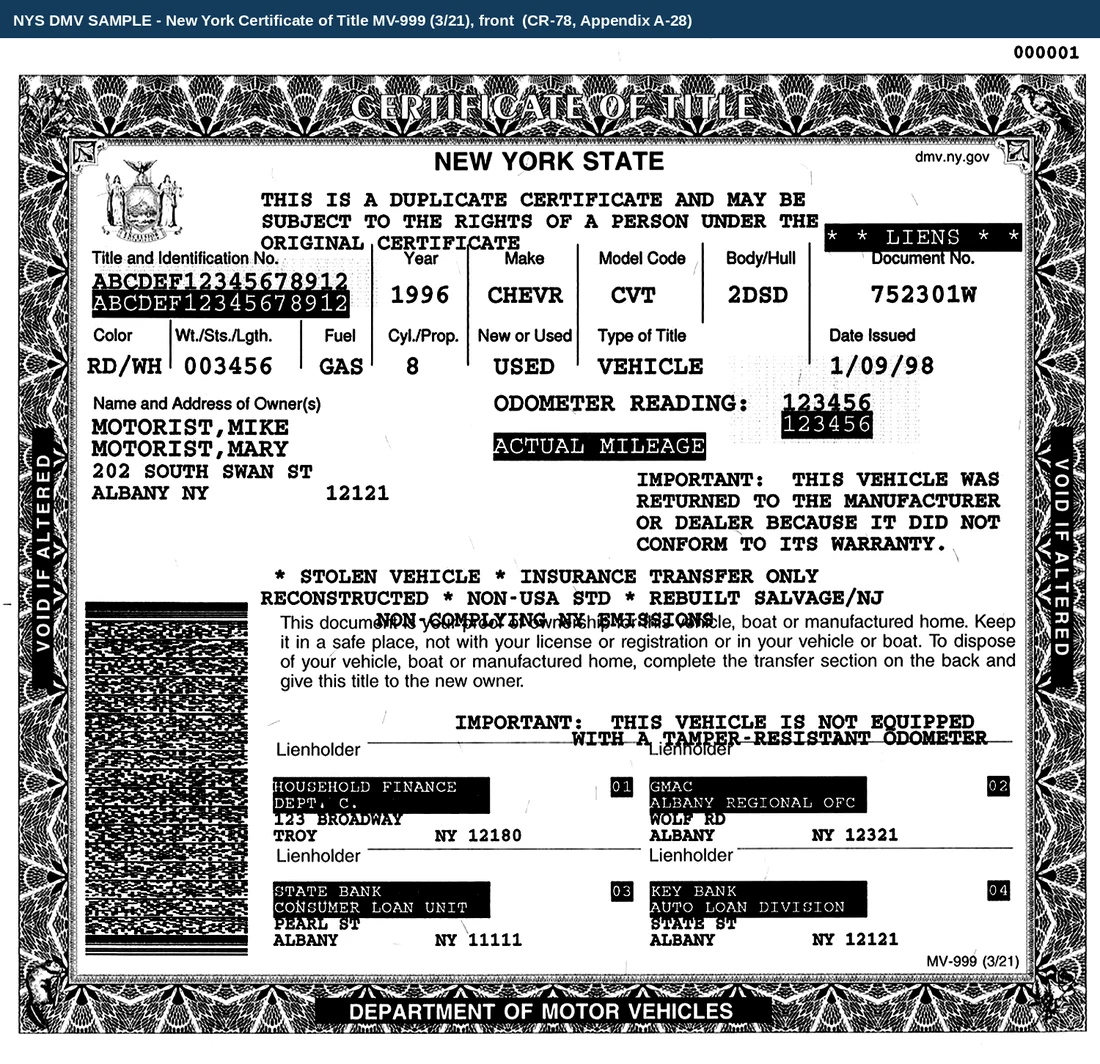
What a New York certificate of title actually looks like
This is the NYS DMV's own sample of the MV-999, published as Appendix A-28 of CR-78. The owners on it are the department's placeholders - MOTORIST, MIKE and MOTORIST, MARY at 202 South Swan Street, which is the DMV's own address in Albany - and the identification number reads ABCDEF12345678912. Nothing on the front is yours to complete, which is why none of it is shaded amber.
Amber — you write it, in pen
Grey — not yours to fill
Numbered — matches the steps below
Click or tap the picture to open it full size.
Published by the NYS DMV itself, with the department's own placeholder owners and a made-up identification number on it. Three things on the face are worth checking before anybody signs anything. The identification number, against the number stamped on the car. The lienholder blocks at the foot - a name in any of those four boxes is a lender who has to release before the buyer gets a clean certificate. And the banner across the top of this particular specimen, which reads THIS IS A DUPLICATE CERTIFICATE AND MAY BE SUBJECT TO THE RIGHTS OF A PERSON UNDER THE ORIGINAL CERTIFICATE: that line is printed on every replacement title the DMV issues, and a buyer who has never seen one will ask about it.
Turn it over
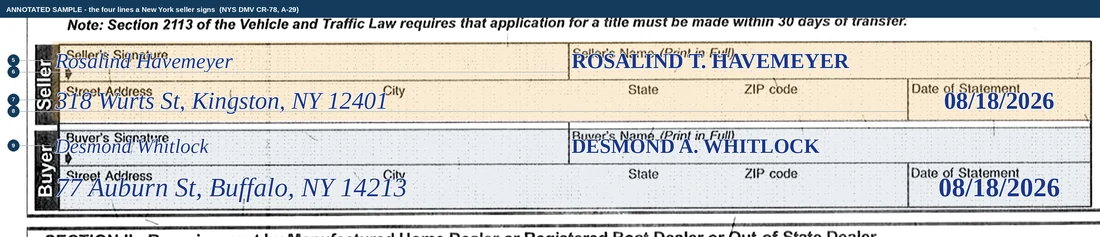
Section I, the four lines that move the car
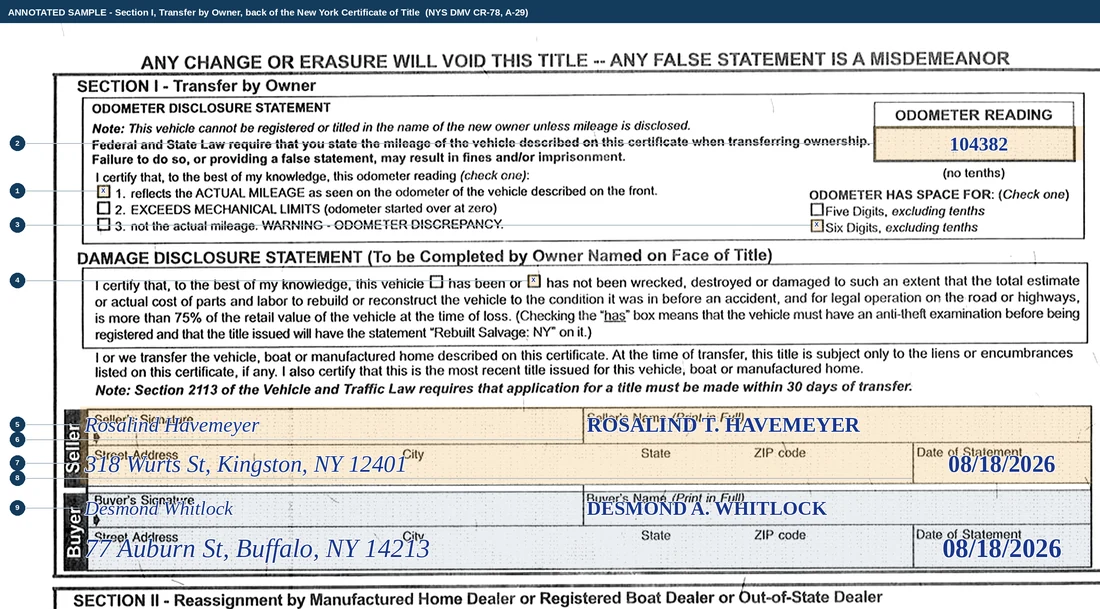
The back is where a private seller works, and the whole transfer is one grid four rows deep. Amber is what a seller writes; the buyer's half sits underneath in grey. Every rectangle in these two pictures was found by detecting the certificate's own printed rules rather than measured off the image.
Click or tap the picture to open it full size.
The note printed directly above this grid is the buyer's deadline, not yours: Section 2113 of the Vehicle and Traffic Law requires that application for a title must be made within 30 days of transfer. It is worth pointing at when you hand the certificate over, because the seller is the one who hears about it if the buyer lets it slide.
Click or tap the picture to open it full size.
The whole of Section I, in the order a seller meets it. Note what is not here: there is no exempt box anywhere on the odometer block, and no age qualifier in the paragraph above it - the printed certificate states the disclosure requirement flatly and leaves the exemption to 49 CFR 580.17 and to the DMV's website.
Before you watch. The NYS DMV publishes no video about selling a car. Its channel carries 267 videos, and searching it for title, sell a car, plates, registration, transfer, lien, odometer and bill of sale returns road-safety campaigns, licence and Real ID guidance, and this one registration walkthrough. Every result was checked through YouTube's oEmbed endpoint to confirm the uploader was the agency itself and not a third party using its name.
Published by the NYS DMV on its own channel. It is the buyer's side of your sale rather than yours - what they have to bring to the office - and it is worth two minutes because a buyer who arrives unprepared comes back to you for paperwork you have already handed over. Nothing loads from YouTube until you press play.
Step by step
Every box, in the order you meet it
0
You fill this in
Before any box: take the plates off
The DMV's instruction comes before the signing, not after it: before you complete the sale, take your license plates off the vehicle and remove your registration sticker from the windshield.
Watch out: This is the step that decides whether the rest of it costs you anything. The plate stays attached to your registration record until the DMV has it back, and the registration has to outlive the insurance - surrender first, cancel second.
1
You fill this in
Odometer disclosure: which certification
Three boxes, and you tick exactly one: the reading reflects the ACTUAL MILEAGE, it EXCEEDS MECHANICAL LIMITS because the odometer rolled over, or it is not the actual mileage and carries an odometer discrepancy warning.
Watch out: There is no exempt box on a New York certificate. If the car is a 2010 or older model year the disclosure is not required at all - but the form gives you nowhere to say so, so leave the block alone rather than inventing an answer for it.
2
You fill this in
The odometer reading itself
Whole miles, in the ruled box at the top right of Section I. The certificate prints "(no tenths)" underneath it.
Watch out: Read it off the dashboard on the day, not off the last inspection report. If the two disagree the buyer's application is the thing that stalls, and the DMV will be asking you about it weeks later.
3
You fill this in
Five digits or six
A second pair of boxes beside the reading, asking how many digits the odometer has space for excluding tenths.
Watch out: This is the question that makes a rollover provable. A five-digit odometer showing 12,300 on a car that has plainly done more is exactly what the EXCEEDS MECHANICAL LIMITS box exists for.
4
You fill this in
Damage disclosure: has been, or has not been
One box of two, certifying whether the vehicle has been wrecked, destroyed or damaged past 75 per cent of its retail value at the time of loss.
Watch out: It must be completed for all vehicles regardless of age - there is no cut-off. And ticking "has been" has consequences the certificate spells out: an anti-theft examination before it can be registered, and REBUILT SALVAGE: NY printed on the new title.
5
You fill this in
Seller's Signature
The upper-left cell of the grid, on the rule marked with an arrowhead.
Watch out: The DMV's wording about this line is unusually direct: when you sign on the line for Seller's Signature, the vehicle will immediately belong to the new owner. Not when the money moves, not when they register it.
6
You fill this in
Seller's Name, printed in full
The cell to the right of your signature. Print, do not initial.
Watch out: It has to be the name the front of the certificate carries. If you married or changed your name since the title was issued you can hand over the title in the former name - the DMV says a title in your new name is not required to sell.
7
You fill this in
Street address, city, state and ZIP
The row directly beneath the signature. The printed labels sit inside one continuous ruled box rather than in separate cells.
Watch out: Use the address the DMV has for you, because this is the block a clerk compares against the record when something does not match. If you have moved, change your address with the DMV before you sell rather than after.
8
You fill this in
Date of Statement
The right-hand cell of your address row. It is the date of transfer.
Watch out: Everything downstream hangs off this date: the buyer's thirty days to apply for a title, the day your plates should already have come off, and the date you will quote if an insurance-lapse letter ever arrives.
9
The buyer fills this in
The buyer's half of the grid
Signature, printed name, address and date, in the four cells marked Buyer down the left-hand edge.
Watch out: Do not let them take the certificate away to fill in later. An assignment with only your half completed is a document the DMV can refuse, and one you can no longer correct - because correcting it voids it.
10
Dealers only
Section II, which is not yours
A second identical grid headed Reassignment by Manufactured Home Dealer or Registered Boat Dealer or Out-of-State Dealer.
Watch out: If you find yourself in Section II you have signed in the wrong half of the certificate, and there is no erasing your way back to Section I.
Before the pen
Before the pen touches the certificate
Six habits, and the first of them is the one New York enforces most brutally: a corrected certificate is not a corrected certificate, it is a void one.
No corrections, at all
Not crossed out, not initialled, not tidied up. A voided certificate has to be replaced with a duplicate before the car can be transferred, and that is a $20 application and a wait for the post.
Blue or black ink
The MV-82 the buyer files says PRINT CLEARLY IN BLUE OR BLACK INK across its head. Nothing in New York vehicle paperwork wants pencil.
Nothing on the front
The whole of the face was set in Albany when the certificate was printed. The seller's half of the document is on the reverse and nowhere else.
Nothing early
Do not fill in any information until you actually make the transfer. A certificate half-completed for a sale that fell through is a wasted certificate.
Print names in full
The certificate asks for Seller's Name (Print in Full) and means it. Initials are the commonest reason a clerk hands the package back.
Whole miles, and no tenths anywhere
Printed under the odometer box on the certificate, and repeated on the MV-103 and the MV-82TON.
Three New York rules people import from somewhere else
Three things repeated confidently about selling a car in New York. Two of them are other states' rules wearing a New York badge, and the third costs about eight dollars a day. Every correction links the New York source it comes from.
"Leave the plates on for the buyer - they can sort the registration out later."
That is the rule in the states where plates stay with the car, and it is the opposite of New York's. The DMV's instruction is to take your license plates off the vehicle and remove your registration sticker from the windshield before you complete the sale, and then either transfer them to another vehicle or turn them in at a DMV office as soon as possible. Leave them on and, in the department's own words, you may be charged with traffic or parking violations that do not belong to you.
"File a release of liability with the DMV and you are out of it."
New York has no such form. There is no notice of sale, no release of liability and no seller's report of transfer anywhere in the DMV's forms library - the department's advice for a seller who receives an insurance-lapse letter is documentary instead: bring the letter and proof that you sold the vehicle to a local DMV office, and the proof it wants is a bill of sale showing the date, both names and addresses, and the year, make and VIN. Keeping that piece of paper is the New York equivalent of filing.
"Cancel the insurance as soon as the car is gone."
Not before the plates are back. The DMV states the order the other way round - before you cancel the vehicle's liability insurance coverage you must surrender your plates and registration - and if you do not turn in the plates it will suspend your registration and can suspend your driver license. The gap between the two dates is charged for: $8 a day for the first 30 days, $10 a day for days 31 to 60, $12 a day for days 61 to 90, and past 90 days it cannot be paid off at all.
Seven rows in the signature grid on the reverse, and who has to be in each of them:
Everyone the front of the certificate names
If the certificate shows two names, the DMV needs the block signed as the face of the title requires. Check the front before either of you writes anything on the back.
Seller's Signature, then Seller's Name in full
Signature on the upper line, printed name in the box beside it, and your street address, city, state and ZIP on the line below. The DMV asks for the printed name in full, not initials.
Date of Statement
Yours and the buyer's, in the right-hand cell of each row. This is the date the buyer's thirty days start running from.
Buyer's Signature and printed name
The mirror of yours, in the Buyer half of the same grid. A seller-only assignment is an incomplete one.
A surviving spouse signing for a decedent
Prints the deceased owner's name in Seller's Name and signs their own name followed by the words "as surviving Spouse".
An executor or administrator
Signs and then writes Executor - or Administrator - of the Estate of, followed by the deceased owner's name, with the Letters from the Surrogate's Court attached.
Section II is not yours
It is headed Reassignment by Manufactured Home Dealer or Registered Boat Dealer or Out-of-State Dealer. A private seller has no business in it.
Once it is signed
Signing is not the last step in New York, it is the second-to-last. The plates have to come off before you sign, and they have to reach a DMV office before your insurance ends - in that order, or the state starts counting days at eight dollars each.