Sell My Car Hub

How to fill out New York MV-103

The standalone version of the two disclosures that are normally printed on the back of the certificate. You need it when the certificate you are handing over has no disclosure section on it - an older title, or a transferable registration - and the DMV will not register the vehicle without one.
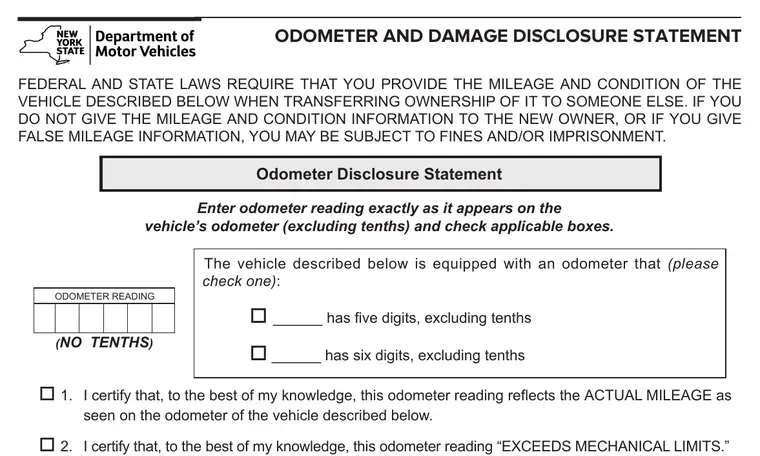
Written against MV-103 (5/25), issued under the federal odometer disclosure regulations at 49 CFR part 580, and the damage disclosure New York requires on every transfer. The mileage on this form, on the certificate and on the buyer's application all have to be the same number. They are read by different people at different desks, and a disagreement between them is the buyer's problem for about a week and then yours.

Two documents, and they are not the same thing. Take the blank MV-103 from the dmv.ny.gov copy so you get the revision that is current today, then print our MV-103 guide and keep it beside you while you fill theirs in.

Filled in

What a completed one looks like

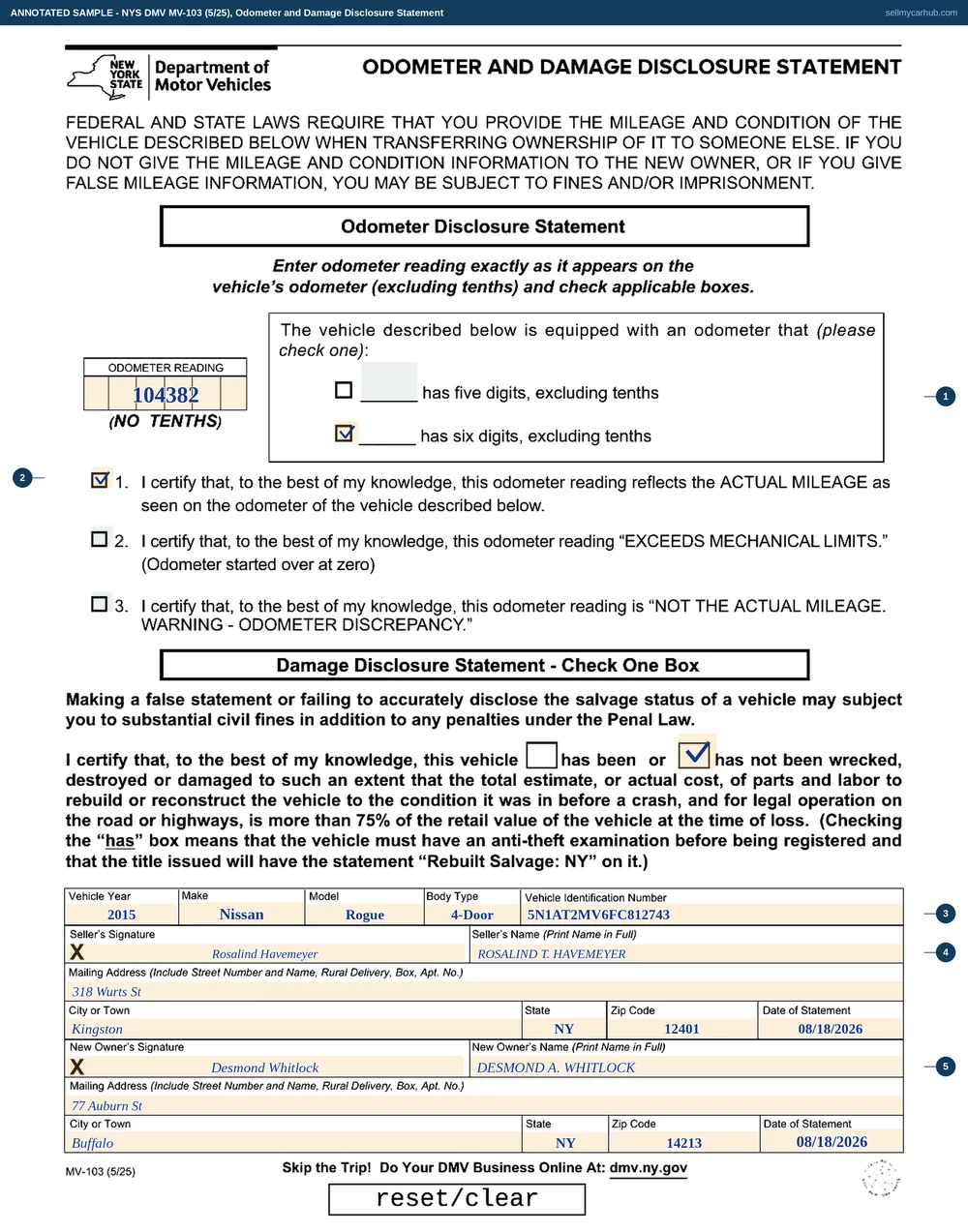
This is the actual MV-103, rendered from the PDF the New York State Department of Motor Vehicles publishes and completed end to end: letterhead, every field, and the blocks at the foot.

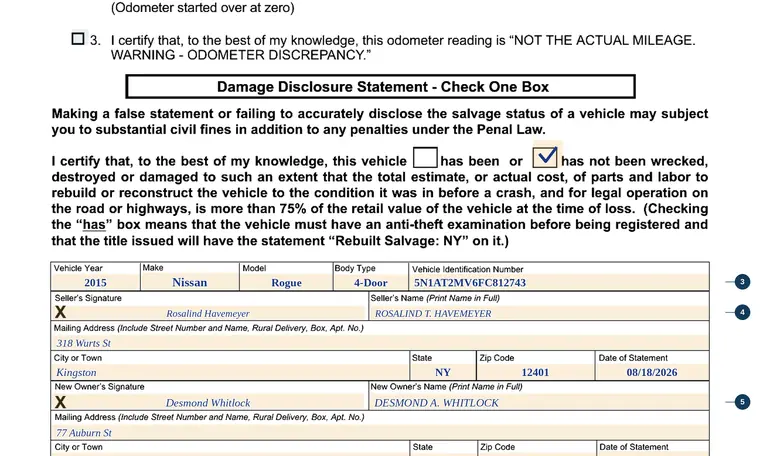
A New York MV-103 filled in: an odometer reading of 104382, the six digits box ticked, certification 1 for actual mileage ticked, the has not been box ticked on the damage disclosure, a 2015 Nissan Rogue with identification number 5N1AT2MV6FC812743, and seller and new owner blocks signed, printed, addressed and dated 18 August 2026.
The actual MV-103 at revision 5/25. The two boxes people leave empty are both ticked here: six digits, which is what makes the reading interpretable, and the damage disclosure, which New York requires whatever the age of the car.
Field by field

Every line, in the order you meet it

  1. 1
    You fill this in

    Odometer reading

    The reading exactly as the dashboard shows it, with no tenths, in the box at the top left.

    Watch out: Read it on the day of the sale. A figure copied off an old inspection report is a false statement even when it was true once.

  2. 2
    You fill this in

    Which certification you are signing

    One of three boxes: actual mileage, exceeds mechanical limits, or not the actual mileage.

    Watch out: Exceeds mechanical limits means the odometer rolled past its last digit and started again - it does not mean the car has done a lot of miles. If the clock has been replaced or is broken, the third box is the honest one.

  3. 3
    You fill this in

    Five digits or six

    How many digits the odometer displays, ignoring tenths.

    Watch out: Count them on the dashboard rather than assuming. This is what turns a low reading on an old car from a suspicion into a documented rollover.

  4. 4
    You fill this in

    Damage disclosure

    Has been, or has not been, damaged past 75% of the vehicle's retail value at the time of loss.

    Watch out: Ticking has been means the buyer needs an anti-theft examination before the vehicle can be registered, and the new certificate will carry the rebuilt salvage statement. That is not a reason to tick the other box.

  5. 5
    You fill this in

    Vehicle description

    Year, make, model, body type and the vehicle identification number across one strip.

    Watch out: Copy the identification number from the certificate. This form gets stapled to a title application and read alongside it.

  6. 6
    You fill this in

    Seller block

    Signature on the rule marked X, printed name in full, mailing address, city, state, ZIP and the date of statement.

    Watch out: Print the name in full. This is a federal disclosure as well as a state one, and initials are not a name on either.

  7. 7
    The buyer fills this in

    New owner block

    The buyer signs, prints, gives their address and dates it, acknowledging that they have seen the reported mileage.

    Watch out: Their signature is the acknowledgement. Without it the form records what you told them but not that they heard it, and the DMV wants both halves.

At a glance

What goes where

On the formWhat to put in it
The warning across the headSet in capitals: federal and state laws require that you provide the mileage and condition of the vehicle when transferring ownership of it, and that giving false mileage information can mean fines and imprisonment.
Odometer reading (no tenths)One box, top left. The instruction above it is to enter the odometer reading exactly as it appears on the vehicle's odometer, excluding tenths.
Five digits or six digitsA pair of boxes asking how many digits the odometer has, excluding tenths. It is what makes a rollover provable rather than arguable.
The three numbered certificationsNumbered 1, 2 and 3: the reading reflects the ACTUAL MILEAGE, it EXCEEDS MECHANICAL LIMITS because the odometer started over at zero, or it is NOT THE ACTUAL MILEAGE and carries an odometer discrepancy warning.
Damage disclosure - check one boxHas been, or has not been, wrecked, destroyed or damaged past 75% of the retail value of the vehicle at the time of loss. Above it sits a line about substantial civil fines and penalties under the Penal Law.
Vehicle descriptionYear, make, model, body type and the vehicle identification number, in one strip across the sheet.
Seller and new owner blocksEach gets a signature rule, a printed name, a mailing address, city, state, ZIP and a date of statement. The buyer signs to acknowledge the reported mileage.

What gets this one rejected

Rules that decide whether it is accepted

Every line here was read off MV-103 (5/25) itself — the PDF is here — and off the New York State Department of Motor Vehicles pages. This is plain-language help with a form, not legal advice, and where our wording and the agency's differ, theirs governs.

Back to all New York seller paperwork, or what selling a car in New York involves.

Want the paperwork handled instead?

Get My Instant Offer → Online · about 2 minutes · free

Or send the details — we'll come to you

Odometer discrepancies, rolled-over clocks and cars with two different mileage records - we buy those too, and the disclosure is our job rather than yours.

or call/text (877) 405-1808