Sell My Car Hub

How to fill out New York MV-900

The form that put the lender's name on your certificate in the first place. It is not a seller's form and you cannot use it to remove anything - it is here because it is what a seller finds when they search for how a New York lien works, and because understanding it explains why the document you actually need looks nothing like it.
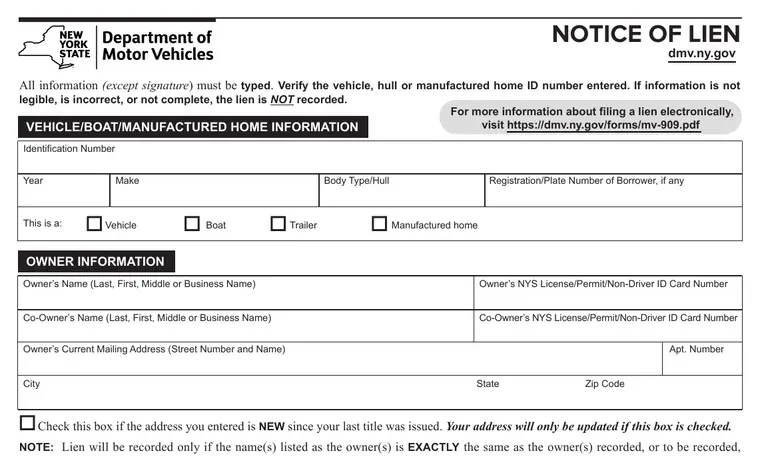
Written against MV-900 (12/24), issued under the Uniform Motor Vehicle Certificate of Title Act, title X article 46 of the New York Vehicle and Traffic Law. Check your certificate for a lienholder block before you advertise the car, not after a buyer asks. A loan paid off years ago stays printed on the record until somebody produces the release, and the lender is the only place that document can come from.

Two documents, and they are not the same thing. Take the blank MV-900 from the dmv.ny.gov copy so you get the revision that is current today, then print our MV-900 guide and keep it beside you while you fill theirs in.

Filled in

What a completed one looks like

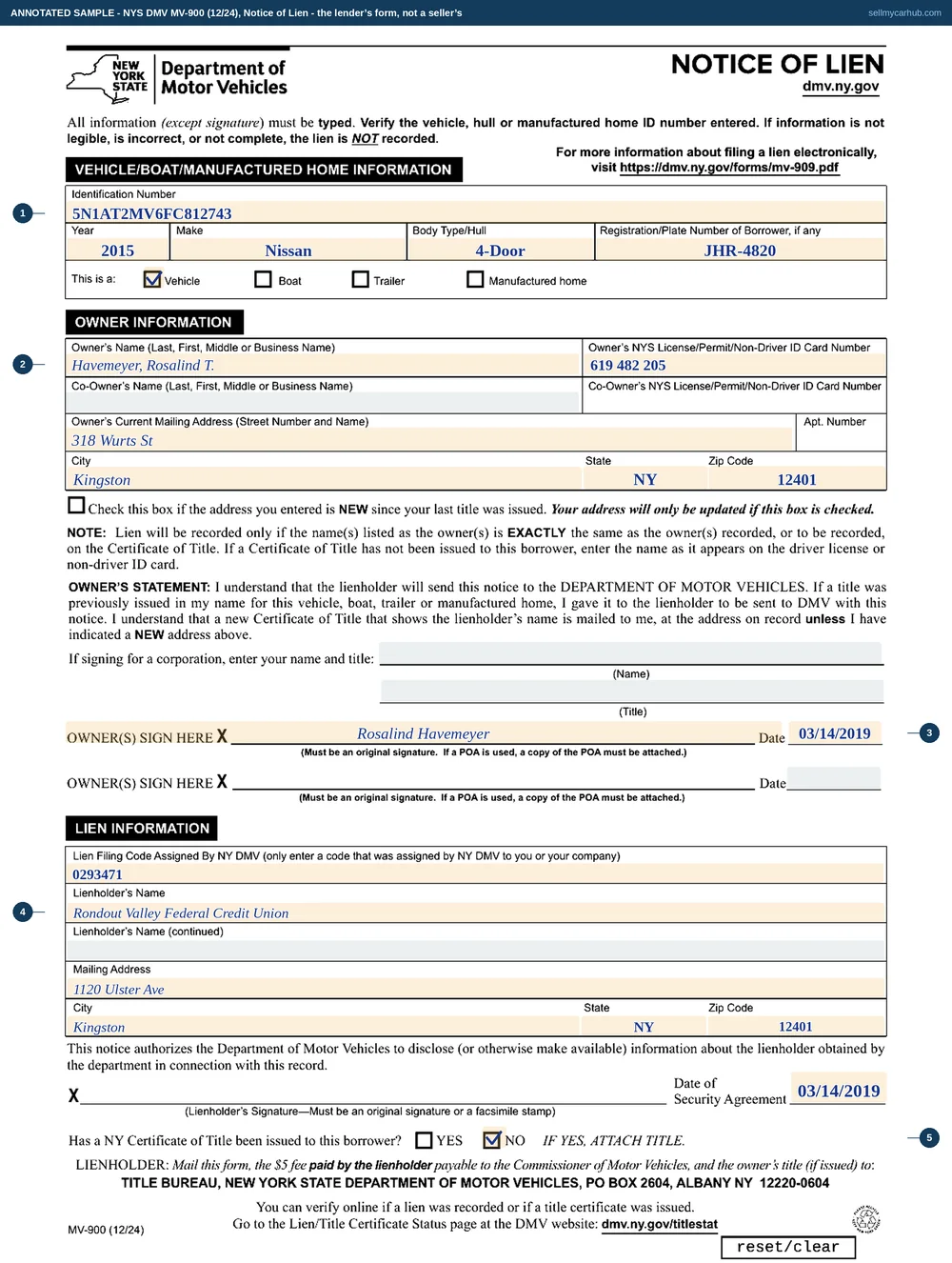
This is the actual MV-900, rendered from the PDF the New York State Department of Motor Vehicles publishes and completed end to end: letterhead, every field, and the blocks at the foot.

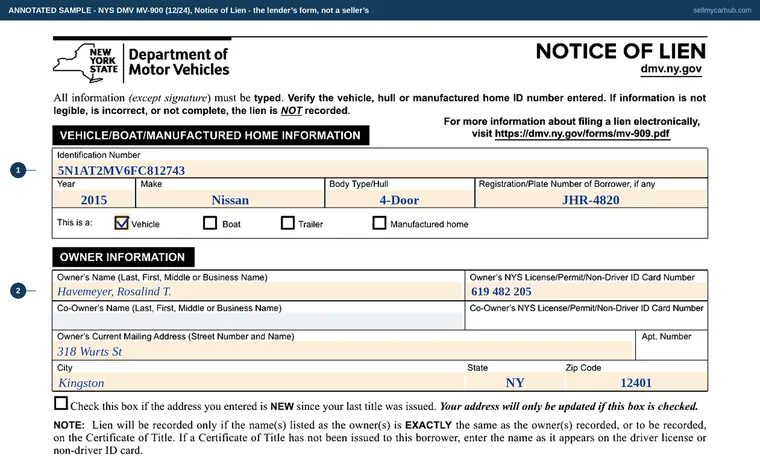
A New York MV-900 Notice of Lien completed by a credit union: a 2015 Nissan Rogue with identification number 5N1AT2MV6FC812743 and plate JHR-4820, the vehicle box ticked, borrower Havemeyer Rosalind T. of Kingston, a lien filing code, the lienholder Rondout Valley Federal Credit Union, a security agreement dated 14 March 2019, and the no box ticked against whether a certificate has been issued to the borrower.
Filled in as the lender would have completed it when the loan was written - which is what a seller is looking at when a name appears in the lienholder block of their certificate. Amber is what gets entered; the grey blocks are the ones this transaction does not use.
Field by field

Every line, in the order you meet it

  1. 1
    The lienholder fills this in

    Identification number and vehicle

    The identification number, year, make and body type, with the borrower's plate number if there is one.

    Watch out: Check this against your own certificate if a lien you do not recognise appears on it. The DMV's advice for a lienholder unknown to you is to contact a DMV contact centre rather than to assume it is an error.

  2. 2
    The lienholder fills this in

    Owner information

    Your name and licence number as the borrower, and the mailing address the new certificate will be posted to.

    Watch out: The name has to match the certificate exactly. This is why a lien sometimes fails to record against a title held in a slightly different version of the same name.

  3. 3
    You fill this in

    Owner's statement and signature

    The borrower signs to acknowledge that the lienholder is sending the notice in and that any existing certificate went with it.

    Watch out: It must be an original signature, and if a power of attorney is used a copy of it has to be attached. This is the one line on the form the borrower actually completes.

  4. 4
    The lienholder fills this in

    Lien information

    The filing code the DMV assigned the lender, the lienholder name and address, the lienholder's signature and the date of the security agreement.

    Watch out: The lienholder's signature may be a facsimile stamp - which is worth knowing, because the release you will later be handed may not look hand-signed either.

  5. 5
    The lienholder fills this in

    Has a certificate been issued to this borrower?

    Yes or no. If yes, the existing certificate is attached and goes to Albany.

    Watch out: This is why a car financed after purchase disappears for a few weeks: the certificate physically travels to the Title Bureau and comes back reprinted with the lender on it.

At a glance

What goes where

On the formWhat to put in it
The typing ruleAcross the head: all information except the signature must be typed, and if information is not legible, is incorrect, or not complete, the lien is NOT recorded.
Vehicle, boat or manufactured home informationIdentification number, year, make, body type or hull, and the borrower's registration or plate number if there is one, then four boxes for what the thing actually is.
Owner informationThe borrower. Name, licence or non-driver identification card number, co-owner if there is one, and the current mailing address - with a box to tick if that address is new since the last title was issued.
The name-matching ruleA note in the middle of the form: the lien is recorded only if the name listed as owner is exactly the same as the owner recorded, or to be recorded, on the certificate of title.
Owner's statementThe borrower acknowledges that the lienholder sends the notice to the DMV, that any title already issued was given to the lienholder to send in with it, and that a new certificate showing the lienholder's name will be posted to them.
Lien informationThe lien filing code the DMV assigned to the lender, the lienholder's name and mailing address, the lienholder's signature - which may be an original or a facsimile stamp - and the date of the security agreement.
Has a certificate of title been issued to this borrower?Yes or no, with the instruction that if yes, the title is attached and goes to Albany with the form.

What gets this one rejected

Rules that decide whether it is accepted

Every line here was read off MV-900 (12/24) itself — the PDF is here — and off the New York State Department of Motor Vehicles pages. This is plain-language help with a form, not legal advice, and where our wording and the agency's differ, theirs governs.

Back to all New York seller paperwork, or what selling a car in New York involves.

Want the paperwork handled instead?

Get My Instant Offer → Online · about 2 minutes · free

Or send the details — we'll come to you

Open lien, lost release, or a lender that has been taken over twice since you borrowed the money - that is a call we make rather than one you have to.

or call/text (877) 405-1808