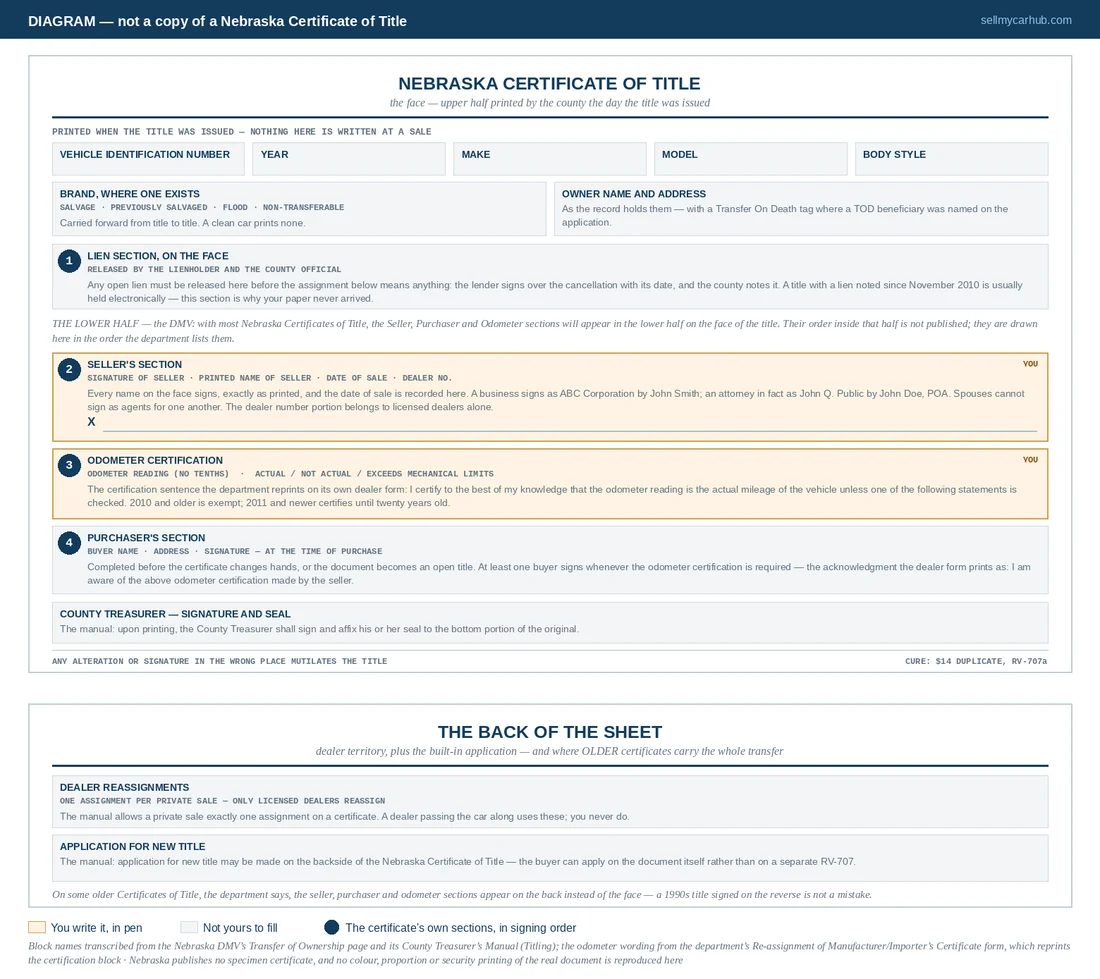
Nebraska puts the sale on the front of the certificate. On the current document the Seller's section, the Purchaser's section and the Odometer Certification sit together in the lower half of the face - only older certificates carry them on the back - and the state's rule for stray ink is total: anything signed in the wrong place mutilates the title. Here is the whole face, block by block, in the order a sale actually meets it.
Last updated .
Your 6 boxes
As a private seller you complete these and nothing else:
There is no blank Nebraska certificate to download and no specimen of one anywhere in the department's library - the counties issue it on secure stock, signed and sealed by the treasurer at the bottom edge. The diagram above is drawn from the DMV's own descriptions instead, and beside this paragraph is our printable checklist of the entries in the three sections that are yours.
Make sure you read the title carefully before making any marks. If a signature is placed in the wrong place or an alteration of any kind is made, the title is mutilated - and the sale waits for a $14 duplicate.
The department's page walks the same order this one does: every name on the face signs off in the Seller's section, the seller completes the odometer certification, and the buyer's name, address and signature must appear in the purchaser's section at the time of purchase.
The certificate itself
The face of a Nebraska certificate, and the lower half where the sale happens
One sheet, and for a private sale one side of it. The upper half is what the county treasurer printed the day the title was issued - vehicle, owner, any brand, any lien - and the lower half holds the three sections a sale completes: seller, odometer, purchaser. The back of the sheet belongs to dealer reassignments and the built-in application for the buyer's new title.
Amber — you write it, in pen
Grey — not yours to fill
Numbered — the certificate's own sections, in signing order
Click or tap the picture to open it full size.
Drawn, and labelled as a drawing on the image itself, because Nebraska publishes no specimen of its certificate. We searched the DMV's own library for one - the County Treasurer's Manual for titling (271 pages, its appendix is applications and affidavits with no certificate exhibit), the registration manual (449 pages, VTR screenshots and plate photographs), the digital-signature guidelines, the 2021 odometer bulletin and the ELT guide - and no picture of the document exists in any of them. Every block name here is transcribed instead from the DMV's Transfer of Ownership page and the titling manual's own chapters, and the odometer wording from the department's dealer reassignment form, which reprints the certification block verbatim.
A real one, filled in
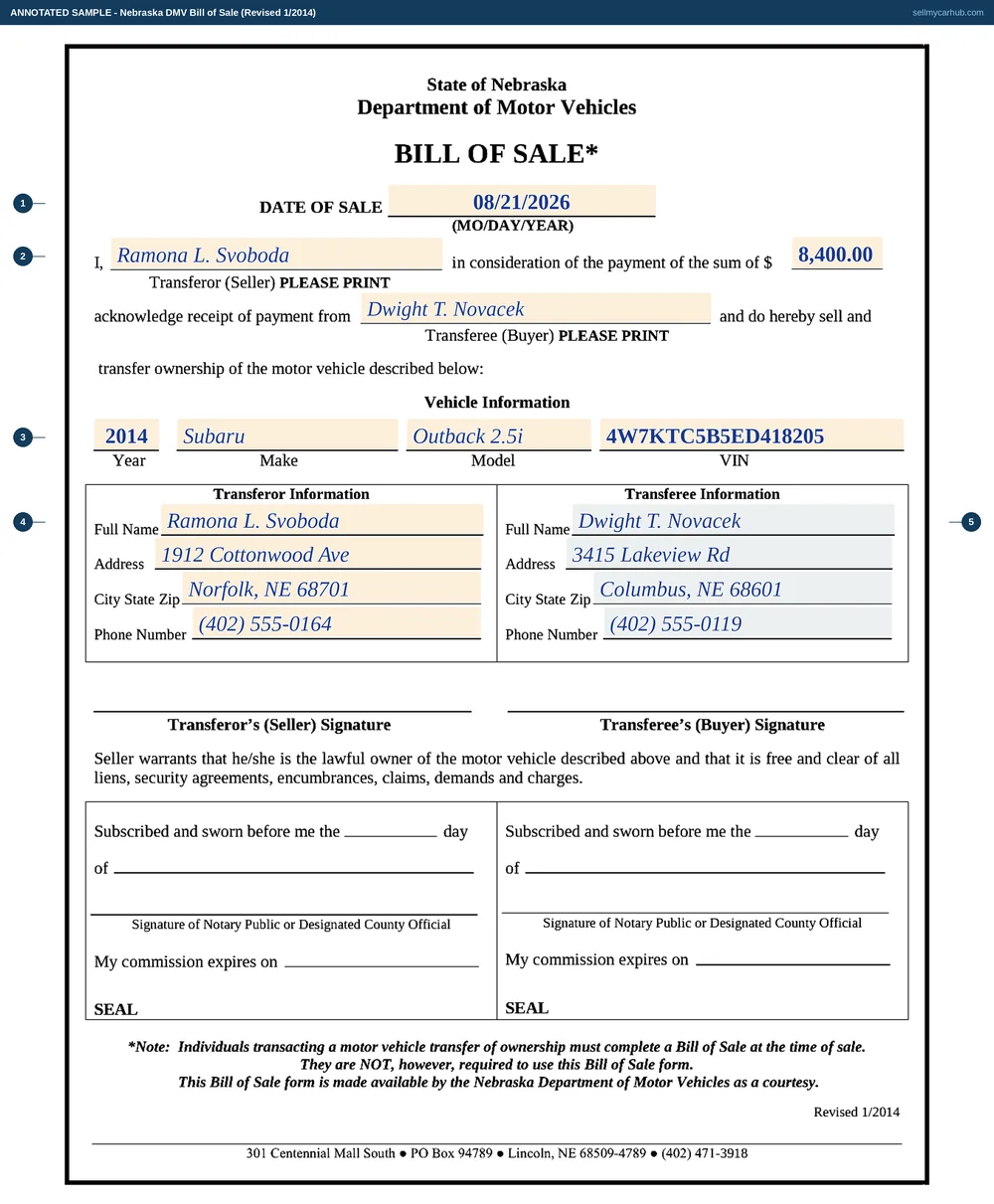
The DMV's own Bill of Sale, completed for the same sale
Nebraska publishes no picture of its certificate, but the transfer's other document is downloadable and here it is completed end to end: the department's courtesy Bill of Sale for a 2014 Subaru Outback sold in Norfolk for $8,400. It records the same transaction the title's lower half carries - seller, buyer, date, price, vehicle - and it is the paper that rides in the car on the buyer's plateless drive home.
Click or tap the picture to open it full size.
The footnote on the form is the rule. Individuals transacting a motor vehicle transfer of ownership must complete a bill of sale at the time of sale - but they are not required to use this form, and a completed Form 6 satisfies the same duty. The signature lines and the notary blocks are left for pen: this is the one Nebraska document that prints a notary block for a private seller, and the annotated page for it explains who actually completes that part.
Step by step
Every box, in the order you meet it
0
You fill this in
Before any ink: read the face, top to bottom
Find the three sections in the lower half, check whether a lien is printed and whether it shows released, and read the connector between co-owner names.
Watch out: This read-through is the cheapest insurance Nebraska sells. A signature on the wrong line cannot be initialled away - the certificate is mutilated and the sale stops for a duplicate.
1
The lienholder fills this in
The lien, if the face shows one
An open lien must be released by the lienholder and the county official on the face of the title before the assignment means anything. The lender signs with the date of cancellation; the county notes it.
Watch out: If your title never came because the lien is electronic, there is no face to release it on - the lender's payoff triggers the DMV to print and mail the clean title, and the sale waits for the post.
2
You fill this in
Seller's section: every owner signs, and the date of sale
Each name printed on the face signs exactly as printed, the printed-name line is completed to match, and the date of sale is recorded in the same section.
Watch out: The date matters beyond formality: the county checks that the date of sale on the assignment is equal to or later than the purchase date of your own title, and it starts the buyer's thirty days and your sixty.
3
You fill this in
Odometer Certification: the reading and one notation
Whole miles for any 2011-or-newer vehicle under twenty years old, with the applicable notation - Actual, Not Actual, or Exceeds Mechanical Limits. A 2010-or-older vehicle is exempt.
Watch out: Writing the word exempt on a car that is not exempt mutilates the title - the DMV's 2021 odometer bulletin uses exactly that mistake as its example, and the seller in it buys a duplicate before the sale can proceed.
4
The buyer fills this in
Purchaser's section: their name, address and signature, now
The buyer completes their details and signs before the certificate changes hands. At least one buyer must sign whenever the odometer certification is required.
Watch out: This is the step that separates a sale from an open title. Signed seller, blank purchaser is the document Nebraska confiscates, and the misdemeanor attaches to whoever is holding it.
5
You fill this in
Hand over the certificate with the bill of sale or Form 6
The buyer leaves with the assigned title and either a bill of sale or your completed Form 6 - the DMV's transfer page makes providing one of them the seller's job.
Watch out: Photograph the completed face before it leaves your hand. Nebraska has no seller's notice to file afterwards, so that photograph and your signed Form 6 copy are the record you keep.
6
You fill this in
Take your plates off the car
The registration expired at the moment of transfer. The plates, the decals and the registration certificate are what the county treasurer wants back.
Watch out: The buyer does not need them and cannot legally use them - a private-party buyer drives home plateless on the strength of the bill of sale and insurance, for up to thirty days.
7
You fill this in
File the refund application within sixty days
The Application for Refund plus plates, decals and registration certificate, to the county treasurer where the car was registered, brings back the unused months of registration fee, motor vehicle tax and motor vehicle fee.
Watch out: Sixty days is a cliff, not a slope. Day sixty-one pays nothing, and the month of the sale itself never counts - so a car sold late in the month has already spent that month's money.
8
The buyer fills this in
The buyer's thirty days
Title application, the $10 fee, the sales tax on the Form 6, insurance in original form, and registration in the county where the car is kept - all within thirty days of purchase.
Watch out: Their delay is their felony exposure, not yours - but a buyer who stalls is also a buyer whose tax penalty and interest are growing, which is worth mentioning when you hand them the folder.
Before the pen
Six rules for the pen on a certificate with no correction form behind it
Six habits for a certificate on which any alteration of any kind is a $14 mutilation.
Read first, write second
The department's warning is the closest thing Nebraska has to a pen rule, and it exists because the state offers no eraser: a signature in the wrong place or an alteration of any kind means a mutilated title and a $14 duplicate before the sale can proceed.
Sign as the face prints you
The county matches the Seller's section signature against the name on the title. A legal signature that is a nickname or initials is accepted - the manual says so - but a name that simply differs from the face invites the counter to stop.
Date the sale in the Seller's section, accurately
The recorded date of sale must be the same as or later than the purchase date on your own title, it starts the buyer's thirty-day clocks for title and tax, and it fixes the day your sixty-day refund window opens.
Never park a signature on a blank purchaser block
Completing your half and posting the certificate to a buyer creates an open title in the mail. The purchaser's details go in at the time of purchase, with both of you present, or the document is contraband.
Leave the odometer section empty on an exempt car
A 2010-or-older vehicle certifies nothing, and once a title records Exempt no later title may carry mileage again. Writing a reading anyway - or the word exempt on a car that must certify - is an alteration, with the usual $14 consequence.
Keep your copies for five years
The odometer statement you made carries a statutory retention: the seller keeps a copy for five years from the transfer. Keep the signed Form 6 beside it - the Department of Revenue expects its copies kept too, and together they are your entire after-sale file.
The ink rule is Nebraska DMV's own: “Make sure you read the title carefully before making any marks.”
— Nebraska DMV, Transfer of Ownership.
Check your source
Three things Nebraska sellers repeat that are not true
Three things Nebraska sellers hear over the fence, each traceable to some other state's rules, and each contradicted by a Nebraska source you can read.
"Sign the title and get it notarized - it's not legal without the stamp."
Nebraska asks for no notary anywhere on the certificate. The DMV's transfer page requires original signatures - or compliant digital ones - and says nothing about notarisation; the department's own 50-state reference chart for county staff lists Nebraska's notary requirement as a flat No, in the same column where Arizona, Oklahoma and Montana read Yes. The stamp does appear on the edges of a Nebraska sale: the decedent's-vehicle affidavit is notarised, the Parts Vehicle Bill of Sale prints must be notarized beside the seller's signature, and the courtesy Bill of Sale offers a notary block. The certificate itself never needs one.
"Leave the plates on so the buyer can drive it home legally."
Backwards on both halves. Your registration expired the instant ownership transferred - s. 60-395 says so - and the plates were assigned to you, so the buyer displaying them is displaying a registration that is not theirs, which s. 60-399 forbids. Meanwhile the buyer's legal drive home needs no plates at all: Nebraska's county manual states that a car bought from a private party may be driven with no decal or plates until proper registration is obtained, up to thirty days, with proof of ownership and insurance in the vehicle. What leaving the plates on actually does is burn your refund - every month before they reach the county treasurer is a month of tax and fees you cannot claim.
"You have to notify the DMV within days of selling or you're liable for the buyer's tickets."
There is no such filing in Nebraska - no notice of sale, no release of liability, no deadline. The department publishes 186 forms and none of them is a seller's notification; the sixty-day deadline people half-remember belongs to the refund application, which is about getting your money back, not about liability. What Nebraska builds instead is pressure on the buyer: a certificate must reach them properly assigned at the time of purchase, they commit a Class IV felony by re-selling without titling in their own name, and their thirty-day windows for title and tax carry penalties. Your protection is the completed purchaser section, the recorded date of sale, and the copies you kept.
Six signature rules from the department's own page, and the two about agency - spouses and POAs - point in opposite directions:
Every owner on the face, as seller
All names that appear on the Certificate of Title must sign off in the Seller's section. Not most of them, and no signing for each other: spouses cannot act as agent for one another here.
The buyer, in the Purchaser's section, at the time of purchase
Name, address and signature. The county manual adds the odometer link: the signature of at least one buyer is required whenever odometer certification is necessary.
A business, in its registered name
The format the DMV prescribes on both the signature and printed-name lines: ABC Corporation by John Smith - the entity, the word by, and the person with authority.
An attorney in fact or a personal representative
John Q. Public by John Doe, POA (or PR) - the owner's name first, then the signer's, then the capacity, on both the signature line and the printed-name line.
The lienholder and the county official, on the face, first
Any open lien must be released on the face of the certificate - the lender signs with the cancellation date, the county notes it - before the assignment to a new owner means anything.
Nobody, with a stamp or a photocopy
Signatures must be original ink or a compliant digital signature under the DMV's Administrative Guidelines; a signature stamp is tolerated only for a person physically unable to sign, and a witness must sign beside it marked as witness.
Once it is signed
The signed certificate ends your ownership but not your errands. The plates come off, the refund clock runs sixty days, and the buyer needs the bill of sale in the car before it moves a yard.