The one-page receipt with three jobs. Its own footnote states the duty - individuals transacting a motor vehicle transfer of ownership must complete a Bill of Sale at the time of sale - while adding that they are not required to use this particular form, which the department offers as a courtesy. Job two is the drive home: a private-party buyer in Nebraska legally drives unplated for up to thirty days, and the bill of sale is the proof of ownership the law wants in the car. Job three is the tax counter, where it corroborates the price on Form 6. In it you acknowledge receipt of payment and, in the sentence under the signature lines, warrant that you are the lawful owner and the vehicle is free and clear of all liens, security agreements, encumbrances, claims, demands and charges.
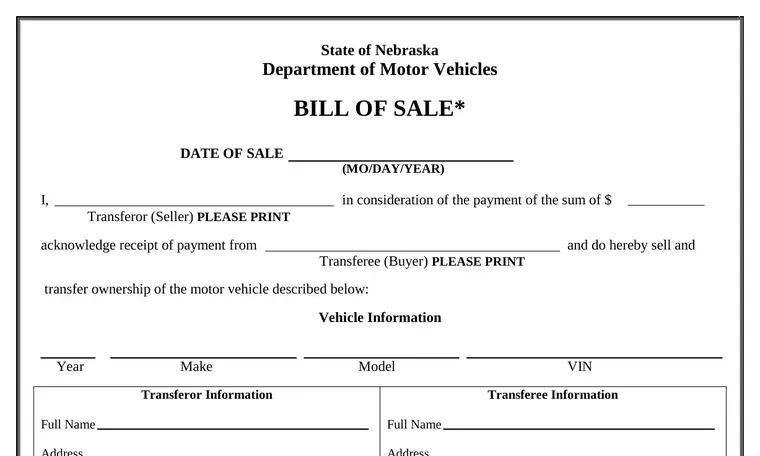
Written against Bill of Sale (Rev 1/2014), issued under Nebraska DMV courtesy form; the duty to complete a bill of sale is printed on the form itself, and Neb. Rev. Stat. s. 60-376 makes it the buyer's proof of ownership in transit. The notary blocks make this form look like it needs a stamp, and that resemblance sends sellers hunting a notary the state never asked for. Read what Nebraska prints where notarisation is actually required - the parts-vehicle version of this form says must be notarized beside the seller's signature; this one does not. Completing the block costs nothing and hardens the document; skipping it voids nothing on an ordinary sale. What you cannot skip is completing a bill of sale at all.
Two documents, and they are not the same thing. Take the blank Bill of Sale from the dmv.nebraska.gov copy so you get the revision that is current today, then print our Bill of Sale guide and keep it beside you while you fill theirs in.
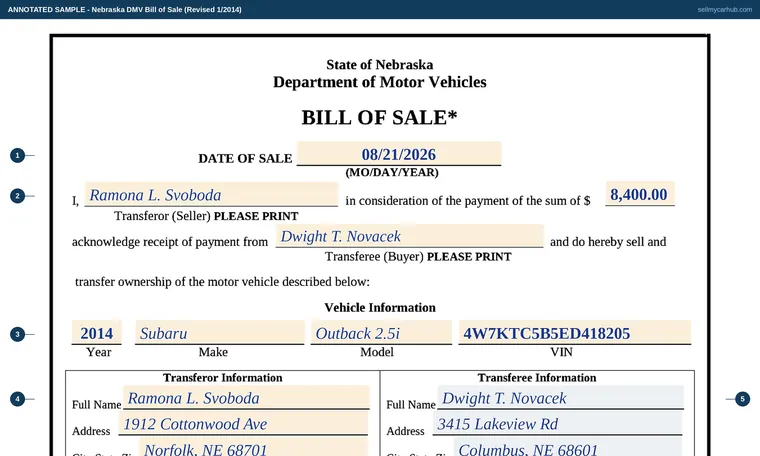
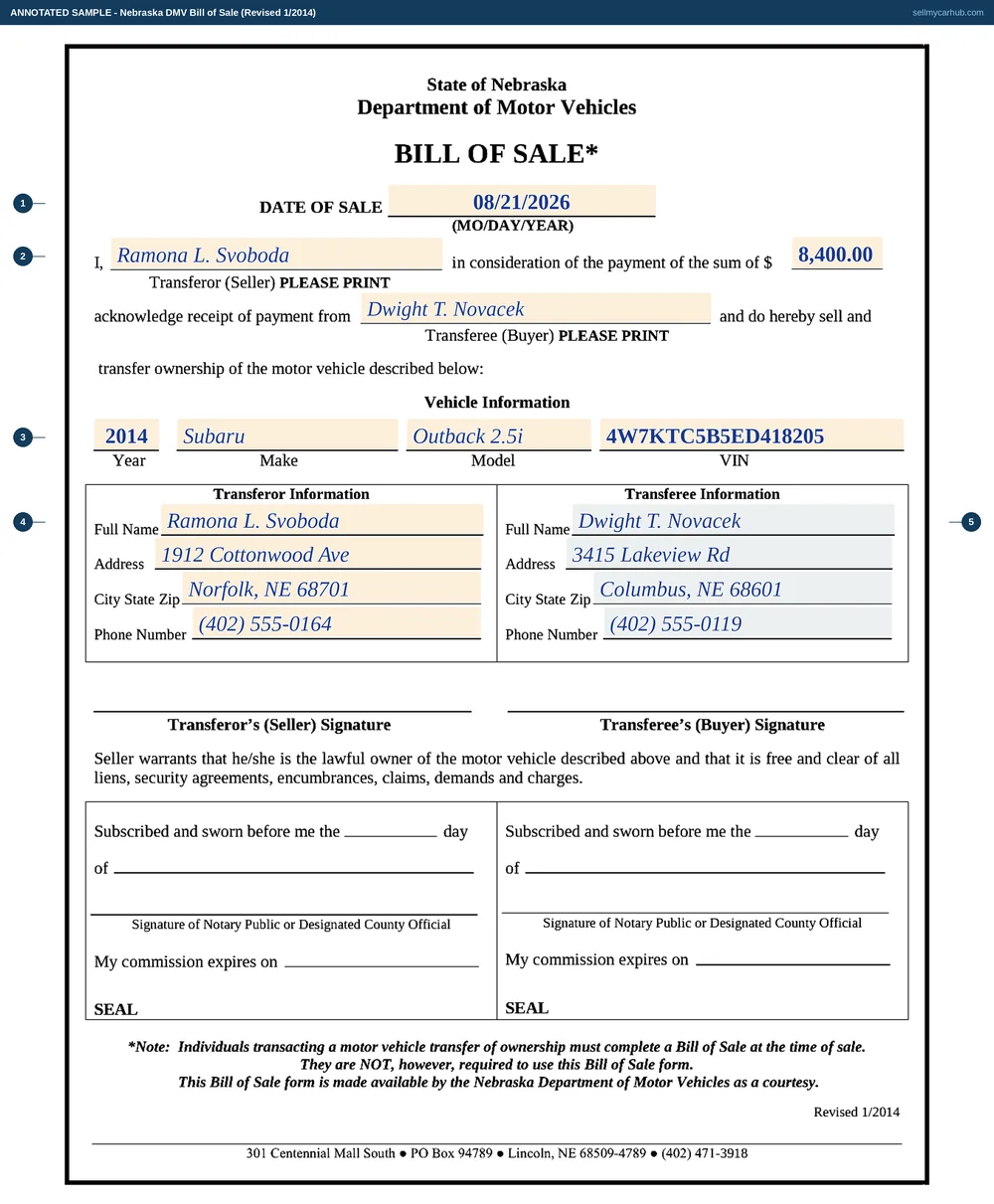
This is the actual Bill of Sale, rendered from the PDF the Nebraska Department of Motor Vehicles, Driver and Vehicle Records Division publishes and completed end to end: letterhead, every field, and the blocks at the foot.
Month, day, year, in the box at the top.
Watch out: Make it identical to the date of sale you recorded in the Seller's section of the certificate. Three documents leave this sale carrying a date, and the county reads all three.
Your printed name after I, the sum after the dollar sign, the buyer's printed name after acknowledge receipt of payment from.
Watch out: The sentence is written in the past tense - it acknowledges money received. Complete it when you are actually paid, not as a promise that payment is coming.
Year, make, model, VIN.
Watch out: Copy the VIN from the certificate, character by character. This sheet may be the only ownership document a patrol officer sees on the buyer's drive home, and it identifies the car by nothing else.
Full name, address, city-state-zip and phone number, left column.
Watch out: A reachable phone number is a kindness to yourself: a buyer stuck at a counter with a question calls you once, or drives back to your house.
The buyer's same four entries, right column - in their hand or yours, but from their documents.
Watch out: Read the address off their license rather than taking dictation. It is the address you would need if the car surfaced somewhere it should not.
Transferor's signature on the left line, transferee's on the right, above the warranty sentence.
Watch out: Before you sign, reread what the sentence beneath warrants - lawful owner, free and clear of all liens, security agreements, encumbrances, claims, demands and charges. If any of that is not yet true, the signing waits.
Each subscribed-and-sworn block is completed by a Notary Public or Designated County Official, with day, month, signature, commission expiry and seal.
Watch out: If you want the belt-and-braces version, any county treasurer's or clerk's counter can act as the designated official - the same building the buyer is headed to anyway.
One copy travels in the vehicle with the buyer, one stays in your file.
Watch out: The buyer's copy is load-bearing for thirty days - it is the proof of ownership the in-transit rule requires in an unplated car - so hand it over before the goodbyes, not after.
| On the form | What to put in it |
|---|---|
| Date of Sale | Month, day and year, boxed at the top before any name appears. |
| I, (Transferor) | The seller's printed name, opening the operative sentence: in consideration of the payment of the sum of a stated amount, you sell and transfer ownership. |
| The sum of $ | The price, written into the same sentence. It should be the same figure as line 1 of Form 6 and nothing else. |
| Acknowledge receipt of payment from (Transferee) | The buyer's printed name, completing the sentence - the form is past tense, a receipt for money already handed over. |
| Vehicle Information | Year, make, model and VIN, one box each. Nothing else identifies the car, so the VIN carries the weight. |
| Transferor Information | Your full name, address, city-state-zip and phone number in the left column. |
| Transferee Information | The buyer's same four entries in the right column. |
| Transferor's and Transferee's Signature | Two signature lines above the seller's warranty sentence. These lines have no fillable field in the PDF - they are signed in pen. |
| Subscribed and sworn before me | Twin notary blocks at the foot, one per signature, each with a line for a Notary Public or Designated County Official and a commission expiry. See the caution - this is the only ordinary-sale document in Nebraska that prints one. |
Every line here was read off Bill of Sale (Rev 1/2014) itself — the PDF is here — and off the Nebraska Department of Motor Vehicles, Driver and Vehicle Records Division pages. This is plain-language help with a form, not legal advice, and where our wording and the agency's differ, theirs governs.
Back to all Nebraska seller paperwork, or what selling a car in Nebraska involves.