Sell My Car Hub

How to fill out Massachusetts TTL113

An insurer's or a licensed dealer's route to a salvage title when the certificate of title for the vehicle acquired by the applicant is not available. It is not a private seller's form and its first sentence says so, but the reverse of it reprints the whole of chapter 90D section 20 - and two of those subsections are addressed to an ordinary owner rather than to a company. If a wrecked car of yours is being argued over by an insurer, a repair shop or a tow facility, this is the document being prepared about it.
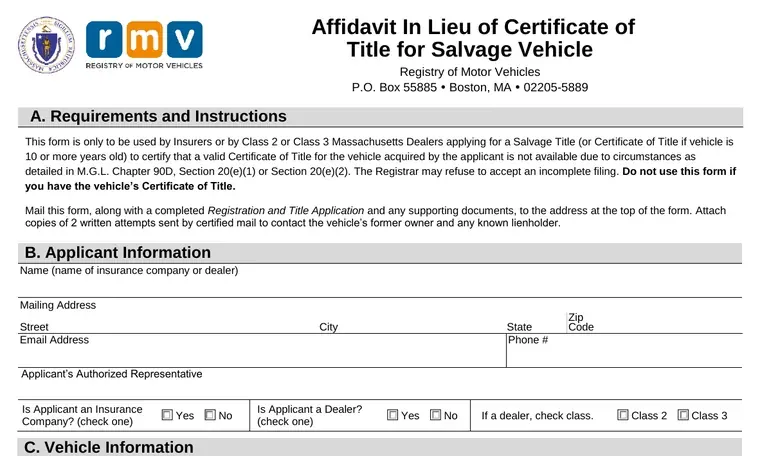
Written against TTL113 (TTL113_1119, November 2019), issued under M.G.L. c.90D s.20(e)(1) and s.20(e)(2). If your car was written off and you handed the certificate to the insurer, this form is not part of your story - the company already has the title. It appears when no certificate can be produced at all, which is why the seller who most often sees it is the one whose vehicle sat at a repair shop or a tow facility after a claim that was never paid, and who then finds a Class 2 dealer applying for a salvage title in its own name.

Two documents, and they are not the same thing. Take the blank TTL113 from the mass.gov copy so you get the revision that is current today.

Filled in

What a completed one looks like

This is all 2 pages of the actual TTL113, rendered from the PDF the Massachusetts Registry of Motor Vehicles publishes and completed end to end: letterhead, every field, and the blocks at the foot.

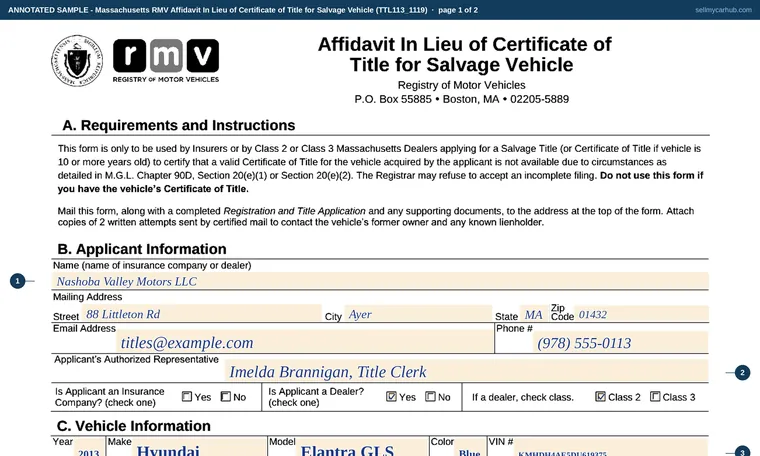
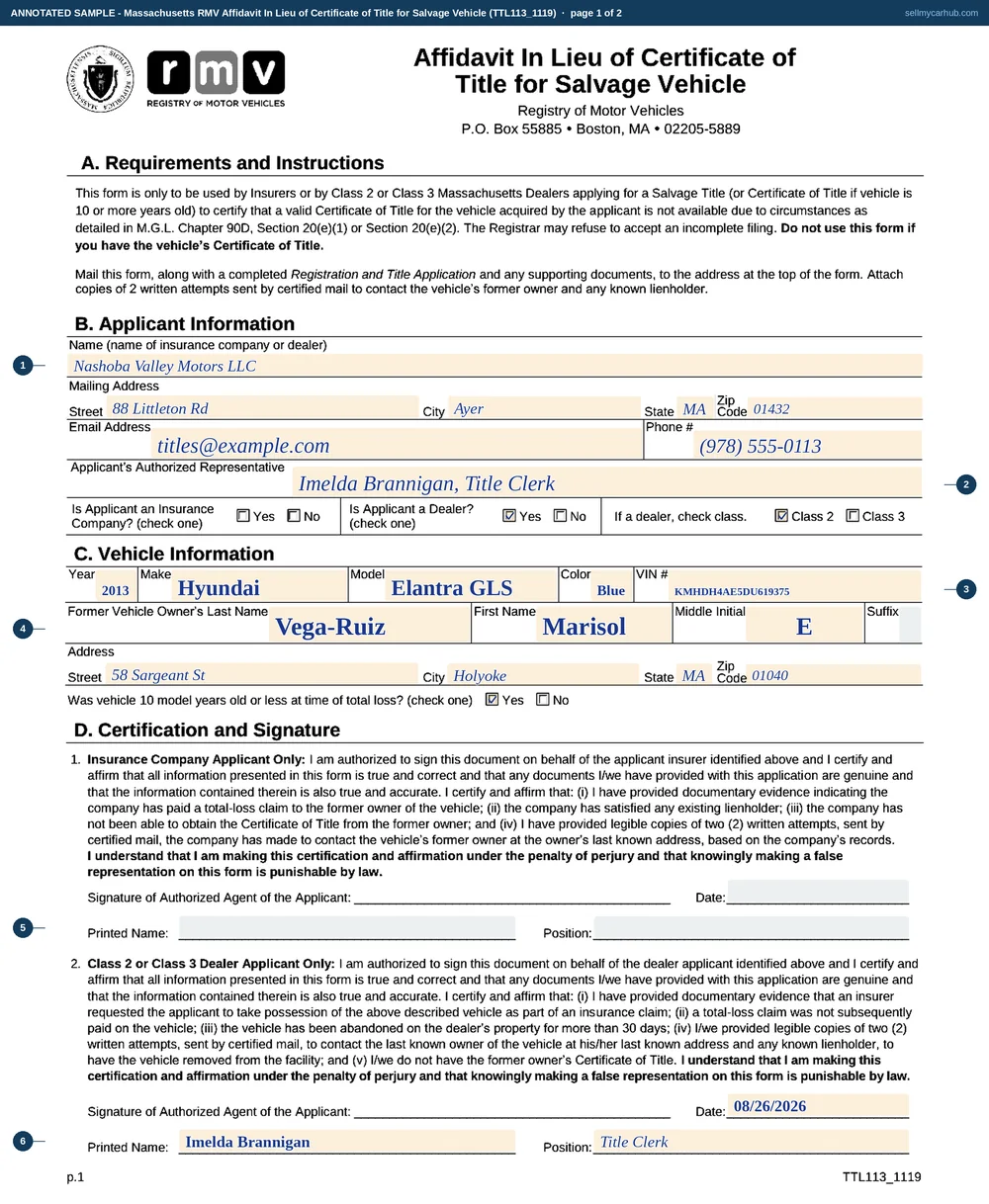
The Massachusetts Affidavit In Lieu of Certificate of Title for Salvage Vehicle filled in as an annotated sample: Nashoba Valley Motors LLC of Ayer as applicant with an authorised representative, the Dealer box ticked and Class 2 selected, a 2013 Hyundai Elantra with its colour and vehicle identification number, the former owner Marisol E. Vega-Ruiz of Holyoke with her address, the ten years or less box ticked, the insurance-company certification at the foot greyed and the Class 2 or Class 3 dealer certification completed with a printed name, position and date. Page two carries the full text of chapter 90D section 20.
Page 1 of 2. Applicant, vehicle and former owner. The certification at the foot is two alternatives - insurer or Class 2 or Class 3 dealer - and the one that does not apply is greyed.
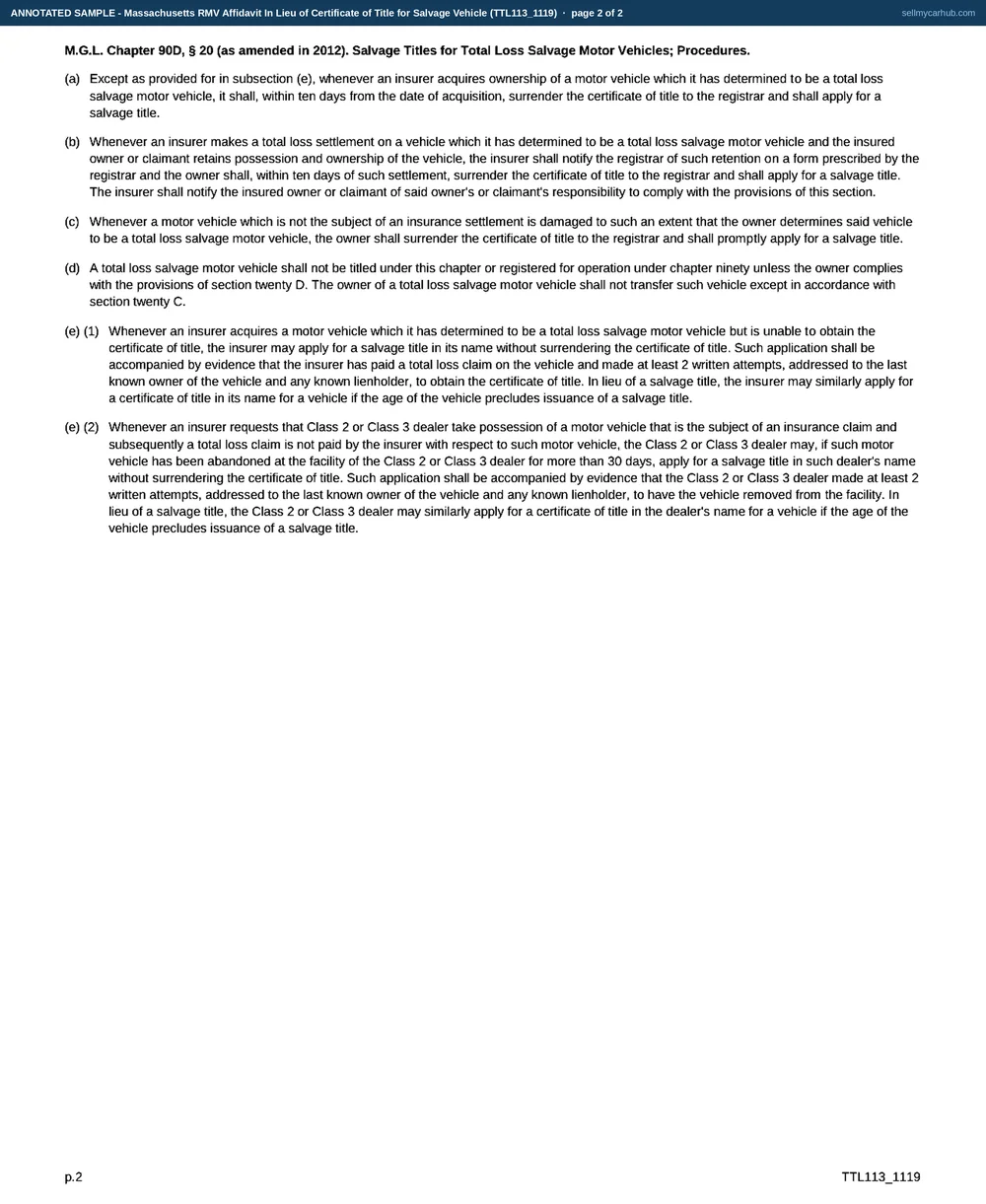
The Massachusetts Affidavit In Lieu of Certificate of Title for Salvage Vehicle filled in as an annotated sample: Nashoba Valley Motors LLC of Ayer as applicant with an authorised representative, the Dealer box ticked and Class 2 selected, a 2013 Hyundai Elantra with its colour and vehicle identification number, the former owner Marisol E. Vega-Ruiz of Holyoke with her address, the ten years or less box ticked, the insurance-company certification at the foot greyed and the Class 2 or Class 3 dealer certification completed with a printed name, position and date. Page two carries the full text of chapter 90D section 20.
Page 2 of 2. The whole of chapter 90D section 20 reprinted on the back of the form. Subsections (b) and (c) are the ones addressed to an ordinary owner, and they are the reason it is worth turning this form over even though you will never file it.
Field by field

Every line, in the order you meet it

  1. 1
    Dealers only

    Whose form this is

    An insurance company, or a Class 2 or Class 3 Massachusetts dealer, and nobody else.

    Watch out: A private owner cannot use it even for their own wreck. An owner without a certificate applies for a duplicate; an owner who has decided their own car is a total loss surrenders the certificate under section 20(c) instead.

  2. 2
    Dealers only

    Section B, the applicant

    Name, mailing address, email, phone, the authorised representative, and the two check-one questions with the dealer class beside them.

    Watch out: Class 2 and Class 3 are the used-vehicle and parts categories of the municipal dealer licence. The class ticked here is what section 20(e)(2) turns on.

  3. 3
    Dealers only

    Section C, the vehicle

    The year, the make, the model, the colour and the identification number, and nothing else.

    Watch out: No title number, because the whole premise of the affidavit is that the certificate cannot be produced.

  4. 4
    Dealers only

    Section C, the former owner

    Last name, first name, middle initial, suffix and address of whoever the certificate should have come from.

    Watch out: This is the person the two certified letters went to, at the last known address on the company's own records. The copies of those letters are the attachment the Registrar can refuse the filing without.

  5. 5
    Dealers only

    Ten model years old or less

    One check-one question, answered as at the time of total loss rather than as at today.

    Watch out: It decides the outcome. Where the age of the vehicle precludes issuance of a salvage title, the applicant applies for an ordinary certificate of title in its own name instead.

  6. 6
    Dealers only

    One of the two certifications

    Paragraph 1 for an insurer, paragraph 2 for a dealer, each with a signature, a date, a printed name and a position.

    Watch out: They swear different things. The insurer certifies it paid a total-loss claim and satisfied any existing lienholder; the dealer certifies the claim was never paid and the vehicle was abandoned at its facility for more than thirty days.

  7. 7
    You fill this in

    Turn it over and read the statute

    Page two is chapter 90D section 20 in full, printed by the Registry on the back of its own form.

    Watch out: Subsection (b) gives an owner who keeps a settled total loss ten days to surrender the certificate and apply for a salvage title, and subsection (c) puts the same duty on an owner who writes the car off with no insurer involved. Both are yours, and neither is on any form the RMV addresses to you.

At a glance

What goes where

On the formWhat to put in it
A, Requirements and InstructionsWho may file and on what authority: insurers, or Class 2 or Class 3 Massachusetts dealers, applying for a salvage title - or a certificate of title if the vehicle is 10 or more years old - to certify that a valid certificate of title for the vehicle acquired is not available for the circumstances set out in section 20(e)(1) or section 20(e)(2). Two warnings sit in the same paragraph: the Registrar may refuse to accept an incomplete filing, and do not use this form if you have the vehicle's certificate of title.
What travels with itThe form goes to the Title Division with a completed Registration and Title Application, any supporting documents, and copies of two written attempts sent by certified mail to contact the vehicle's former owner and any known lienholder.
B, Applicant InformationThe name of the insurance company or dealer, its mailing address, email and phone, the applicant's authorised representative, then two check-one questions - is the applicant an insurance company, is the applicant a dealer - and, if a dealer, whether the class is 2 or 3.
C, Vehicle InformationThe vehicle's year, make, model, colour and identification number across one row. Then the former vehicle owner's last name, first name, middle initial, suffix and address - and one more check-one question: was the vehicle 10 model years old or less at the time of total loss?
D1, Insurance Company Applicant OnlyFour sworn certifications. That documentary evidence has been provided indicating the company has paid a total-loss claim to the former owner; that the company has satisfied any existing lienholder; that the company has not been able to obtain the certificate of title from the former owner; and that legible copies of two written attempts, sent by certified mail to the owner's last known address based on the company's records, are attached.
D2, Class 2 or Class 3 Dealer Applicant OnlyFive sworn certifications, and none of them mentions a paid claim. That documentary evidence shows an insurer requested the applicant to take possession of the vehicle as part of an insurance claim; that a total-loss claim was not subsequently paid on it; that the vehicle has been abandoned on the dealer's property for more than 30 days; that legible copies of two certified-mail attempts to have the owner remove it from the facility are attached; and that the dealer does not have the former owner's certificate of title.
The signature blocksEach certification has its own signature of authorized agent of the applicant, a date, a printed name and a position. Above both sits the same sentence: the signer understands the certification and affirmation is made under the penalty of perjury and that knowingly making a false representation on this form is punishable by law.
Page two, the statute in fullThe back of the form reprints M.G.L. chapter 90D section 20 as amended in 2012, all five subsections, which is where the reasons this form exists - and the two duties it puts on an ordinary owner - are actually set out.

What gets this one rejected

Rules that decide whether it is accepted

Every line here was read off TTL113 (TTL113_1119, November 2019) itself — the PDF is here — and off the Massachusetts Registry of Motor Vehicles pages. This is plain-language help with a form, not legal advice, and where our wording and the agency's differ, theirs governs.

Back to all Massachusetts seller paperwork, or what selling a car in Massachusetts involves.

Want the paperwork handled instead?

Get My Instant Offer → Online · about 2 minutes · free

Or send the details — we'll come to you

A written-off car with a disputed title is the hardest thing to sell privately in this state. Tell us what happened to it.

or call/text (877) 405-1808