The one form the whole Massachusetts vehicle system runs on. Fourteen lettered sections across two sides cover registering, titling, transferring a plate, renewing, reinstating and amending, and the buyer's copy of it is what turns your assigned certificate into their title. A seller is named on it in Section L and nowhere else - but Section L is not optional, and neither is the insurance stamp in Section K that a private buyer cannot get without visiting an agent.
Written against TTLREG100 (TTLREG100_0923, September 2023), issued under M.G.L. c.90 s.2 and c.90D s.4. Section I3 is headed Gross Sale Price (Proof Required). If the assignment on the back of the certificate has no price written on it, that proof is a bill of sale the buyer has to produce - and the person who has to write it is you, after the car has already gone.
Two documents, and they are not the same thing. Take the blank TTLREG100 from the mass.gov copy so you get the revision that is current today.
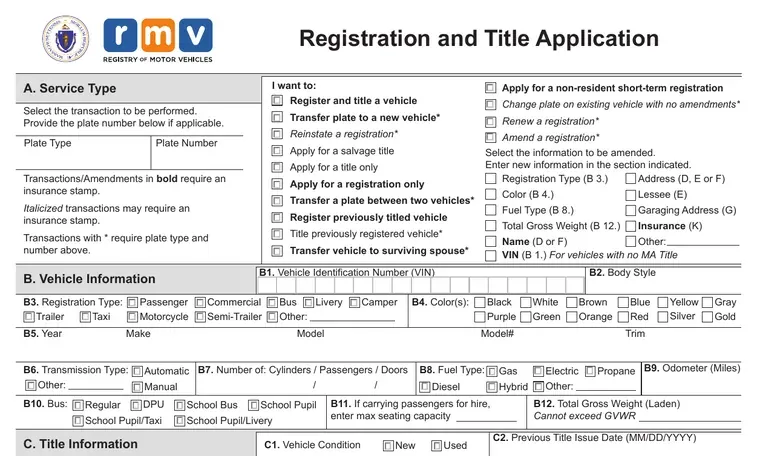
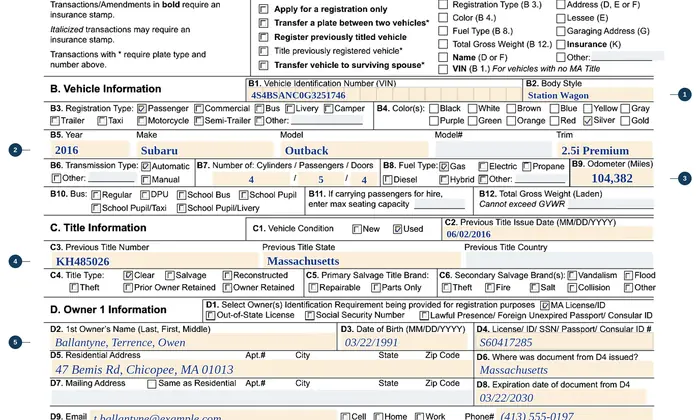
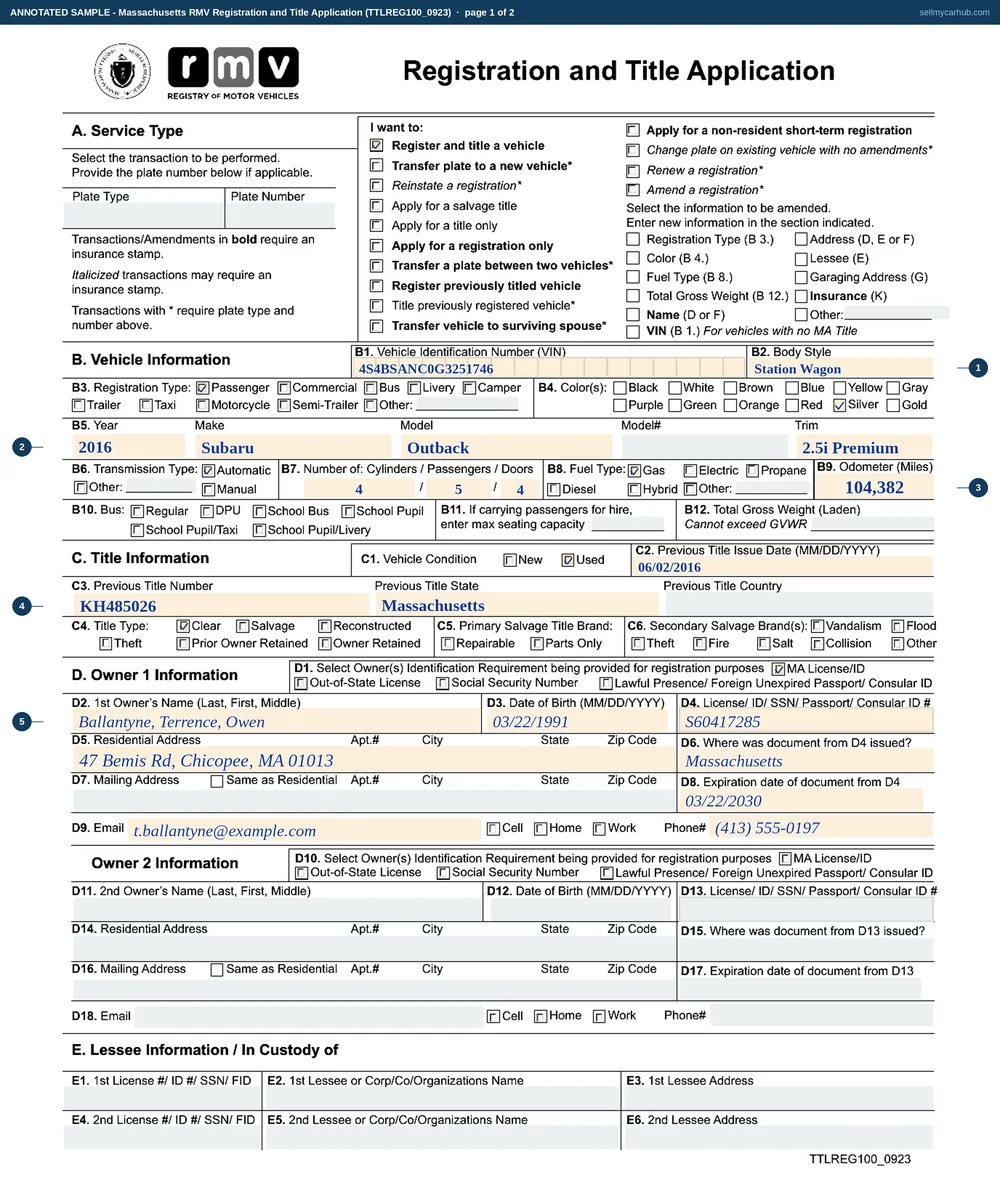
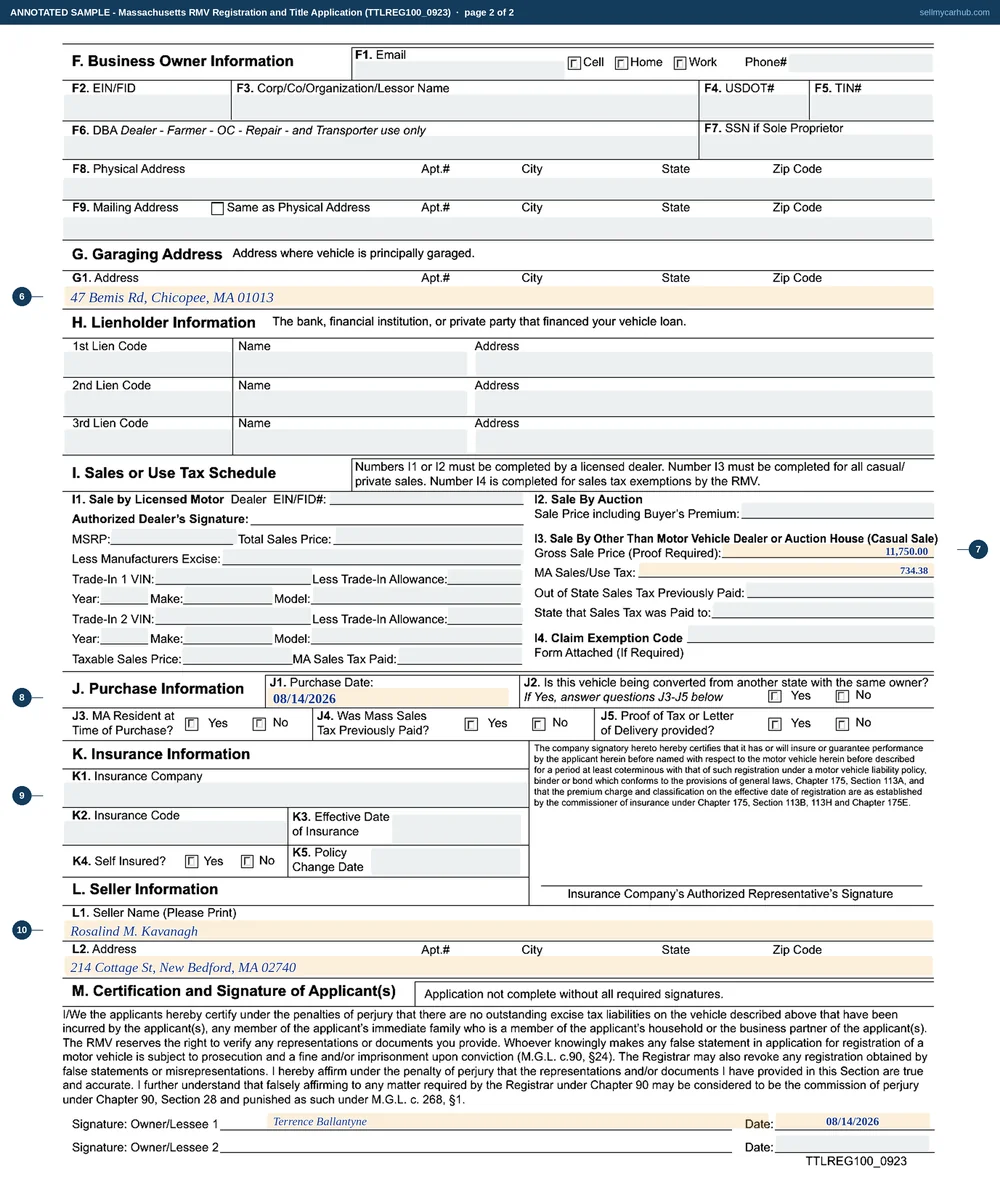
This is all 2 pages of the actual TTLREG100, rendered from the PDF the Massachusetts Registry of Motor Vehicles publishes and completed end to end: letterhead, every field, and the blocks at the foot.
Tick register and title a vehicle for a car going on the road, or apply for a title only for one that is not.
Watch out: Title only is the answer for a car being stored, restored or shipped. It skips the insurance stamp entirely - proof of insurance is required on all transactions with the exception of salvage title and title only.
Vehicle identification number, body style, registration type, colours, year, make, model, trim, transmission, cylinders, passengers, doors, fuel and the odometer.
Watch out: Copy the identification number off the certificate and then check it against the plate on the car. The Registry runs it through the national title database, and a single wrong character stops the title being printed until somebody resolves it.
New or used, the previous title's issue date, number, state and country, and any brands.
Watch out: The issue date is not the date of purchase. Both are on the front of the certificate in separate boxes and the Registry checks the one it asked for.
Identity document type and number, name, date of birth, where the document was issued, when it expires, and a residential address.
Watch out: The name here has to match the name written into the assignment on the back of the certificate. If the buyer goes by a shortened first name, the licence wins.
Where the vehicle is physically kept overnight.
Watch out: This is the field that decides which town sends the excise bill, and it is collected as a full street address rather than a town name so the bill lands in the right place.
Gross sale price, the Massachusetts tax on it, and anything already paid to another state.
Watch out: I1 and I2 are for dealers and auction houses. A private sale uses I3 and only I3 - the instruction is that number I3 must be completed for all casual and private sales.
Completed, signed and stamped by a Massachusetts authorised insurance agent or company. Nobody else may touch it.
Watch out: It expires. The stamp is valid for thirty days, so the trip to the agent and the trip to the Service Center have to happen inside the same month.
Your printed name and your address, in two boxes near the foot of page two.
Watch out: Write it exactly as the front of the certificate prints it. This is the block the Registry uses to tie the application to the title record it already holds.
Every owner signs and dates. The certification above the line is about outstanding excise, not about the vehicle.
Watch out: Read what is being certified: that neither the applicant, nor anyone in their household, nor a business partner has unpaid excise on this vehicle. An old unpaid bill on the car can stop the registration.
| On the form | What to put in it |
|---|---|
| A, Service Type | A grid of fourteen transactions with a tick beside each. Register and title a vehicle is the one a private buyer uses; apply for a title only is the one for a car that will not be driven. Transactions printed in bold need an insurance stamp, italicised ones may, and anything marked with an asterisk needs the existing plate type and number written in the boxes underneath. |
| B, Vehicle Information | B1 the full vehicle identification number and B2 the body style, then registration type, up to two colours numbered 1 and 2, year, make, model, model number and trim, transmission, cylinders, passengers and doors, fuel type, and B9 the odometer in miles only. |
| C, Title Information | New or used, the previous title's issue date, number, state and country, then title type - clear, salvage, reconstructed, theft, prior owner retained or owner retained - and the primary and secondary salvage brands. These four fields are checked against the National Motor Vehicle Title Information System, so they are copied off the certificate rather than remembered. |
| D, Owner Information | Up to two owners. For each: which identity document is being produced, the name as it appears on it, date of birth, the document number, where it was issued and when it expires, a residential address, a mailing address if different, and an email and phone. |
| E and F, Lessee and Business Owner | Left empty on an ordinary private purchase. E is for a leased vehicle or one in the custody of a Massachusetts resident; F is for a company, and needs an EIN and IRS proof of it. |
| G, Garaging Address | Where the vehicle actually sleeps. It is not a formality - this address decides which city or town issues the excise bill. |
| H, Lienholder Information | Three rows for a lender's code, name and address. On a cash sale all three stay blank. |
| I, Sales or Use Tax Schedule | Four boxes, and a private sale uses exactly one of them. I3, Sale By Other Than Motor Vehicle Dealer or Auction House, takes the gross sale price with proof required, the Massachusetts tax, any out-of-state tax already paid and which state it went to. I1 and I2 belong to dealers and auction houses; I4 is completed by the Registry when an exemption is claimed. |
| J, Purchase Information | The purchase date, then four questions that only matter if the vehicle is being converted from another state with the same owner. |
| K, Insurance Information | Insurance company, insurance code, effective date, a self-insured tick and a policy change date - all of it completed, signed and stamped by a Massachusetts authorised insurance agent or company. The applicant does not fill this in. |
| L, Seller Information | Two boxes: seller name printed, and seller address. This is the seller's whole appearance on the form. |
| M, Certification and Signature | Signed and dated by every owner. The printed certification is that there are no outstanding excise liabilities on the vehicle incurred by the applicant, a member of their household or a business partner. |
Every line here was read off TTLREG100 (TTLREG100_0923, September 2023) itself — the PDF is here — and off the Massachusetts Registry of Motor Vehicles pages. This is plain-language help with a form, not legal advice, and where our wording and the agency's differ, theirs governs.
Back to all Massachusetts seller paperwork, or what selling a car in Massachusetts involves.