Massachusetts puts the whole private transfer in one block on the back of the certificate, headed ASSIGNMENT OF CERTIFICATE OF TITLE BY OWNER. Five rows: the price and the buyer, the buyer's address, the odometer strip, your signature, theirs. Everything below it is for licensed dealers. The pictures on this page are the RMV's own - it publishes both faces of a Massachusetts title inside the manual it gives to insurance agents and dealers, filled in with its own invented cast, so nothing here belongs to a member of the public.
Last updated .
Your 9 boxes
As a private seller you complete these and nothing else:
There is no blank Massachusetts title to download - the assignment lives on the certificate that came in the post from the Title Division, and the Registry does not publish a printable version of it. What it does publish is a picture of both faces inside a manual written for insurance agents, and that is what this walkthrough is built from.
ANY ALTERATION OR ERASURE VOIDS THE ASSIGNMENT AND ALL ASSIGNMENTS THAT FOLLOW
The Registry's requirement is a list rather than a sentence, and it is worth checking against the sheet before the buyer leaves: date of sale, purchase price if it is a casual sale, printed name and address of the buyer, buyer's signature, printed name of the seller, seller's signature, odometer reading.
The Registry's own specimen
Both faces of a Massachusetts certificate, published by the RMV itself
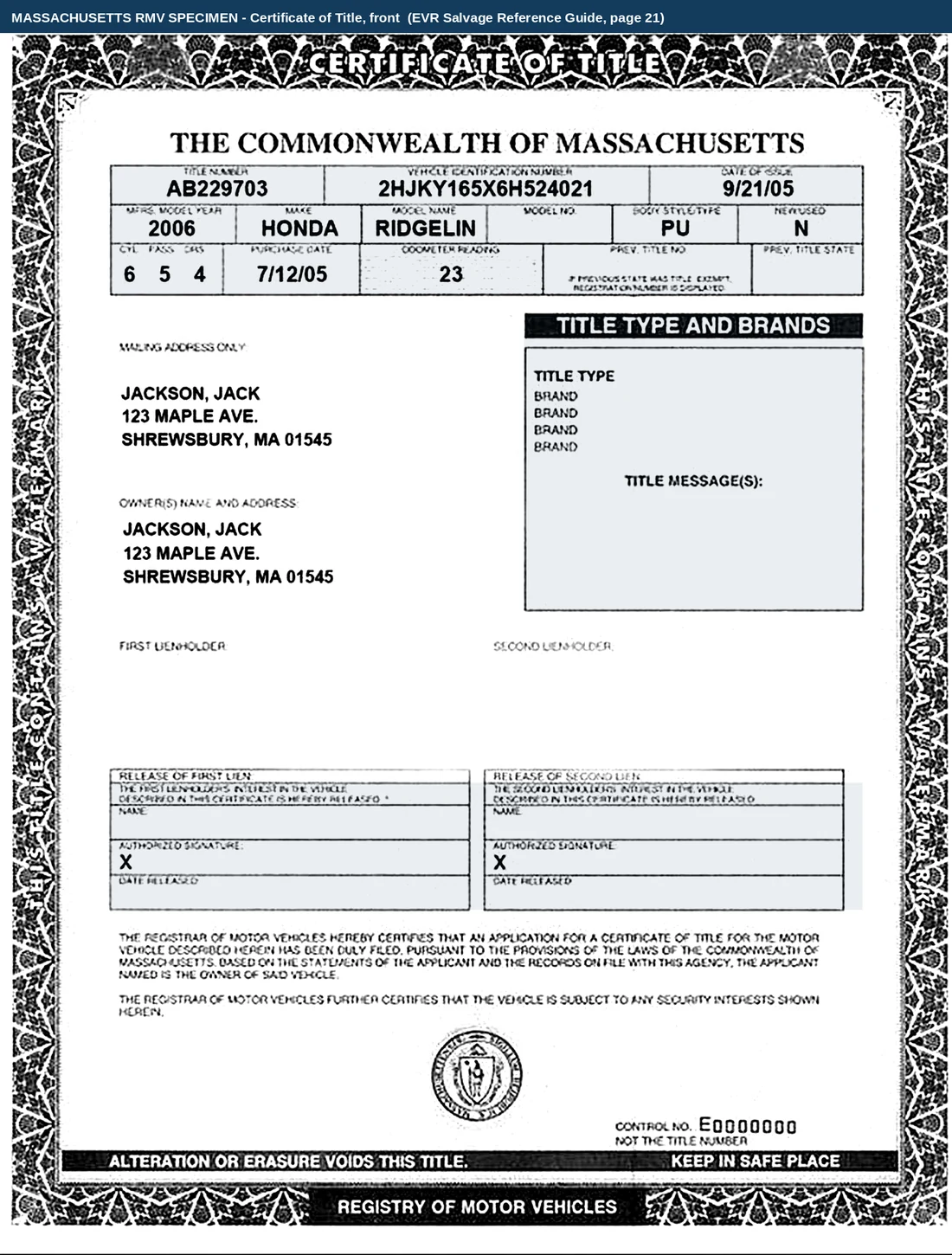
This is the picture the Registry prints on page 21 of its EVR Salvage Reference Guide, the manual it issues to the insurance agents and dealers who file title work electronically. The certificate is made out to JACKSON, JACK of 123 Maple Ave., Shrewsbury, and its control number is eight zeros, which no issued certificate carries. Everything shaded grey here is printed in Boston before the certificate ever reaches you.
Amber — you write it, in pen
Grey — not yours to fill
Numbered — matches the steps below
Click or tap the picture to open it full size.
Nothing on this face is a seller's to write on. Two parts of it decide whether the sale can happen at all. TITLE TYPE AND BRANDS is where a salvage, reconstructed or owner-retained status appears, and a branded title changes what you are allowed to sell and to whom. RELEASE OF FIRST LIEN is where a lender signs off; if a lienholder is named and that panel is empty, the certificate is not yet yours to assign. Note also the control number at the foot, printed in red and labelled NOT THE TITLE NUMBER - the number the buyer's paperwork needs is the one at the top left.
The block that sells the car
Assignment of Certificate of Title by Owner, completed
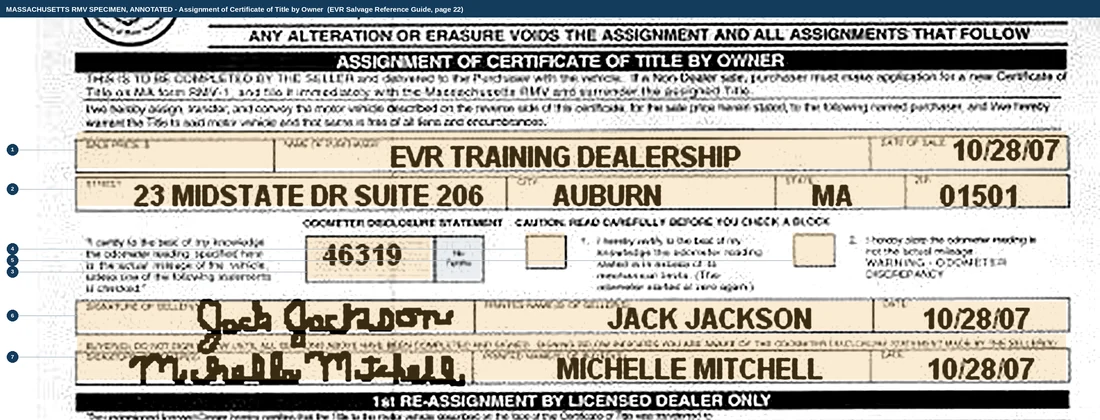
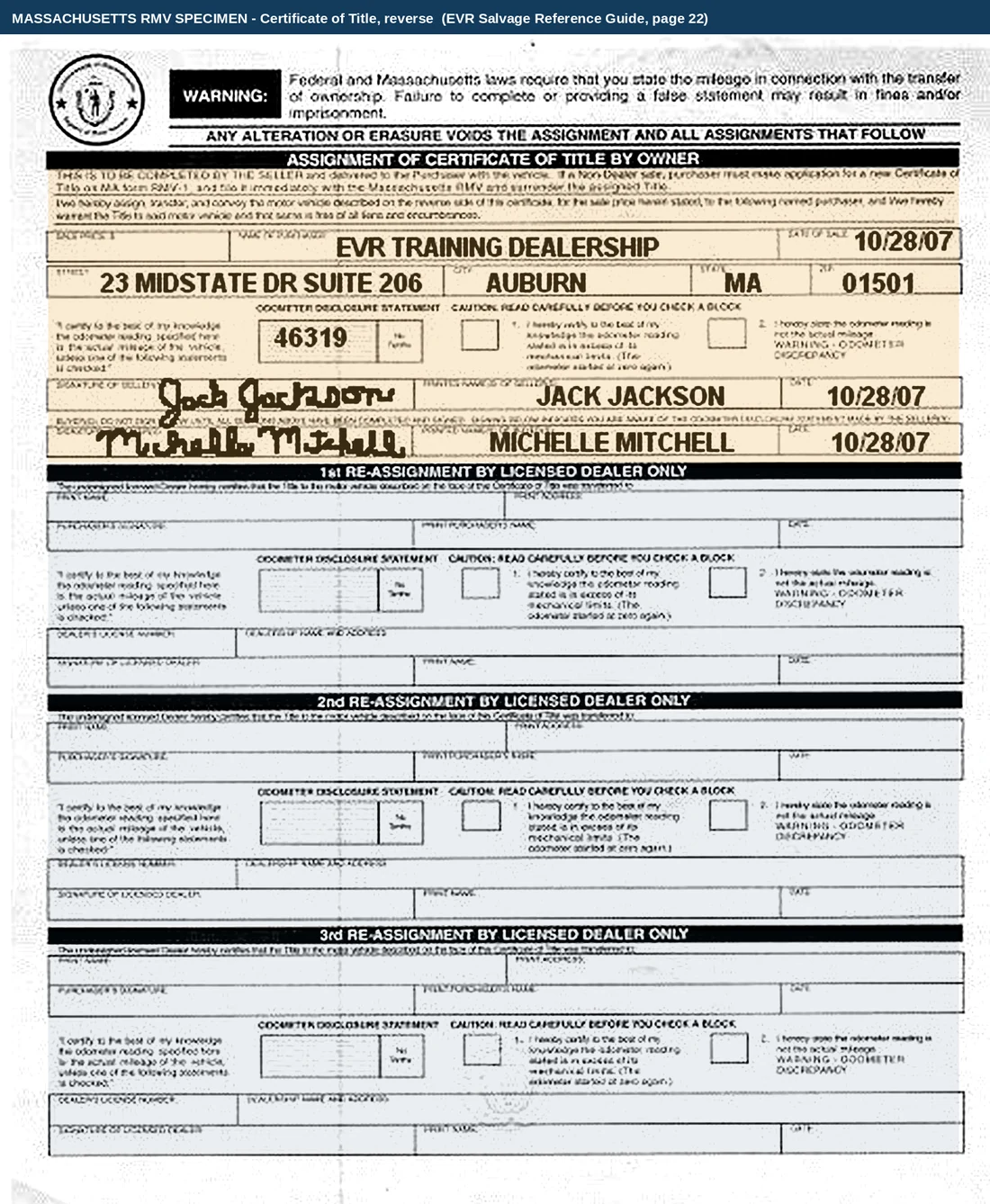
The same manual prints the reverse on page 22, and the Registry has filled it in: Jack Jackson selling to its own EVR Training Dealership in Auburn, 46,319 miles, signed by both sides and dated. Amber marks the five rows a seller works through. The greyed cell inside the odometer strip is marked No Tenths and is not for writing in.
Click or tap the picture to open it full size.
Look at the first box on row one. The Registry left SALE PRICE empty here because this is a dealer taking a trade-in; on a casual sale it is one of the seven items that must be recorded, and leaving it blank is what sends the buyer back to you for a bill of sale. The two caution boxes are also both empty, which is how a normal reading is certified - the printed sentence to their left already says the reading is the actual mileage unless one of the following statements is checked.
Click or tap the picture to open it full size.
Three quarters of this side is not yours. The re-assignment blocks exist so a licensed dealer can pass a car to another dealer without a new certificate being issued in between, and the Registry's rule for a private sale is that the assignment by owner is the only assignment. A seller who runs out of room in the owner's block and continues into the first dealer block has not found extra space - they have altered the certificate.
Step by step
Every box, in the order you meet it
1
You fill this in
Row one - sale price, name of purchaser, date of sale
Three boxes across the top of the block. The price goes in the narrow box on the left, the buyer's full name in the wide one, and the date of the sale on the right.
Watch out: Write the price even though the box looks optional. The Registry lists purchase price, if a casual sale among the items the back of the title must carry, and where the certificate has no price on it the buyer is told to produce a bill of sale showing one instead.
2
You fill this in
Row two - the buyer's street, city, state and ZIP
Four boxes on the row underneath, in your handwriting rather than theirs.
Watch out: Copy it off the licence they showed you, not off the message they sent you. This address and the name above it are what tie the odometer disclosure to a real person, and a mismatch with the buyer's identity document stops the transaction at the counter.
3
You fill this in
The odometer reading, in whole miles
One box inside the strip headed ODOMETER DISCLOSURE STATEMENT. Beside it sits a narrower cell marked No Tenths, which is the certificate telling you where to stop.
Watch out: Miles only. The Registry cannot process a reading recorded in kilometres or in hours as it stands - kilometres have to be converted on a notarised affidavit of correction, and hours have to go to a Service Center.
4
You fill this in
Caution box 1 - in excess of mechanical limits
Tick it only if the odometer has rolled past its maximum and started again from zero.
Watch out: This is the box with a price on it. Where the vehicle is not an antique and this box is ticked, the Registry adds 100,000 miles to the reading on the new title - and the fix afterwards is a notarised affidavit of correction.
5
You fill this in
Caution box 2 - not the actual mileage
Tick it if the reading is wrong for any other reason: a replaced cluster, a broken instrument, a number you cannot vouch for.
Watch out: Ticking it brands the title Odometer Discrepancy for the rest of the car's life. Hiding the problem is worse - turning an odometer back to mislead a buyer is a Massachusetts crime carrying a fine of $500 to $1,000, up to two years, or both.
6
You fill this in
Row four - signature of seller, printed name, date
Sign on the left, print the same name in the middle box, date it on the right. Every owner named on the front of the certificate does this.
Watch out: Print it the way the front of the certificate prints it. If the face says a maiden name and you sign a married one, the assignment and the record no longer agree and the Registry needs an amendment before it will issue.
7
The buyer fills this in
Row five - the buyer signs and prints
The last row of the block, directly under yours, with its own date box.
Watch out: Watch it happen before the car leaves. The printed line above that row tells the buyer not to drive until everything above is complete and signed, and a certificate with your half finished and theirs empty is not a transfer.
8
You fill this in
Hand over the certificate itself
The assigned certificate goes with the vehicle. There is no copy for you and nothing to post to the Registry.
Watch out: Photograph both faces before you let go of it. That photograph is your only record of the mileage you disclosed and the date you disclosed it on, and it costs nothing to take.
9
You fill this in
Take the plates off
The registration expired the moment ownership transferred, so the plates on that car are attached to nothing.
Watch out: The buyer is not stranded by this. They get their own plates at a Service Center after a Massachusetts insurance agent has stamped their application - they were never going to drive away on yours.
10
You fill this in
Cancel the registration, then cancel the policy
Online through myRMV in a few minutes, free, with a Registration Cancellation Receipt to download at the end. Two owners on the registration means the affidavit instead.
Watch out: Do it in that order and send the receipt to your insurer, which the Registry asks you to do. Then destroy the plates - the RMV does not want them back and says they can be cut in half and discarded.
Before the pen
Before you turn the certificate over
Six habits, and the first one exists because this certificate has no undo.
One attempt, in ink
There is no correcting a Massachusetts assignment in place. A mistake means a notarised affidavit of correction, or $25 and a wait for a duplicate certificate.
Never leave the buyer's name out
An assignment with the purchaser blank is an open title. It leaves a car in your name that somebody else is driving, and it is the single fastest way to inherit their parking tickets.
Fill the price in
The Registry's list of what the back of the title must carry includes the purchase price on a casual sale. Skip it and the buyer needs a bill of sale to show the same number.
Print as well as sign
Signature and printed name are separate boxes on the same row, and both are on the list. So is the date, twice.
Whole miles, and nothing in the No Tenths cell
The strip is designed to stop you writing a decimal. The two caution boxes below it are certifications, not disclaimers - leave both untouched unless one is actually true.
Stay out of the dealer blocks
The three re-assignment sections underneath are headed BY LICENSED DEALER ONLY. Writing in one is an alteration, and the warning at the top of the page applies to everything that follows it.
Three things said confidently about selling a car in Massachusetts. Each is wrong, each has the state's own source under it, and each of them costs a seller either an excise bill, a revoked registration or a second $25.
"The plates belong to the car, so they go with it."
In Massachusetts the registration expires by operation of law the instant ownership transfers, so those plates are covering nothing from the moment the buyer takes the keys. Worse, until you cancel, the Registry still shows a live registration in your name - and a live registration is what generates next year's excise bill and what has to be insured. The RMV's instruction is the opposite of leaving them on: cancel, then recycle or destroy the plates, which can be cut in half and discarded.
"Write a low price on the title and the buyer saves the tax."
It does not work here and it is the buyer who pays for the attempt. On a casual sale the Department of Revenue charges 6.25% on the greater of the actual sales price and the vehicle's clean trade-in book value, and the Registry applies a mileage adjustment to that book value at the counter. Condition is expressly not considered - the guidance says value adjustments based on the mechanical or structural condition of the motor vehicle are not considered under current sales and use tax law, so a genuinely rough car does not get a lower valuation either.
Not in Massachusetts. Chapter 90D section 15 asks the owner to execute an assignment including the actual odometer reading at the time the vehicle is delivered, and asks for nothing to be sworn. There is no notary panel anywhere in the assignment block. The two Registry title forms that do need a notary are the affidavit for correcting an assignment that has already gone wrong and the affidavit a lender swears after a repossession - both of them are what you do when a sale has gone sideways, not how you make one.
Six rules about who signs the reverse, and only two of the signatures are yours:
Every owner printed on the front
If the face of the certificate names two people, both of them sign the seller's row. One signature on a two-owner title is an incomplete assignment and the counter will say so.
Signature of seller, then the printed name beside it
Two adjacent boxes on the same row, and the Registry asks for both. A signature with no printed name next to it is one of the seven required items missing.
The buyer, on the row underneath
Their signature and their printed name, against a printed line telling them not to drive until every section above has been completed and signed.
The date, twice
There is a date box at the end of the seller's row and another at the end of the buyer's. They are not decorative - the date of sale is the first item on the Registry's list of what the assignment must carry.
A named agent under a power of attorney, if an owner genuinely cannot attend
The Registry's own limited power of attorney expires thirty days from signature or the moment the transaction is processed, whichever comes first, and it needs two witnesses with their dates of birth.
Nobody from a bank, and no notary
A lienholder releases its interest on the front of the certificate, not in the assignment. Nothing on this side of the sheet is sworn.
Once it is signed
Signing the reverse is half of it. The other half is that the registration in your name is still live, still generating excise, and still expected to be insured, until you switch it off.