The three-page application that turns a repaired salvage vehicle back into something that can be registered. A State Police inspector examines the identification number, and on a randomly selected proportion of vehicles every major component that was replaced. It ends with a title branded RECONSTRUCTED or RECOVERED THEFT - and it contains the sentence that matters most to anyone holding a salvage title.
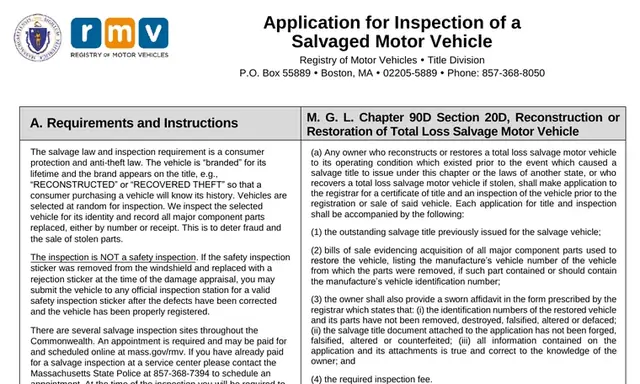
Written against TTL109 (TTL109_0225, February 2025), issued under M.G.L. c.90D s.20D. Read that first rule before advertising a salvage car. A private seller who simply signs a salvage title over to another private buyer has produced a transfer the Registry will not process, and the buyer discovers it at the counter rather than in the driveway.
Two documents, and they are not the same thing. Take the blank TTL109 from the mass.gov copy so you get the revision that is current today.
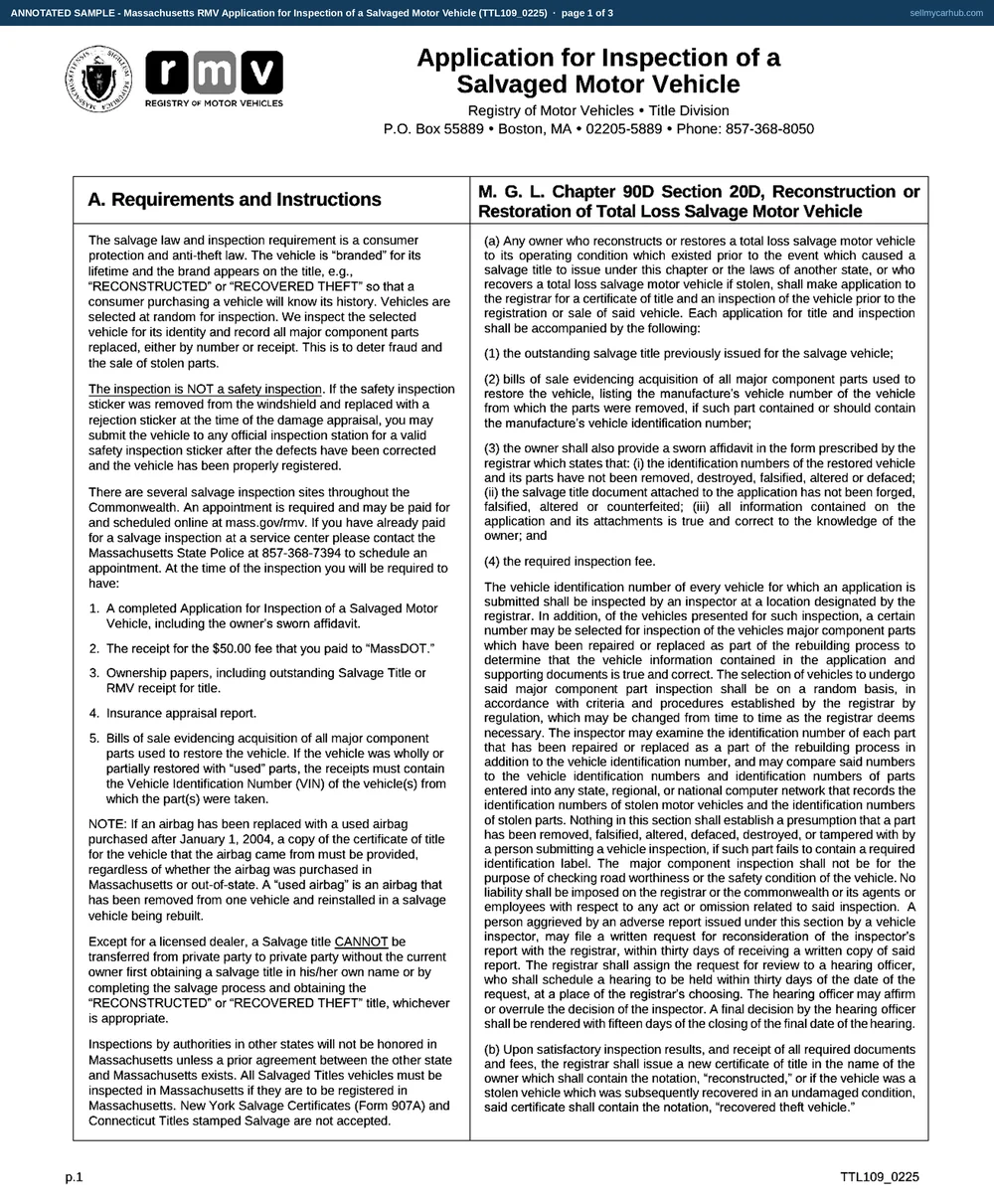
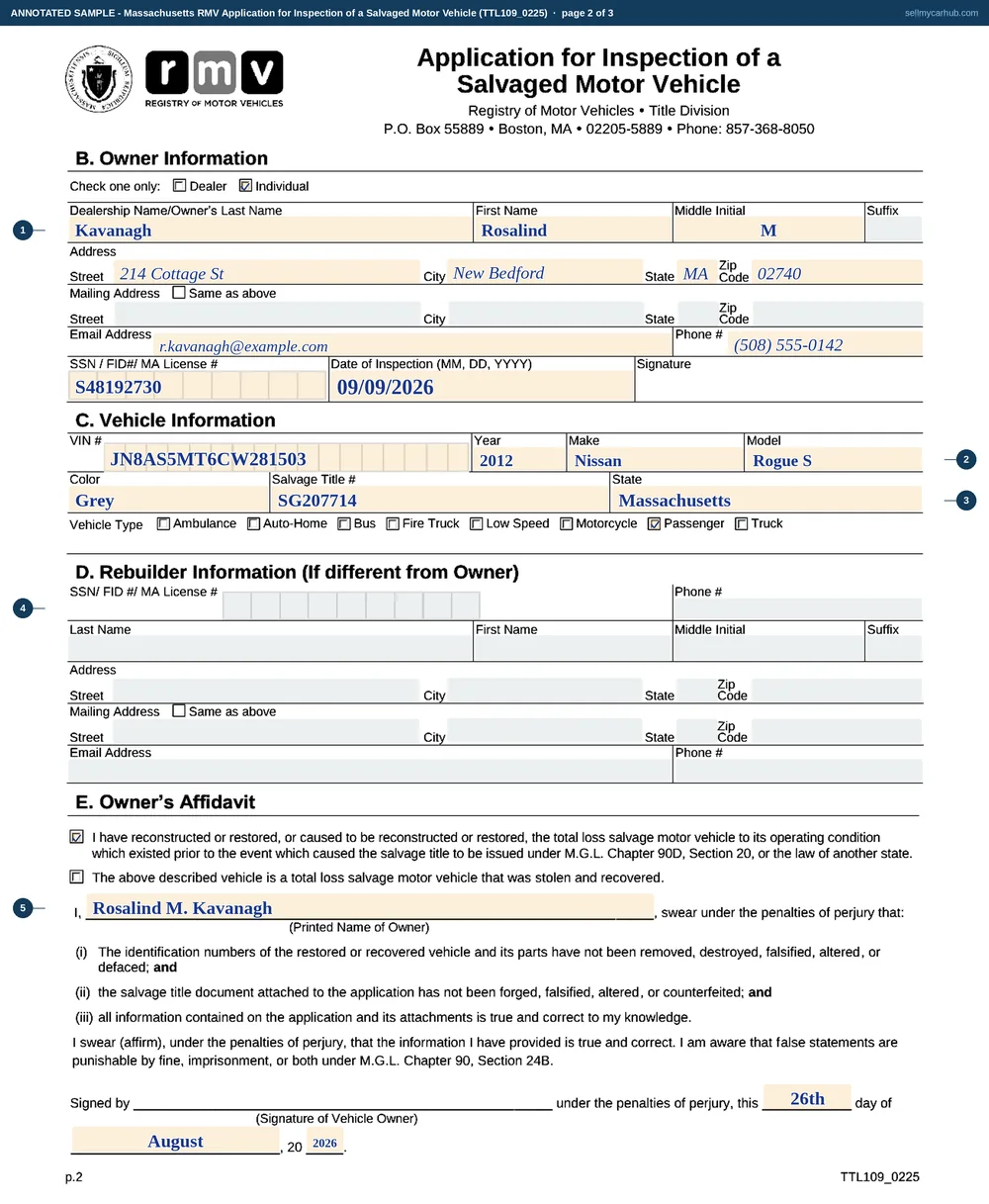
This is all 3 pages of the actual TTL109, rendered from the PDF the Massachusetts Registry of Motor Vehicles publishes and completed end to end: letterhead, every field, and the blocks at the foot.
At a Service Center or online, to MassDOT, and keep the receipt.
Watch out: The receipt is one of the five items the inspection site asks for. Arriving with the money but not the receipt does not work.
An appointment is required and can be paid for and scheduled online; if the fee was already paid at a Service Center, the State Police salvage unit books it.
Watch out: There are several salvage inspection sites across the Commonwealth and they are State Police sites, not Registry counters.
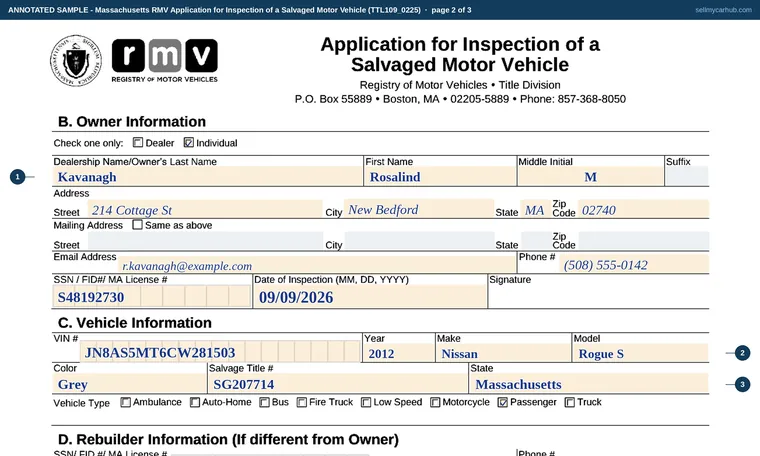
Dealer or individual, name, addresses, email, telephone, identification number, date of inspection and signature.
Watch out: Tick Individual. The form is used by dealers and by private owners and the two are processed differently.
Vehicle identification number, year, make, model, colour, salvage title number and state, and the vehicle type.
Watch out: The salvage title number is not the number that was on the clear title before the loss. A salvage title is a new certificate with a new number.
Completed where the repairs were done by somebody other than the owner.
Watch out: Leave it empty if you did the work yourself, and fill it in if a body shop did - the inspector will ask either way.
Tick one of the two boxes - reconstructed, or stolen and recovered - then print your name and date the sworn statement.
Watch out: They are alternatives. A car rebuilt after a flood or a collision is the first box; the second is only for a vehicle that was stolen, written off and then found. Ticking both says two different things happened.
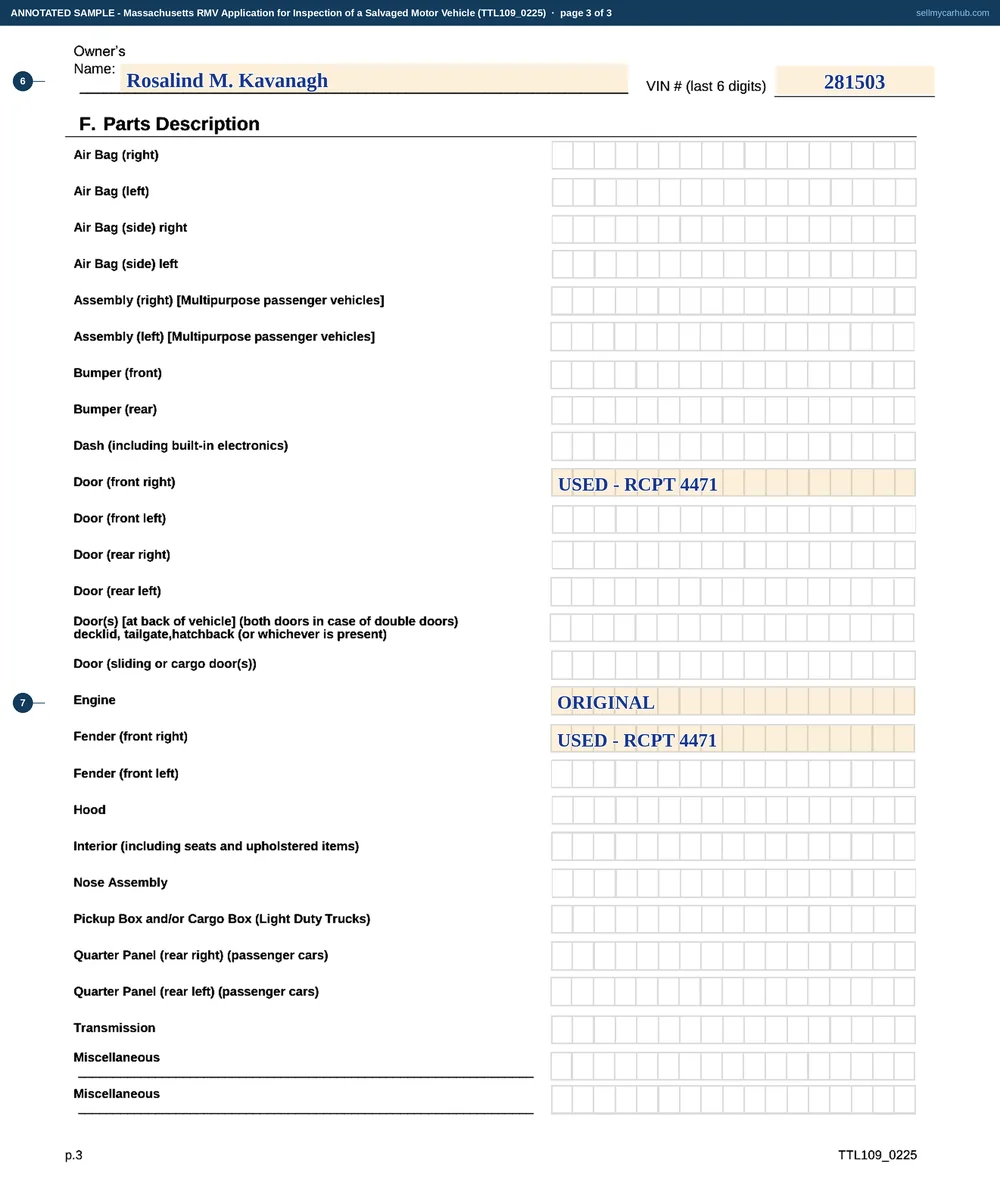
Twenty-six named components with a space beside each for the part number or the receipt that covers it.
Watch out: Bring the bills of sale themselves as well. Used parts need the identification number of the vehicle they came off, and a used air bag needs a copy of the donor vehicle's title.
| On the form | What to put in it |
|---|---|
| A, Requirements and Instructions | A page of rules and the text of chapter 90D section 20D printed alongside it, including the five things to bring to the inspection: the completed application with the owner's sworn affidavit, the receipt for the $50.00 fee paid to MassDOT, ownership papers including the outstanding salvage title, the insurance appraisal report, and bills of sale for every major component part used to restore the vehicle. |
| B, Owner Information | Dealer or individual, name, address, mailing address, email, telephone, Social Security or federal identification or Massachusetts licence number, the date of inspection and a signature. |
| C, Vehicle Information | Vehicle identification number, year, make, model, colour, salvage title number and state, and the vehicle type from eight tick boxes. |
| D, Rebuilder Information | Completed where somebody other than the owner did the work. |
| E, Owner's Affidavit | Two tick boxes that are alternatives rather than a pair - one for a vehicle reconstructed or restored to the condition it was in before the loss, one for a total loss salvage vehicle that was stolen and recovered - then the owner's printed name and three sworn statements: that the identification numbers of the restored or recovered vehicle and its parts have not been removed, destroyed, falsified, altered or defaced; that the salvage title attached has not been forged, falsified, altered or counterfeited; and that everything on the application and its attachments is true. |
| Page three, major component parts | A column of twenty-six named parts - air bags, assemblies, bumpers, dash, each door, engine, fenders, hood, interior, nose assembly, pickup box, quarter panels, transmission and four miscellaneous lines - each with a space for a number or a receipt reference. |
Every line here was read off TTL109 (TTL109_0225, February 2025) itself — the PDF is here — and off the Massachusetts Registry of Motor Vehicles pages. This is plain-language help with a form, not legal advice, and where our wording and the agency's differ, theirs governs.
Back to all Massachusetts seller paperwork, or what selling a car in Massachusetts involves.